
Ideas clave
1. Internet aesthetics have shifted from subcultural niches to the very center of contemporary art and collective cultural expression.
Le cosiddette «estetiche di internet» non sono la periferia dell’arte contemporanea: ne sono il centro.
Subcultural evolution. Over the past twenty-five years, the internet has evolved from a slow, static, and predictable network into a monumental, self-aggregating global infrastructure. This techno-social ecosystem is now the primary engine of cultural production, where collective digital expressions bypass traditional gatekeepers. While mainstream institutions often dismiss these collaborative movements as minor subcultures, they actually represent the most reliable symptoms of our contemporary cultural climate.
The database impulse. Modern internet users navigate an "hyper-flat" digital sphere as "database animals," assembling their identities from modular, cataloged aesthetic blocks. Platforms like The Aesthetics Wiki document this phenomenon, categorizing hundreds of styles using suffixes like "-core," "-academia," and "-wave." This bottom-up classification reflects a highly collaborative yet standardized process of identity construction.
Aesthetic democratization. Rather than relying on top-down artistic curation, these digital aesthetics emerge organically from online communities. They represent a collective effort to find new ways of relating to reality, blending technology, nostalgia, and visual art.
- Collaborative, bottom-up creation by millions of global users
- Modular assembly of identity using tags, databases, and hyperlinks
- Constant tension between individual personalization and algorithmic standardization
- Rejection of traditional art world institutions in favor of digital platforms
2. Vaporwave pioneered "hauntology" online, using corporate ruins and nostalgic loops to mourn lost futures.
La vaporwave è il primo genere musicale nato e cresciuto su internet; la sua natura è trasversale e globale, i suoi riferimenti sono radicati nell’esperienza della vita online, una nuova modalità di relazione che crea riferimenti, estetiche e sentimenti in grado di scavalcare le differenze culturali e talvolta anche generazionali.
Spectral nostalgia. Emerging in the early 2010s, Vaporwave became the first native internet aesthetic, defined by its surreal, nostalgic relationship with consumer technology and late-capitalist advertising. By slowing down, looping, and distorting corporate muzak, elevator music, and 80s pop samples, artists like Macintosh Plus (Vektroid) created a ghostly, melancholic soundscape. This music acts as a sonic ghost, evoking a deep sense of "hauntology"—a yearning for lost, unrealized futures that were promised by the techno-optimism of the late 20th century.
The virtual plaza. Visually, Vaporwave is a pastiche of early web design, Windows 95 interfaces, classical Greek busts, and Japanese corporate logos. This imagery represents the "Virtual Plaza," a digital non-place where the solid reality of capitalism dissolves into a gaseous, sensory mist. It functions as both a sarcastic critique and a sincere, comforting embrace of the consumerist ruins of our childhoods.
Anemoia and temporal displacement. Vaporwave allows younger generations to experience "anemoia"—a profound nostalgia for a time they never actually lived. It freezes time through endless loops, offering a meditative escape from the anxieties of the present.
- Slowed-down, chopped-and-screwed corporate muzak and pop samples
- Pastel palettes dominated by pinks, purples, and teal
- Anachronistic juxtapositions of Windows 95, floppy disks, and classical statuary
- Techno-orientalist imagery reflecting 80s/90s Japanese economic dominance
- Glitch art, VHS tracking lines, and low-resolution renders
3. The "affective turn" has turned digital media into tools for sensory self-medication and mood modulation.
I video ASMR non sono contenuti da comprendere o interpretare: sono impulsi da trasmettere e ricevere.
Sensory self-medication. In an era of information overload and chronic anxiety, internet users have turned to digital media for physical and emotional comfort. This is exemplified by the massive popularity of "oddly satisfying" videos and ASMR (Autonomous Sensory Meridian Response). These contents are designed not for intellectual decoding, but to trigger physical sensations—like a pleasant tingling in the scalp—that soothe the nervous system and induce a state of deep relaxation.
Digital intimacy. ASMR artists and ambience creators construct highly immersive, simulated environments to foster a sense of safety and human connection. Through whispered role-plays, close-up camera angles, and meticulous sound design, they offer a form of "digital intimacy" that modern, hyper-productive society often fails to provide. These videos act as modern, empirical equivalents of Philip K. Dick's fictional "Penfield mood organ," allowing users to actively modulate their emotional states.
Atmospheric escape. Similarly, "ambience videos" recreate specific, comforting soundscapes—like a jazz cafe on a rainy night or a spaceship cabin—to replace the user's physical surroundings. This trend highlights a broader cultural shift where feelings and sensory vibes have become the ultimate arbiters of personal truth.
- ASMR videos utilizing triggers like tapping, scratching, and whispering
- Role-play ASMR simulating personal care (e.g., haircuts, medical exams)
- Ambience videos combining static, cozy visuals with repetitive environmental sounds
- "Sludge content" on TikTok featuring multi-screen, hyper-stimulating videos to induce a flow state
- "In another room" playlists that simulate hearing music muffled through walls
4. Liminal spaces and the Backrooms reflect a collective obsession with empty, transitional, and procedurally generated architectures.
Gli spazi liminali sono deserti artificiali, monumenti alla rovescia, macchine dell’alienazione.
The threshold aesthetic. Liminal spaces are empty, transitional locations—such as abandoned shopping malls, school corridors at night, or vacant hotel lobbies—that evoke a mixture of comfort, nostalgia, and deep unease. By stripping these spaces of human presence, they trigger "kenopsia," the eerie atmosphere of a place usually bustling with people that is now silent and abandoned. These images act as spatialized memories, freezing time and forcing us to confront the transience of our own existence.
The Backrooms myth. This aesthetic culminated in the viral myth of the Backrooms, a theoretical, infinite maze of yellowed wallpaper, damp carpets, and buzzing fluorescent lights. Originating from a single anonymous post on 4chan in 2019, the Backrooms represent a "theoretical liminal hellscape" that users "noclip" into when they slip out of physical reality. It is a digital folklore masterpiece that combines architectural horror, gaming mechanics, and existential dread.
Procedural nightmares. The infinite, repetitive nature of the Backrooms mirrors the concept of procedural generation in video games, where algorithms endlessly construct nonsensical, non-functional spaces. This reflects a modern anxiety about being trapped in a synthetic, simulated reality that has no human purpose.
- Complete absence of human beings in spaces designed for crowds
- Low-resolution, splayed-flash photography that mimics amateur, nostalgic snapshots
- Eerie, repetitive ambient soundtracks (e.g., buzzing neon lights, muffled jazz)
- "Noclipping" as a metaphor for psychological dissociation or reality glitches
- Infinite, labyrinthine structures that evoke "apeirophobia" (fear of the infinite)
5. Collaborative digital folklore like the SCP Foundation has democratized myth-making away from corporate ownership.
La fan fiction è il modo in cui la cultura cerca di riparare ai danni fatti da un sistema in cui i miti contemporanei sono diventati proprietà delle grandi aziende invece che del popolo.
Democratized mythology. The internet has revived the ancient tradition of oral folklore, adapting it into collaborative, open-source digital writing projects. The most prominent example is the SCP Foundation, a massive, wiki-based creative writing project detailing a fictional secret organization that contains paranormal anomalies. Unlike corporate-owned franchises, this universe is built entirely from the bottom up, allowing anyone to contribute to its sprawling, intricate "lore."
The power of lore. In a fragmented digital landscape, "lore"—the collective history, myths, and rules of a community—serves as the social backbone for online subcultures. It provides a structured framework for users to collaborate, build worlds, and make sense of a chaotic, context-collapsed reality. This collaborative storytelling acts as a cultural defense mechanism, reclaiming the power of myth-making from media conglomerates.
Decontextualized art. Digital folklore often absorbs and reinterprets real-world art, as seen when a sculpture by Japanese artist Izumi Kato was transformed by the community into the terrifying anomaly SCP-173. This process of digital appropriation shows how internet communities breathe new, collective life into isolated cultural artifacts.
- Open-source, wiki-style databases with strict formatting and "canons"
- Pseudo-scientific, bureaucratic documentation of paranormal anomalies
- Spontaneous, viral expansion of narratives across multiple platforms (Reddit, YouTube, TikTok)
- Active participation of the audience in writing, illustrating, and gaming within the universe
- Blurring of the lines between fiction, urban legends, and real-world events
6. Surrealist aesthetics like Weirdcore and Dreamcore visually represent psychological states of dissociation and derealization.
Il weirdcore è una rappresentazione visiva delle sensazioni di depersonalizzazione e derealizzazione.
Visualizing dissociation. Weirdcore and Dreamcore are surrealist internet aesthetics that gained massive popularity during the isolation of the COVID-19 pandemic. Using low-resolution, heavily edited images of suburban landscapes, retro bedrooms, and empty fields, these genres capture the psychological sensations of derealization (feeling that the world is unreal) and depersonalization (feeling detached from one's body). They reflect the mental state of a generation that spends its life mediated by screens, where the boundary between the physical self and the digital avatar has dissolved.
Cryptic communication. These images are often overlaid with enigmatic, comforting, or mildly threatening text boxes, mimicking retro video game dialogues or internal monologues. Phrases like "Is this real?" or "Don't you wonder what's inside?" speak directly to the viewer's subconscious, evoking a sense of being watched by unseen, "biblically accurate" angelic entities. The aesthetic relies on the stark contrast between innocent, nostalgic childhood imagery and a subtle, pervasive sense of existential dread.
The dream as refuge. Unlike historical Surrealism, which sought to unleash the subconscious for revolutionary purposes, Dreamcore uses the dream state as a cozy, nostalgic refuge. It romanticizes the confusion of the dream world, turning dissociation into a comforting, shared aesthetic experience.
- Low-resolution, over-saturated images of 90s/00s suburban environments
- Characters with heads replaced by eyes, flowers, mushrooms, or old TV screens
- Retro video game text boxes with existential, non-sequitur questions
- "Biblically accurate angels" represented as multi-winged, multi-eyed entities
- Collages blending natural landscapes (like Windows XP's Bliss) with digital glitches
7. Traumacore serves as a collective, template-based therapeutic outlet for processing childhood and digital-era trauma.
La pagina di Reddit dedicata al traumacore definisce il genere «un meccanismo di strategia di adattamento (coping) che aiuta le persone traumatizzate ad affrontare il loro trauma, tramite l’impiego di una certa estetica».
Aestheticized coping. Traumacore is a highly sensitive, therapeutic subgenre of internet art that uses visual templates to help users externalize and process deep psychological wounds, such as abuse, neglect, and mental illness. By combining cute, innocent childhood imagery—like Hello Kitty, plush toys, and pastel bedrooms—with dark, disturbing text and symbols of self-harm or decay, creators map out the landscape of their trauma. It functions as "vent art," providing a non-verbal, symbolic language for experiences that are otherwise too painful to articulate.
The digital trauma pool. Many members of Generation Z trace their psychological distress back to unsupervised, early childhood access to the dark corners of the internet. Traumacore visually represents this specific "digital trauma," where the bright, joyful promise of the early web is permanently stained by premature exposure to adult content and online dangers. The aesthetic's reliance on ruined, decaying domestic spaces reflects a sense of lost innocence and a corrupted childhood home.
Community through templates. While critics argue that Traumacore romanticizes mental illness, its structured templates actually lower the barrier to entry for therapeutic expression. It fosters a deeply supportive, anonymous community where survivors can share their pain without fear of judgment.
- Juxtaposition of "morbid" and "cute" (morute) aesthetics
- Use of beloved childhood cartoon characters (e.g., Sanrio, My Little Pony)
- Text overlays expressing feelings of worthlessness, dirtiness, or a desire to disappear
- Ruined, dusty, or abandoned domestic interiors representing a broken home
- Visual censorship, such as faces scribbled out or replaced with static noise
8. Corecore and "chaos edits" capture the sensory overload of a chronically online generation facing cultural extinction.
Il corecore, in altre parole, è una teoria popolare dell’estinzione; è una teoria dell’estinzione fatta dalle masse per le masse, un’opera corale e collettiva di modellazione e assemblaggio dell’estinzione...
The sound of the collapse. Corecore (or "nichetok") is the ultimate, self-reflective culmination of internet aesthetics, exploding on TikTok as a response to chronic media saturation and information overload. These short videos are "chaos edits"—fast-paced, dadaist montages of movie clips, viral TikToks, news broadcasts, and video game footage, usually set to melancholic ambient music like Aphex Twin's "QKThr." Rather than being meaningless, corecore attempts to capture the exact feeling of being "chronically online," translating the overwhelming noise of the digital age into a profound, poetic emotional resonance.
A theory of extinction. At its heart, corecore is a collective, folk-theory of cultural and environmental extinction. It juxtaposes the hyper-stimulating, superficial distractions of modern technology with the slow, devastating realities of climate change, late-stage capitalism, and human isolation. It is a visual scream of a generation that feels the world is ending, offering a space for collective mourning and catharsis through shared digital "feels."
The beauty of the crash. Corecore proves that even within the algorithmic "black hole" of modern platforms, users can subvert technology to express genuine, un-curated human emotion. It is an aesthetic of the breakdown, finding a strange, tragic beauty in the collapse of our shared reality.
- Rapid, non-linear editing of highly contrasting media fragments
- Recurring motifs of existential dread, environmental destruction, and corporate greed
- Melancholic, repetitive ambient soundtracks that induce a trance-like state
- Juxtaposition of high art (classic cinema) with low-brow digital trash (Subway Surfers gameplay)
- A focus on raw, un-ironic human emotion ("feels") over algorithmic perfection
9. Reality shifting and modern techno-paganism treat the digital screen as a magical portal to alternate dimensions.
La connessione a internet assume quindi le sembianze del viaggio extracorporeo; risucchia la mente e i sensi in un vortice di stimoli che finisce per avere un effetto ipnotico.
Techno-spiritual escape. Reality shifting is a viral phenomenon where young users employ meditation, self-hypnosis, and lucid dreaming techniques to "shift" their consciousness from their current reality (CR) to a desired reality (DR). Drawing on the scientific language of the multiverse and the esoteric traditions of astral projection, shifters write detailed "scripts" to configure their destination worlds, which are often beloved fictional universes like Harry Potter or Marvel. This practice represents the ultimate form of escapism, where the digital screen is no longer just a display, but a magical portal to a malleable, customizable existence.
The return of magic. This trend is part of a broader resurgence of "technognosis"—the intersection of digital technology and magical thinking. From "tulpamancy" (creating independent mental companions, often shaped like My Little Pony characters) to "meme magic" (using viral images to manipulate real-world political events), internet users are treating the web as a psychic matrix. In a world where traditional institutions have failed, these practices allow individuals to reclaim a sense of agency and control over their lives.
The malleable real. This techno-pagan worldview is perfectly captured by the "real or cake" meme, where everyday objects are sliced open to reveal they are actually cakes. This viral trend reflects a deep, philosophical uncertainty about the stability of our physical world, suggesting that reality is merely a synthetic, editable simulation.
- Reality shifting methods (e.g., Raven Method, Alice in Wonderland Method)
- Detailed "scripting" to program the rules, safety, and appearance of desired realities
- Tulpamancy, or the meditative creation of sentient, imaginary companions
- Randonautica, an app using quantum random number generators to guide real-world "psychogeographical" exploration
- "Meme magic" and the creation of digital sigils to direct collective psychic energy
10. The physical "battlestation" and digital wallpapers like Windows XP's "Bliss" have merged into a singular, haunted landscape of survival.
In mezzo tra il nostro mondo e quello digitale c’è la battlestation, il computer, lo snodo da cui possiamo abbandonare il nostro ambiente terrestre per esplorare la distesa quasi illimitata di internet...
The digital altar. The "battlestation"—the highly customized, physical desk setup of a gamer or internet user—has become a sacred space, acting as both a cockpit for digital exploration and a personal altar. As physical opportunities and social mobility decline in the real world, individuals increasingly retreat to these setups, simulating autonomy and agency within virtual environments. This extreme digital eremitism, seen in the global rise of hikikomori, represents a survival strategy where the physical body is neglected while the mind travels endlessly through the network.
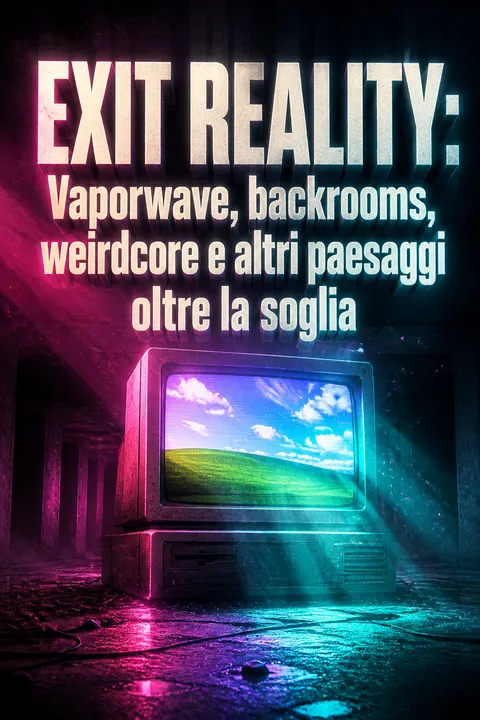
The haunted landscape. This blurring of physical and digital geography is epitomized by Windows XP's iconic "Bliss" wallpaper—the green hill under a blue sky that served as the default background for billions of users. Though a real photograph of California, Bliss has been internalized as a synthetic, archetypal landscape of the collective unconscious. In modern digital art, this landscape is often depicted as a physical room or a haunted, empty space, showing that our most intimate memories are now permanently housed within corporate software interfaces.
The screen as a threshold. Ultimately, we live in a "post-modem" world where the screen has dissolved as a boundary. We are no longer merely looking at images; we are living inside them, navigating a haunted, intermediate zone where the natural and the artificial have fused forever.
- The "battlestation" as a physical-digital interface and status symbol
- "Bliss" (the Windows XP hill) as the ultimate, nostalgic landscape of the digital generation
- The "Blue Screen of Death" as a modern memento mori, representing the fragility of our simulated worlds
- The "platopticon," where users are trapped in individual, self-stimulating digital caves of surveillance
- The "this is where I post from" meme, highlighting the ironic, often decaying physical realities behind online personas
Resumen de reseñas
I'd be happy to help translate your content, but it appears the text between the backticks is "null" — meaning there's no actual content to translate.
Could you please provide the English text you'd like me to translate into Spanish? Once you share it, I'll translate it matching the style, tone, and formality of the Hábitos Atómicos sample you provided.
Descargar PDF
Descargar EPUB
.epub digital book format is ideal for reading ebooks on phones, tablets, and e-readers.








































