
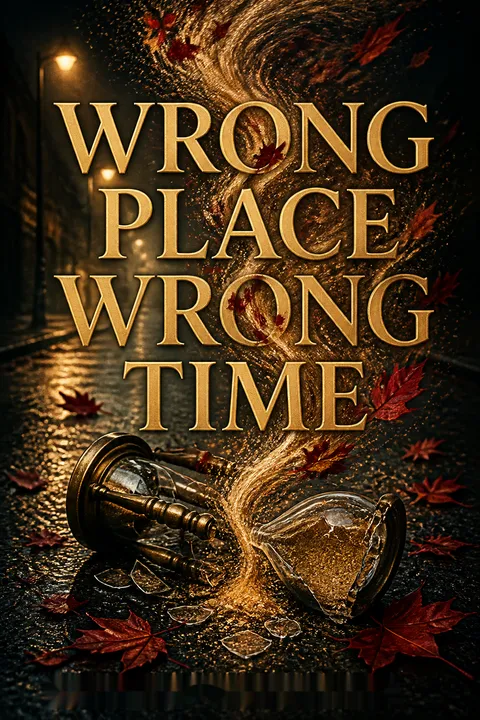


Plot Summary
The Knife on Their Street
Late on October 29th, as Daylight Saving Time clicks backward, Jen1 stands at her picture window in Crosby, waiting for her eighteen-year-old son Todd3 to come home. He appears on the unlit street just as a hooded stranger approaches from the opposite direction.
Before Jen1 and her husband Kelly2 can reach them, Todd3 has the man by his coat. A knife catches the lamplight. Three rapid wounds. Blood pools on the driveway in astonishing quantities. The stranger dies in Jen's1 arms while Kelly2 holds Todd3 back. Police arrive within minutes.
Todd3 doesn't resist — offers his wrists for handcuffs and tells the officers flatly that he did it. He refuses a solicitor. Kelly2 rages at the station. Jen,1 a divorce lawyer by profession, can do nothing but watch her son disappear behind a locked white door.
Waking Up in Yesterday
Morning light fills the bedroom, but the calendar reads October 28th — the day before the stabbing. Todd3 emerges from his room cheerful, making puns, with no memory of blood or handcuffs. The pumpkin Jen1 carved sits on the kitchen counter whole and untouched.
Kelly2 answers his phone from a jobsite he already finished. No police tape stains the street. Jen1 vomits, calls Kelly,2 spirals — then tricks Todd3 into going upstairs and searches his schoolbag. Beneath textbooks and sandwich crumbs, her fingers close on a leather sheath.
Inside: a long knife, new and gleaming. She hides it in the under-stairs cupboard and watches her son leave for school still believing he's armed. It wasn't a dream. The crime hasn't happened yet. And somehow, impossibly, Jen1 has been sent backward to stop it.
The Black Audi Flips
Further back now, Jen1 confides in Rakesh,6 her closest colleague and a former doctor, who connects her with Andy Vettese,5 a physicist studying time loops. Andy5 theorizes she's trapped in a closed timelike curve, landing on days significant to the crime, and that her subconscious already holds knowledge she hasn't consciously assembled.
To convince Kelly,2 Jen1 walks him to a quiet intersection where she knows a black Audi will crash that night. It does — flipping exactly as she described, the driver stumbling out unharmed.
Kelly2 watches the impossible unfold and begins to believe. They spend the evening on their kitchen sofa making lists of theories about why Todd3 kills a man named Joseph Jones.4 Kelly2 goes quiet, then says he would kill Joseph4 himself if it meant sparing their son.
The Bundle on the Wardrobe
Jen1 skips four days backward and ransacks Todd's3 bedroom. On top of his wardrobe she finds a bundle held with an elastic band: a Merseyside Police badge stamped with the name Ryan Hiles and number 2648, a poster of a missing four-month-old baby, and a pay-as-you-go flip phone.
The phone's three contacts are Joseph Jones,4 Ezra Michaels,11 and Nicola Williams;9 the texts arrange meetings and mention a baby. Meanwhile, in chapters running parallel to Jen's1 backward journey, a young police constable named Ryan Hiles starts his career, is recruited into undercover work, and begins mapping an organized-crime ring that steals cars and ships them overseas — the same ring, the same names. A police badge in her son's bedroom, and a cop who shares its number.
The Snooker Club Revelation
At a snooker club where Todd3 plays with his girlfriend Clio,7 Jen1 crouches on a dark staircase and peers through a door hinge. Loud jukebox music drowns the conversation, but she recognizes Joseph Jones4 and a woman named Nicola Williams9 among the players. After they leave, Todd3 makes a call from the parking lot. Jen1 catches fragments: he's distancing himself from Clio,7 handling someone's dirty work, things are nearly finished.
Then the words that detonate everything — he tells whoever is listening that he'll be home soon. The call is to Kelly.2 When Jen1 confronts her husband2 about knowing Nicola9 and Joseph,4 Kelly2 flatly denies it and storms out of the house. The mystery pivots: Todd3 held the knife, but Kelly2 is the one hoarding secrets.
Screaming at the Garden Gate
Hidden behind their garden gate on an earlier night, Jen1 overhears Kelly2 order Todd3 to end things with Clio.7 Todd3 screams about lies and kidnapped children. Kelly2 insists Joseph4 is close to discovering something dangerous, and afterward Jen1 hears her husband sobbing alone in the dark.
In another backward leap, she watches Kelly2 receive a brown package from Joseph4 beneath a streetlight near their house, then follows him to a takeaway where she overhears him on a burner phone arranging delivery of a stolen car key.
Confronted, Kelly2 admits the package is a key but refuses to explain further. His warning is blunt and terrifying: Jen1 is in danger, and she must stop investigating Joseph4 and the missing baby. He leaves her standing on the street, the takeaway cooling at her feet.
Twenty Years of We
Jen1 visits Joseph Jones4 at HMP Altcourse, where he's serving twenty years for drug supply, robbery, assault, and grievous bodily harm. He knows her immediately — addresses her as the love of Kelly's2 life. When she asks about their connection, Joseph4 leans close and recites his own charge sheet, then tells her every one of those crimes was committed jointly.
She asks how Kelly2 escaped imprisonment while Joseph4 didn't. Joseph4 gives a thin smile and says only that he never informs on anyone. As guards escort him away, he leans to her ear and whispers that he's astonished she never figured it out. Jen1 leaves the prison trembling, now convinced that her husband has been concealing a criminal life for the entirety of their marriage.
The Photograph at Sandalwood
Jen1 tracks Kelly's2 phone to an abandoned cottage in Salford called Sandalwood. Through a grimy window, she sees a photograph of young Kelly2 standing beside another man — same navy-blue eyes, same bone structure, unmistakably a relative.
The property has passed to the Crown because its owner, named Hiles, is recorded as dead. Across further backward jumps, more evidence accumulates. Kelly2 accidentally says our dad instead of my, then covers it with a lie. When police pull them over on a holiday drive, Kelly2 drops his wallet to avoid showing identification.
Later, Jen1 examines his driving license — the hologram is flat and unconvincing. She cross-references it online. It's a forgery. Her husband's name, his history, his entire identity is counterfeit. The man she married may not exist.
Through His Childhood, Backward
Deeper into the past, Jen1 relives Todd's3 birthdays and school outings. At a Chinese dinner when he's seventeen, he tells her plainly that she never pays attention to his science — the physics he loves, the people he admires.
At his sixteenth birthday, she stays after Kelly2 leaves for a call, and Todd3 admits it's usually Jen1 who disappears. She visits her father8 on the evening he dies, saves him with an ambulance call, but notices he deflects her questions about timeshare work the firm once handled.
Yet the most piercing moment comes when Todd3 is three, reaching for her in their country cottage — his eyes completely alight with love. The crime's origin isn't her mothering. It lives in Kelly's2 past, buried beneath decades of carefully maintained silence.
Witness B Behind the Curtain
In September 2003, Jen1 follows Kelly2 to Liverpool Crown Court. The case is R v. Joseph Jones.4 Kelly2 changes into a suit and enters the building. Inside, a barrister calls Witness B — a serving undercover police officer whose identity is shielded by a black curtain and attempts at voice disguise.
But Jen1 recognizes the cadence, the Welsh accent flattened like planed wood. Her husband's2 voice. He describes infiltrating Joseph's4 crime ring from the inside.
When the defense objects to his references about a stolen baby, the judge reprimands him, and Kelly2 pushes back with the stubborn fury she has known for twenty years. The entire architecture of Jen's1 understanding collapses in a single moment. Kelly2 was never Joseph's4 criminal partner. He was the undercover officer who brought Joseph4 down.
His Name Is Ryan
Outside the courthouse, Kelly2 admits his real name is Ryan. He was a young constable recruited for undercover work who chose the alias Kelly to honor a brother who died young. He infiltrated Joseph's4 crime ring, fell in love with Jen1 while investigating her father's8 law firm, and quit the police to be with her.
He kept the alias because any change would signal to Joseph4 that he was the officer who sent him to prison. If Joseph4 ever discovered the truth, Ryan said, the man would come to kill him. Jen1 now grasps the complete chain: Joseph's4 release from prison, Ryan's forced compliance, Todd's3 devastating discovery of his father's secret, the knife bought out of fear, and a son who stabbed a man to protect his dad.
Her Father's Timeshare List
On the very day she first met Kelly2 — March 2003, when a young man walked into her father's8 law firm asking about decorating — Jen1 watches from a different angle. Kelly2 leafs through papers on her desk, then asks her father Kenneth8 about a timeshare address.
Jen1 confronts Kenneth8 privately. He confesses: when the firm couldn't make rent, Joseph4 offered money in exchange for timeshare schedules showing when homeowners would be on holiday, leaving their houses and cars unguarded. Kenneth8 took the proceeds for years — funded Jen's1 legal training, kept Eagles afloat.
Ryan discovered this while undercover and cut a deal: Kenneth8 would stop, and Ryan wouldn't expose him. Protecting Jen1 from the truth about both her father and her husband became the silent contract underpinning their entire marriage.
The Night Eve Is Saved
Jen1 wakes in January 2003 — the night a baby named Eve is due to be stolen from a car on a suburban driveway. She drives to Merseyside Police and gives them the address. Officers swarm the scene just as two teenage foot soldiers attempt the theft. The baby is never taken.
Afterward, Jen1 finds Ryan — still a police constable, still someone who doesn't know her — in the station parking lot. She introduces herself. He introduces himself as Ryan. Their eyes meet under a January drizzle nearly identical to the October mist where everything began.
She knows the loop is ending. She closes her eyes, and everything she has lived and changed is wiped clean — replaced by a single new timeline flowing forward from this rainy night, twenty years before a murder that will now never happen.
The Pumpkin Window, Rewritten
Jen1 wakes on October 30, 2022. Her husband is Ryan2 — a serving police officer. Todd3 bounds upstairs, safe, joking, no blood on his hands. His girlfriend's name is Eve Green. Jen1 stares at the photo on his phone: the same face as Clio,7 but this girl was never stolen from a car, never renamed, never raised among criminals. She grew up as Eve and found Todd3 anyway.
Joseph Jones4 was never imprisoned through the operation Jen1 disrupted, so he never came seeking revenge against Ryan.2 No crime ring reunited. No knife. No murder. At the front door, Jen1 feels a flutter of déjà vu — something about a pumpkin, a brass knob, October mist — but it dissolves like breath on glass. By the next morning, she remembers nothing at all.
Epilogue
Pauline10 wakes to dread. Her son Connor13 was arrested overnight — drugs, thefts, involvement with a man named Joseph.4 Without Ryan's2 entanglement in Joseph's4 world, without Todd3 as a target, Joseph4 found other young men to recruit, and Connor13 was among them. Pauline10 remembers the déjà vu from last night, sharp and unfamiliar. She checks the date: October 30th.
But yesterday was also October 30th. The clock has gone backward. The book's final page names what has happened: hysterical strength — an extreme maternal force that in rare cases bends the fabric of time itself. Another mother now stands where Jen1 stood, pulled backward toward the origin of her child's destruction, armed with nothing but love fierce enough to fracture physics.
Analysis
Wrong Place Wrong Time is structured as a reverse-engineered archaeology of family secrets, where the backward timeline isn't a gimmick but a thematic necessity: crime is always rooted in the past, and mothers always replay it in reverse. McAllister literalizes the anxious parent's 3 AM spiral — the compulsive inventory of every missed signal, every school event skipped for work — by granting it supernatural force. The concept of hysterical strength, invoked in the epilogue, reframes the entire time loop as a manifestation of maternal love powerful enough to fracture physics: not technology, not science fiction machinery, but raw parental terror generating a force one thousand times a body's weight.
The novel's deepest insight is that the opposite of a lie isn't truth — it's trust. Kelly's2 deception isn't malicious; it's born from genuine love and impossible institutional constraints. Yet silence corrodes everything it was meant to protect. His humor, his evasiveness, his refusal to fly or join a payroll — every charming eccentricity turns out to be a load-bearing wall in an architecture of concealment. McAllister suggests that marriages built on unilateral protection, however well-intentioned, rest on eroding ground.
Kenneth's8 crime adds a devastating layer: Jen's1 entire professional identity rests on a law firm funded by organized crime. Her father's8 stoicism wasn't temperament — it was guilt management. Three generations share the same pathology: burying hard truths to spare those they love, then watching the pressure find other outlets — in knives, in lies, in stolen cars.
The epilogue's transfer of the time loop to Pauline10 crystallizes the novel's most uncomfortable proposition. Justice is not created; it is merely redirected. Saving one child does not eliminate the forces that endangered them. It only changes which mother stands at the window, watching the wrong thing happen at the wrong time, beginning the long work of rewinding it all.
Review Summary
Wrong Place Wrong Time is a mind-bending thriller about a mother who witnesses her son commit murder, then finds herself traveling backward in time each day. As she uncovers clues about the events leading to the crime, she hopes to prevent it from happening. Readers praise the unique premise, clever plot twists, and exploration of family relationships. While some found the pacing slow at times, many were captivated by the intricate storytelling and unexpected revelations. The novel's blend of mystery, time travel, and emotional depth resonated with most readers, making it a compelling and thought-provoking read.
People Also Read







Characters
Jen
Divorce lawyer, time-looping motherJen is a divorce lawyer, a chronic worrier, and a mother who has spent her adult life juggling professional ambition with guilt about never being present enough. She is fiercely empathetic — she takes on clients' emotional burdens alongside their legal cases — but this same porousness leaves her vulnerable to self-doubt. Raised by a stoic, repressed father8 after losing her mother young, she married a man2 whose humor seemed the antidote to emotional silence. Motherhood arrived as a shock; she struggled with bonding but found deep, overwhelming love once Todd3 began to grow. Her driving instinct is protection — of clients, of her son, of appearances. Underneath her competence lives a woman who has always felt slightly insufficient, and who now channels that anxiety into solving an impossible mystery.
Kelly
Jen's guarded, enigmatic husbandJen's1 husband is a man of deflection and devotion in equal measure. Outwardly sardonic and anti-establishment, he works alone restoring floors and avoids parties, payrolls, and social media. His humor is quick and dark — a shield so effective that even Jen1 rarely sees past it. He is deeply private, allergic to emotional vulnerability, and possesses a quietly fierce temper that surfaces only when those he loves are threatened. He adores Jen1 and Todd3 with an intensity he struggles to express directly. His aversion to institutions, his refusal to fly or travel, and his careful avoidance of cameras all appear as personality quirks but carry deeper significance. He is a man whose every daily choice conceals a history he cannot share, and whose greatest fear is that the past will find him.
Todd
Their brilliant, secretive sonAt eighteen, Todd is a paradox of intellect and innocence. He devours physics and statistics, constructs elaborate puns, and still sleeps with a childhood teddy bear. He inherited Kelly's2 blue eyes and dry wit alongside Jen's1 emotional transparency — though he's learned to mask the latter with teenage bravado. His first girlfriend dumped him for being too intense, leaving him more secretive about relationships. His connection with his parents runs deep but has grown strained; he talks down to Jen1 not from cruelty but from the frustration of feeling unheard about the things that matter to him. He craves being taken seriously. His loyalty — especially to family — is absolute, the kind of devotion that in extreme circumstances could become dangerous.
Joseph Jones
Imprisoned crime ring leaderThe head of a sprawling organized-crime ring spanning car theft, drug supply, and money laundering. Joseph is charismatic and threatening in equal measure — elfin ears, a goatee, and the practiced stillness of someone accustomed to controlling rooms. He speaks with authoritative brevity and shifts from charm to menace mid-sentence. His relationship with Kelly2 predates Jen's1 marriage and contains secrets both men have guarded for decades. His release from prison sets the story's events in motion.
Andy Vettese
Physicist and time-loop guideA physicist at Liverpool John Moore's University who studies time loops and memory. Jaded by pranksters claiming time travel but genuinely brilliant, Andy becomes Jen's1 intellectual anchor — a Gandalf figure dispensing theories about closed timelike curves and the power of the subconscious. He's sardonic but warm, and his willingness to believe Jen1 transforms her isolation into structured investigation. He provides her with the framework she needs: each day she lands on is significant, and the answer lies at the crime's inception.
Rakesh Kapoor
Jen's witty colleague and allyJen's1 closest work friend, a former doctor turned divorce lawyer. Logical, deadpan, addicted to cigarettes and baked potatoes, Rakesh is the first person Jen1 confides in about the time loop. He doesn't fully believe her but treats her with the bedside manner of his former profession, connecting her to Andy5 and serving as a sounding board across multiple versions of the same conversation. His steady presence grounds Jen1 when the mystery threatens to overwhelm her.
Clio
Todd's striking first girlfriendAn art student with a short fringe and Roman nose, Clio is warm, beautiful, and guarded. She shrinks from Jen's1 questions and defers to the men around her. Her connection to Todd3 is genuine and intense — their text messages overflow with affection. But her family ties to Ezra11 and Joseph4 place her at the intersection of crime and innocence. She lives near her uncle's house on Eshe Road North and carries a Chanel handbag that seems impossible for a student to afford.
Kenneth Eagles
Jen's stoic lawyer fatherFounder of Eagles law firm, Kenneth is a driven, detail-oriented man who raised Jen1 alone after her mother's death. His relationship with his daughter is loving but complicated by professional pressure and a generational inability to express vulnerability. He mellowed with age, becoming a warmer grandfather than he was a father. His devotion to the firm borders on obsessive, and the lengths he went to in order to keep it solvent reveal a man whose moral compass bent under financial pressure.
Nicola Williams
Mysterious woman from Kelly's pastAthletic and alert, Nicola appears in coded text messages, at the snooker club, and in secret meetings with Kelly2. She clearly shares history with both Kelly2 and Joseph's4 circle. Her role in the story is deeply ambiguous — she seems to know secrets others are desperate to keep, and her injury two days before the murder suggests she is both participant and victim in a game far older than Todd's3 involvement.
Pauline
Jen's irreverent, fierce friendMother of Connor13 and young Theo, Pauline is a formidable, irreverent woman who divorced a cheating husband with Jen's1 legal help. She's frank, funny, and fiercely protective — the kind of mother who checks her eldest son's school attendance daily. Her humor masks real anxiety about Connor's13 trajectory into smoking, skipping class, and associating with older boys. She represents the ordinary mother whose child is always one wrong friendship away from danger.
Ezra Michaels
Joseph's port-working associateClio's7 uncle, a thickset man with a bent nose who works at the port facilitating the export of stolen cars. He operates as a mid-level cog in Joseph's4 machine, checking vehicles in and turning a blind eye to their origins.
Gina Davis
Client turned investigatorA heartbroken private investigator who comes to Jen1 wanting to punish her ex-husband. Jen1 counsels her toward reason, and Gina repays the kindness by using her professional skills to research the missing baby and the dead policeman.
Connor
Pauline's eldest, Todd's friendTall, tattooed, and edgy, Connor is Todd's3 school friend whose friendship coincides with Todd's3 behavioral changes. He smokes, skips homework, and unsettles Jen1 with a knowing wink at the school gates.
Leo
Undercover unit handlerA jaded, brilliant supervisor who runs covert operations with intensity and impatience. He recruits the young constable Ryan Hiles and guides his transformation from tea-making rookie into an undercover operative capable of infiltrating organized crime.
Plot Devices
The Backward Time Loop
Drives investigation in reverseAfter witnessing her son3 commit murder, Jen1 wakes each morning further in the past, landing on days significant to the crime's causation. The physicist Andy Vettese5 theorizes she has created a closed timelike curve through hysterical strength — an extreme maternal force exceeding normal human capacity. The loop's rules are strict: notes vanish, wounds heal, conversations reset between jumps. Only Jen1 retains memories across iterations. Changes she makes don't persist unless she reaches the crime's origin and resolves it. The mechanism literalizes what every parent does when something goes wrong: obsessively replays the past, searching for the moment they could have intervened. Each backward day becomes both a clue and a sentence — one step closer to the truth, one step further from the present she's trying to save.
The Bundle
Widens the crime's scopeHidden on Todd's3 wardrobe, a small package wrapped in bubble wrap contains three items that transform a domestic stabbing into something far larger: a Merseyside Police badge bearing the name Ryan Hiles and number 2648, a poster for a missing four-month-old baby, and a pay-as-you-go flip phone with contacts for Joseph Jones4, Ezra Michaels11, and Nicola Williams9. Each item opens a new investigative thread — a missing policeman, a stolen child, a secret communication network. Their presence in a teenager's bedroom suggests Todd3 is entangled in something organized, dangerous, and far older than himself. The bundle is Jen's1 Rosetta Stone: once found, it transforms every subsequent backward day into a piece of a much larger puzzle.
The Pumpkin
Marks which reality Jen inhabitsA whole, uncarved pumpkin serves as Jen's1 most visceral proof that she has traveled backward. On the night of the murder, she carved it and placed it in the picture window; when she wakes the previous morning, it sits on the counter intact and smooth beneath her fingers. Its presence or absence instantly orients both Jen1 and the reader to which version of reality they occupy. The humble gourd becomes an unlikely symbol of temporal displacement and domestic ritual — the kind of seasonal obligation Jen1 performs to keep up appearances, now transformed into the most reliable clock she has. Its final appearance in a rewritten timeline signals that the loop has ended and a new present has taken hold.
Find My iPhone
Tracks Kelly's hidden movementsEach morning Jen1 wakes in a new past day, she activates location tracking on Kelly's2 phone — a ritual as routine as breakfast. This consumer technology becomes her primary surveillance tool, revealing that her husband is never where he claims. It shows Kelly2 at the Grosvenor Hotel instead of at work, at an abandoned house in Salford instead of camping with friends, and at locations that systematically contradict his cover stories. The device embodies the collision between domestic trust and investigative suspicion. The same technology that lets worried parents locate teenagers becomes the instrument a wife uses to dismantle her husband's decades-long deception, turning ordinary marital proximity into a one-sided intelligence operation.
The Courtroom Curtain
Shields the pivotal identityIn a 2003 courtroom, a black curtain conceals the identity of Witness B, an anonymous officer testifying against Joseph Jones4. Designed to protect undercover methods and personal safety, the curtain also functions as the book's central dramatic mechanism: it literally hides the answer Jen1 has been seeking throughout her entire backward journey. Voice-disguise attempts fail against twenty years of marital familiarity. When Jen1 recognizes the speaker behind the fabric, the curtain becomes a metaphor for every evasion, every deflection, every carefully crafted joke her husband2 has used to keep her from seeing who he truly is. The moment the voice registers, two decades of marriage are reframed in a single breath.
FAQ
Synopsis & Basic Details
What is Wrong Place Wrong Time about?
- Time-bending thriller unfolds: A mother, Jen, witnesses her son commit a murder and then begins reliving the days leading up to it in reverse, desperately trying to prevent the crime.
- Family secrets and hidden identities: The story explores the complexities of family relationships, revealing hidden connections and past secrets that contribute to the unfolding tragedy.
- Race against time and fate: Jen's journey becomes a desperate attempt to change the past and save her son, while grappling with the nature of time and the consequences of her actions.
Why should I read Wrong Place Wrong Time?
- Unique narrative structure: The reverse chronological order creates a compelling and suspenseful reading experience, keeping you guessing until the very end.
- Emotional depth and relatable characters: The story explores the complexities of motherhood, marriage, and the lengths people will go to protect their loved ones, making the characters feel real and relatable.
- Intriguing blend of genres: The novel seamlessly blends elements of crime thriller, mystery, and science fiction, offering a fresh and thought-provoking reading experience.
What is the background of Wrong Place Wrong Time?
- Contemporary setting with a twist: The story is set in modern-day England, but the time-bending element adds a unique layer of complexity and intrigue.
- Focus on family dynamics: The novel explores the intricacies of family relationships, highlighting the impact of secrets and past actions on the present.
- Exploration of the justice system: The story touches on the legal system, police procedures, and the challenges of uncovering the truth, adding a layer of realism to the narrative.
What are the most memorable quotes in Wrong Place Wrong Time?
- "I had to,": Todd's repeated phrase after the stabbing, highlighting his perceived lack of choice and the complex motivations behind his actions.
- "You're fine,": Kelly's often-repeated reassurance to Jen, which takes on a deeper meaning as his secrets are revealed, showcasing his attempts to maintain control.
- "Life's too long for this worry,": A phrase used by both Jen and Kelly, reflecting their different approaches to life and the anxieties they carry, and highlighting the theme of time.
What writing style, narrative choices, and literary techniques does Gillian McAllister use?
- Reverse chronological structure: The story unfolds backward, creating suspense and forcing the reader to piece together the puzzle alongside Jen.
- First-person perspective: The narrative is told from Jen's point of view, allowing readers to experience her confusion, fear, and determination firsthand.
- Foreshadowing and callbacks: McAllister uses subtle hints and recurring details to foreshadow future events and create a sense of unease, while also providing satisfying callbacks as the story progresses.
Hidden Details & Subtle Connections
What are some minor details that add significant meaning?
- The pumpkin: The uncarved pumpkin becomes a symbol of the disrupted timeline, its presence or absence indicating whether Jen is in the "present" or reliving the past.
- The tattoo: Kelly's tattoo of the date he fell in love with Jen, initially a symbol of their love, becomes a reminder of the lies and secrets that underpin their relationship.
- The Christmas pajamas: Todd's continued tradition of receiving Christmas pajamas each year highlights his childlike innocence and the tragedy of his involvement in the crime.
What are some subtle foreshadowing and callbacks?
- The déjà vu: Jen's rare experience of déjà vu at the beginning of the story foreshadows the time loop and her journey through the past.
- The mention of Old Sandy: The seemingly throwaway mention of Old Sandy, a homeless man, by Ryan's tutor, foreshadows Ryan's own future as a man without a fixed identity.
- The recurring phrase "More oysters in buckets?": This seemingly innocuous phrase, repeated by Jen, highlights the cyclical nature of her experience and the subtle changes in each iteration.
What are some unexpected character connections?
- Kelly and Joseph's past: The revelation that Kelly and Joseph were old friends and partners in crime adds a layer of complexity to their relationship and explains Kelly's secretive behavior.
- Todd and Clio's connection to Joseph: The fact that Clio is Joseph's niece and that Todd's relationship with her is a catalyst for the events leading up to the murder highlights the interconnectedness of the characters.
- Ryan and Jen's shared history: The revelation that Ryan is the undercover cop who investigated Jen's father adds a layer of tragic irony to their relationship and explains why he was so drawn to her.
Who are the most significant supporting characters?
- Rakesh: Jen's colleague and friend, provides a logical perspective and helps her navigate the complexities of her situation, offering a sense of stability.
- Andy: The physicist, offers a scientific explanation for the time loop and helps Jen understand the rules of her situation, providing a framework for her actions.
- Nicola Williams: A mysterious figure with ties to both Kelly and Joseph, whose actions and motivations are crucial to understanding the events leading up to the murder.
Psychological, Emotional, & Relational Analysis
What are some unspoken motivations of the characters?
- Kelly's desire for control: Kelly's need to control his environment and his relationships stems from his past as an undercover cop and his desire to protect Jen, even if it means lying to her.
- Todd's need for validation: Todd's desire to be seen as intelligent and capable drives his actions, and his frustration with his parents' lack of understanding contributes to his vulnerability.
- Jen's fear of failure: Jen's deep-seated fear of failing as a mother and a wife drives her to take extreme measures to protect her family, even if it means sacrificing her own well-being.
What psychological complexities do the characters exhibit?
- Jen's maternal guilt: Jen grapples with the guilt of not being a perfect mother and the fear that her actions have contributed to Todd's involvement in the crime.
- Kelly's identity crisis: Kelly struggles with his dual identities as a former police officer and a loving husband, leading to internal conflict and a sense of isolation.
- Todd's teenage angst: Todd's teenage angst and desire for independence make him vulnerable to manipulation and contribute to his involvement in the crime.
What are the major emotional turning points?
- Jen's discovery of Kelly's lies: The revelation of Kelly's true identity and his involvement with Joseph shatters Jen's trust and forces her to re-evaluate their relationship.
- Jen's realization of her own role: Jen's understanding that her actions and inactions as a mother may have contributed to Todd's vulnerability leads to a moment of profound self-reflection.
- Jen's acceptance of the time loop: Jen's eventual acceptance of the time loop and her focus on understanding the events leading up to the crime mark a shift from panic to determination.
How do relationship dynamics evolve?
- Jen and Kelly's marriage: The novel explores the complexities of Jen and Kelly's marriage, revealing the hidden secrets and unspoken tensions that lie beneath the surface of their seemingly perfect relationship.
- Jen and Todd's mother-son bond: The story highlights the deep bond between Jen and Todd, showcasing the lengths a mother will go to protect her child, even when faced with seemingly insurmountable obstacles.
- Todd and Clio's relationship: The novel explores the intensity of first love and the ways in which it can be both a source of joy and a catalyst for tragedy.
Interpretation & Debate
Which parts of the story remain ambiguous or open-ended?
- The nature of the time loop: The novel doesn't fully explain the mechanics of the time loop, leaving the reader to wonder about its origins and purpose.
- The extent of Kelly's involvement: While Kelly's past as an undercover cop is revealed, the full extent of his involvement in the criminal world and his motivations remain somewhat ambiguous.
- The true nature of Joseph Jones: Joseph's motivations and the full scope of his criminal activities are never fully explored, leaving the reader to wonder about the true extent of his influence.
What are some debatable, controversial scenes or moments in Wrong Place Wrong Time?
- Jen's decision to follow Todd: Jen's decision to follow Todd and interfere in his life, while driven by maternal love, raises questions about the boundaries of parental control and the potential for unintended consequences.
- Kelly's lies and secrets: Kelly's decision to keep his past a secret from Jen, while motivated by a desire to protect her, raises questions about the nature of trust and honesty in relationships.
- The ending: The ending, while providing a sense of resolution, leaves some questions unanswered and may be interpreted differently by different readers, sparking debate about the nature of fate and free will.
Wrong Place Wrong Time Ending Explained: How It Ends & What It Means
- The time loop breaks: Jen's journey through the past culminates in her understanding of the events leading up to the murder, allowing her to break the time loop and return to the present.
- The crime is prevented: By understanding the motivations behind the crime, Jen is able to prevent it from happening, saving her son from a life of violence and imprisonment.
- A new beginning: The ending suggests that Jen and Kelly's relationship will be different, but that they will move forward with a deeper understanding of each other and a renewed commitment to their family.
About the Author
Other books by Gillian McAllister
Download PDF
Download EPUB
.epub digital book format is ideal for reading ebooks on phones, tablets, and e-readers.








































