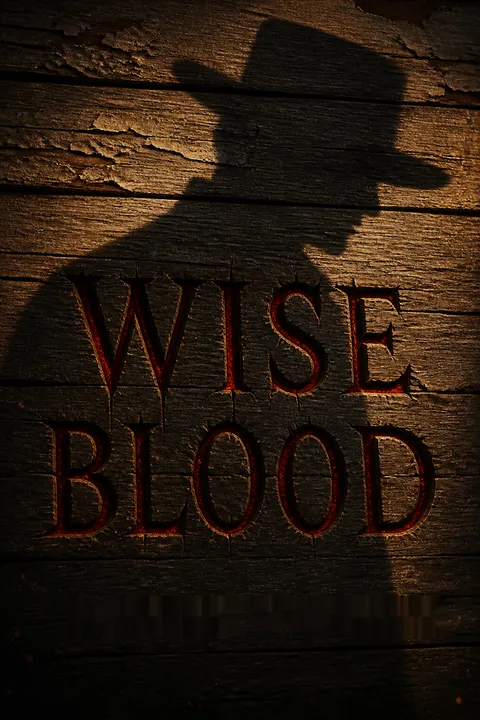

Plot Summary
Homeward Soul, Haunted Country
After the trauma of war and death in his family, Hazel Motes—clad in a preacher's hat and a cheap blue suit—travels back toward Eastrod, Tennessee, while wrestling with a faith he cannot abandon. He remembers his family's rigid Christianity, his grandfather's circuit preaching, and his attempts to elude Jesus's persistent call. Arriving home, Motes finds only ruins: a childhood house now hollow, his family gone, his former world empty and eroded by time. The ghost of his religious upbringing looms, as Hazel tries to escape guilt and the relentless presence of Christ. His past, however, clings to him like a shadow, as he sets off for the city seeking to do "things he never has done before." The emptiness of Eastrod propels him toward the unknown, with faith and doubt wrestling for his soul.
Cities of Darkness, Unsettled Rest
Arriving in Taulkinham, the city dazzles Hazel with its buzzing signs and anonymous filth. He wanders into a brothel, meeting Mrs. Watts, whose crude hospitality provides brief, uncomfortable comfort but not solace. He feels adrift, an outsider looking for anchor in sin, only to find these pleasures hollow. His sense of spiritual exile intensifies as he witnesses evidence of broken dreams and empty rituals—vivid in the rooms he occupies and the city's daily churn. The metropolis mocks his search for certainty and clean beginnings. Hazel soon encounters figures as lost as he, including Enoch Emery, an outcast clinging to a primal sense of fate—his "wise blood." Taulkinham becomes a stage for Hazel's existential struggle, where escape from Jesus threatens to transform into a new, more profound kind of spiritual bondage.
Prophets, Pretenders, and Peeler Men
The city teems with performers and preachers. Hazel's path crosses that of Asa Hawks, a blind evangelist with a dubious past; his sharp-tongued daughter, Sabbath Lily; Enoch, eager for connection; and a crowd eager for miracles. Through crowded streets and market corners, Hazel watches commercial spectacles—peeler men hawking gadgets—and religious ones. Hawks challenges Hazel, sniffing out his guilt. Sabbath Lily, with her desperate innocence, eyes Hazel as a possible savior or mark. Enoch hounds Hazel, on a futile quest for friendship and cosmic meaning. The swirl of charlatans and seekers draws Hazel further into public performance, where belief and disbelief become theatrical—competing for souls, money, and truth. These meetings push Hazel closer to his own "calling"—to found a religion stripped of Christ.
Church Without Christ Begins
In a burst of defiant inspiration, Hazel proclaims the "Church Without Christ" from his car's hood. He preaches a gospel where "the blind don't see... and what's dead stays that way." Rejecting sin and redemption, he tries to assert a new faith of nothingness, declaring freedom from the tyranny of Christ's blood. His impromptu sermons attract mockery, indifference, and suspicion in equal measure. Yet, Hazel's harsh certainty cannot still his internal unrest. The crowds diminish; a few seek to exploit his zeal. Hawks, meanwhile, proves to be a fraud—his piety a pose, his blindness likely feigned. Sabbath Lily and Enoch orbit Hazel's stage, alternately tempting and bedeviling him. Faith becomes a public battleground, fraught with absurdity and dark comedy.
Enoch's Mystery and Wise Blood
Enoch Emery's journey runs parallel to Hazel's, driven by uneasy instincts—his "wise blood" whispers secrets and compels action. He guards the "mystery" he's discovered in the city's park museum: a shrunken, embalmed man—a holy relic, or a grotesque idol. Enoch believes showing it to Hazel will be significant. He processes his own loneliness and sense of fate by fixating on rituals and objects. Gradually, Enoch's grip on reality loosens. He's convinced he is destined for transformation, which the city ultimately delivers in humiliating form. His quest, initially full of naive hope for a sign or connection, devolves into derangement. Enoch's encounter with Gonga the gorilla—seeking blessing or recognition—brings only further humiliation and the spark for his final, self-destroying metamorphosis.
Blindness and Pretense Exposed
Hazel, desperate for authenticity, confronts Asa Hawks, demanding to witness true suffering or faith. Hawks and his daughter are exposed as poseurs—Hawks's "blindness" only a cowardly half-measure, a fraud to elicit pity and coins. Sabbath Lily, both seductress and child, reveals her own desolation, having inherited neither faith nor purpose. Hazel's attempts to seduce, destroy, or redeem them all fail. Sabbath Lily clings to him, craving validation, while Hazel obsesses over the emptiness of all their rituals. Ultimately, the city's religious spectacle exposes the futility and self-deceit underlying both performance and belief. The result is a profound erosion of trust—both in others and self—pushing Hazel toward acts of increasing extremity.
Desire, Seduction, and Defiance
Sabbath Lily's pursuit grows more intimate and desperate. She seeks to seduce Hazel and be "saved" by him, seeing herself as tainted beyond rescue. Hazel, haunted by contradictory impulses, rejects her advances—averse to both pleasure and grace, sickened by his own body, spirit, and the hypocrisy he finds everywhere. Their meetings brim with tension: Sabbath Lily alternately mourns and mocks her bastard status; Hazel resists, yet remains entangled. Efforts to find transcendence through flesh, or through rejection of flesh, both collapse. Hazel's Church Without Christ begins to seem as empty and meaningless as the pieties he fled. The city, meanwhile, offers only more cycles of temptation and disappointment.
Gonga's Revelation and Transformation
Enoch, socially lost and spiritually stunted, is tantalized by the city's latest spectacle: "Gonga the Giant Jungle Monarch"—a man in a gorilla suit greeting children. Enoch desperately seeks Gonga's approval, but is brusquely told to "go to hell." Humiliated yet possessed by mysterious purpose, Enoch steals the shrunken man ("new jesus") from the museum, convinced it will revolutionize Hazel's church and his own destiny. Driven by an irrational need for significance, Enoch dons the gorilla suit himself and symbolically sheds his human life—burying his clothes and identity. His animalistic transformation marks a grotesque, tragicomic apotheosis—emphasizing the city's promise of rebirth as farce rather than salvation.
False Prophets Compete
Hazel's movement is soon usurped by Hoover Shoats ("Onnie Jay Holy"), who turns the "Church Without Christ" into a commercial success. He recruits Solace Layfield, a sickly "prophet" dressed and made to resemble Hazel, to spout marketable heresies. True faith, already in ruins, is replaced with capitalist hucksterism. Hazel is powerless to check the usurpation; his message now circulates as a cheap joke and scam. Anguished by this profanation, Hazel hunts for truth and authenticity while his church mutates into a self-parody—reflecting back at him the futility and inescapable circus of modern belief.
Violent Redemption, Shattered Doubt
Consumed by the falsity all around him, Hazel tracks and kills Solace Layfield, the false prophet, running him over with his car and demanding he strip off the impostor's hat and suit. This brutal act is meant as a purifying sacrifice—a grotesque rejection of imitation, hypocrisy, and disbelief. Yet this gesture offers no peace, only deeper guilt and isolation. Stripped of faith, family, and love, Hazel attempts to flee—believing that leaving town, abandoning even the car that symbolized brief freedom, might offer respite. The act of violence fails to heal the wounds that religious and existential failure have left raw.
Auto-da-Fé and Abandonment
The final sequence is marked by the destruction of Hazel's battered car—pushed off an embankment by a cop "just because he didn't like his face"—and Hazel's subsequent act of self-blinding with quicklime. Bereft of purpose and vehicle, Hazel at last literally embraces the blindness he once despised and pitied in others. Physical self-mortification becomes his final act of penance, surrender, or severance from the visible world. His vision gone, Hazel becomes more solitary, dwelling in a boarding house, lost in silence and bleak rituals, rigidly performing acts of self-punishment. His pain grows more abstract, his effort to "pay" for sins more consuming and mysterious, sealing his fate as a living legend of futility.
Final Blindness, Futile Refuge
Now blind, Hazel becomes a ghost in his own life, cared for by his opportunistic landlady, Mrs. Flood, who shifts from suspicion to obsession. She tries to possess him—financially, emotionally, then by marriage. Hazel, unmoved, focuses on small silent rituals: walking on gravel in his shoes, binding his chest with barbed wire, fasting, receding into internal darkness. His existence turns silent, inward, and meaningless to those around him—his blindness both shield and prison. All watching him struggle and decay are left bewildered; the outside world cannot comprehend the depths of Hazel's alienation.
Searching for Meaning in Darkness
The boarders, Sabbath Lily, and Mrs. Flood gaze at Hazel with curiosity, desire, or pity, but no one comprehends his self-imposed suffering. Mrs. Flood tries to save or claim him, but is rebuffed. Her attempts to lure him into earthly happiness or respectable marriage fail, as do her schemes to exploit his government checks or cure his spiritual ills. Hazel's refusal to compromise, accept charity, or explain his pain marks the completeness of his alienation. He appears to the world as a puzzle: unreadable, unreachable, his life reduced to bodily suffering and shadow. Everyone suspects hidden meaning, but no one can find it.
Pinpoint of Light
Hazel disappears into the freezing rain, resisting Mrs. Flood's final, desperate plea for companionship. Two policemen find his body and return it to the landlady, who sits watching him endlessly—seeking in the empty sockets and the stern contours of his dead face an answer or revelation. She feels, finally, as if she is at "the beginning of something she can't begin," and glimpses a distant, wandering point of light. Hazel's journey closes not with clarity or redemption, but with ambiguous, unresolved longing—a tragic sense of searching in a cosmos devoid of clear grace. The book ends as it began: with yearning, doubt, and the inescapable mystery of faith.
Analysis
Religious hunger in an age of lost faith—O'Connor's ambiguous American parableWise Blood remains one of the most unsettling and original examinations of modern spiritual crisis. O'Connor crafts a world where the need for faith is absolute, but the forms of faith have become hollow, fraudulent, or perverse. Hazel Motes's violent pursuit of a Christ-less gospel exposes the impossibility of living without meaning—his own "church" soon becomes as brittle and theatrical as those he despises. Other characters mirror his estrangement: Enoch seeks communion but devolves into an animal, Sabbath Lily collapses under meaninglessness, and both belief and unbelief are shown to generate their own dogmatic suffering. O'Connor's world is grotesquely comic yet pitilessly tragic, indicting modernity's confusion of commercial promise and religious longing. The novel leaves us in a state of unresolved yearning: redemption is glimpsed but never attained, and the mysteries at the heart of suffering and identity—like the darkness behind Hazel's blinded eyes—remain opaque. The lesson is not that faith is false, but that its absence, in a fallen world, may be more horrifying still. Wise Blood stands as a visionary parable of the price of spiritual estrangement, and the brutal cost of seeking meaning in a secular, commercial age.
Review Summary
Reviews for Wise Blood are largely positive, averaging 3.82/5 across nearly 39,000 ratings. Admirers praise O'Connor's dark humor, grotesque Southern Gothic characters, and sharp prose, comparing her work to Faulkner and Dickens. Many find protagonist Hazel Motes' tortured spiritual crisis compelling, noting the novel's rich symbolism and irony. Critics who rated it lower struggled to connect emotionally with the alienating characters or felt the narrative, assembled from short stories, lacks cohesion. Nearly all reviewers acknowledge the book's literary power, even when finding it personally challenging or disturbing.
People Also Read

Characters
Hazel Motes
Hazel is a returned war veteran, the descendant of preachers, unable to escape the gravitational pull of Christ and "sin." His psycho-spiritual life is a violent reaction against inherited faith, manifested by founding a "Church Without Christ" that becomes a parody of religious conviction. Hazel is both zealous and dissociated: he craves truth, yet his actions are marked by self-destruction, rigid discipline, and outbreaks of violence. He is unable to believe, but equally unable to rest in unbelief. Haunted by childhood trauma and a sense of doom, Hazel traverses extremes—seeking, suffering, and finally, blinding himself. His loneliness is absolute, yet he becomes a tragic symbol for anyone caught between belief and modern rootlessness.
Enoch Emery
Enoch is an eighteen-year-old lost in the city, driven by mysterious impulses he attributes to his "wise blood." He is obsessed with order, ritual, and "mysteries"—notably, a mummified shrunken man who becomes a totem or false "jesus." Enoch's relentless desire for meaning drives him into humiliating, absurd, and finally transformative acts. His transformation—stealing a gorilla suit and becoming a beast—is O'Connor's surreal vision of failed spiritual seeking: Enoch becomes as much animal as human, his madness echoing Hazel's futility. In truth, Enoch's "wise blood" is only alienation and compulsion—never the wisdom he hopes for.
Sabbath Lily Hawks
Sabbath Lily is the teenage daughter of fake evangelist Asa Hawks. Brash, manipulative, and emotionally wounded, she seeks validation through sex and religious posturing. Seeing herself as a hopeless "bastard," she oscillates between seductress and broken child roles, fixating on Hazel as possible lover and redeemer. Her interactions with Hazel reveal both his and her inability to find real grace—her "faith" is transactional and performative, a product of upbringing and neglect. She is as lost as any character, ultimately abandoned after Hazel self-blinds.
Asa Hawks
Asa Hawks is introduced as a blind—and thus saintly—preacher, but Hazel soon exposes his sight as intact, his blindness a ruse. Asa's inability to carry out self-blinding (a failed promise from his revivalist past) haunts him; he is trapped in a pose of piety he can neither abandon nor fulfill. A fraud and a coward, Hawks offers nothing but pretense to those around him, ultimately deserting his daughter and disappearing, leaving chaos behind. His character is the clearest example of the novel's theme of religious fraudulence.
Mrs. Flood
Mrs. Flood, Hazel's landlady, is at first suspicious and later obsessed with him. She tries to manage Hazel—financially, emotionally, and physically—offering food, marriage, and eventually, desperate companionship. Her pragmatic greed fades as she becomes fascinated by Hazel's suffering and mystery. She stands in for "the world's" attempt to understand or claim the suffering artist or seeker. In the end, she is bewildered, yearning, and left empty—seeking a revelation she cannot attain.
Hoover Shoats / Onnie Jay Holy
Hoover Shoats is a fast-talking entrepreneur who hijacks Hazel's heresy, styling himself "Onnie Jay Holy." He transforms the "Church Without Christ" into a cash cow, turning faith into entertainment and cheap consolation. Like other frauds in the novel, he exploits spiritual hunger for material gain, embodying O'Connor's indictment of America's commercialization of religion and gullibility of audiences.
Solace Layfield
Solace Layfield is the "true prophet" hired by Hoover Shoats—chosen for his resemblance to Hazel. He parrots Hazel's gospel for a fee, ultimately becoming Hazel's target of wrath. Layfield's imitation and eventual murder become an externalization of Hazel's internal struggle with his double nature—faith and disbelief, zeal and fraud cohabiting within one soul.
Mrs. Watts
Mrs. Watts represents the earthy, transactional, and empty pleasures Hazel seeks to replace faith. She offers Hazel "shelter" and sex, but their intimacy is demeaning and distasteful. Her practical, crude outlook highlights the emptiness of Hazel's search for meaning in the flesh. She is ultimately discarded as Hazel's despair grows.
The "New Jesus" (Shrunken Man)
The mummified, shrunken man in the city's museum—exhumed and taken as a "new jesus" by Enoch—serves as the most poignant physical symbol of failed faith. Treated as an object of devotion, then destroyed and discarded, this grotesque figure mirrors the characters' spiritual hopelessness, the decay of religious meaning, and the danger of misplaced or ignorant worship.
Gonga the Gorilla (and Enoch-in-Gorilla-Suit)
Gonga, a carnival gorilla, becomes an accidental focus of Enoch's yearning for meaning. When Gonga (a man in a suit) rebuffs Enoch, he steals the gorilla suit himself, embarking on a delusional transformation. The gorilla is a motif for both failed humanity and the tragic absurdity of seeking animalistic or performative escape from existential despair.
Plot Devices
Radical Satire, Religious Parody, Southern Gothic
Wise Blood employs a radical blend of satire and dark comedy to probe the collapse of religious belief in modern America. O'Connor destabilizes every form of faith—preaching, public spectacle, and private piety—by exaggerating its fraudulence and exposing its commercial, grotesque underbelly. Constant irony and inversion undermine any comfortable resolution: belief begets hypocrisy, and attempts at radical disbelief become new forms of zeal or violence. Devices of parody (mock churches, commercials), doubling (Hazel/Solace; blindness/sight), and Southern Gothic grotesquerie (shrinking men, mummified relics, animal transformations) heighten the sense of spiritual absurdity. Narrative structure tracks a descent from hope, to rebellion, to self-destruction—foreshadowing each fall with recalled trauma, physical decay, and comic yet harrowing interactions.
Download PDF
Download EPUB
.epub digital book format is ideal for reading ebooks on phones, tablets, and e-readers.








































