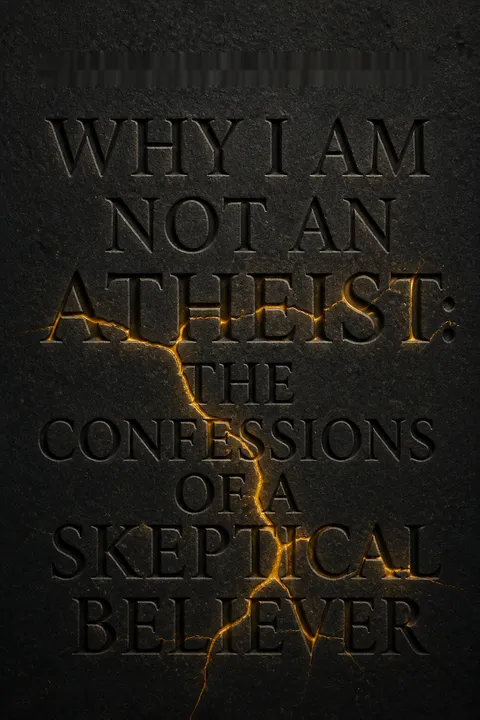

Key Takeaways
1. The Personal Quest for Meaning Beyond Inherited Faith
I had enough friends whose families weren’t religious (or who’d already rejected their family’s faith) to know that disbelief was an option, but I felt little reason to consider it for myself.
Early faith. The author's childhood was deeply immersed in a Catholic world, where faith provided the unquestioned "furniture" of existence, making disbelief seem unnecessary. This comfortable acceptance was challenged by profound personal experiences.
Seeds of doubt. A near-fatal accident involving his twin brother and his own later cancer diagnosis shattered the author's abstract understanding of suffering and mortality. These events made the problem of suffering acutely personal, leading him to question a God who would allow such arbitrary pain, especially when many more devout individuals were not spared. This realization made weekly devotion feel obscene.
Embracing reason. Reading Bertrand Russell's "Why I Am Not a Christian" provided an intellectual framework for his burgeoning doubts, arguing that religious claims were likely false and a source of suffering, perpetuated by fear. Russell's call to "look the world frankly in the face" with a "fearless outlook and a free intellect" resonated deeply, leading the author to reject faith for reason and embrace atheism as a new identity.
2. Scientific Materialism: A Rational Worldview with Insoluble Mysteries
The trouble was that when I took this approach, I could find no obvious factual or scientific answer to the question that seemed most pressing to me: How am I to live?
Defining the worldview. Scientific materialism posits that the material world is all that exists, known through sense perceptions and scientific methods that convert data into objective facts governed by immutable physical laws. Its ethics, primarily utilitarianism, judge actions by their objective consequences in the physical world.
Historical foundations. This worldview emerged from the Enlightenment, with figures like Francis Bacon emphasizing usefulness as the test of knowledge and René Descartes seeking a "universal science" through mathematical certainty. Thomas Hobbes reduced mind to matter in motion, grounding ethics in self-interest, while John Locke established empiricism, arguing knowledge comes from experience and that morality is based on pleasure and pain.
Hume's challenge. David Hume, a radical empiricist, exposed the shaky foundations of this approach, arguing that causality is merely habit and morality is sentiment, not objective fact. He famously stated, "Reason is and ought only to be the slave of the passions," undermining the very rational certainty scientific materialism sought.
3. The Unsolvable "Hard Problems" of Materialism
As far as scientific explanation goes, [sentience] might as well not exist.
Limits of explanation. Despite its comprehensive claims, scientific materialism struggles with fundamental aspects of reality. The origin of the universe remains a profound mystery, with theories like the Big Bang and multiverse models often described as "modern creation myths" that still face the problem of infinite regress.
Quantum strangeness. Modern physics, particularly quantum mechanics, reveals a subatomic reality utterly inconsistent with common sense, where particles behave in incomprehensible ways. This suggests that reality itself may surpass human comprehension, challenging the materialist promise of a complete, rational picture.
The consciousness dilemma. The "hard problem" of consciousness—why physical processes are accompanied by subjective, inner experience—remains unsolved. Scientific materialists like Steven Pinker admit that sentience "might as well not exist" from a scientific standpoint, effectively treating humans as "philosophical zombies" whose rich inner lives are dismissed as irrelevant or illusory.
4. Romantic Idealism: Finding Meaning in Subjective Will and Artistic Creation
Perhaps I would make lasting art from the discomfort of living in a godless universe.
A different path. Disillusioned with scientific materialism's inability to address the "riddle of life," the author turned to romantic idealism, an atheist tradition that prioritizes subjective experience, will, and artistic creativity. This worldview, rooted in figures like Spinoza, Rousseau, Kant, Schopenhauer, and Nietzsche, grounds knowledge in internal experience rather than external facts.
Will as reality. Arthur Schopenhauer, a key figure, posited that the world, as a "thing-in-itself," is pure, blind, irrational "Will," and our subjective experience of our own will offers the only direct insight into this ultimate reality. This view sees existence as an endless, meaningless struggle, leading to profound pessimism.
Art as refuge. For Schopenhauer, art offers a temporary escape from the suffering of the will by allowing "fixed contemplation" of "Ideas" (Platonic forms) rather than individual objects caught in the causal chain. The artist, though suffering, makes this insight available to others, offering a brief respite from the world's relentless striving.
5. Existentialism's Call: Authenticity, Anxiety, and Being-Toward-Death
Because Dasein is in each case essentially its own possibility, it can, in its very Being, ‘choose’ itself and win itself; it can also lose itself and never win itself; or only ‘seem’ to do so.
The essence of existence. Martin Heidegger's philosophy of Dasein (human existence) emphasizes that our essence lies in our existence, meaning we are defined by our possibilities and choices. Authenticity involves confronting this responsibility, while inauthenticity means fleeing into "average everydayness" and the "dictatorship of the 'they'."
Anxiety and death. Dasein's paradigmatic mood is anxiety, a feeling of threat "in the face of nothing," which reveals our ultimate responsibility for meaning. Authentic "Being-toward-death" means courageously facing our finitude and the possibility of nothingness, which unveils the full truth of our existence.
The silent call. Heidegger describes a "call" from the authentic self to the inauthentic self, a "voice of conscience" that speaks in "the uncanny mode of keeping silent." This call, which cannot be rationally explained or attributed to a transcendent God, urges us to choose our authentic selves and embrace our guilt for falling short of our potential.
6. The Nietzschean Challenge: Embracing the "Death of God" and the Will to Power
God is dead. God remains dead. And we have killed him.
The ultimate loss. Nietzsche's famous declaration, "God is dead," is not a celebration for atheists but a profound lament for the loss of all objective meaning and value. He argued that modern science and philosophy had systematically dismantled the foundations of traditional morality and metaphysics, leaving humanity adrift.
Overcoming humanity. In "Thus Spoke Zarathustra," Nietzsche introduces the concept of the "Superman" (Übermensch), a future human who transcends conventional morality and creates his own values, embracing life's suffering and affirming the "will to power." This is a call to overcome our current, decadent human nature, which has been weakened by life-negating illusions like Christian morality.
Life as aesthetic phenomenon. Nietzsche believed that "it is only as an aesthetic phenomenon that life can be justified." In a world without inherent meaning, individuals must become artists of their own lives, choosing their myths and values based on whether they are conducive to greatness and vitality, rather than objective truth.
7. The Social and Moral Perils of Unfettered Atheist Ideologies
You readily accepted despair, and I never yielded to it.
The "Last Man." Nietzsche warned against the "Ultimate Man" or "Last Man," a complacent, conformist citizen of liberal democracies who prioritizes comfort and security over greatness, embodying a "contemptible" end to human striving. This vision critiques the utilitarian ideal of universal happiness as a form of spiritual mediocrity.
Illiberalism's rise. The author observes that contemporary illiberal movements, both on the political right and left, often draw from romantic idealist themes. They champion authenticity and identity, doubt objective truths, and see "truths" as expressions of power dynamics. This suggests that the threats to liberalism today are often atheist in nature, rooted in the very philosophies that sought to liberate humanity from dogma.
The social media mirror. The author argues that social media platforms are a "purest imaginable expression of romantic idealist ideology," where individuals constantly create and perform identities, engage in endless disputes, and experience heightened anxiety. This environment, driven by a "war of truths" without ground rules, fosters isolation and misery by denying the shared reality and inherent worth of others.
8. Language as a Social Game: Meaning is Made, Not Discovered
What is true or false is what human beings say; and it is in their language that human beings agree.
Beyond the picture theory. Ludwig Wittgenstein, initially a proponent of language as a "picture" of reality, later rejected this view. He argued that language is not a monolithic system for describing objective facts but a collection of diverse "language-games," each with its own rules and contexts.
Family resemblance. Words do not have single, absolute meanings but rather "family resemblances" that allow for flexible and context-dependent use. Meaning is not an abstract essence but is derived from how words are used within a "form of life," a shared way of living and interacting.
Philosophy as therapy. For the later Wittgenstein, philosophical problems arise when language "goes on holiday," taken out of its practical context. The task of philosophy is not to discover ultimate truths but to "soothe the mind about meaningless questions" and "show the fly the way out of the fly-bottle," liberating us from conceptual confusions.
9. Love as the Unshakeable Foundation for Re-found Faith
God is love, it says, and love is God.
A new starting point. After years of intellectual wandering and profound personal unhappiness, the author found himself drawn back to faith, not through rational argument, but through the undeniable reality of love experienced in a new relationship. This love became his "foundational principle," challenging the materialist and idealist worldviews he had previously embraced.
Beyond reductionism. This love, understood as a foundational reality, could not be reduced to mere physical sensations, neurochemical processes, or adaptive genetic strategies. It demanded a rejection of strict materialism and the idealism that saw love as a subjective projection, asserting instead that love exists objectively, outside the self.
The reality of others. Starting with love meant acknowledging the inherent reality and subjective richness of other people, not as "cardboard cutouts" or characters in one's own drama, but as beings whose joys and sufferings were as real and important as one's own. This also necessitated acknowledging the reality of the physical world, with its boundaries of time and space, which love made acutely felt.
10. Christian Mysticism: Knowing God Through Love, Beyond Reason
God can well be loved, but he cannot be thought.
The via negativa. The author found resonance in Christian mystical traditions, which advocate a "negative path" (via negativa) to understanding God. This approach acknowledges that God exists beyond human reason, time, and space, and any attempt to describe God conceptually will fall short.
Love as direct knowledge. Mystics like Meister Eckhart and Julian of Norwich teach that God, being love, can be "grasped and held" by love, not by thought. Through "thrusts of love" and detachment from the temporal self, one can "pierce" the "cloud of unknowing" and gain intuitive, direct knowledge of God's essence.
God's immanence. This mystical understanding emphasizes God's immanence in creation, not just as a transcendent creator but as the very love that sustains existence. Julian's vision of the hazelnut, "all that is made," lasting because "God loves it," illustrates that the physical world is not debased but a loving creation, meant to be enjoyed and stewarded.
11. The Skeptic and the Believer: A Rational Case for Faith
Belief can be rationally justified—that is, taking the step into belief can be rationally defended.
Beyond rational proof. The author concludes that a rational proof for faith does not exist, nor is it necessary. Instead, his return to belief was a response to an inner "soul voice," a call that he had long suppressed. This "whispering voice" defied pure reason but resonated with his deepest needs, offering a framework for love, meaning, and purpose.
Faith as a form of life. Drawing on Wittgenstein's later philosophy, the author understands belief not as a set of propositional truths to be intellectually assented to, but as a "form of life." It is a continuous act of living, choosing, and acting as if the beliefs are true, even when intellectual certainty wavers.
The need for infinite help. The author's journey led him to recognize himself as "the man who needs infinite help," a realization that made Christian belief, with its promise of divine love and grace, not just appealing but existentially necessary. This perspective allows for both skepticism and belief, acknowledging the limits of reason while embracing a reality ordered by love.
People Also Read




Download PDF
Download EPUB
.epub digital book format is ideal for reading ebooks on phones, tablets, and e-readers.








































