
Plot Summary
Daddy's War Within Walls
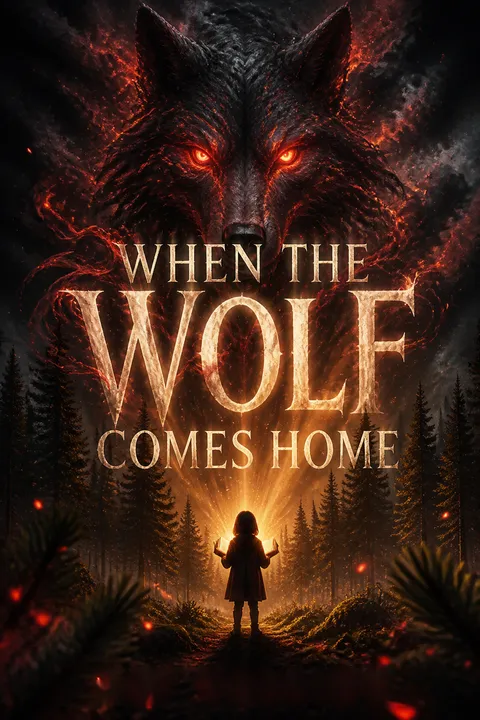
In the opening moments, a small boy cowers in fear as his father, gripped by wild, animalistic rage, tears through their home. The child clings to a forbidden picture book full of fairy tales, which has become his haven and portal to wonder. But this rare joy anchors him to the storm. When discovered, he flees—haunted not just by his father's violence but by images of a monstrous wolf from his cherished book—a beast that seems to take shape from all his fears. This primal introduction is the spark; both a literal and metaphorical 'wolf' now stalks the child, giving form and hunger to the story's deepest terrors.
Laughter and Loss at Poppy's
Jess, a brash and witty waitress in a Los Angeles diner, uses banter with her older coworker Margie to mask inner turmoil. Jess's father has died, and though he abandoned her decades ago, his absence now feels more real than ever. Her internal monologue splits: Outer Jess is flippant and self-sufficient, while Inner Jess is obsessed with her father's neglect, replaying old wounds. When a sick, disheveled customer is kicked out, and Jess is tasked with cleaning the bathroom, the reader glimpses the aching interplay between distraction and real, grinding sorrow—defensive laughter barely containing black, inherited pain.
Toilet Spirals and Traumas
Alone with the stench and filth, cleaning an odious bathroom, Jess is assaulted by intrusive questions about her father's abandonment. Her anger and insecurity surface as she self-analyzes and recalls career rejections, wondering if she's cursed to be unwanted. This emotional spiral crests when she's stuck by a dirty needle—her hands plunged into the worst kind of present danger. Panic and self-loathing mix, and as Jess robotically rushes from the bathroom, fear replaces sorrow: she is now marked both by psychological poison and the literal threat of contamination, setting a new, sharper edge to her dread.
The Needle's Terrible Bite
Jess responds to the needlestick with mechanical urgency—action a shield against terror. Her instincts war between shock and the desperate need to seek medical help. But she forgets her phone, leading her on a confused, anxious trip home. Her mind fractures further: action Jess fights with inner child Jess, both overwhelmed by the onslaught of fear, guilt, and shock. Exhausted, she opens her back door to the night—and hears a child's pitiful whimpering. As Jess discovers the filthy, bruised boy clutching a fairy tale book, the story's parallel threads entwine, mutual terror radiating off both.
Night of the Stray Child
Jess feeds the exhausted boy, then contemplates what to do next amid a cascade of anxieties: exposure to disease, guilt over failing her roommate Kelsey, and the child's muteness. As sirens and neighborly chaos erupt outside, a naked, frantic man arrives searching for the boy, but before the truth can surface, chaos spills into violence: a monstrous wolf-thing crashes through Jess's life—literally. Death tears through her community. Jess, Kelsey, and the boy run, but there is no escape for all. In this moment, fairy-tale horror is made flesh—Jess is both protector and prey.
Violence Howls, Neighbors Fall
The wolf-thing decimates neighbors, police, and Kelsey, leaving Jess and the boy alone in carnage. Survival mode overtakes reason—Jess is forced into the role of protector, snatching the petrified child and fleeing in Margie's car. As they drive away, the numbing horror mingles with Jess's guilt (for possibly shooting a cop) and the child's raw loss. Each acts on trauma instinct; there can be no normalcy. As they escape, Jess's old life—the promise of LA, the consolation of being 'unwanted' but anonymous—collapses, replaced by the feral knowledge that true danger wears a parent's face.
Escape, Guilt, and Plans
Through pain and adrenaline, Jess seeks haven with Margie, her coworker, whose compassion is tinged with fear and limits. Jess's and the boy's trauma is a contagion: Margie is kind, but anxious not to become a casualty herself. Amid tears and waning bravado, Jess admits she has no plan. Meanwhile, ominous news reports of animal attacks escalate the sense of siege. Jess is forced to confront her dependence on others—for protection, for direction, for meaning. But even friendship can be fragile when fear and violence are at the threshold, and no place feels truly safe.
Monster's Trail, Cop's Hunt
In parallel, Special Agent Santos is brought onto the case by a shadowy government agency, learning that the boy's fear makes monsters real. As bodies pile up down the monster's eastward trail, lines between hunter and prey blur. Santos's own memories are haunted by a persistent itch—symptoms of reality warping at the boy's whim. As Jess tries to remain hidden, the agency closes in on what they only partially understand—a "Project Albatross" child whose terror breeds catastrophe. The entire narrative becomes a chess game: the boy and Jess desperate for sanctuary, the world intent on capturing what it fears.
Rooms Full of Monsters
On the run, Jess and the boy shelter in cheap motels, passing time with board games and uneasy bonding. The boy's powers escalate with his emotions—cartoons crawl from the television, and even the comfort of a movie spins into jaw-snapping violence. Attempts at normalcy break under the weight of supernatural chaos: the line between real, imagined, and manifest horror vanishes. In moments of unsteady peace, Jess tries to parent, to teach, to comfort—realizing that her own childhood wounds echo the boy's isolation. But the domestic sphere has become a haunted house where anything feared might come to life.
Invisibility and Shelter Shattered
The group's attempts at hiding—whether at Margie's home, a hotel, or a remote cabin—are sabotaged by both relentless government pursuit and the boy's own subconscious. Manipulating invisibility and the stuff of nightmares, the boy both shields and imperils himself and Jess. Attempts to appear normal—shopping trips, kindness—devolve into horror as children's fears create literal monsters. Other would-be rescuers (cop, Margie, Cookie) are destroyed, and Jess's anxiety deepens: who is the real threat? The government's offer to "help" is untrustworthy; every effort to surrender or ask for protection ends in betrayal or carnage.
Roadblocks and Unravelings
As survivors recount losses, both adult and child flashbacks converge. The boy's father closes in, tormented and shape-shifting, his own love become monstrous. Jess faces her own fears of infection, abandonment, and loss—sometimes literally as her wounds fester, and often emotionally, as past neglect dictates current reactions. Grief warps reality and memory. All the while, the ultimate pursuers—the government, the father, fear itself—draw closer. Jess realizes that no adult can offer unbroken safety, and every parental figure is a paradox: both the source of comfort and the generator of monsters.
Games, Fears, and Complications
Jess and the boy reach the remote cabin, trying to forge a routine amidst trauma. They invent games and tell stories, but beneath these childish rituals, terror grows: the boy's guilt over "badness," Jess's mounting anxiety and paranoia. Each is haunted by their own failing parent—Jess by her mother's secrets and father's absence, the boy by a father who is both protector and destroyer. Their homemade fortress is no more than a fairy tale cottage—walls thin against howling wolves, both outside and within. As the past encroaches, safety proves illusory.
Reunion and Revelations at the Cabin
The climax arrives with the father's monstrous return—a fusion of all the story's themes: love twisted by fear, protection weaponized, parent as both shield and predator. The boy, suffocated by self-loathing and the belief in his own badness, wishes for punishment. In the volcanic violence of the showdown, Jess, the boy, and his father are each pushed to their limits. The boy's guilt and longing for approval reach a breaking point and his father, believing there's no other way, commits the unthinkable. Jess's role as protector and victim converges; all fairy tales about monsters dissolve into one brutal truth.
Final Showdown in the Woods
Wounded and near death, Jess witnesses the child run to his father's arms—a reunion born of desperation, pain, and fractured love. But the embrace is fatal: the father, seeing no way to end the cycle of monstrous transformations, kills the boy in a final, wrenching act of "protection." This grim mercy killing is followed by his own suicide at Jess's hand. All hope of a redemptive, happy ending is swallowed by the reality that terror breeds terror, and no comfort lingers for the survivors. The cost of power, of trauma, is always paid in blood.
A Wolf's Shadow Remains
Shell-shocked, Jess submits to questioning, shuffles through the motions of debriefing and travel. She is haunted by imagined dog ghosts—perhaps the boy's final, innocent wish for a better world. Institutional authorities cover up the carnage; reality is sanitized, but not repaired. The true wounds, psychic and existential, are irreversible. As Jess stares at the boy's abandoned fairy tale book, she knows she will never be free of what happened: guilt, loss, and the sense that the "wolf" remains just beyond the firelight, never gone, never sated.
Guilt, Grief, and Ghosts
Jess holes up in a hotel, drowning in liquor and numb avoidance. Medical results—ambiguous, terrifying—loom over her, another "wolf" gnawing at her safety from within. Her remorse and doubt take supernatural form: nightmares, apparitions of her mother, her father, and the dead boy blame and taunt her. The boundaries between reality and hallucination blur. The dread of contamination, the legacy of parental failure, and the dangers of fear itself all converge as Jess is forced to see that she is both haunted and haunter, monster and victim.
The Power to Unmake
In dreams—or perhaps something more—Jess is confronted by her own complicity. She discovers the boy's powers were mirrored in herself: she too can unmake, can bring terror to life. Her mind spirals towards annihilation, haunted by the possibility that adult fear is more apocalyptic, more dangerous, than a child's. The narrative becomes meta: Jess is actor and audience, improviser and improvisation, her dread the engine of the world's destruction. All roads lead to this insight: the greatest horror isn't the monster, but the stories we believe about our own inadequacy.
Never Say No
In a fever dream of improv's "never say no" ethos, Jess confronts the ultimate improv: if belief itself has power, is it possible to choose not to be afraid? To believe in safety, healing, a world without suffering? The temptation is enormous, but the wisdom of pain—of Ursula K. Le Guin's "lathe"—intervenes. One cannot change the world without unforeseen cost. The narrative closes with Jess embracing uncertainty: the wolf is never wholly banished, but life goes on. The real fairy tale is learning, after trauma, to live with fear—never letting it define the ending.
Analysis
Cassidy's When the Wolf Comes Home transforms the universal experience of childhood fear and parental trauma into a terrifying, literal force—a nightmare that doesn't just haunt the mind, but stalks the world. Using horror as a lens, the novel interrogates the cyclical inheritance of pain: how parents' wounds shape children, and how children's need for love and safety becomes the very thing that lets monsters in. The "wolf" is omnipresent—a father, addiction, guilt, disease, the gnaw of not being enough—impossible to banish, always at the door. By letting the fantastical and the mundane collapse into one another, Cassidy exposes the stakes of everyday suffering, the danger in pretending fears can be walled off or purged by violence. Perhaps the book's greatest insight is that salvation isn't found in erasure or becoming "fearless," but in the ongoing, improvisational work of living with fear, loving without certainty, and refusing to become the monster you flee. The story's subversion of happy endings—its refusal to banish the wolf once and for all—speaks to the truth that survival, not victory, is the real fairy tale, and that the greatest act of love might simply be staying, trying, and telling the stories anyway.
Review Summary
When the Wolf Comes Home receives overwhelming praise from readers, earning an average of 4.08 stars. Most reviewers highlight its emotional depth, fast-paced action, and surprising twists, frequently noting it transcends typical werewolf fiction. Themes of fatherhood, grief, and fear resonate strongly, with the author's afterword receiving near-universal acclaim. Critics praise protagonist Jess and the book's dark humor. Detractors cite overwrought prose, a misleading title, and an unlikable main character. The audiobook version is frequently recommended as an excellent listening experience.
Characters
Jess (Jessa Rae Bailey)
Jess is a thirty-something, washed-up actress in LA, shaped by lifelong abandonment and disappointment. Her intellect is sharp, humor biting, but beneath her defensive bravado lingers profound vulnerability—especially regarding her father's desertion. Jess's defining struggle is trying to control fear—her own, and, unwittingly, the boy's. She is both haunted daughter and unwilling mother-figure, a survivor who lurches between self-loathing and stubborn hope. Throughout the story, she wrestles with the paradox of trying to save others when she cannot save herself, ultimately realizing she is as much monster as protector, and her greatest battle is accepting uncertainty and imperfection.
The Boy ("Kiddo" / Peter Calvert, Jr.)
The unnamed boy is both narrator of primal fear and its victim: a five-year-old raised in isolation by a violent, traumatized father. Lacking name, language, or a sense of safety, he processes the world through dread and guilt, believing himself "bad." His unique supernatural power—manifesting fears as physical reality—mirrors the helplessness and intensity of childhood trauma. His psychological development is catastrophically stunted—fear and love, punishment and forgiveness intermingled in confusion. The boy's arc, from hiding to reunion to tragic death, crystallizes the novel's thesis: a child's terror, left unacknowledged, can destroy everyone.
Peter Calvert (The Father)
A former soldier marked by secret government experiments, Peter is driven by shame, anger, and parental failure. His intention to "protect" his son is warped by abuse, negligence, and his own monstrous transformations—literal and figurative. At moments, he appears superhuman (wolf-beast), but he is always a man fleeing his guilt and incapacity to control himself or his son. His connection to the boy is a closed loop of fear escalating fear. In the end, his choice to kill his son ("for his own good") is the dark apotheosis of parental horror—love poisoned by terror and regret.
Margie Hurd
Margie is Jess's coworker—a tough, exhausted, tender-hearted waitress who offers compassion without illusions. She represents found family and hard-earned wisdom, providing a brief respite of safety for Jess and the child. Her kindness, though, cannot shield her from the rippling violence of fear, and she becomes a victim, her death a consequence of trying to help those caught up in cycles of trauma. Her significance is in showing the limits of goodwill in the face of supernatural (and psychological) horror.
Cookie (Jess's Mom)
Cookie, Jess's eccentric, socially dominant mother, is Jess's confidante, co-conspirator, and guiding voice. The single parent who stayed, Cookie's complicated love is a brittle shell protecting both herself and Jess from pain—sometimes crossing the line into overprotection or secrecy. Her dynamic with Jess is all rapid-fire affection, codependence, and, ultimately, betrayal—her withholding of Jess's father's whereabouts planting seeds of resentment. Cookie's brutal death symbolizes both the end of childhood security and the last bulwark against inherited fear.
Marginalized Cop ("Maynard")
This anonymous diner regular and addict embodies the grim realities of urban vulnerability. When Jess is stabbed with his discarded needle, an eruption of medicalized fear and guilt is set into motion. He is not a villain, but rather the mechanism by which Jess's anxieties are made literal—an agent of contagion, societal neglect, and the random violence of fear.
Special Agent Michael Santos
Santos, an FBI agent with literary aspirations, is tasked with "retrieving" the boy. His investigation links the story's supernatural elements with government conspiracy, but his real function is to highlight the futility of rational control and the arrogance of adults who seek to contain or weaponize fear. His gradual mental unraveling—marked by a physical itch where his existence will be "unmade"—dramatizes the theme that no one is immune to the consequences of trauma, no matter their intentions or tools.
Uncle Pepsi
Tommy's cousin "Pepsi" is the unassuming "safe harbor" who shelters Jess and the boy at the story's climax. His presence reinforces family's inescapable role—helpful but never romanticized. He is warmth and memory, but also a reminder of the pervasiveness of parental failure and the imperfect, contingent nature of all refuge.
Kelsey
Jess's detached, pragmatic roommate is the first "friend" destroyed by the monster. Her death is a grotesque demonstration of the suddenness with which love and protection can become powerless when up against the force of unchecked fear and inherited violence.
The Wolf / Monsters Manifest
Neither simply a metaphor nor exclusively supernatural, the "monster" shifts form: wolf, cartoon demon, apparition, and, most chillingly, a parent. It is the flesh made from fear, ensuring the deadliness of what is repressed and the inevitability of confrontation. The wolf is the story's engine, always returning home, always feeding on what the family cannot articulate—and in doing so, reveals that what is most feared most cannot be escaped.
Plot Devices
Child's Fear as World-Shaping Power
The narrative hinges on a speculative conceit: the boy's fear (and, later, Jess's adult anxieties) actually manifests monsters, violence, and supernatural happenings. This is not mere hallucination—the results are psychically and physically real, blending horror tropes with magical realism to show how childhood terror (and unresolved parental pain) shapes the present and future. The cause-and-effect cycle is recursive: parental violence breeds fear, fear births monsters, monsters justify violence, and the cycle turns. This device also allows for meta-fictional uncertainty: the line between imagination and reality is persistently destabilized.
Improv and Storytelling Metaphor
Jess's history with improv comedy becomes a core metaphor for coping—her reliance on "never say no" and adapting in crisis underscores resilience but also the dangers of improvising morality and survival. The meta-structure of storytelling—fairy tales, improv games, acting—acts both as a refuge (comfort in narrative) and a threat (when stories become cages, or when belief itself is weaponized).
Parental Paradox
The recurring device of "the wolf comes home" reframes family as the surest source of both comfort and brutal harm. The father is both literal wolf and the force that shapes the boy's powers: "how do you protect?" is asked again and again, never answered, because danger and shelter are inseparable. This duality is mirrored in Jess's relationships—with her father absent but haunting, her mother present but secretive, and the boy as surrogate child.
Escalation and Escaping Reality
The plot's tension is maintained by the converging threats: the supernatural monsters conjured by fear, the relentless, misinformed pursuit by the government, and the suspicion between Jess and the boy of who is truly dangerous. Each attempt to seek help, confess, or surrender only makes events spiral—demonstrating both the futility of escape and the impossibility of walking away from inherited trauma.
Metafictional Unraveling
In the final act, the story fractures: Jess discovers her own fears might manifest power similar to the boy's. The difference between dream, memory, meta-narrative, and reality dissolves. The story ends (and does not end) with the possibility that healing—that the world itself—depends not on defeating fear, but on accepting it and refusing to let it control the story.
Download PDF
Download EPUB
.epub digital book format is ideal for reading ebooks on phones, tablets, and e-readers.








































