Key Takeaways
1. Heroism is an Accessible Choice, Not a Birthright
What we’re saying is that anyone can be a hero.
Challenging assumptions. There's a widespread cultural belief that heroes are born with remarkable qualities, like mythical figures or divine beings. However, researchers like Stanford professor Phil Zimbardo, known for the Stanford Prison Experiment, argue against this notion, proposing the "banality of heroism." This concept suggests that just as ordinary people can commit evil under certain conditions, anyone is capable of sacrificing for the greater good, regardless of their background or innate abilities.
Defining heroism. Heroism traditionally involves significant personal sacrifice or risk, often in high-stakes situations like saving a life. This contrasts with altruism, which is helping others out of unselfishness, typically in less extreme circumstances. However, Zimbardo and others suggest a spectrum: "heroism lite" (daily altruism) can prepare individuals for larger heroic interventions, blurring the lines between the two.
Everyday heroes. The book highlights examples like Dave Hartsock, a skydiving instructor who sacrificed his mobility to cushion a student's fall, and Jeff Bornefeld, a mentor for at-risk youth. These individuals, whether through a single dramatic act or sustained dedication, demonstrate that heroic identity can be built piece by piece over time. The core message is empowering: the capacity for heroism is within reach for ordinary people who choose to act.
2. Our Brains Are Wired for Generosity, Making Altruism Rewarding
There’s some primary reward people get from seeing money go from themselves to provide to other people.
Beyond self-interest. Classical economic theory often posits humans as fundamentally self-interested, but scientific research reveals a more complex picture. Studies using fMRI scanners show that when people choose to donate to a worthy cause, the midbrain—the same region that processes cravings for food, sex, and other rewards—lights up. This suggests that giving is inherently pleasurable, providing a "brain buzz" akin to receiving a lottery ticket.
The "helper's high." Economist Bill Harbaugh's research indicates that this pleasurable response, dubbed the "helper's high," is a significant motivator for charitable giving. Even mandatory donations, like taxes, can elicit a degree of satisfaction, though less intense than voluntary acts. This neurological evidence challenges the idea that altruism must be purely selfless, suggesting that feeling good from giving is a natural part of our biological makeup.
Individual variation. Not everyone experiences the same level of reward from giving; some individuals, labeled "altruists" in studies, show greater brain activation than "egoists." However, this variation doesn't negate the potential for generosity. Understanding that our brains are wired to enjoy helping can be a powerful incentive to engage in more prosocial behaviors, potentially leading to a positive feedback loop where giving becomes a desired, even craved, activity.
3. The "Collapse of Compassion" Hinders Action for Mass Suffering
An individual life is very valuable when it is considered singly, but we feel little different about the prospect of eighty-eight deaths than we do eighty-seven.
Psychophysical numbing. Psychologist Paul Slovic's research reveals a phenomenon called "psychophysical numbing" or the "collapse of compassion." This means our capacity for empathy and our willingness to act diminish as the number of victims increases. We are more moved by the plight of a single, identifiable individual than by statistics representing thousands or millions of suffering people, even if the scale of suffering is far greater.
The identified victim effect. Studies, such as the "Rokia" experiment, demonstrate that people donate significantly more to a single, identifiable child in need than to a large, anonymous group of starving Africans. Intriguingly, presenting both an individual story and mass statistics can even dampen compassion for the individual, suggesting that the overwhelming scale of a problem can lead to emotional shutdown.
Overcoming the block. This tendency to tune out mass suffering may stem from evolutionary roots, where immediate threats were prioritized. To counteract it, aspiring heroes and altruists can:
- Personalize suffering: Find your "Rokia" by connecting with individual stories.
- Allow emotions: Give yourself permission to feel empathy, rather than suppressing it.
- Employ logic: Consciously use moral reasoning to guide action, rather than relying solely on gut reactions.
- Seek actionable steps: Focus on what you can do, as people are motivated to act when they perceive efficacy.
4. Cultivating Inner Focus and Empathy Can Awaken Compassionate Action
There’s something about noticing your own resistance and deciding to stay put with it that relates to compassion.
Meditation's role. Ancient contemplative practices, like Buddhist tonglen, have long linked meditation to increased compassion. Modern science is now exploring this connection. Richard Davidson's research at the Center for Investigating Healthy Minds shows that long-term compassion meditators exhibit distinct brain activity—stronger gamma waves and increased activity in areas associated with emotion and empathy—when exposed to sounds of distress.
Compassion Cultivation Training (CCT). Programs like Stanford's CCT teach participants to focus on their breath, then on the suffering of loved ones, and eventually on broader groups. This practice helps individuals "stay put" with suffering rather than instinctively pushing it away, a crucial skill for compassionate action. Participants report reduced fear of showing compassion and improved emotional regulation.
Beyond self-report. While self-reported increases in compassion are encouraging, researchers are developing more objective measures, such as video games and implicit attitude tests, to assess real-world behavioral changes. Preliminary findings suggest that compassion meditation can lead to more empathetic and forgiving responses, even towards convicted murderers, and an increased willingness to give money to others in need in experimental settings.
5. Personal Suffering Can Be a Powerful Catalyst for Selflessness
My goal is to turn my pain into purpose.
Redemptive lens. For many heroes and altruists, personal suffering is not a barrier but a profound catalyst for helping others. Jodee Blanco, an anti-bullying advocate, transformed her traumatic school experiences into a mission to save other bullied children, stating, "I was meant to be bullied. Look at what it did. I’m able to save lives." This perspective shifts anger into gratitude and resentment into purpose.
Empathy from experience. When individuals endure hardship—be it bullying, depression, or natural disaster—they often emerge with heightened empathy and a deeper understanding of others' pain. Ervin Staub, a Holocaust survivor and psychologist, coined the term "altruism born of suffering," observing that trauma survivors are more likely to express empathy and take action to help others in similar situations.
Conditions for transformation. Not all suffering leads to altruism; healing and trust are crucial preconditions. Factors that foster this transformation include:
- Receiving help: Being supported during a difficult time can renew faith in humanity.
- Strong relationships: Close ties provide a template for love and caring.
- Processing pain: Acknowledging and reflecting on pain, rather than denying it, helps create meaning.
- Universal perspective: Viewing personal setbacks as shared human experiences fosters empathy for others facing similar struggles.
6. Helping Others Significantly Boosts Our Own Health and Happiness
When I started with Elijah, they tell you you have to hang out twice a month for an hour, but you get addicted right away.
The "helper's high." Engaging in altruistic acts provides a powerful sense of well-being, often referred to as the "helper's high." Allan Luks's research found that 95% of volunteers reported a pleasurable physical sensation, including inner warmth and an energy spike, during or after helping. This positive feedback loop can make helping addictive, as individuals seek to replicate these rewarding feelings.
Health and longevity benefits. Beyond mood boosts, consistent helping is linked to tangible health advantages. Studies show that frequent volunteers report lower pain levels, higher overall well-being, and even a significantly lower mortality risk compared to non-volunteers. This suggests that our bodies and minds are designed to thrive under the "canopy of positive emotions" generated by benevolent actions.
Quality over quantity. The most significant benefits come from helping activities that foster genuine interpersonal connections and allow for quality time with those being helped. While writing a check is helpful, direct engagement—like mentoring a child or distributing care packages—creates a deeper sense of satisfaction and community. However, it's crucial that the motivation for helping remains primarily unselfish; those who help solely for personal gain may not experience the same long-term benefits.
7. Heroic Education and Training Can Fortify Moral Courage
You don’t learn this overnight.
Inoculation against inaction. Programs like Phil Zimbardo's Heroic Imagination Project (HIP) aim to train "everyday heroes" by exposing students to psychological phenomena that lead to inaction, such as the bystander effect and obedience to authority (e.g., Milgram experiments, Stanford Prison Experiment). The idea is that awareness of these pitfalls acts as an "inoculation," enabling individuals to recognize and resist negative social pressures.
Practice makes perfect. Heroic education emphasizes that moral courage is a skill, not an innate trait. Lynne Henderson and Brooke Deterline's "Courageous Leadership" program, adapted from social fitness training for shyness, uses role-playing to help corporate employees practice confronting ethical dilemmas. By starting with low-stakes scenarios and gradually increasing intensity, participants build confidence and "moral muscle memory" to speak truth to power.
Situational awareness. Beyond practice, developing "situational awareness"—the ability to accurately assess a situation and determine the most effective course of action—is crucial. This involves:
- Recognizing pitfalls: Identifying when conformity or authority might sway judgment.
- Strategic intervention: Knowing when to act directly, yell for help, or alert authorities.
- Mental rehearsal: Visualizing challenging scenarios and planning responses to steel oneself against fear.
8. Real-Life Superheroes Democratize Heroism Through Direct Action
I think ‘hero’ can define people who are going above and beyond to make a difference.
Accessible heroism. The real-life superhero movement, exemplified by groups like Superheroes Anonymous, challenges traditional notions of heroism by making it accessible to anyone. Individuals like Chaim Lazaros ("Life") and "Prowler" don costumes and conduct "patrols" to distribute necessities to the homeless or intervene in minor crimes. This approach democratizes the heroic ideal, emphasizing dedication and direct action over innate superpowers or grand, one-off feats.
Motivation and control. These self-styled heroes are often motivated by a desire for immediate, tangible impact and a sense of control over their efforts, bypassing the bureaucracy of larger organizations. The costumes serve as a "visual shorthand," empowering wearers and signaling their purpose to the outside world. While some critics question the motivations or potential for reckless intervention, proponents argue that these acts, though often altruistic rather than death-defying, still represent a significant "going above and beyond."
Inspiring others. The movement's core value lies in its insistence that heroism is attainable. By transforming heroic impulses into concrete actions, real-life superheroes inspire others to make a difference in their communities. Their philosophy aligns with the idea that consistent, small acts of selflessness can collectively repair the world, proving that dedication and a willingness to act are more important than winning a "heroism lottery."
9. Cultivating a Heroic Life Requires Deliberate Practice and Willpower
Forty percent is choices and practices the individual pursues.
Heroes are made. The journey to becoming a hero or extreme altruist is rarely an overnight transformation; it's a steady, deliberate climb. Research suggests that while genetics and environment play a role, a significant portion of heroic capacity—up to 40%—stems from individual choices and consistent practices. This means qualities like empathy, courage, and compassion can be strengthened through intentional effort, much like learning a new skill.
Willpower as a muscle. Psychologist Roy Baumeister highlights the critical role of willpower. Being selfish is often a default human pattern, requiring self-control to overcome. Strengthening overall self-discipline, through practices like regular exercise or sticking to commitments, can enhance one's capacity for altruism. While willpower is a finite resource that can be temporarily depleted, consistent "mental strength training" can make altruistic behaviors easier and more ingrained over time.
Strategic cultivation. To foster a heroic life, individuals should:
- Align passions: Choose altruistic commitments that genuinely resonate, making them enjoyable and sustainable.
- Build support: Surround oneself with role models and a "tribe" of like-minded individuals who encourage selfless behavior.
- Broaden identity: Emphasize commonalities with others to foster empathy and a sense of shared humanity.
- Embrace moral codes: Define personal ethical principles and commit to upholding them, even when difficult.
- Start small: Begin with modest acts of generosity to build confidence and reinforce positive neural pathways, gradually progressing to greater sacrifices.
Review Summary
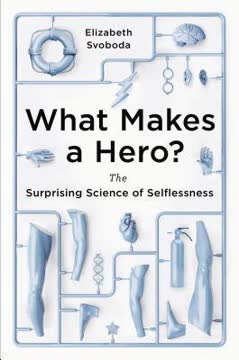
What Makes a Hero? receives mixed reviews (3.34/5 stars). Readers appreciate its exploration of altruism's science and the message that heroism can be developed through practice. Many find the research and real-life examples compelling. However, critics note the book focuses more on altruism than heroism, relies heavily on debunked psychology experiments (Zimbardo, Milgram), uses overly complex vocabulary, and reads more like a textbook. Some found the author's personal anecdotes self-absorbed. Positively, readers value its insights on empathy, compassion, and volunteering, though effectiveness varies individually.