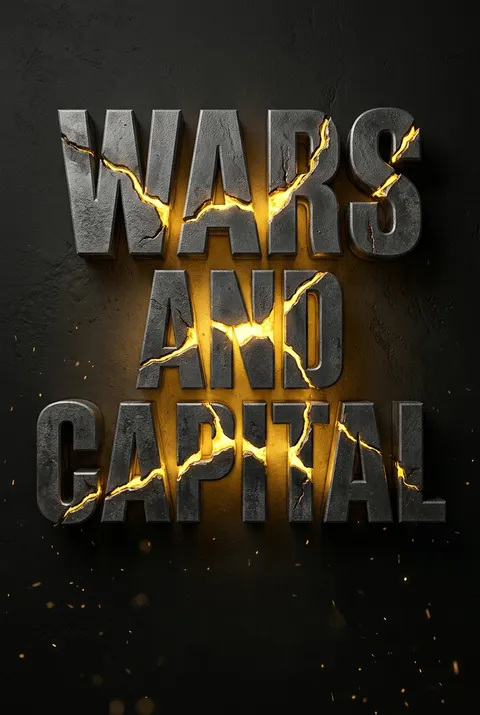

Key Takeaways
1. Capitalism is Ontologically Defined by the Inseparable Forces of War, Money, and the State
Our first thesis is that war, money, and the State are constitutive or constituent forces, in other words the ontological forces of capitalism.
Foundational triad. Capitalism, from its very inception, is not merely an economic system but a complex interplay of war, money, and the State. These three elements are not external factors influencing capitalism; rather, they are its inherent, foundational forces, shaping its development and perpetuating its existence. The critique of political economy alone is insufficient, as the economy does not replace war but continues it through other means, always involving the State's monetary regulation and monopoly on force.
Mutual reinforcement. The accumulation of capital and the State's monopoly on force are mutually dependent. Without external wars and internal civil wars waged by the State, capital accumulation would be impossible. Conversely, without capital's capture and valorization of wealth, the State could not fund its administrative functions or organize increasingly powerful armies. This parallel development of military and industrial proletarianization underscores their constitutive relationship.
Historical genesis. The historical emergence of money, as Foucault argued, was not primarily for market exchange but as a political tool to manage social demands arising from military revolutions. Early states used money to integrate military power, redistribute wealth partially, and expand debt, thereby preserving class domination and warding off civil war. This established money as a continuation of civil war by other means, intertwining economic and political power from the outset.
2. Primitive Accumulation is a Continuous, Multi-Front War Against Populations
“Wars” and not the war is our second thesis. “Wars” as the foundation of internal and external order, as organizing principle of society.
Ongoing process. Primitive accumulation, far from being a mere initial phase of capitalism, is a continuous process of creation and destruction that constantly accompanies capital's development. It involves relentless expropriation and commodification of all existence, both in the "New World" through external colonization and in Europe through internal colonization. This ongoing process is fundamental to the global market and its inherent hierarchies.
Multiplicity of conflicts. Capitalism's genesis since 1492 has unfolded through a multiplicity of integrated wars, not just a singular "war." These include:
- Wars of class, race, and sex
- Wars of subjectivity
- Colonial wars against indigenous peoples
- Wars against the poor and women in Europe
These diverse conflicts precede and enable the class struggles of later centuries, all aiming for a "productive pacification" achieved through various means, both "bloody" and "not bloody."
Colonial matrix. The "war against women," characterized by witch hunts and the destruction of female autonomy, paralleled the wars against colonized peoples. This established a new sexual order and assigned women to unpaid reproductive labor, mirroring the forced labor of slaves. Colonial practices, in turn, had a "boomerang effect" on Western power mechanisms, leading to internal colonialism and the "majoritarian model" of Man (male, white, adult) that continues to fuel divisions and exploitation.
3. The State's War Machine is Constantly Appropriated and Reconfigured by Capital
The constitution of the State as a “megamachine” of power thus relied on the capture, centralization, and institutionalization of the means of exercising force.
State's initial capture. The modern State, unlike cities, proved uniquely capable of centralizing and institutionalizing the feudal period's multiple war machines, transforming them into a professional army with a legitimate monopoly on public force. This "statification of war" was crucial for capital's early development, as it provided the necessary stability and means for wealth accumulation, particularly through colonial expansion. The military revolution, with its technological and logistical demands, necessitated the absolutist state to finance and administer these vast undertakings.
Capital's appropriation. From the late 19th century, especially with "total war," Capital began to directly appropriate the State and its war machine, integrating its instruments of polarization. Financial capital profoundly modified state sovereignty and administrative functions, subordinating them to its direction. This process culminated in Integrated Global Capitalism (IGC), where the production machine became indistinguishable from the war machine, merging civilian and military, peace and war, into a continuous process of isomorphic power.
Executive's rise. This appropriation led to a reconfiguration of state powers, increasingly privileging the executive branch over legislative and judicial functions. The executive adopted a "political-military" model, mirroring the scientific organization of labor and military command structures. This "motorization of law" into decrees and directives, driven by the speed and efficiency demanded by financial and military fluxes, allowed governments to act as factories of laws, effectively executing the strategies of financial capital.
4. Total Wars Integrated Production and Destruction, Forging the Welfare State as Warfare
The First and Second World Wars are connected like two fiery continents, linked rather than separated by a chain of volcanoes.
Total mobilization. The total wars of the 20th century abolished distinctions between civil and interstate war, military and non-military conflict, and combatants and non-combatants. They represented a radical break, where entire nations and populations were mobilized, and production and destruction became absolutely intertwined. This era saw the "real subsumption" of society into the war economy, challenging traditional political economy and Marxist notions of productive forces.
Colonial boomerang. The extreme violence of colonial "small wars," always waged against populations, returned to redefine interstate warfare. Practices like targeting civilian populations, destroying infrastructure, and indiscriminate killing, previously confined to the colonies, became central to total war. The industrialization of warfare, exemplified by the machine gun, demonstrated a promethean force of destruction, turning "civilizing" technologies back against European populations.
Welfare as warfare's continuation. The welfare state, far from being a purely social innovation, emerged as a direct consequence and continuation of total warfare. It served as compensation for the population's involvement in the war effort, a "blood tax" paid for cannon fodder. Welfare policies, such as pensions, social security, and public health programs, were designed to ensure a healthy, educated population capable of serving as effective troops and workers, thus integrating the militarization of society into a new economic cycle.
5. The Cold War Was Capital's Global War Machine, Normalizing Social Control and Endocolonization
The Cold War is intensive socialization and capitalization of the real subsumption of society and populations in the war economy of the first half of the 20th century.
Militarized Keynesianism. The Cold War intensified the "Keynesianism of war," where military investments became the primary means of resolving capital's contradictions, stimulating economic growth, and controlling surplus value. This era saw unprecedented military spending, driving technological and scientific innovation, and shaping "General Intellect" as the brain of Integrated Global Capitalism. The "arms race" was not merely a military competition but a fundamental economic and social strategy.
Cybernetic governance. The Cold War marked the advent of the cybernetic age, where communication and control became central to managing a virtual-real planetary war. This involved:
- Transdisciplinary research networks (e.g., RAND Corporation)
- Development of "Big Science"
- Integration of social sciences into "behavioral sciences"
- Optimization of control and information circulation
This "science of organization" extended to all aspects of society, from industrial management to urban planning, effectively making the Cold War a project of globalized social control driven by a cybernetics of the population.
Endocolonization of the "American Way of Life." The Cold War was also a war of subjectivation, transforming militarized populations into individualist consumers. The "American Way of Life," promoted globally, became a form of endocolonization, where domesticity, mass consumption, and private property (e.g., homeownership via mortgage credit) were integrated into capital's war machine. This involved:
- "Job Marketing" and "Patriot's Job" to align workers with corporate interests
- Privatization of welfare through company benefits
- Racial and gendered divisions to maintain social hierarchies
This process aimed to neutralize class struggle and racial tensions by framing them as "last imperfections" in the democracy of capital, while simultaneously projecting American hegemony through economic and cultural means.
6. Liberalism's "Peace" is a Denial of Ongoing Civil Wars, Masking Capital's Violence
The assertion that civil war does not exist, is one of the first axioms of the exercise of power.
Denial of conflict. Liberal ideology, particularly since the 19th century, has consistently denied the existence of civil war, presenting itself as a force for peace and economic rationality. It posits that economic interests and individual egoism replace warring passions, and the "invisible hand" of the market renders the sovereign superfluous. This "pacifist" hypocrisy masks the inherent violence and continuous civil wars that are constitutive of capitalism.
Foucault's critique. Foucault's analysis of "generalized civil war" reveals that power relations are not post-conflict pacifications but rather a permanent state of confrontation between collective entities (rich vs. poor, owners vs. propertyless). Absolute monarchy and liberalism converge in their need to deny this underlying civil war to assert juridical or economic subjects. Political economy, in this sense, becomes the "science" of this denial, claiming to negate both war and sovereignty.
"Governing the least possible" as domination. The liberal ideal of "governing the least possible" or promoting the "independence of the governed" was never applied to the masses of non-property owners, slaves, or the poor. Instead, it served to protect the liberty of property owners to exploit and dominate. This "liberal management of freedom" was, in reality, a governmentality of civil war, exercising unlimited domination over those deemed incapable of self-governance, thereby maintaining deep societal divisions.
7. Contemporary Capitalism Wields Fractal Wars Against Divided Populations Globally
The war machine of Capital thus introduced its politics (financial order and governmentality of this order) into the conduct of war in two different ways: industrial war and “war amongst the people,” i.e. the population.
New paradigm of conflict. The end of the Cold War brought the exhaustion of "industrial war" and its replacement by "war amongst the people/population." This new paradigm recognizes that the battlefield is no longer confined to traditional fronts but encompasses entire populations, their streets, houses, and fields. Military engagements occur in the presence of, against, and in defense of civilians, who become targets and objectives to be won.
Fractal and transversal. Contemporary wars are "fractal" and "transversal," reproducing the same model of conflict across different scales of reality. This means:
- They operate at macro-political levels (social classes, races, genders) and micro-political levels (molecular engineering of interactions).
- They connect civilian and military spheres, North and South, and the "Souths" within the "Norths" (e.g., immigrants, marginalized communities).
- The enemy is often "undetectable," "hidden," or "nondescript," emerging from within the population itself.
Governmentality of divisions. "War amongst the population" is a governmentality exercised not on a monolithic "population" but on and through its inherent divisions (family, tribe, nation, race, religion, ideology, profession, etc.). This involves controlling the "milieu" or "environment" in which people live, using both military and non-military weapons (e.g., financial violence, structural adjustments, psychological operations) to maintain global pacification and secure capital's productivity.
8. The Anthropocene is a Capitalocene, Driven by Capital's Unlimited Destructive Mode
The “ecological crisis” is not the result of a modernity and humanity blinded to the negative effects of technological development but the “fruit of the will” of some people to exercise absolute domination over other people through a global geopolitical strategy of unlimited exploitation of all human and non-human resources.
Capital's geological force. The Anthropocene, often framed as a universal "humanity" problem, is more accurately understood as a "Capitalocene." Capitalism, from its origins, has exerted a geological force, transforming the Earth's surface and ecosystems through its inherent drive for unlimited accumulation and destruction. This is not a new phenomenon but the culmination of a long history where "Nature = Industry = History."
Necrocene and Thanatocene. The proposed starting dates for the Anthropocene—1610 (post-genocide reforestation), 1784 (Industrial Revolution), or 1945 (atomic bomb)—all correspond to critical stages of capitalist development. This highlights that ecological disaster is intrinsically linked to:
- Colonial genocide and ecocide (Necrocene)
- Industrialization and fossil fuel reliance (Thermocene/Anglocene)
- Total wars and nuclear destruction (Thanatocene)
These are not merely "human" impacts but specific outcomes of capital's destructive mode.
Disaster as opportunity. For capitalists, ecological "disasters" and "limits" are not existential threats but opportunities for new valuation and profit. "Sustainable development," "green economy," and "carbon markets" are mechanisms to displace and capitalize on ecological degradation, transforming environmental crises into new sources of wealth. This involves the financialization of nature, creating new "cat bonds" and "green bonds," and integrating ecological concerns into military-security strategies, further militarizing nature under the guise of preservation.
9. Revolutionary Movements Must Forge New War Machines to Counter Capital's Multi-Front Wars
Since the political defeat of the working class in the longest duration of the Cold War, no collective “theoretical practice” has been elaborated or tested at the scale of the civil wars launched by Capital.
Beyond traditional frameworks. Revolutionary movements, historically reliant on Leninist interpretations of Clausewitz and the centrality of class struggle, have struggled to adapt to capital's evolving war machine. The "’68 thought" attempted a radical break, reversing Clausewitz's formula to see politics as a continuation of war, but ultimately fell short in developing a strategic knowledge adequate to the new forms of civil war unleashed by capital.
The challenge of "fractal wars." Capital's contemporary war machine operates through "fractal wars" that are multiscalar, diffuse, and constantly reproduce divisions (class, race, sex, subjectivity). These wars are waged in a continuum of "bloody" and "bloodless" means, making it difficult for traditional movements to identify a clear adversary or front. The "governed" are caught in a web of power relations that solicit and incite "fabricated" freedoms, making collective rupture challenging.
Inventing new war machines. To counter capital's pervasive war, anti-capitalist movements must move beyond the "governed" position and forge autonomous war machines. This requires:
- Neutralizing internal divisions (class, race, gender) within the proletariat.
- Developing a concept of freedom that opposes liberal "freedom."
- Creating new forms of organization and disorganization that are not dependent on state or party structures.
- Actively constructing a "subjective continuum of collective rupture" to oppose capital's continuous war.
This involves a "critical and clinical breaking" with the condition of "normopaths" (salaried workers, consumers, users) to engage in decisive battles on the strategic terrain of civil wars.
Review Summary
People Also Read

Download PDF
Download EPUB
.epub digital book format is ideal for reading ebooks on phones, tablets, and e-readers.








































