
Key Takeaways
1. 3D Printing Unlocks Mathematical Visualization
With these models, you, the reader, can experience three-dimensional concepts directly, as three-dimensional objects.
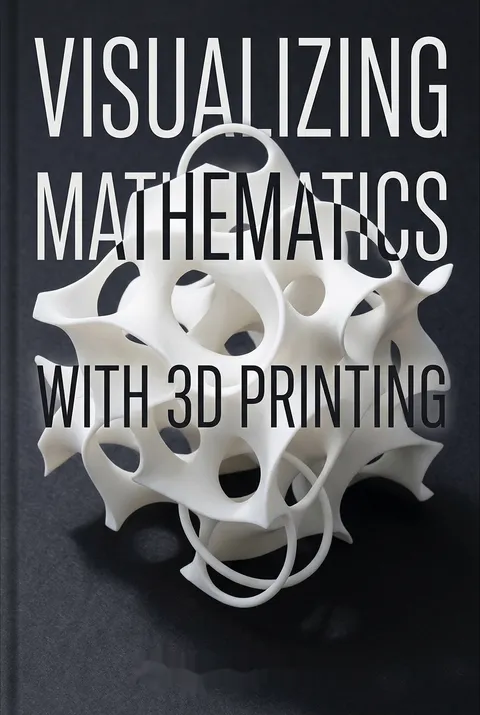
Experiencing mathematics directly. This book champions 3D printing as a revolutionary tool for understanding complex mathematical concepts, especially those that defy easy two-dimensional representation. By transforming abstract mathematical ideals into tangible, physical objects, 3D printing allows for a direct, hands-on engagement that traditional diagrams or computer renders cannot fully replicate. It bridges the gap between theoretical understanding and sensory experience, making intricate geometries accessible to a wider audience.
Overcoming visualization limits. Many mathematical ideas, particularly in geometry and topology, are inherently three-dimensional or even higher-dimensional. Attempting to convey these through flat images often leads to distortion, ambiguity, or an incomplete understanding. 3D printing bypasses these limitations by providing physical models that can be rotated, held, and examined from all angles, revealing hidden structures and relationships that are otherwise difficult to perceive.
Precision and accessibility. The technology's ability to build objects layer by layer from precise computer-generated designs ensures that physical models closely approximate their mathematical ideals. This automated production also makes small runs and on-demand creation feasible, enabling the widespread distribution of complex mathematical forms. The companion website, 3dprintmath.com, further enhances this accessibility by offering virtual models and downloadable files for personal printing.
2. Symmetry: The Language of Form
A symmetry of an object is a motion of the object that leaves it looking the same.
Defining symmetry. Symmetry is a fundamental concept in mathematics, art, and nature, describing motions (like rotations or reflections) that leave an object visually unchanged. The book introduces Conway's notation to classify these symmetries, moving from simple 2D rosette symmetries to complex 3D spherical symmetries. Understanding an object's symmetries reveals its inherent structure and beauty.
Identifying symmetry types. The book uses a clever analogy: "What are the different ways to take a photograph of a three-dimensional object?" The number of unique photographs, considering rotations and reflections as equivalent, reveals the object's symmetry group. For instance, a sphere has infinite symmetries, while a cube has 48, each corresponding to a unique "panel" of views on a sphere of possible camera positions.
Conway's notation. This system provides a concise way to describe symmetry types, using numbers for rotational symmetries, asterisks (*) for mirror planes (kaleidoscopic symmetry), and 'x' for "sliding reflections."
- Numbers: Indicate rotational symmetry (e.g., '2' for twofold rotation).
- Asterisk (*): Denotes mirror symmetry. Numbers after it indicate kaleidoscopic symmetry points.
- 'x': Represents a sliding reflection.
This notation allows for a precise classification of both finite and infinite symmetry groups, revealing underlying mathematical structures in diverse objects.
3. From Polyhedra to Polychora: Exploring Higher Dimensions
There are infinitely many regular polygons because we can just keep adding sides as in fig. 2.2. But in three dimensions, there are only five regular polyhedra.
Building blocks of geometry. Polytopes are generalized geometric objects across dimensions: points (0D), line segments (1D), polygons (2D), and polyhedra (3D). Regular polytopes are those where all "flags" (a sequence of nested sub-polytopes) can be mapped to each other by symmetry. This strict definition ensures uniformity, leading to the familiar regular polygons (equilateral triangle, square, etc.) and the five Platonic solids in 3D.
The five regular polyhedra. These iconic shapes—tetrahedron, cube (hexahedron), octahedron, dodecahedron, and icosahedron—are the only possible regular polyhedra. Their existence is dictated by the "angle defect" at each vertex: the sum of face angles around a vertex must be less than 360 degrees to enclose space.
- Triangles: 3 (tetrahedron), 4 (octahedron), or 5 (icosahedron) per vertex.
- Squares: 3 (cube) per vertex.
- Pentagons: 3 (dodecahedron) per vertex.
Any more faces would result in a flat or negatively curved arrangement, not a closed polyhedron.
Extending to four dimensions. The concept of regular polytopes extends to four dimensions, where they are called polychora. Just as polyhedra are bounded by polygons, polychora are bounded by polyhedra (called "cells"). The Schläfli symbol, like {4,3} for a cube, generalizes to {4,3,3} for a hypercube, indicating cubes as cells with three around each edge. This systematic approach allows mathematicians to explore geometries beyond our direct perception.
4. Seeing the Unseeable: Projecting Four-Dimensional Objects
We can get a sense of what is going on by squishing four-dimensional things down into three dimensions.
Visualizing the fourth dimension. While direct perception of four spatial dimensions is impossible for humans, mathematics provides tools to conceptualize and visualize them. The primary method is projection, analogous to how a 3D object casts a 2D shadow. These "shadows" in 3D space allow us to infer properties of their 4D counterparts, though distortions are inherent.
Types of projections. The book explores various projection methods, each with its own advantages and distortions:
- Parallel projection: Light rays are parallel, preserving parallelism but distorting angles and lengths.
- Perspective projection: Light source is near, creating a realistic but distorted view, like a drawing.
- Radial projection: Projects onto a sphere, creating "beach ball" versions of objects.
- Stereographic projection: Projects from a sphere's pole onto a plane (or from a 3-sphere to 3D space), preserving angles but distorting lengths and making one "face" extend to infinity.
The hypercube (tesseract). A key example is the 4D hypercube, or tesseract, which can be visualized through its 3D projections. A stereographic projection of a hypercube reveals eight cubical cells: one central, six surrounding it, and one encompassing all others, extending to infinity. This method, while distorting, offers a remarkably accurate representation of the hypercube's angular relationships and cellular structure, allowing us to "see" its complexity.
5. Curvature Shapes Our Worlds: Euclidean, Spherical, and Hyperbolic
The curvature of the surface near a point measures how much it looks like a hill or a bowl (positive curvature), a flat plane (zero curvature), or a saddle (negative curvature).
Understanding curvature. Gaussian curvature quantifies how a surface deviates from flatness at any given point. It's not about convexity (like a bowl or hill) but about how circles drawn on the surface behave.
- Positive curvature: Circles are "too short" (like a sphere or hill).
- Zero curvature: Circles are "just right" (like a flat plane or cylinder).
- Negative curvature: Circles are "too long" (like a saddle or Pringles crisp).
This concept is crucial for understanding how different geometries manifest in space.
Tilings and angle defect. The angle defect at a vertex of a polyhedron (360 degrees minus the sum of face angles) directly relates to curvature. Positive defect means positive curvature (e.g., Platonic solids on a sphere), zero defect means zero curvature (e.g., tilings of the Euclidean plane like {3,6} or {4,4}), and negative defect implies negative curvature.
The hyperbolic plane. Surfaces with constant negative curvature exist and are called hyperbolic. Unlike the Euclidean plane or sphere, the hyperbolic plane cannot be perfectly embedded in 3D space without self-intersection or boundary. However, it can be visualized through models like the Poincaré disk, Klein model, or upper half-plane model, which project its infinite, negatively curved geometry into a finite, distorted representation. These models reveal a geometry where, for instance, infinitely many parallel lines can pass through a point not on a given line.
6. Knots: Where Geometry Meets Topology
The question of whether two pictures of knots are the same is not a geometric problem in the usual way we think about geometry.
Knots as closed loops. In mathematics, a knot is an idealized closed loop of string, without ends, that cannot be untied. This definition removes the triviality of untying a real-world knot by finding an end. The core challenge in knot theory is determining if two seemingly different knot diagrams actually represent the same underlying knot (e.g., the unknot, trefoil, figure-eight).
Topology vs. geometry. Knot theory is primarily a topological problem, meaning it focuses on properties that remain unchanged under continuous deformation (stretching, bending, twisting) without cutting or tearing. The precise geometric shape of a knot is irrelevant; what matters is its fundamental structure and how its strands interlace. This is why a topologist might famously confuse a coffee mug with a doughnut—both have one hole.
Methods of knot representation. Mathematicians use various methods to study and visualize knots:
- By-hand method: Physical models or drawings.
- Parametric/implicit method: Mathematical formulas define the knot's shape, often revealing symmetries (e.g., torus knots).
- Iterative method: Computer simulations optimize a knot's shape based on criteria like "minimal ropelength," finding the tightest possible configuration.
These methods help explore the vast catalog of knots, from simple prime knots (those not formed by combining smaller knots) to complex links like the Borromean rings, where cutting one loop frees the others.
7. Surfaces: Classifying Shapes by Intrinsic Properties
Amazingly, it turns out that these three numbers do the job.
Defining surfaces. A surface is a 2D manifold, meaning that if you zoom in on any small part, it looks like a flat plane. Examples include the sphere, torus (doughnut), disk, annulus (ring), and Möbius strip. Surfaces can be classified by their intrinsic properties, which are observable by a "shortsighted ant" crawling on the surface, unaware of its embedding in higher dimensions.
Intrinsic vs. extrinsic.
- Intrinsic properties: Depend only on the surface itself (e.g., number of boundary loops, one-sidedness/orientability). An ant can tell an annulus (two boundary loops, two-sided) from a Möbius strip (one boundary loop, one-sided).
- Extrinsic properties: Depend on how the surface is embedded in space (e.g., whether a torus is knotted, or if a Klein bottle self-intersects). From an intrinsic view, a Klein bottle doesn't "crash through itself."
The Euler characteristic. This powerful topological invariant is calculated as Vertices - Edges + Faces (V - E + F) for any tiling of a surface. Remarkably, this value is constant for a given surface, regardless of the specific tiling.
- Sphere: Euler characteristic = 2
- Torus: Euler characteristic = 0
- Disk: Euler characteristic = 1
- Möbius strip: Euler characteristic = 0
- Genus two surface: Euler characteristic = -2
Combined with the number of sides and boundary loops, the Euler characteristic provides a complete classification for all surfaces.
8. The Gauss-Bonnet Theorem: Unifying Topology and Geometry
This is a truly amazing result: the Euler characteristic only depends on the topology of the surface, but the curvature depends on the geometry, which could be almost anything.
A profound connection. The Gauss-Bonnet theorem is a cornerstone of differential geometry, establishing a deep relationship between a surface's intrinsic geometry (curvature) and its topology (Euler characteristic). For closed surfaces (without boundary loops), the theorem states that the integral of the Gaussian curvature over the entire surface is equal to 2π times its Euler characteristic.
Topology dictates geometry's sum. This means that no matter how a surface is stretched, bent, or deformed in space, as long as its topology remains unchanged, the total sum of its curvature will always be the same. For example, any torus, regardless of its specific shape (from a coffee mug to a fat doughnut), will have a total curvature of zero, because its Euler characteristic is zero. This implies that areas of positive curvature must be precisely balanced by areas of negative curvature.
Uniform geometries. The theorem also helps explain why certain uniform geometries are possible for different surfaces:
- Sphere (Euler characteristic = 2): Must have uniform positive curvature (spherical geometry).
- Torus (Euler characteristic = 0): Must have uniform zero curvature (Euclidean geometry, like a flat grid).
- Higher genus surfaces (Euler characteristic < 0): Must have uniform negative curvature (hyperbolic geometry).
This elegant theorem reveals how fundamental topological properties constrain the geometric possibilities of surfaces, providing a powerful framework for understanding their shapes.
9. Hyperbolic Space: A Universe of Infinite Possibilities
All of the length-three Schläfli symbols other than {3,3,3}, {4,3,3}, {3,3,4}, {3,4,3}, {5,3,3}, {3,3,5}, and {4,3,4} live in three-dimensional hyperbolic space.
Beyond Euclidean and spherical. Just as the hyperbolic plane offers a geometry of constant negative curvature in two dimensions, three-dimensional hyperbolic space extends this concept. While Euclidean space has only one regular tiling (cubes, {4,3,4}) and the 3-sphere has six (the regular polychora), hyperbolic space hosts an infinite array of regular tilings, or "honeycombs."
Visualizing hyperbolic honeycombs. Like the hyperbolic plane, 3D hyperbolic space cannot be directly perceived or perfectly embedded in Euclidean 3D space. Instead, we rely on projection models, such as the Poincaré ball model. In this model, hyperbolic objects appear to shrink as they approach the boundary of the ball, which represents infinity. This distortion allows us to visualize infinite structures within a finite volume.
Examples of hyperbolic tilings. The book showcases several hyperbolic honeycombs:
- {5,3,4}: A tiling of dodecahedra, with four meeting at each edge.
- {3,5,3}: A tiling of icosahedra, with three meeting at each edge.
- {3,3,6} and {6,3,3}: Dual honeycombs, where cells can be "infinite" tilings of the Euclidean plane (like hexagonal tilings) that touch the Poincaré ball's boundary.
These complex structures demonstrate the richness and vastness of hyperbolic geometry, a realm where intuition often fails but mathematical rigor prevails.
10. Beyond the Basics: Fractals, Minimal Surfaces, and Mechanisms
The pattern of veins on a leaf is an example of a fractal.
Fractals: Self-similar complexity. Fractals are geometric objects that exhibit self-similarity across different scales, meaning they look similar whether zoomed in or out. Examples range from natural phenomena like leaf veins and tree branches to mathematically constructed shapes like the Hilbert curve, which is a space-filling curve that, despite being one-dimensional, passes through every point of a two-dimensional square (or a 3D cube). 3D printing allows for the creation of intricate fractal sculptures, like mobiles or Hilbert curve visualizations.
Minimal surfaces: Nature's geometry. Minimal surfaces are mathematical models of soap films, which naturally minimize their surface area given a boundary. While the plane, catenoid, and helicoid are classic examples, more complex forms like the Gyroid exist. These surfaces are "minimal" in that every small patch locally minimizes area, even if the entire surface doesn't globally. 3D printing allows for the visualization of these intricate, often triply periodic, structures that are difficult or impossible to form with actual soap films due to instability.
Mechanisms: Applied geometry. 3D printing also enables the creation of complex mechanical puzzles and gears, showcasing applied geometry and engineering. Examples include:
- Twisty puzzles: Like Oskar van Deventer's 17x17x17 Rubik's cube variant, demonstrating intricate polyhedral designs and rotational symmetries.
- Magic Gears: Gears that paradoxically turn in the same direction when one is flipped, highlighting unusual kinematic properties.
- Triple Gear: A Borromean-like link of three rings that can only turn together, illustrating unique interdependencies.
These creations highlight the practical and playful applications of mathematical principles, pushing the boundaries of design and physical interaction.
Download PDF
Download EPUB
.epub digital book format is ideal for reading ebooks on phones, tablets, and e-readers.








































