
Key Takeaways
1. Ungoverning: The Intentional Destruction of State Capacity
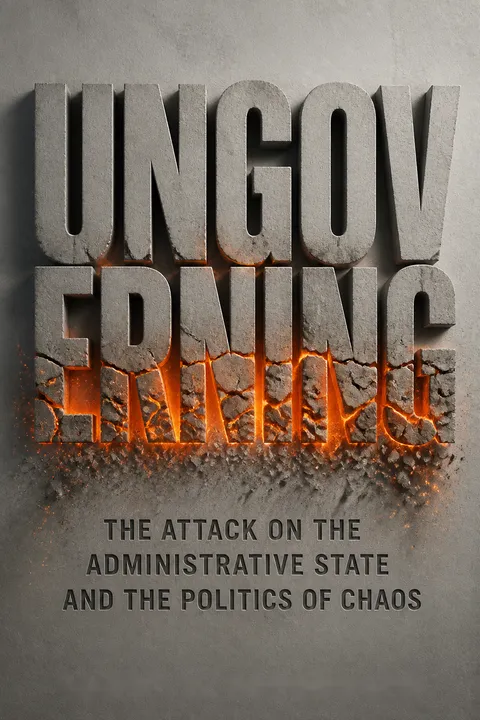
We call the willful destruction of state capacity ungoverning.
Defining the threat. Ungoverning is a novel and dangerous phenomenon: the deliberate attack on government's ability to function, particularly targeting the administrative state. This isn't about institutional reform or accidental state failure; it's a chosen path of "deconstruction" aimed at dismantling the very machinery of governance. The objective is not to improve government, but to make it not work, as exemplified by calls to abolish the Internal Revenue Service, which would cripple revenue collection.
Beyond traditional challenges. This concept distinguishes itself from common political actions like reducing government scope, deregulation, or obstruction. While these can be purposeful and strategic, ungoverning is indiscriminate and unbounded, driven by animus toward government itself rather than a coherent policy vision. It represents a "backward evolution" from a highly developed state capacity, replacing rule-bound procedures and expertise with arbitrary personal will.
A distinct assault. Ungoverning is a unique assault on liberal democracy, different from military coups, as it's led by elected leaders with popular support. By degrading the government's capacity to respond to public needs, it creates a state unable to function effectively. This intentional disruption of regular order, often for reasons unrelated to public welfare, poses a profound danger to the essential securities of liberal democracy, including constitutionalism and the rule of law.
2. The Administrative State: Essential, Yet Vulnerable and Unloved
Administration, Woodrow Wilson wrote in 1887, is where laws, which exist only on paper, become real. It is "government in action."
The invisible necessity. The administrative state, comprising vast government agencies and civil servants, is indispensable for translating laws into action and addressing public problems. Despite its critical role in everything from clean air to national security, its functions are often invisible to citizens, leading to a lack of appreciation for its complex work. This "submerged state" makes it easy for people to overlook the benefits and services government provides.
Vulnerability to attack. This invisibility, coupled with its anomalous constitutional status and the frustrating nature of bureaucratic encounters, leaves the administrative state highly vulnerable. Literary portrayals often depict bureaucracy as irrational and tyrannical, fostering public distrust and resentment. These ingrained attitudes soften the ground for ungoverning, as citizens may not recognize the value of what is being degraded.
Illegibility and distrust. The sheer illegibility of the administrative state, with its countless agencies and complex structures, further fuels public disaffection. There is no single, authoritative list of federal agencies, and their constitutional placement is unclear. This opacity creates fertile ground for conspiracism, allowing the administrative state to be cast as a malignant "deep state" by those seeking to undermine its legitimacy and capacity.
3. Personal Rule: Replacing Governance with Unchecked Will
What the ungoverning president tried to do was to resolve it permanently in favor of personal rule and to eradicate the constraints of office.
Subverting the office. Ungoverning's core purpose is to liberate the president from the constraints of established procedures and the expertise of public servants. This transforms the presidency from an office, defined by bounded authority and public purpose, into a vehicle for personal rule, where the individual's will dominates. Donald Trump's administration exemplified this by forming the first "anti-administration" presidency, openly promoting the destruction of state capacity.
Disdain for expertise and process. This shift manifests as a systematic "shrugging off process" and "out with knowledgeable personnel." Procedures for decision-making are circumvented, experts are silenced or fired, and public purposes are abandoned without justification beyond thwarting "enemies." This is not about strategic policy change but about asserting personal power, as seen in the Zero Tolerance immigration policy, which disregarded inter-agency coordination and record-keeping.
Theatrics and corruption. Personal rule relies heavily on theatrics, symbolic actions, and false claims to project an image of unbridled control. It also normalizes corruption, as loyalty to the leader often translates into opportunities for personal gain, blurring the lines between public service and private interest. This approach, while creating the illusion of control, paradoxically cripples the government's ability to achieve sustained, effective outcomes, as demonstrated by the chaotic "wall" project.
4. The Reactionary Movement: A Quest for Apocalyptic Restoration
The deep aspiration, the political fantasy of restoration, cannot be met by a liberal democracy and indeed not by any government at all.
Grievance and recognition. The MAGA movement, forged by Trump from the remnants of the Tea Party, is driven by a profound sense of grievance and a desperate desire for recognition. Its followers feel that their "American way of life" is disappearing, and that progressive policies deny them their rightful social standing and values. Trump's genius lay in articulating this collective identity, positioning himself as their champion and avenger against perceived victimizers.
Countercultural and anti-pluralist. This movement is not merely political but a reactionary counterculture, dedicated to eradicating liberal culture, pluralism, and diversity. It seeks a return to an imagined old order where America was a Christian, white nation that subordinated women and was free from a "new world order." This vision of restoration is inherently anti-democratic, as it cannot be achieved through normal political means in a diverse society.
Apocalyptic and immediate. The movement is imbued with apocalypticism, believing that total destruction is necessary before a new, purified nation can rise from the ashes. This mindset fuels a demand for immediate action, rejecting the slow, incremental processes of democratic governance. Everyday gratifications, such as performative aggression, transgression of norms, and the "knowingness" of conspiracy theories, sustain the movement while it awaits an unattainable, millennial restoration.
5. The Ungoverning Party: From Conservatism to Deconstruction
The party could not govern itself, and it did not intend to govern the country.
A troubled transformation. The Republican Party has undergone a profound transformation, moving from small-government conservatism to unyielding obstructionism, and finally to active ungoverning. Ronald Reagan's ambivalent legacy, which combined a desire to correct government excesses with a more radical anti-government rhetoric, laid the groundwork for this shift. Subsequent Republican presidencies attempted to govern, but ultimately failed to solidify a pragmatic conservative philosophy.
The rise of obstructionism. Figures like Newt Gingrich pioneered a "no-holds-barred style of partisan warfare," prioritizing confrontation over cooperation and shattering legislative processes. This obstructionist ethos intensified with the Tea Party movement, which not only opposed Democrats but also sought to purge "Republicans in Name Only" (RINOs) who were willing to compromise. This internal insurgency further eroded the party's capacity for governance.
Embracing deconstruction. By the Trump era, the Republican Party had largely abandoned governing, embracing deconstruction as a core tenet. This was evident in episodes like the vote against TARP, the debt limit crisis, and the inability to offer a coherent alternative to Obamacare. The party's internal chaos, as seen in the protracted struggle to elect a House Speaker, reflects its broader disinterest in governing the country, instead aligning with the reactionary movement's goal of dismantling the administrative state.
6. Inciting Violence: Abdicating the State's Core Responsibility
Ungoverning is the abdication of government’s "mono poly of the legitimate use of force," a phrase that comes from Max Weber’s classic definition of the state.
Eroding the monopoly of force. A fundamental function of any state is to maintain a monopoly on the legitimate use of force, ensuring a peaceful civil society. Ungoverning, however, actively corrodes this capacity by inciting or exploiting violence from individuals and organized groups. When leaders send messages that violence against political opponents is acceptable, they abdicate this core responsibility, allowing threats and intimidation to permeate society.
Violence out of the shadows. In a liberal democracy, the specter of justified revolutionary violence always exists, but responsible leaders work to keep it in the shadows. Today, however, invitations to violence have become overt, with leaders encouraging followers to intimidate and assault the opposition. This includes:
- Trump's calls to "knock the crap out of" protesters and pay their legal fees.
- Ron DeSantis's pledges to "slit throats" of "deep-state people" and use "deadly force" against migrants.
- Excusing and even praising January 6 insurrectionists as "hostages."
Targeting civil society. This licensed violence extends beyond political opponents to civil society groups and everyday citizens. Health workers faced threats during the pandemic, and election workers, like Ruby Freeman and Shaye Moss, endured harassment and death threats for simply doing their jobs. The proliferation of guns, particularly assault weapons, further escalates the incendiary potential, creating an atmosphere of fear and insecurity that undermines the very fabric of a peaceful society.
7. States as Laboratories of Autocracy: Federalism in the Ungoverning Era
One election-law expert put it well, calling states "laboratories of autocracy."
Partisan federalism's rise. Traditional federalism, where states act as "laboratories of democracy" or counterweights to national power, has been distorted by partisan federalism. In this new dynamic, state parties align with national partisan conflicts, becoming tools and accomplices of national agendas. This means that states, particularly "trifecta" states controlled by one party, actively affirm, obstruct, or initiate policies in line with their national party's goals.
Ungoverning at the state level. This shift brings ungoverning out of Washington D.C. and into state capitals, counties, and towns. Governors become "ungovernors," using their authority to impede federal government actions or implement policies that undermine administrative capacity. Examples include:
- Governor Greg Abbott's installation of razor wire and floating barriers at the Texas border, flouting federal laws and international treaties.
- Republican state legislators filing bills to curb public health authorities and ban mask mandates during the COVID-19 pandemic.
- Governor DeSantis's efforts to alter scientific data and ban mask mandates in schools, undermining public health expertise.
Deconstructing election administration. A critical target of ungoverning in the states is election administration. Fueled by "Rigged!" conspiracy theories, efforts are made to:
- Run election deniers for obscure but crucial offices like Secretary of State.
- Give partisan state legislatures greater control over election boards.
- Abandon bipartisan voter list programs like ERIC, making voter fraud harder to detect but easier to allege.
These actions aim to neuter the impartial administration of elections, turning states into instruments for imposing desired electoral outcomes.
8. Judicial Assault: Constitutional Doctrines Undermining Administration
The most comprehensive legal critiques of administration function as the tip of the spear that provides a sharp weapon for the political forces of ungoverning.
Constitutional challenges. The political project of ungoverning is mirrored by a judicial assault on administrative authority, often framed as upholding the Constitution's separation of powers. Critics argue that the administrative state unconstitutionally usurps legislative (nondelegation doctrine), executive (unitary executive thesis), and judicial (Article III violations) powers, blending them in a way that Justice Roberts warned could be "the very definition of tyranny."
The unitary executive doctrine. This doctrine, particularly in its extreme form, asserts the president's complete power of oversight and control over the administrative state, including the ability to remove any agency official at will. This would dismantle the independence of agencies like the SEC or FEC, allowing a president to replace commissioners for personal or political reasons, effectively converting independent bodies into instruments of personal will. While theoretically empowering the "Crown," in practice, it enables a willful president to degrade agency capacity.
Attacking Chevron deference. A more potent judicial weapon is the attack on Chevron deference, a 1984 Supreme Court ruling that mandated judicial deference to agency interpretations of ambiguous statutes. The conservative majority's decision in West Virginia v. EPA (2022) introduced the "major questions doctrine," allowing courts to reject agency actions on "major questions" of economic or political significance, effectively making the Supreme Court the arbiter of climate policy. This move constricts the authority of expert agencies and invites constant litigation, providing a constitutional foothold for wholesale attacks on the administrative state.
9. Forebodings: The Path to an Incapacitated and Fragmented Nation
The most impor tant political distinction among countries concerns not their form of government but their degree of government.
Beyond fascism and authoritarianism. While ungoverning shares alarming similarities with historical fascism (dehumanizing rhetoric, "big lies," promises of restoration) and authoritarianism (willfulness, suppression of opposition), it presents a distinct threat. Unlike these regimes, which aim to capture and wield a strong state, ungoverning intentionally incapacitates the state. This makes direct comparisons misleading, as the U.S. context involves a deliberate weakening of governmental capacity rather than its redirection.
Populist authoritarianism's American face. Ungoverning is best understood as a virulent form of indigenous American populist authoritarianism. This arises from democracy, with leaders elected to power, but it is poisonous to liberal democracy because it is radically anti-pluralist. It fosters a direct, emotional connection between the leader and a homogeneous "true people," while excluding and demonizing others. This anti-institutional thrust fuels the attack on governmental institutions, as anything mediating the leader's will is deemed intolerable.
An incapacitated and fragmented future. If unchecked, ungoverning leads to an incapacitated state, unable to protect individuals or the nation from larger forces. This creates a fragmented country, where some state governments might fill the void left by a diminished national state, while others continue the work of deconstruction. This scenario, akin to "neo-feudalism," means citizens face unpredictable and highly variable protections, leading to widespread insecurity of expectation and a degradation of the moral underpinnings of liberal democracy.
10. Rehabilitating Governance: Reclaiming Necessity and Legitimacy
The health of the administrative state will therefore require more than officials who want to govern. It will require public understanding and appreciation of what the administrative state is and what it does, and why it matters.
The urgent need for rehabilitation. Ungoverning has become a defining purpose of the Republican Party and its allied reactionary movement, with officials openly vowing to dismantle federal agencies and purge civil servants. This necessitates not just defeating these forces but also a profound rehabilitation of the administrative state in the public mind. The challenge is to make its functions legible, its necessity appreciated, and its authority broadly accepted, moving beyond the current "weirdly normalized" state of deconstruction.
Educating the public mind. This rehabilitation requires actively demonstrating what government does that no private entity can achieve alone, from food safety to national security. It means illuminating the often-invisible work of administration in preventing crises and anticipating risks, correcting misleading narratives about how laws are made and implemented. Storytelling by civil servants, recounting their work and the personal costs of ungoverning, can humanize bureaucracy and foster appreciation for public service.
Beyond necessity to legitimacy. While appreciating the administrative state's practical necessity is crucial, the more difficult task is establishing its legitimacy. Its authority, rooted in expertise and regular process, is often perceived as arid compared to the exalted terms of "democracy" and the "Constitution." Ultimately, broad public endorsement of the administrative state's meaning, value, and authority is needed. In a deeply polarized nation, this means continuously asserting its irreplaceable role in making democratic government work, even when policies are highly contested.
Review Summary
Ungoverning (rated 3.81/5) examines the systematic dismantling of America's administrative state, particularly during Trump's presidency. Reviewers appreciate the book's coining of "ungoverning" to describe politics aimed at destroying rather than reforming government. Many found it timely and clarifying, explaining why executives would sabotage their own governance capacity. Common criticisms include its heavy focus on Trump over broader historical analysis and writing primarily from a political science perspective. Readers valued the defense of bureaucracy and examination of populist authoritarianism, though some wanted deeper philosophical exploration and practical solutions for countering administrative state attacks.
People Also Read








Download PDF
Download EPUB
.epub digital book format is ideal for reading ebooks on phones, tablets, and e-readers.








































