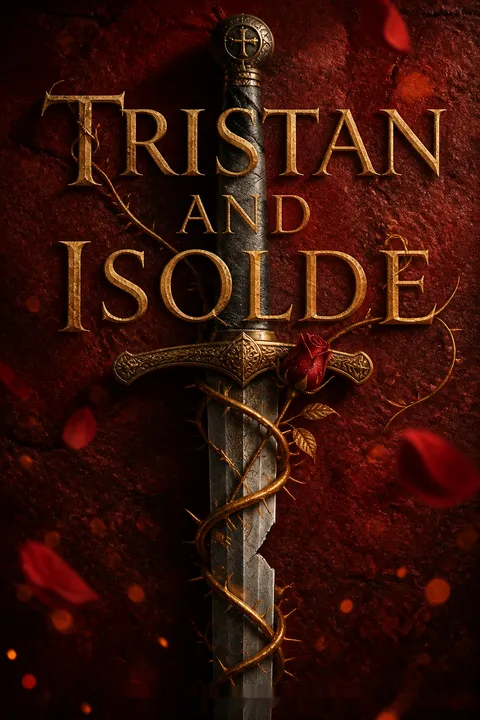

Plot Summary
Rivalin's Exile and Love
Rivalin, a noble prince of Parmenie, is forced into exile by war and ambition. Seeking honor, he journeys to the court of King Mark of Cornwall, where he is welcomed as a guest. Amidst the festivities, Rivalin and Mark's sister, Blanchefleur, fall deeply in love. Their affection grows in secret, fueled by longing and the uncertainty of their future. When Rivalin is gravely wounded in battle, Blanchefleur's devotion saves him, and their love becomes a sanctuary against the world's dangers. Their union, though clandestine, is marked by passion and the hope of a new beginning, setting the stage for a legacy shaped by both joy and tragedy.
Birth Amid Sorrow
Rivalin and Blanchefleur, united in secret marriage, return to Parmenie, only to be beset by war. Rivalin is killed in battle, and Blanchefleur, overcome by grief, dies giving birth to their son, Tristan. The faithful marshal Rual, fearing for the child's safety, fakes Tristan's death and raises him as his own. The infant's name, meaning "sorrow," reflects the grief that marks his entry into the world. Tristan's birth is thus both a symbol of hope and a harbinger of the suffering that will define his life, as love and loss become inseparable in his destiny.
Tristan's Hidden Childhood
Tristan grows up unaware of his royal heritage, nurtured by Rual and his wife. He is educated in the arts of chivalry, music, and languages, becoming a youth of remarkable talent and virtue. His upbringing is marked by both affection and caution, as Rual shields him from those who would threaten his life. Tristan's identity remains a secret, even to himself, and his longing for adventure and belonging foreshadows the journey that will soon uproot him. The innocence and promise of his early years are shadowed by the fate that awaits him beyond the safety of his foster home.
Abduction and Lost Identity
While visiting merchants, Tristan is kidnapped by Norse traders who are captivated by his charm and skill. He is taken far from home, separated from Rual and all he knows. A storm drives the ship to Cornwall, where Tristan, alone and disguised, must fend for himself. His resourcefulness and courtesy win him favor among King Mark's hunters, and he is brought to the Cornish court. Unaware of his true lineage, Tristan's journey becomes one of self-discovery, as he navigates a world that is both foreign and strangely familiar, setting the stage for the revelation of his identity.
Arrival in Cornwall
Tristan's talents in music, languages, and the hunt quickly endear him to King Mark, who is unknowingly his uncle. The king is drawn to the youth's nobility and appoints him master of the hunt. Tristan's presence at court stirs admiration and envy, as his abilities surpass those of his peers. The bond between Tristan and Mark deepens, though the truth of their relationship remains hidden. The court becomes both a haven and a crucible, as Tristan's destiny begins to intertwine with the fate of Cornwall and its troubled king.
Mark's Court and Kinship
Rual, after years of searching, arrives in Cornwall and recognizes Tristan. The revelation of Tristan's parentage brings both joy and sorrow: Mark embraces his nephew as heir, while Tristan mourns the loss of his foster father's exclusive love. The court celebrates the restoration of the rightful bloodline, and Tristan is knighted. Yet, the knowledge of his origins brings new responsibilities and expectations, as Tristan must navigate the complexities of loyalty, inheritance, and the burdens of nobility.
The Irish Tribute and Morolt
The kingdom is threatened by Morolt, the Irish champion, who demands tribute in the form of noble youths or single combat. The Cornish nobles, paralyzed by fear, draw lots to sacrifice their children. Tristan, appalled by their cowardice, volunteers to fight Morolt, risking his life for the honor and freedom of Cornwall. His decision is both an act of heroism and a challenge to the fatalism that has gripped the court, marking the beginning of his transformation from outsider to savior.
Duel on the Islet
Tristan and Morolt meet in single combat on a remote islet, witnessed by the anxious Cornish people. The duel is fierce and brutal; both warriors are gravely wounded. Tristan's courage and skill ultimately prevail—he slays Morolt, but not before receiving a poisoned wound. The victory liberates Cornwall from the Irish tribute, but the cost is high: Tristan's life hangs in the balance, and the seeds of future tragedy are sown in the blood and bitterness of the fight.
Tristan's Mortal Wound
Tristan's wound, inflicted by Morolt's poisoned blade, resists all attempts at healing. Desperate, he learns that only the Queen of Ireland, Morolt's sister, possesses the knowledge to cure him. Disguised as a minstrel named Tantris, Tristan sails to Ireland, risking death in the land of his enemy. His journey is an act of faith and desperation, as he seeks salvation from those who have every reason to hate him. The wound becomes both a physical and symbolic mark of the price of heroism and the inescapable ties between love and enmity.
Healing in Ireland
In Ireland, Tristan's musical gifts and gentle demeanor win the favor of Queen Iseult and her daughter, the beautiful Princess Iseult. The queen heals his wound, unaware of his true identity. Tristan becomes the princess's tutor, and a deep, unspoken connection forms between them. The healing is both literal and metaphorical, as Tristan and Iseult's destinies become entwined. Yet, the secret of his identity and the memory of Morolt's death cast a shadow over their growing affection, foreshadowing the tragic love that will define their lives.
The Dragon's Challenge
A fearsome dragon ravages Ireland, and the king promises Princess Iseult's hand to whoever slays it. Tristan, seeking both glory and a means to secure peace, defeats the dragon in a perilous battle, nearly dying from its venom. The seneschal, a cowardly rival, attempts to claim credit for the deed, but the truth is revealed through the dragon's tongue, which Tristan had taken as proof. The episode cements Tristan's reputation as a hero and brings him closer to Iseult, but also entangles him in courtly intrigue and rivalry.
The False Seneschal
The seneschal's false claim to the dragon's slaying threatens to rob Tristan of his reward and Iseult of her agency. A public trial is held, and the evidence of the dragon's tongue exposes the seneschal's deceit. Tristan's honor is vindicated, and the seneschal is shamed before the court. The episode underscores the themes of truth, justice, and the perils of ambition, as well as the precariousness of reputation in a world governed by appearances and intrigue.
Iseult's Discovery and Dilemma
Iseult discovers Tristan's true identity as her uncle's killer when she matches a splinter from Morolt's skull to Tristan's sword. Torn between love and the duty of vengeance, she confronts him with the weapon. The revelation is a moment of crisis: Iseult's desire for justice battles her growing affection for Tristan. The emotional intensity of the scene lays bare the tragic paradox at the heart of their relationship—love born from enmity, and forgiveness demanded by fate.
The Test of the Sword
Iseult's mother, the queen, intervenes to prevent bloodshed, reminding her daughter of the sacred bond of hospitality and the greater good at stake. Iseult, overcome by conflicting emotions, ultimately spares Tristan. The sword, once an instrument of death, becomes a symbol of mercy and the possibility of reconciliation. The episode marks a turning point, as forgiveness and understanding begin to replace hatred, and the path toward tragic love is irrevocably set.
Forgiveness and Alliance
The truth of Tristan's identity is revealed to the Irish court, and, through the intercession of the queen, he is pardoned for Morolt's death. An alliance is forged between Cornwall and Ireland, with Tristan as the agent of reconciliation. The act of forgiveness is both political and personal, as old wounds are healed and new bonds are formed. Yet, the peace is fragile, and the love between Tristan and Iseult, now acknowledged but unfulfilled, becomes a source of both hope and impending sorrow.
The Princess Promised
As part of the alliance, Princess Iseult is promised in marriage to King Mark. Tristan, tasked with escorting her to Cornwall, suppresses his own feelings for her in service of duty and loyalty. The journey is fraught with longing and unspoken desire, as both Tristan and Iseult struggle with the demands of honor and the dictates of their hearts. The impending union is both a triumph of diplomacy and a prelude to tragedy, as love and obligation come into irreconcilable conflict.
The Journey Homeward
Tristan, Iseult, and their retinue set sail for Cornwall, carrying with them the fragile hope of peace and the heavy burden of forbidden love. The journey is marked by uncertainty and anticipation, as the lovers approach a future shaped by choices not entirely their own. The stage is set for the fateful events that will follow—the love potion, the betrayal, and the ultimate sacrifice. The chapter closes with a sense of inevitability, as the forces of fate, love, and tragedy converge on the horizon.
Analysis
Tristan and Isolde, as retold by Gottfried von Strassburg, is a masterwork of medieval romance that explores the interplay of love, fate, and the tragic consequences of human desire. The narrative is driven by the tension between individual passion and social obligation, as embodied in the doomed love of Tristan and Iseult. Their story is both universal and particular: it speaks to the longing for connection, the pain of separation, and the impossibility of reconciling personal happiness with the demands of honor and duty. The use of disguise, mistaken identity, and public trials reflects the complexities of selfhood and the challenges of discerning truth in a world governed by appearances. The recurring motifs of wounds, healing, and forgiveness underscore the paradoxical nature of love as both a source of suffering and redemption. In a modern context, the tale resonates as a meditation on the costs of authenticity, the limits of agency, and the enduring power of love to transcend—even as it is shaped by—the boundaries of culture, history, and fate.
Review Summary
Reviews of Tristan and Isolde are mixed, averaging 3.63/5. Many praise its beautiful, poetic depiction of tragic love, while criticizing its excessive length and repetition. Readers appreciate the complex themes of love, honor, and societal conflict, but find the protagonists often selfish and unsympathetic. The love potion device divides opinion. Multiple reviewers note the work's incompleteness, as Gottfried never finished it. Translation quality significantly impacts reader experience, with some versions praised and others criticized for anachronistic language.
People Also Read


Characters
Tristan
Tristan is the son of Rivalin and Blanchefleur, orphaned at birth and raised in secrecy. Gifted in music, languages, and arms, he embodies the ideals of chivalry and courtly love. His life is marked by loss, exile, and the search for belonging. Tristan's psychological complexity lies in his dual identity: both a noble heir and a perpetual outsider. His loyalty to King Mark, his sense of honor, and his passionate love for Iseult create an irresolvable conflict between duty and desire. Tristan's journey is one of self-discovery, sacrifice, and tragic inevitability, as he becomes both the architect and the victim of his own fate.
Iseult (Isolde) the Fair
Iseult is the daughter of the Irish king and queen, renowned for her beauty, wisdom, and skill in healing. She is both a prize and a person, caught between the expectations of her family and her own desires. Iseult's relationship with Tristan is defined by mutual recognition, longing, and the tension between love and vengeance. Her psychological depth emerges in her struggle to reconcile duty with passion, and in her capacity for forgiveness and sacrifice. Iseult's fate is inseparable from Tristan's, as their love becomes both a source of transcendence and a cause of suffering.
King Mark
Mark is the king of Cornwall, Tristan's uncle, and eventual rival in love. He is portrayed as honorable, generous, and deeply attached to Tristan, whom he adopts as his heir. Mark's role is that of a well-meaning but ultimately powerless figure, caught between the demands of his court, the machinations of his nobles, and the forces of fate. His inability to recognize or control the passions that surround him makes him both a sympathetic and a tragic character, as he becomes an unwitting obstacle to the love between Tristan and Iseult.
Blanchefleur
Blanchefleur, Mark's sister and Tristan's mother, is a figure of beauty, devotion, and tragedy. Her secret love for Rivalin and her death in childbirth set the tone for the generational cycle of love and loss. Though her presence is brief, her legacy endures in Tristan's name and in the sorrow that marks his life. Blanchefleur represents the ideal of selfless love, as well as the vulnerability of women in a world governed by power and violence.
Rual
Rual, the faithful marshal, raises Tristan as his own son, protecting him from danger and guiding his development. His devotion is unwavering, and his actions are motivated by love, duty, and a sense of justice. Rual's relationship with Tristan is both paternal and sacrificial, as he relinquishes his claim on the boy when the truth of Tristan's heritage is revealed. Rual embodies the virtues of loyalty, humility, and steadfastness, serving as a moral anchor in the shifting tides of fate.
Queen Iseult (the Elder)
The elder Iseult is the queen of Ireland, renowned for her wisdom and knowledge of healing. She saves Tristan's life, unaware of his identity, and later becomes a mediator between her daughter and the forces of vengeance and forgiveness. Her psychological insight and capacity for mercy are crucial in transforming enmity into alliance. The queen's role as healer extends beyond the physical, as she facilitates the reconciliation of past wrongs and the possibility of new beginnings.
Morolt
Morolt, the Irish champion, is both a symbol of oppression and a test of Tristan's valor. His demand for tribute and his deadly duel with Tristan set the central conflict in motion. Morolt's death is both a liberation and a curse, as it frees Cornwall but condemns Tristan to suffering and exile. Morolt's legacy endures in the wound he inflicts and in the cycle of vengeance and reconciliation that follows.
The Seneschal
The seneschal of Ireland is a figure of ambition, deceit, and cowardice. He seeks Iseult's hand through trickery, attempting to claim credit for slaying the dragon. His exposure and humiliation serve as a counterpoint to Tristan's honor, highlighting the dangers of falsehood and the importance of truth. The seneschal's actions catalyze the public recognition of Tristan's heroism and the restoration of justice.
Kurwenal
Kurwenal is Tristan's loyal squire and friend, accompanying him through exile, peril, and triumph. He provides practical support, emotional comfort, and unwavering loyalty. Kurwenal's presence underscores the importance of friendship and solidarity in a world marked by betrayal and loss. His devotion to Tristan is both a source of strength and a reminder of the bonds that sustain the hero through adversity.
Brangoene
Brangoene serves as Iseult's attendant and confidante, playing a crucial role in the unfolding of the central romance. She is a witness to the secrets, dilemmas, and transformations that define the relationship between Tristan and Iseult. Brangoene's loyalty, discretion, and empathy make her an essential mediator between the lovers and the world around them.
Plot Devices
Disguise and Mistaken Identity
Throughout the narrative, disguise and mistaken identity are central plot devices. Tristan's concealment as Tantris allows him to seek healing in Ireland and to form a bond with Iseult without the burden of enmity. The motif of hidden identity creates dramatic irony, suspense, and opportunities for both conflict and reconciliation. The eventual revelation of true identities serves as a catalyst for transformation, forcing characters to confront the complexities of love, loyalty, and justice.
The Poisoned Wound
Tristan's poisoned wound, inflicted by Morolt, is both a literal and symbolic device. It represents the inescapable consequences of violence and the interconnectedness of love and suffering. The wound drives the plot forward, compelling Tristan to seek aid from his enemies and setting the stage for his fateful encounter with Iseult. The motif of the incurable wound recurs throughout medieval romance as a metaphor for the wounds of the heart and the impossibility of escaping one's destiny.
The Test of the Sword
The recognition of Tristan as Morolt's killer hinges on the matching of a sword splinter to the wound in Morolt's skull. This device of physical evidence serves as a means of revelation, justice, and the resolution of conflict. It also symbolizes the inextricable link between love and violence, as the instrument of death becomes the key to truth and transformation.
Public Trials and Ordeals
The narrative frequently employs public trials, duels, and ordeals as mechanisms for resolving disputes and establishing truth. These spectacles serve both as tests of character and as opportunities for the affirmation of communal values. The outcomes of these trials are determined not only by skill and courage but also by the intervention of fate and the moral order of the universe.
Foreshadowing and Irony
The story is rich in foreshadowing and dramatic irony, as characters act in ignorance of the full consequences of their choices. The audience, aware of the impending tragedy, experiences both anticipation and pathos. The motifs of love born from enmity, healing that leads to new wounds, and alliances that sow the seeds of future conflict all contribute to the sense of inexorable fate that pervades the narrative.
Download PDF
Download EPUB
.epub digital book format is ideal for reading ebooks on phones, tablets, and e-readers.








































