
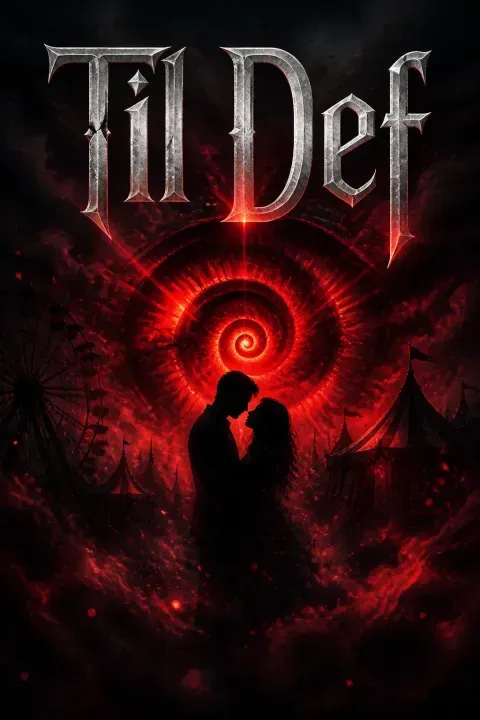


Plot Summary
Prologue
At thirteen, Ty Easton2 pads barefoot through the silent mansion, his father's axe heavy in his small hands. The thought loops in his mind like a chant: they must die before they kill him or anyone else. He enters the master bedroom, his father's chest rising and falling in oblivious sleep.
He struggles to lift the axe overhead, the blade trembling as he fixates on the vulnerable line of skin at his father's throat. The moment is suspended: a boy2 on the precipice of becoming a killer, driven by a darkness instilled by the very people he is about to destroy. The prologue ends before the blow, leaving the bloodshed implicit but the intent irrevocable.
The prologue roots Ty's violence in childhood trauma rather than innate evil. The image of a boy wielding an axe too heavy for him symbolizes the impossible weight of abuse that forces children to become what they hate. By withholding the actual murder, the narrative focuses on the psychological tipping point: the moment when self-preservation and vengeful rage become indistinguishable. This framing challenges the easy label of 'psychopath' and asks whether killing one's tormentors can be a rational response to unendurable suffering.
First Session with a Killer
Raven Tate1 arrives at Sacred Heights Asylum, a crumbling gothic institution in the remote town of Morbid Crypt, for a one-month internship. Dr. Moss,3 the director, assigns her to Ty Easton,2 a twenty-eight-year-old convicted of killing both parents with an axe at age thirteen, now days from release.
When Raven1 enters Ty's2 room, his intense light-brown eyes and unsettling stillness disarm her. He demands she remove her glasses, calls her Kitten,1 and spots the raven tattoo behind her ear, instantly learning her real name.
He warns her she does not belong here, that she is too precious, and tells her to stay away. Yet when she tries to leave, he orders her to sit back down. She is rattled but determined, sensing both danger and a profound brokenness beneath his menace.
This first meeting establishes the central dynamic: Raven's professional ambition and empathy collide with Ty's predatory intuition. He immediately sees through her professional mask, using her tattoo to trespass into personal territory. His alternating threats and charm exemplify the manipulative seduction of a traumatized individual who has weaponized his psychological insight. Raven's lingering despite clear red flags foreshadows her own unresolved grief and the magnetic pull of the darkness she claims to want to heal in others.
Billy's Assault and Ty's Rescue
Later on Raven's1 first day, she has a brief session with Billy Wade,8 a convicted rapist and murderer supposedly making progress. That evening, during a staff shift change, Billy8 ambushes her in a janitor's closet, ripping at her clothes and attempting to rape her.
Ty,2 who had noticed Billy's8 predatory interest, follows with a hidden razor blade, yanks Billy8 back by the hair, and slits his throat in a single motion. Raven,1 covered in blood and trembling, stares at her rescuer.2 Ty2 kneels, calls her his kitten,1 and asks if she is hurt.
She instinctively protects him, wiping blood from his face and instructing him to flee. She then stages the scene as self-defense, telling police she wrestled the blade from her attacker.8 Ty's2 violence has saved her, and her lie binds them together.
This event marks Raven's point of no return. Her decision to cover for Ty, despite professional ethics, stems partly from genuine gratitude but also from a deeper identification with his role as protector. His sudden violence on her behalf creates an intense, traumatic bond: he becomes her savior and her secret. The scene also exposes the asylum's failure to protect staff, foreshadowing the institutional rot that Dr. Moss oversees. From this moment, Raven's moral compass begins to recalibrate around Ty's code of loyalty and retribution.
Release Day Warning
On Ty's2 release day, Raven1 requests a final session. She finds him packing his few belongings, a cigarette dangling from his lips. He pulls her inside and locks the door. She thanks him with a kiss on the corner of his mouth, a gesture meant as gratitude but received as fuel. He cages her against the wall, describing in explicit detail how he has mentally violated her, how his control frays every time he sees her.
He tells her the only reason he has not already claimed her violently is the asylum's constraints. Raven,1 attempting professionalism, tells him to forget her and live a normal life. He gives a cold laugh, agrees she is right, but his eyes promise otherwise. She leaves shaken, knowing this is far from over.
The release scene crystallizes the paradox of their attraction: she is drawn to his raw honesty, he to her attempts at control. Ty's confession of mental obsession reveals a man who has never been taught healthy attachment—his desire is fused with violence because that was the only form of intimacy modeled for him. Raven's refusal to engage is both professional boundary and self-protective denial. Her kiss, though small, is the first crack in her armor, and Ty's apparent acquiescence is the calm before a storm of stalking and possession.
The Barroom Butcher
Raven1 joins new acquaintances Jess5 and Mike9 at a local bar. While she dances, Mike9 slips a drug into her drink. Unbeknownst to her, Ty,2 wearing a ski mask and watching from the shadows, sees everything. He follows Mike9 to the restroom, beats him, and begins severing his fingers with a knife. When Raven1 enters by mistake, she finds Mike9 unconscious and Ty2 holding a severed finger.
Ty2 informs her that Mike9 drugged her drink, then forces her to watch as he gouges out one of Mike's9 eyes, calling it punishment for looking at what is his. Raven1 manages to knee him in the groin and flees into the rain. Ty2 pockets the eyeball as a trophy, letting her go for now — but the night's horror has only begun.
Ty's vigilante violence at the bar blurs the line between protector and predator. He justifies his brutality as defense of Raven, yet his enjoyment of the act and his theatrical display for her reveal a sadistic need to control through fear. Raven's reaction—horror mixed with the realization that he saved her again—complicates her moral stance. This incident plants the disturbing question: if the monster only targets other monsters, can she condemn him? The eyeball token later left on her pillow concretizes his inability to separate affection from trophies.
Knife-Handle Humiliation
Ty2 follows Raven1 to her rental house. When she grabs a kitchen knife, he dares her to use it, then disarms her. He spins her around, pins her to the counter, and yanks up her dress. With his hand over her mouth, he inserts the knife's handle into her, thrusting roughly until her body betrays her with a climax. The sensation is alien and shaming, yet her body responds against her will.
He whispers that she breaks beautifully for him. After he leaves, she finds her phone gone and, the next morning, Mike's9 severed eyeball on her pillow. The assault and the trophy combine psychological terror with unwanted pleasure, leaving her feeling complicit and trapped. She cannot call the police now without implicating herself.
The knife-handle scene is a deliberate act of domination designed to prove that Ty can reach her physically even when she resists mentally. By using a weapon associated with his identity, he marks her as his. Her orgasm, despite non-consent, creates a shameful bond that many abuse survivors wrestle with—the body's autonomic response becomes a source of self-blame. The eyeball on the pillow serves as a tangible reminder that his surveillance is absolute and his 'gifts' are threats. Raven's isolation intensifies as she realizes she can turn to no one.
Midnight's Trap
Determined to escape, Raven1 packs to leave town. But her kitten Midnight6 unexpectedly bolts into the cemetery and woods. Raven1 chases her through fog to a decaying gothic mansion. Inside, as she searches the dark halls, a hand shoots from a crawl space and drags her into a hidden room. There stands Ty,2 Midnight6 purring in his arms.
He explains he used the cat6 to lure her because he knew she could not leave without her.6 He handcuffs her to a radiator and forces her to straddle his lap fully clothed, grinding against his erection until they both climax. He then prepares a makeshift bed by the fireplace, cuffing them together for the night. She lies beside him, her cat6 now his ally, feeling the last door to escape slam shut.
The mansion capture transforms the cat from a symbol of comfort to an instrument of betrayal, underlining Ty's manipulative genius. By using Midnight, he exploits Raven's only emotional attachment besides her deceased father. The forced grinding, resulting in mutual climax, deepens the psychological fusion: she cannot claim to hate him completely when her body responds. The handcuff binding them as they sleep literalizes their inescapable connection. This chapter shifts the narrative from pursuit to captivity, allowing for the forced intimacies that will become the crucible for Raven's eventual emotional surrender.
Axe-Handle in the Forest
When Raven1 slips out of the mansion and runs, Ty,2 naked and gripping his axe, hunts her through the forest. She flags down a truck, but Ty2 hurls his axe through the windshield, killing the driver instantly. He drags her deeper into the woods, pins her to a tree with the axe handle across her throat, and forces her to perform oral sex while he plants the axe handle in the ground and guides her onto it, penetrating her anally.
He then throat-fucks her as she rides the handle, the double penetration pushing her to a shattered orgasm. Afterward, he carries her back, promising that even when he breaks her, he will be the one to reassemble the pieces. Her defiance dissolves into a raw, taboo surrender.
The forest chase is a primal ritual where Ty asserts total physical and sexual dominance. The use of the axe handle—an extension of his violent self—as a penetrative tool forges an indelible link between his weapon and their intimacy. The death of the truck driver is almost incidental, demonstrating that any obstacle to his possession of Raven is disposable. Yet amid the brutality, his promise to 'put her back together' hints at a twisted caretaking impulse. This scene cements the dynamic: she is his prey, his lover, his project—and resistance only intensifies his claim.
The Forest Ritual
Ty2 brings Raven1 to a moonlit clearing where robed figures surround a stone altar. A small boy is laid on the cold rock while his well-dressed parents watch impassively. The chanting rises as a hooded figure approaches with a ritual instrument.
Raven1 shakes, whispering for Ty2 to stop it, but he holds her back, murmuring that he cannot, that this is the untouchable world that created him. After they return to the motel, he tells her in the shower — tears mingling with water — that he was that boy2 once, that his parents gave him and later his sister4 to these same rituals.
He killed them not out of madness but revenge. He breaks down, and Raven,1 naked and silent, climbs into the shower to hold him, seeing for the first time the shattered child inside the killer.2
The ritual scene is the moment Raven's perspective shifts from fear to empathy. Witnessing the horror firsthand dismantles her abstract notions of 'evil' and replaces them with visceral understanding. Ty's confession afterward strips away his psychopathic mask, revealing a man whose violence is not random but targeted at the system that destroyed him. Raven's act of holding him in the shower is her first fully voluntary, non-coerced gesture of care. It signals the beginning of genuine emotional bonding, built not on romanticized redemption but on shared recognition of irreparable damage.
Bloody Vigilante Justice
Ty2 locates the parents who offered their son to the ritual and asks Raven1 if she wants them dead. She nods. They break into the mansion at night; the couple is having sex. Ty2 decapitates the husband with his axe, then Raven1 trips the fleeing wife, enabling Ty2 to hack her to pieces.
Afterward, on the blood-drenched bed, Ty2 cuts his own arm to bleed on her body, then has rough, possessive sex with her amid the gore. He calls her his beautiful ruin, and for the first time, she feels no horror at the violence, only a fierce connection. The act of shared killing transforms her from victim to willing participant, and the sex that follows is a mutual ritual of acceptance rather than coercion.
By participating in the murder, Raven crosses the final ethical boundary. Her consent to the killing and her subsequent arousal signify a profound moral restructuring. The blood sharing becomes a dark baptism, washing away her previous identity as a healer and rebirth as Ty's partner. This turn is controversial: it can be read as Stockholm syndrome or as a woman reclaiming agency by choosing the darkness rather than being consumed by it. The narrative refuses to judge, instead presenting their union as the logical culmination of their shared trauma and mutual need.
The Director's Snare
Ty2 leaves Raven1 at the motel, intending to confront Ricco,10 the man who took his sister.4 His goodbye is tender, his first admission of love, and he leaves the door unlocked, giving her a choice to run. Shortly after, Dr. Moss3 arrives with orderlies and injects her with a sedative.
She wakes in Sacred Heights, strapped nude to a gurney, as Moss3 calmly sets up electroshock equipment, claiming she needs to be cured of her 'brokenness.' Nurse Jess5 shaves Raven's1 red hair and takes her mother's necklace, gloating that she blames Raven1 for her fiancé Mike's9 death.
Repeated shocks blur her memory, leaving her disoriented. The asylum, once her workplace, has become her prison, and the true purpose of Sacred Heights — to silence inconvenient witnesses — becomes horrifyingly clear.
Moss's abduction of Raven reveals the full extent of the conspiracy: the asylum is not a hospital but a disposal system for those who threaten powerful pedophiles. The electroshock, a historical horror, is repurposed here as a tool of memory erasure, literalizing the theme of institutional silencing. Jess's involvement personalizes the corruption, showing how grief can be weaponized to turn victims into perpetrators. Raven's shaved head and stolen necklace strip her of identity, reducing her to a body to be processed. This low point sets the stage for Ty's rescue and the revelation that Penny is also a victim of this machine.
Sister in the Shadows
On the asylum's top floor, a young woman named Penny4 befriends Raven,1 explaining in scattered fragments how the institution uses drugs and shock to erase people. Together, they spark a riot, attacking staff and creating chaos.
Meanwhile, Ty,2 having survived his confrontation with Ricco10 thanks to a mysterious rescuer,7 discovers underground tunnels leading into the asylum. He fights his way inside, taking a keycard from a dead chef. During the riot, he finds Raven.1
Dr. Moss3 appears and, with a cold smile, reveals the truth: Penny4 is Ty's2 lost sister, kept in the asylum for fifteen years, her memories fractured by repeated 'therapy.' Ty's2 world tilts as he stares at the girl4 he thought was dead, now alive but damaged, a living reminder of his failure and the conspiracy's cruelty.
The Penny revelation is the narrative's master twist, transforming Ty's revenge quest from a solitary vendetta into a rescue mission with living stakes. It retroactively grants meaning to his years of suffering and his escape from the asylum: he was unknowingly imprisoned alongside his sister. The riot, initiated by two women the system tried to break, symbolizes resistance against erasure. This convergence of plot threads—the asylum, the trafficking ring, Ty's past—elevates the story from dark romance to thriller, raising the stakes to life-or-death for the entire found family.
Oven and Ashes
Dr. Moss3 attempts to recapture them, brandishing a syringe and threatening to finish what he started. Ty2 swings his axe, severing Moss's3 arm. He then drags the doctor3 to a walk-in industrial oven, locks him inside, and turns the heat to maximum. Inside, Moss,3 bleeding and enraged, pulls out a detonator, vowing to take everyone with him.
As Ty,2 Raven,1 and Penny4 flee into the underground tunnels, the asylum erupts in explosions. Walls collapse, flames roar, and the trio barely escape as the entire building implodes, burying Moss3 and the remaining patients under tons of rubble. The destruction is absolute, a fiery grave for decades of hidden horrors. They emerge in the woods, coughing, bloodied, but together.
The asylum's destruction is a cathartic climax, burning away the physical space where so much trauma occurred. Ty's choice to throw Moss in the oven rather than simply kill him is an echo of Moss's own ovens of abuse—a poetic justice. The detonator twist shows Moss's ultimate control: even in death, he tries to claim his experiments. The escape through the tunnel that once brought Ty in as a prisoner now becomes a path to freedom, reversing its symbolism. With the explosion, the entire corrupt institution is erased, making way for the possibility of a new life.
Rebuilding from Ruin
Back at the motel, Penny4 sleeps deeply for the first time since the asylum fell, Midnight6 curled beside her. In the car, Ty2 cups Raven's1 shaved head, telling her he loves the look. She breaks down, releasing the tension of captivity and torture, and he holds her. He asks if she wants to keep him, and she answers always.
Their kiss seals a commitment forged in fire and blood. They talk about adventures, about showing Penny4 the world she was denied. The heavy darkness of the past weeks lifts slightly, replaced by a tentative hope. They are no longer captive and captor, therapist and patient, but two people who have seen the worst in each other and chosen to stay anyway.
The final chapter prioritizes emotional resolution over plot action. The image of Penny sleeping safely, the tenderness of Ty touching Raven's bald head, and the mutual declaration of commitment all signal a shift from survival mode to intentional partnership. Their bond, born from trauma, is now being deliberately rebuilt on trust and shared purpose. The inclusion of Penny and Midnight as a new family unit softens Ty's character without erasing his darkness. This ending argues that redemption is not about becoming 'good' but about choosing to protect what you love, even if the methods remain morally ambiguous.
Epilogue
Months later, Ty,2 Raven,1 and Penny4 visit a carnival called Oddity Circus. A man with black-and-white spiral eyes, tattoos, and an air of danger approaches Ty.2 He is Hell,7 the one who saved Ty2 during the Ricco10 fight. Ty2 learns that Hell7 was a boy from the same trafficking ring, now running this carnival of outcasts.
They exchange a wordless acknowledgment of shared history and survival. Hell7 tells Ty2 he is no longer alone; he has a family and a place among the misfits. As Penny4 dashes toward the lights and Raven1 laughs, Ty2 reflects on how far they have come: from an axe-wielding child to a man who, against all odds, found peace in the chaos. The story closes on a note of earned belonging.
The epilogue ties up the subplot of the mysterious rescuers and expands the world, hinting at a network of survivors who have carved out spaces of power and freedom. The carnival, with its horror aesthetic, becomes a sanctuary for those who do not fit into society—a place where monsters can be at peace. Hell's presence reassures Ty that his violence was not just random vengeance but part of a larger reckoning. The final image of Penny laughing and Raven beside him affirms that family can be built from broken pieces, and that even the darkest past can lead to a strange kind of light.
Analysis
Til Def operates as a dark romance that weaponizes the tropes of therapist-patient dynamics to explore trauma bonding, the nature of evil, and the possibility of redemption through shared darkness. The central question is whether a man who kills without remorse2 can still love, and whether the woman who falls for him1 is a victim or a willing participant in his violence. Ty's2 diagnosis of psychopathy is repeatedly undermined by his emotional breakdowns and his protective devotion to Raven1 and Penny,4 suggesting that the mental-health system that labeled him is itself the true sickness. The asylum, with its electroshock and memory erasure, stands as a metaphor for institutional abuse that silences survivors while protecting predators. Raven's1 arc — from a therapist seeking to cure others of the darkness that killed her father, to a woman who embraces that darkness in the man she loves2 — mirrors the reader's own negotiated sympathy with a serial killer. The novel does not offer a clean moral resolution. Instead, it proposes that for those broken by unimaginable cruelty, healing may look less like becoming 'good' and more like finding someone who sees your scars and chooses to stay. The epilogue's carnival, a haven for misfits, reinforces the idea that family and belonging can be built outside society's norms. Ultimately, Til Def is a story about survival: not the survival that leaves you the same, but the survival that remakes you into something the world might call monstrous, yet which finds its own fragile peace.
Review Summary
Til Def is a dark horror romance featuring Ty, a psychopath being released from Sacred Heights Asylum after fifteen years, and Raven, his new student therapist. Readers praise the intense, obsessive relationship and unhinged MMC, though warn it's extremely graphic with gore, violence, and disturbing content. The book polarizes readers—many find it gripping with emotional depth and plot twists, while others cite unrealistic scenarios, weak character development, and excessive darkness. Common praise includes the chemistry, pacing, and shocking revelations, particularly connections to the author's other works. Trigger warnings are heavily emphasized.
People Also Read


Characters
Raven Tate
Student therapist turned captiveA red-haired, blue-eyed, freckled student in her twenties, interning at Sacred Heights to launch a mental-health career after her father's suicide. She is empathetic, intelligent, and deeply lonely, carrying unresolved grief that makes her yearn to heal the darkest minds. Her encounter with Ty2 awakens a hidden attraction to danger and a capacity for moral compromise. Over the story, she transforms from a naive caregiver into a woman willing to embrace violence and protect the broken man she loves2. She projects her need to save her father onto Ty2, blurring professional boundaries, and ultimately finds purpose not in fixing him but in sharing his darkness.
Ty Easton
Axe-wielding avenger and obsessive loverA twenty-eight-year-old man who killed his abusive parents with an axe at thirteen. Diagnosed as a psychopath, he spent fifteen years in Sacred Heights faking rehabilitation to gain release. Tall, scarred, with dark hair and light-brown eyes, he is fiercely possessive, sexually dominant, and driven by a quest to destroy the trafficking ring that took his sister4. Beneath the violence, he craves acceptance and feels unworthy of love. His 'psychopathy' is actually a trauma response: he feels deeply but channels all emotion into protective rage. His arc moves from isolated avenger to a man who lets himself be vulnerable with Raven1 and reunites with his long-lost sister4.
Dr. Henry Moss
Corrupt asylum directorThe elderly director of Sacred Heights, presenting a grandfatherly smile that masks profound sadism. He is a key figure in the trafficking conspiracy, using the asylum to silence victims, conduct memory-erasing experiments, and manipulate the legal system to imprison people like Ty2. His calm, polite demeanor makes his cruelty more chilling. He enjoys breaking people's minds and sees patients as research subjects. He ultimately orchestrates Raven's1 abduction and reveals the extent of his corruption before Ty2 kills him.
Penny Easton
Ty's long-lost younger sisterAbducted at age ten and presumed dead, she survived for fifteen years in Sacred Heights, her memories shattered by electroshock and drugs. She is rebellious, sharp, and despite trauma retains a chaotic energy that helps her survive. She unknowingly befriends Raven1 on the top floor and helps spark the riot that enables their escape. Her reunion with Ty2 is the emotional core of the story, giving his revenge a living purpose and completing the found family.
Jess
Grieving fiancée turned tormentorA young woman who befriends Raven1 but is secretly a nurse at Sacred Heights. After Ty2 kills her fiancé Mike9, her grief curdles into vengeful cruelty. She participates in Raven's1 torture, shaving her head and stealing her mother's necklace, demonstrating how personal loss can be weaponized to turn victims into perpetrators within the corrupt asylum system.
Midnight
Raven's black kitten and unwitting lureA black cat with orange eyes, Raven's1 only companion before Ty2. Her mysterious bond with Ty2—responding to his commands—serves as the key device that lures Raven1 into the mansion trap. Later, she becomes a quiet symbol of the family unit the three humans form, curling beside Penny4 as she sleeps.
Hell
Carnival ringmaster and shadow rescuerA man with black-and-white spiral eyes, face paint, and an air of menace who runs the Oddity Carnival. He was a fellow child survivor of the trafficking ring who briefly befriended Ty2 years ago. He watched Ty's2 warpath from the shadows, saved his life during the Ricco10 fight, and represents a wider network of survivor vigilantes. His presence at the carnival signals that Ty2 has a place among outcasts.
Billy Wade
Predatory asylum patientA convicted rapist and murderer at Sacred Heights who appeared to be making progress. He attacks Raven1 on her first day, triggering Ty's2 lethal intervention. His death is the first killing Raven1 covers up, binding her to Ty's2 violence.
Mike Wright
Jess's doomed fiancéJess's5 fiancé who attempts to drug and sexually assault Raven1 at a bar. Ty2 intercepts him, brutally torturing and mutilating him. His assault and subsequent death set off a chain of events that further entangle Raven1 and fuel Jess's5 revenge.
Ricco
Trafficking ringleaderA wealthy, sadistic man who took Penny4 and presided over her abuse and eventual death. He taunts Ty2 about her fate, triggering the final brutal confrontation. Ty2 dismembers him alive, but only with the help of the mysterious spiral-eyed rescuers7.
Plot Devices
Ty's Axe
Signature weapon and phallic symbolThe black-handled, razor-sharp axe Ty2 used to kill his parents at age thirteen. It reappears throughout the novel as his weapon of choice for every subsequent murder, including Billy8, the priest, the abusive parents, Ricco10, and Dr. Moss3. The axe represents the moment his childhood ended and his agency began—the first time he fought back. It also becomes a tool of sexual domination when Ty2 forces Raven1 onto its handle during the forest scene, fusing violence and intimacy. Owning and wielding the axe is Ty's2 reclaimed power, the extension of his body and his wrath.
Sacred Heights Asylum
Gothic prison masking a conspiracyThe crumbling, centuries-old asylum where Raven1 interns. Its tiered floor system supposedly moves patients from madness to release, but the upper floors are a torture chamber where memory-erasing electroshock and drugs silence victims of the trafficking ring. The institution represents the corrupt intersection of medicine, law, and organized abuse. It held Ty2 for fifteen years and later imprisons Raven1 and Penny4. Its eventual destruction by explosion symbolizes the obliteration of the system that created Ty's2 suffering.
The Handcuffs
Physical restraint and bonding symbolTy2 uses metal handcuffs to bind Raven1 during her captivity, first to a radiator, then to himself, and later to a steering wheel. The cuffs physically enforce his control and prevent escape, but they also create forced proximity that deepens their psychological fusion. As the story progresses, Ty2 removes the cuffs as trust grows, and their occasional re-use becomes a consensual part of their dynamic. The cuffs thus chart the evolution from coercion to chosen partnership.
The Raven Tattoo
Hidden identifier and symbolic linkA small raven inked behind Raven's1 ear, noticed by Ty2 in their first session. He immediately deduces her real name because of it, shattering her professional anonymity. The raven as a bird traditionally symbolizes death, darkness, and prophecy, aligning with Ty's2 world. The tattoo becomes a private touchstone between them, a permanent mark that ties her identity to his obsession and foreshadows her eventual embrace of his violent mission.
The Child Trafficking Ring
Hidden network driving the central revenge plotA vast, powerful conspiracy of wealthy elites who ritually abuse, traffic, and murder children, protected by corrupt law enforcement and institutions like Sacred Heights. The ring took Ty2 and his sister Penny4 as children, leading to her presumed death and his kill list. The revelation of the ring's reach—spanning judges, doctors, and business owners—transforms the story from a simple psychopath romance into a dark thriller about systemic evil. Ty's2 warpath is targeted at the ring's members, and the carnival epilogue hints that other survivors are also fighting back.
About the Author
Other books by Jodie King



Download PDF
Download EPUB
.epub digital book format is ideal for reading ebooks on phones, tablets, and e-readers.








































