
Key Takeaways
1. Our Dominant Worldview is Fundamentally Flawed.
Distilled to their essence, these themes come down to a few basic building blocks. Humans are selfish individuals. All creatures are selfish – in fact, selfish genes are the driving force of evolution. Nature is just a very complex machine, and human ingenuity has, for the most part, figured out how it works. The modern world is the spectacular result of technology enabled by the market forces of capitalism, and in spite of occasional setbacks, it’s continually improving. There may be problems, such as global poverty or climate change, but technology, powered by the market, will solve them – just as it always has in the past.
The "Uncle Bob" narrative. The prevailing worldview, often articulated by figures like "Uncle Bob," posits that humans are inherently selfish, driven by "selfish genes," and that nature is a mere machine. This perspective champions free-market capitalism and technological progress as the ultimate solutions to all global challenges, from poverty to climate change. This narrative is so pervasive that it shapes our collective consciousness, often without conscious recognition.
A mental cage. This dominant worldview, largely forged by 17th-century European thinkers, has indeed fueled scientific advancement and technological wonders. However, it has also been a root cause of immense devastation to non-European cultures and the natural world. Its foundational flaws have now become so critical that they threaten the very survival of our civilization, pushing us towards:
- Extreme inequities (2 dozen billionaires own as much as half the world's population)
- Ecological collapse (68% decline in animal populations since 1970)
- Climate breakdown (greenhouse gas emissions creating conditions unseen for millions of years)
Cracks in the foundation. The core tenets of this worldview—human selfishness, nature as a machine, and technology as a panacea—are not indisputable facts but rather a "constructed lens." Modern research across diverse fields increasingly reveals these building blocks to be deeply flawed, necessitating a radical re-evaluation of our collective assumptions to steer humanity away from catastrophe.
2. Human Consciousness is a Dynamic Integration of "I" and "Self."
The split between ‘I’ and ‘self ’ most likely occurred early in human evolution, and is viewed by many experts as one of the defining characteristics of humanity.
The inner dialogue. We all experience a split in our consciousness, an "I" that engages in an ongoing relationship with a "self." The "I" represents our conceptual consciousness, mediated by the prefrontal cortex, responsible for language, planning, and creating coherent narratives about our past and future. It's the "interpreter" that makes sense of our experiences, often leading to "purposive action" (yu-wei).
Animate intuition. The "self" embodies our animate consciousness—the primal stream of feelings, impulses, urges, and sensations we share with other mammals. It exists purely in the present moment, driven by the fundamental desire for life, often expressed as "effortless action" (wu-wei). When the prefrontal cortex is severely damaged, as in the case of Phineas Gage, the "I" struggles to function, highlighting the crucial role of this integrated system.
A democracy of consciousness. Rather than a battle, the ideal is an integrated relationship between the "I" and the "self." This "democracy of consciousness" involves acknowledging and harmonizing both rational thought and intuitive feelings. Practices like mindfulness, qigong, and tai chi help strengthen the neural pathways between these two aspects, fostering a more cohesive and healthful inner experience.
3. Life is Animate Intelligence, a Self-Organized, Interconnected Web.
Where there is life there is mind, and mind in its most articulated forms belongs to life.
Beyond human-centric intelligence. The conventional Western view often limits intelligence to human conceptual abilities, dismissing the profound "animate intelligence" pervasive in nature. From single-celled organisms like slime molds solving mazes and designing efficient networks, to plants communicating and learning, life demonstrates astonishing cognitive capacities. This challenges "anthropodenial," the denial of shared emotional and intellectual experiences between humans and other animals.
The wisdom of Dreamtime. Indigenous traditions, like the Australian Aboriginal concept of Dreamtime, intuitively understood that our "original ancestors" (single-celled organisms) still exist and laid the pathways for all life. Modern science confirms this: all living beings share common genetic lineage and fundamental life processes, a "deep homology" that underscores our interconnectedness. Even a banana shares 44% of its genes with us.
Patterns that perpetuate. The universe is not a collection of isolated "things" but an intricately interconnected "web of activity." Neo-Confucian philosophy, with its concepts of qi (energy/matter) and li (organizing principles/patterns), offers a framework for understanding how dynamic patterns persist even as their components change, like a river or a candle flame. This "systems thinking" reveals that the relationships between elements are often more important than the elements themselves.
4. Evolution is a Harmonic Dance of Cooperation, Maximizing Life's Purpose.
Life did not take over the world by combat but by networking.
Debunking the selfish gene. The pervasive "selfish gene" myth, popularized by Richard Dawkins, claims that ruthless competition is the sole driver of evolution. However, modern evolutionary biology reveals that cooperation, not just competition, has been the foremost driving force in life's major transitions. This includes:
- Prokaryote genomes fusing to form the first eukaryotes.
- Eukaryotes partnering with ingested mitochondria for energy.
- Single cells combining to create multicellular organisms.
The power of symbiosis. From bacteria sharing genes to trees exchanging nutrients via fungal networks, symbiosis is a bedrock of Earth's ecologies. In these mutually beneficial relationships, different species exchange specialized skills, creating systems where the whole is greater than the sum of its parts. This challenges the "zero-sum game" mentality often applied to nature.
Life's negentropic purpose. Life's "deep purpose" is to resist the Second Law of Thermodynamics (entropy) by continually converting disorder into self-organized order (negentropy). Evolution, then, is life developing increasingly sophisticated ways to maximize this energy conversion. This process is a "harmonic dance," where competition and cooperation create dynamic tension within a larger, integrated system, fostering resilience and diversity.
5. True Flourishing (Eudaimonia) Requires Integrated Well-being.
There is no greater delight than to realize cheng upon self-examination.
Beyond hedonic pleasure. Ancient wisdom, like Aristotle's distinction between hedonia (transient pleasure) and eudaimonia (flourishing from fulfilling one's true nature), and Buddhist sukha (enduring happiness), highlights a deeper form of well-being. This contrasts with modern society's "hedonic treadmill," which traps individuals in an endless pursuit of fleeting pleasures, leading to dukkha (unease and suffering).
Mind-body integration. Health is not merely the absence of disease but a harmonious balance within an integrated organism. The "therapeutic meaning response" of the placebo effect demonstrates the profound connection between mind and body. Practices like yoga, qigong, and tai chi cultivate this integration, strengthening neural pathways and promoting physical and mental well-being by:
- Improving vagal tone
- Maintaining telomere health
- Reducing stress and inflammation
Fractal flourishing. Individual flourishing is inextricably linked to the health of the larger world, a concept called "fractal flourishing." Just as a cell cannot thrive in a diseased organism, a person cannot fully flourish in an unhealthy society or a degraded ecosystem. This holistic view, echoed by Indigenous wisdom and modern planetary health initiatives, emphasizes that our well-being is deeply intertwined with the well-being of our community and the living Earth.
6. Humanity's Moral Nature is Innately Prosocial, but Culturally Distorted.
We are evolution’s latest major transition. Alone among primate species, we crossed the threshold from groups of organisms to groups as organisms.
Born with moral sprouts. Contrary to the Hobbesian view of innate human selfishness, humans possess an intrinsic moral sense, evident even in infants. Experiments show babies prefer helpful puppets and exhibit rudimentary fairness and empathy. This "moral instinct," rooted in our mammalian "Engagement Ethic," evolved from the necessity of cooperation in early hominid groups, leading to "altruistic punishment" to maintain group harmony.
The cultural shaping of values. While innate, our moral intuitions are profoundly shaped by culture during sensitive developmental periods. Agrarian societies, with their emphasis on possessions and hierarchy, led to "domination systems" that often suppressed innate prosociality, replacing it with fear and force. The Axial Age introduced transcendent values like the Golden Rule, expanding moral concern beyond immediate kin.
The moral arc. History shows a "moral arc" bending towards justice, with significant reductions in violence and increased recognition of rights. However, this progress is uneven and often parochial. The "moral Flynn effect" suggests an improvement in abstract moral reasoning, but this must be balanced with our embodied moral intuition. A truly integrated value system would recognize our shared humanity and extend compassion to all, challenging the "parochial altruism" that limits our moral scope.
7. Human Supremacy Drives Ecological Catastrophe; Conscious Symbiosis Offers a Path.
A thing is right when it tends to preserve the integrity, stability, and beauty of the biotic community. It is wrong when it tends otherwise.
The Windigo's rampage. The anthropocentric view—that humans are superior and nature exists for our benefit—has fueled a "Windigo-like infection" of relentless consumption. This ideology, rooted in Western thought, has led to the "Great Acceleration" of human impact, causing the "Great Dying" of species, climate breakdown, and the "First Extermination Event" of Earth's history.
Nature as a "beautiful ruin." The concept of "shifting baseline syndrome" means we often fail to recognize the immense loss of nature's abundance, accepting degraded environments as normal. "Ecosystem services" attempts to value nature financially, but this "financialization of nature" reduces it to a balance-sheet item, justifying its exploitation and even geoengineering as a "fix" for a machine-like Earth.
Tending Mother Earth. An alternative, "conscious symbiosis," draws from Indigenous wisdom like the "Honorable Harvest" and permaculture. This approach, akin to the Taoist concept of shi (skillfully arranging circumstances), involves "tending the wild" to create mutually flourishing relationships between humans and nature. It recognizes our "ecological self" and the intrinsic value of all life, aiming for a "Symbiocene" where human activity regenerates Earth's health.
8. Meaning and Love Emerge from Deep Interconnectedness.
Meaning is itself a function of connectedness.
The mystical revelation. Mystical experiences, increasingly common, often involve a loss of ego, a dissolution of boundaries, and a profound sense of "oneness" accompanied by intense positive emotions. These states, whether induced by psychedelics or meditation, reveal a massively interconnected neural network, suggesting that our ordinary consciousness acts as a "reducing valve," filtering out a deeper, more unified reality.
Immanent oneness. This "oneness" is not necessarily a transcendent, otherworldly realm, but an immanent reality, present "in the ants, the grass, the earth – even in the 'piss and shit'," as Zhuangzi said. It's the "quantum jazz of life," where everything vibrates and synchronizes, from Huygens' pendulums to human brains. Meaning, like music or a rainbow, is an emergent phenomenon, actualized through our participatory attunement to the universe's connective rhythms.
Love as cosmic connection. Love can be defined as the "realization and embrace of connectedness." This isn't just a human emotion but a "cosmic ontological force," akin to gravity, that brings things together, counteracting entropy. The "Jewel Net of Indra" metaphor illustrates this: each jewel (entity) reflects all others, signifying infinite interrelationships. This deep integration, a "unity with differentiation," is the source of profound meaning and purpose.
9. Our Identity is a Fractal Flow, Not a Fixed Self.
What fills the universe I regard as my body; what directs the universe I regard as my nature. All people are my brothers and sisters; all things are my companions.
Beyond the egoic self. The Western tradition's concept of a fixed, autonomous individual "I" is a cultural construct. Buddhist anatman (no-fixed-self) and Taoist dissolution of boundaries point to identity as a dynamic, impermanent process—a "temporarily identifiable wiggle in a stream." Our personhood is a "multidimensional natural attractor," constantly in flux yet maintaining coherence.
The spirit as li. The Chinese concept of shen (vital spirit) can be understood as the emergent, integrative property of any natural entity—the intangible unifying principle of a natural attractor. Our own spirit, or li, exists within our loved ones and in the patterns of meaning transmitted through time, like Chopin's "soul-shards." Spirituality, then, is seeking meaning in the coherent connections (li) between things, rather than in the things themselves.
Infinite ripples of being. Our identity extends far beyond our individual ego, encompassing our community, humanity, and all life. This expanded "ecological self" recognizes that our actions create li ripples in the fabric of existence, influencing others and the world in unseen ways. This realization brings an inherent ethical responsibility: to devote our sentience to the flourishing of all life, embracing our role as the universe reflecting on itself.
10. We Must Weave a New Story: Towards an Ecological Civilization.
The future is not a spectator sport. It’s not something constructed by others, but by the collective choices each of us makes every day: choices of what to ignore, what to notice and what to do about it.
The Windigo's endgame. Our current global civilization, driven by the "Windigo AI" of corporate capitalism, is careening towards a precipice. Its insatiable demand for perpetual growth, fueled by a flawed worldview, has led to ecological overshoot and the threat of civilizational collapse. "Green growth" is a fantasy; we are rapidly approaching climate tipping points that could lead to a "Fortress Earth" scenario, where a privileged few survive at the expense of billions.
Rewriting the operating system. To avert catastrophe, we need a new "operating system"—an "ecological civilization" based on life-affirming principles. This means replacing the Windigo AI's drive for wealth with nature's AI: the animate intelligence of symbiotic cooperation, harmony, balance, and fractal flourishing. This civilization would prioritize eudaimonia for all, ensuring equitable distribution of resources and fostering individual dignity within thriving communities.
Hope as active engagement. The transition to an ecological civilization is an epochal undertaking, requiring a metamorphosis in every aspect of human experience. While daunting, history shows that dramatic positive change can occur rapidly. A global movement for life-affirming change is already underway, from climate justice alliances to the Rights of Nature. Our task is to "come back to life," shed our "consensus trance," and consciously weave our unique strands into a new story of meaning, guided by "revolutionary love" and a deep devotion to the well-being of all life.
Review Summary
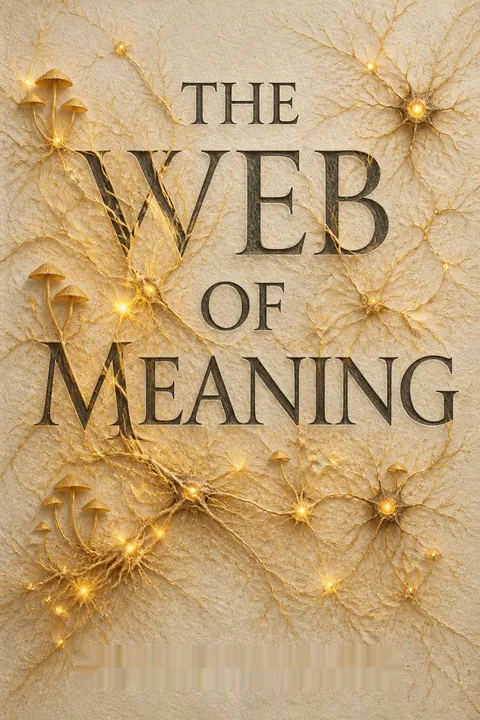
Reviews of The Web of Meaning are largely positive, averaging 4.26/5. Admirers praise its ambitious synthesis of Eastern philosophy, indigenous wisdom, and modern science, finding it perspective-shifting and deeply meaningful. Critics, however, flag cherry-picking of evidence, oversimplification of Western thought, an idealized portrayal of Eastern traditions, and weak engagement with opposing viewpoints. Many note the book's first half outshines its second. Several readers found it repetitive compared to Lent's prior work, though most agree its core message about interconnectedness and ecological responsibility is vital and timely.
People Also Read
Download PDF
Download EPUB
.epub digital book format is ideal for reading ebooks on phones, tablets, and e-readers.








































