
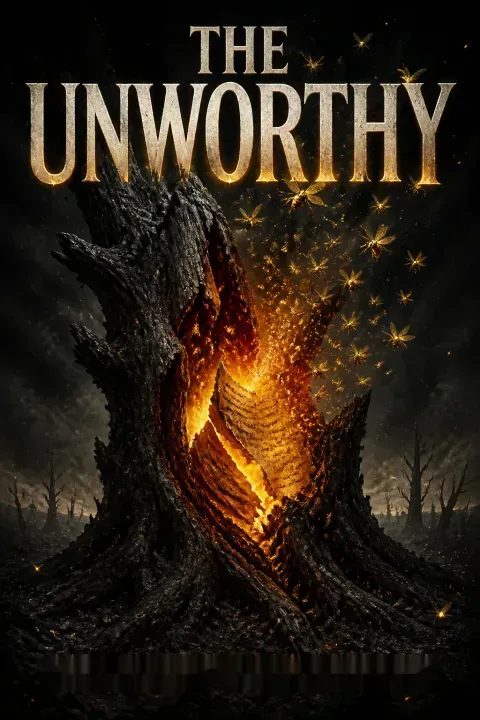


Plot Summary
Bleeding Saints at Dawn
The narrator1 inserts cockroaches into Lourdes5's pillow and writes hidden pages with a quill. In the Chapel of Ascension, three Minor Saints with sewn eyes sing the Primary Hymn until one bleeds, a botched stitching by Mariel.8 The Superior Sister3 punishes Mariel8 with needles.
Afterward, the narrator1 glimpses a Full Aura escape and radiate, then cleans the blood from the floor, tasting its essence. She walks to the carved black door of the Enlightened's Refuge, touches its carved angel, and hears a smothered scream before fleeing.
The ritual establishes the theocracy's structure: Him4 speaks from behind a chancel screen, the Chosen are mutilated, and the unworthy serve through sacrifice and fear. The narrator's1 secret writing exists in defiance of total erasure.
The opening juxtaposes private rebellion against public ritual. The narrator's cruelty toward Lourdes and fascination with cockroaches reveal how oppression implants sadism as a survival reflex. The Full Aura's escape is a crack in the totalitarian facade, while the carved door already whispers of the horrors inside. The tasting of blood is a perverse communion, suggesting the narrator's hunger for meaning in a meaningless system.
Mariel Did Not Kill
A Minor Saint is found murdered, her sacred crystal stolen. Mariel,8 already bearing needle wounds in her nipples, is brought before the assembly. The Superior Sister3 whips her ten times with a branch, then orders her tied to a pole surrounded by kindling. Mariel8 screams a forbidden prayer in another language as flames consume her.
The narrator1 smiles behind her veil, disappointed she was not chosen to administer the punishment. The unworthy feign horror while hiding pleasure. The mantra spreads among the servants: Mariel8 did not kill, but Mariel8 blazed. The execution cements the regime's method of sacrificing the weak to preserve order and obscure the real killer. Lourdes5's role as organizer of punishment grows, her ambition clear.
Mariel's death is a political liturgy: the community gathers to witness violence that is framed as justice, while the actual crime goes uninvestigated. The narrator's disappointment at not being the executioner reveals how the system manufactures willing perpetrators. The forbidden prayer Mariel recites, invoking the erroneous God, is her only authentic act, a remnant of a lost world.
The Deer Among Amanitas
Sent to gather mushrooms for funeral pastries, the narrator1 finds a young woman2 unconscious among red amanitas. The stranger2 wears a stained dress and men's combat boots, her black hair spread like a deer.
The narrator1 observes her immaculate skin, no signs of contamination, and feels an otherworldly pull. When the woman2 wakes, she screams silently, and the narrator1 runs. That night, after the Minor Saint's funeral, the narrator1 sneaks to the Tower of Silence to steal the quartz from the corpse.
Inside, she finds the same woman,2 who begs for help. The narrator1 strikes her for using a forbidden prayer but then agrees to hide her. The woman2 pretends to faint in the garden, undergoes quarantine, and is renamed Lucía2 after proving free of contamination.
Lucía's arrival is the inciting miracle, appearing first among poisonous mushrooms and later among bones. The narrator's conflicting impulses of curiosity and violence reveal her moral confusion. Lucía's submission to the naming ritual masks an inner sovereignty that will gradually upend the Sisterhood's power structure.
Feet That Did Not Burn
Threatened by acid rain, the Superior Sister3 demands sacrifice. Before Lourdes5 can speak, Lucía2 volunteers to walk on burning embers. That evening, veiled and barefoot, Lucía2 steps onto the glowing path. She crosses without faltering, her soles unmarked. The Superior Sister's3 bell drops, her mouth ajar. Lourdes5's fists clench in fury.
The narrator1 feels awe and a deepening attachment. The sacrifice is declared a success, the storm never comes. Lucía2's act, whether miracle or mental mastery, marks her as both holy and dangerous. The narrator1 visits her afterward to offer care, but Lucía2 is serene, untouched. The unworthy begin to whisper about her power, while Lourdes5's jealousy hardens into a vendetta.
The firewalking is a liminal moment where Lucía's body defies the regime's logic of pain. The Superior Sister's shock betrays that her authority depends on predictable suffering. Lourdes's reaction is the birth of a rivalry that will consume her. The narrator's attraction to Lucía becomes a gravitational force pulling her away from complicity.
Wasps Obey the Witch
Lourdes5 has her followers place a wasp nest in Lucía2's bed during the night. The next morning, the unworthy find Lucía2 standing unharmed amid a halo of wasps that do not sting her. When she lifts her eyes, the wasps attack Lourdes5 and her minions, biting and stinging them repeatedly. Lucía2 walks to the garden with wasps trailing like a cloak.
At breakfast, the Superior Sister3 silently gives Lucía2 her own coffee, a rare gesture. Lourdes,5 swollen and humiliated, spreads rumors that Lucía2 is a witch. The narrator1 and Lucía2 begin their secret meetings, entering the thicket together. The wasp miracle shifts the balance of fear: Lucía2 now holds a power the regime cannot control or explain.
The wasp incident inverts the hierarchy. Lucía's embodied authority over nature contrasts with the Sisterhood's artificial hierarchy. The Superior Sister's gift of coffee is a strategic feint, an attempt to co-opt what she cannot crush. The narrator, accustomed to dominating cockroaches, now witnesses a living creature that refuses subjugation, foreshadowing her own rebellion.
Fireflies and the Cat
In the tree hollow, Lucía2 and the narrator1 kiss and make love as thousands of fireflies, extinct for decades, pulse golden light around them. Afterward, the narrator1 tells Lucía2 about the tarantula kids, their leader Ulysses,10 and Circe7 the cat. She recounts how men attacked her in a metallic woods, raping her and killing Circe7 with multiple stab wounds.
The memories had been suppressed; now they flood back. Lucía2 holds her, strokes her hair. The narrator1 describes burying Circe7 under a dead tree with a small green shoot. The fireflies seem to respond to Lucía2's presence, resurrecting lost beauty. Their bond deepens into a love that will demand everything. The narrator1 begins to imagine escape beyond the wall.
The lovemaking and the fireflies are one event: intimacy with Lucía is the catalyst that restores memory and reanimates the world. The narrator's body, once a site of violation and inflicted pain, becomes capable of ecstasy. Circe's death, which severed the narrator's childhood, is revisited and mourned, making room for a new self. The tree hollow becomes a womb-like sanctuary outside the regime's geography.
A Spirit's Open Mouth
Returning from the woods at dawn, the narrator1 and Lucía2 find a Diaphanous Spirit dead in the garden, her tongueless mouth agape, her legs bloodied. The narrator1 steals the sacred crystal from the corpse. The Superior Sister3 orders confinement for all. During the locked days, Lourdes5 circulates whispers that Lucía2 used dark magic to trap the Spirit in another dimension.
The unworthy shun Lucía,2 calling her cockroach. Fearing for Lucía2's safety, the narrator1 bakes amanita mushrooms into Lourdes5's cricket bread. That night, Lourdes5 dances naked in the garden under the full moon, raving about the monks' secrets. The narrator1 and Lucía2 observe her ecstatic, unguarded movements before the Superior Sister3 appears.
The dead Spirit, likely another victim of Him, becomes a blank screen for projection. The community's need for a scapegoat overrides evidence, and Lucía's otherness makes her the ideal target. The narrator's poisoning of Lourdes mirrors the regime's tools, revealing that resistance still operates within the logic of harm, even when motivated by love.
Lourdes Dances Then Hangs
Under the influence of amanita, Lourdes5 dances until the Superior Sister3 finds her, drags her into the thicket, and assaults her. The narrator1 and Lucía,2 hidden in the hollow, attack the Superior Sister3 with branches, striking her head and kidneys until she falls.
They rescue Lourdes5 and flee. By morning, Lourdes5's body hangs from a tree, a rope around her neck. The narrator1 and Lucía2 cut her down, bury her with the stolen crystal, and wash in the Creek of Madness.
The Superior Sister,3 seeking the gravediggers, inspects hands and interrogates. The murder of a favorite signals that no one is safe; the narrator1 realizes that violence is the only language the system respects. They vow to rescue María de las Soledades9 from the Tower of Silence next.
Lourdes's death, at the hands of the woman she served, exposes the lie of earned favor. The narrator's direct physical intervention, though it fails to save Lourdes, is her first active resistance against the Superior Sister. The burial ritual, performed in secret under the stars, reclaims a humanity the official narrative denied Lourdes. The creek's mad water cleanses them, but also blurs the boundary between ritual and insanity.
Lucía Is Taken
The Enlightened announce that Lucía2 is the new Enlightened one. The narrator1 is devastated; no one who enters the Refuge returns. During the ceremony, Lucía2 squeezes the narrator's1 hand under their tunics, a silent plea. Two Diaphanous Spirits lead her behind the carved black door. The unworthy are relieved the witch is contained.
That night, the narrator1 presses her head to the door and hears screams, broken cries, and roars. She resolves to free Lucía,2 practicing the lock on an empty cell near the door. María de las Soledades9 has died in the Tower of Silence, her withdrawal from speech complete. The narrator's1 memory of the tarantula kids and Circe7 now fully accessible, she knows she cannot lose another loved one.
Lucía's selection as Enlightened is the regime's ultimate co-optation: consecration as captivity. The narrator's eavesdropping makes her complicit in knowing, yet refusing to know, what the screams signify. The practice on the lock is a turning point: skills learned for survival under Ulysses now serve liberation. The door, once an object of aspiration, becomes a target of infiltration.
The Refuge's Horrible Truth
The narrator1 picks the lock and enters the Refuge. She sees the Superior Sister3 standing by while He,4 naked, rapes Lucía.2 Other Enlightened women are visibly pregnant, their wombs swollen with sin. The sacred ritual is systematic sexual abuse. The narrator1 stabs the Superior Sister3 in the kidney, seizes the whip, and strikes Him4 across the face.
She and Lucía2 flee, pursued by some Enlightened who join them. The narrator1 jams the lock with her quill to buy time. They reach the tree hollow. The narrator1 reveals she has been stabbed in the stomach; her tunic and the hidden pages are soaked in blood. She cannot run. She tells Lucía2 to escape through the wall's gap with the others.
The revelation crystallizes the novel's thesis: patriarchal religion sanctifies rape, calling it divine insemination. The narrator's use of the knife and whip, the Sisterhood's own instruments, is a necessary appropriation of violence. The quill, the tool of writing, becomes a literal key and then a lock-pick, signaling that words and witness are inseparable from action. The narrator's wound is the cost of seeing and telling.
The Hollow's Last Pages
Lucía2 refuses to leave, but the narrator1 insists. She shows the wound and kisses Lucía2 goodbye. Lucía2 says her real name, a vibration of fire no one else has heard, and is pulled away by other escapees. They crawl through the gap in the wall into the unknown wasteland. The narrator1 remains in the tree hollow, opening the wound further to die faster.
She writes her final words using blood as ink, hiding the pages in the hollow's shelter. The bells toll: the pursuers are coming. She describes the woods as a living cathedral, a pagan temple, and herself as a sacrifice that will feed the roots. The Book of Night will remain, a testament waiting to be found or absorbed by the earth.
The narrator's death is an apotheosis of witnessing. Her body becomes ink, her words become earth. The tree hollow, once a lovers' refuge, is now a tomb and an archive. Lucía's utterance of the name is the novel's only sacrament, a true naming that opposes the Sisterhood's renaming. The open ending refuses closure: some women escape, some pages survive, but the world beyond remains unknown. The bells announce not an ending, but the perpetual cycle of pursuit and resistance.
Analysis
The Unworthy is a dystopian novella that uses the microcosm of a repressive religious convent to dissect the mechanisms of patriarchal control, eco-catastrophe, and women's complicity. The House of the Sacred Sisterhood operates as a miniature totalitarian state: a hidden male God-figure (Him4) speaks from behind a screen, a female enforcer (the Superior Sister3) administers torture, and a hierarchy of mutilated Chosen and aspiring unworthy reproduces the logic of sacrifice. The phrase 'without faith, there is no refuge' functions as an ideological mantra that obscures the material reality of rape, murder, and contamination. The novel's great structural insight is that the narrator1 begins as an enthusiastic participant, a survivor who has internalized cruelty as a survival mechanism. Her love affair with Lucía,2 a woman who seems to command nature itself, gradually unfreezes her repressed memories of childhood trauma and teaches her that mercy is not destructive but transformative. The Book of Night, the secret manuscript she writes at constant risk, is the novel's meta-textual heart: it is both evidence and prayer, a refusal to be silenced that culminates in the narrator's1 literal bleeding onto the page. Bazterrica's world is one where climate collapse has already happened, yet the walled garden of the Sisterhood claims to be a preserved Eden, masking a charnel house. The ending offers no tidy redemption: some women escape into an uncertain wasteland, the narrator1 dies, and the pages wait in a hollow tree. The book argues that witness, even anonymous and wordless, is an act of resistance, and that the truth, like a sphere, contains within it the lie that makes the mechanism turn.
Review Summary
The Unworthy is a disturbing dystopian novel set in a post-apocalyptic world ravaged by climate change. It follows women in a cruel religious cult, exploring themes of power, misogyny, and survival. Readers praised Bazterrica's vivid, poetic writing and the book's ability to unsettle, though some found the ending unsatisfying. Many compared it to her previous work, Tender is the Flesh, with mixed opinions on which was better. The short novel's graphic violence and oppressive atmosphere left a lasting impact on most readers.
Characters
The Narrator
unworthy secret chroniclerAn unnamed young woman living in the House of the Sacred Sisterhood, a post-apocalyptic theocracy. She secretly writes a 'book of the night' using stolen ink, blood, and a hidden quill, chronicling her life and the atrocities around her. Psychologically, she is a survivor of cascading trauma: her mother starved, her street family was murdered, she was raped, and her beloved cat Circe7 was killed. These experiences forged a cunning, cruel persona who tortures cockroaches and once aspired to become Enlightened. Her emotional arc moves from numb complicity and sadism toward love, memory reclamation, and self-sacrifice. She betrayed her former lover Helena6, leading to Helena6's burial alive, a guilt she carries. Through her bond with Lucía2, she rediscovers tenderness and finally acts to destroy the system that shaped her.
Lucía
miraculous wanderer turned loverA wanderer who arrives at the Sisterhood after digging under the wall. Her beauty is compared to a white deer, and she possesses unexplained powers: walking on embers unscathed, commanding wasps, summoning fireflies. She becomes the narrator's1 lover and catalyst for transformation. Lucía is both fragile and fierce, carrying an inner universe that is solitary and ancient. She appears compliant yet strategizes with quiet defiance. Her past remains shadowy, but she recalls walking alone, thirsty, and dreaming of a woman who turned out to be the narrator1. Her gifts make her a target; the regime first tries to destroy her with rumors, then co-opts her as an Enlightened one, hiding the violation behind sacred ritual. Lucía's love reawakens the narrator's1 capacity for trust and sacrifice.
Superior Sister
sadistic enforcer of the HouseThe towering, whip-wielding ruler of the Sisterhood who fought in the water wars and migrated with tribal sages. She maintains order through floggings, spiked muzzles, burnings, and murder, taking visceral pleasure in suffering. She is both beautiful and terrifying, a fusion of military discipline and religious fanaticism. Her relationship with Him4 is ambiguous, but she actively participates in the rape of the Enlightened. Though her authority seems absolute, the narrator's1 attack and Lucía's2 miracles expose her vulnerability. She represents the system's fusion of violence and sanctity, enforcing purity through contamination.
Him
predator behind the screenThe unseen male leader who delivers misogynistic sermons from behind the chancel screen, calling the women unworthy, bitches, and filth. He is rumored to be the Superior Sister's3 brother and is the only man permitted inside the House. His voice shifts from a sacred battalion to a vile whisper. In truth, he systematically rapes the Enlightened women, impregnating them under the guise of divine purpose. His face, revealed only when the narrator1 breaks into the Refuge, has the horrific perfection of a sculpture, a mask for absolute predation.
Lourdes
ambitious, cruel favoriteA manipulative unworthy who curries favor with the Superior Sister3 by devising creative punishments for others. She organizes funerals and rituals, always positioning herself for elevation to Enlightened. Her jealousy of Lucía2 drives her to plant the wasp nest and spread rumors of witchcraft. Beneath her cruelty lies a fragile need for approval; when drugged with amanita, she dances naked and confesses the moon's secrets. Lourdes embodies the system's promise of upward mobility through complicity, and her eventual murder by the Superior Sister3 proves that no amount of service guarantees safety.
Helena
buried first loveThe narrator's1 former cellmate and lover, a compassionate woman who saved the narrator1 when she arrived as a dying wanderer, dragging her inside and nursing her despite risk of contagion. Helena was a secret worshipper of the forbidden God, hiding a gold cross in her mattress. When she discovered the narrator's1 writings, the narrator1 betrayed her by revealing the cross to the others. Helena was buried alive, her mouth filling with dirt. Her memory haunts the narrator1, who still seeks her scent and writes to keep her from oblivion. She represents lost tenderness and the terrible cost of survival.
Circe
beloved cat companionA cat the narrator1 befriended in a ruined cathedral after escaping the city. Circe shared food, warmth, and trust during the wanderers' journey across the devastated landscape. She was killed by the men who raped the narrator1 in the metallic woods, stabbed repeatedly. The narrator1 buried her under a dead tree where a single green shoot grew, a burial that cost her the last of her innocence. Circe's memory was suppressed for years, surfacing only when Lucía's2 love reawakened the narrator's1 capacity to remember and to grieve.
Mariel
scapegoat unworthyA clumsy unworthy who botched the sewing of Minor Saints' eyes and was punished with needles in her nipples. When a Minor Saint was murdered and her crystal stolen, Mariel was accused, whipped, and burned alive while reciting a forbidden prayer. Her death became a mantra among the servants: Mariel did not kill, but Mariel blazed.
María de las Soledades
silenced rebelAn unworthy who was scarred with the word 'Rain' on her back for refusing her assigned name. Punished with a spiked muzzle that deformed her mouth, she gradually lost the ability to speak. She was later sent to the Tower of Silence for coughing during a ceremony, where she died among the Chosen's bones, staring up at the vultures.
Ulysses
tarantula kids' leaderThe young, resourceful leader of the tarantula kids, a band of orphaned children surviving in a collapsed city by stealing, hunting, and reading stories. He taught the narrator1 to pick locks, use slingshots, and lead with loyalty. His parents fought in the water wars. He gave the narrator1 coins before the adults murdered him and the other children, an act that erased the narrator's1 childhood and hardened her into a predator.
Plot Devices
The Book of Night
clandestine witness manuscriptThe narrator's1 secret diary, written on aged, stained pages with ink made from charcoal, berries, or her own blood. She hides it in her tunic, under floorboards, or in the hollow tree. It contains her observations, confessions, and memories, serving as both a survival mechanism and a testament against erasure. The book is nearly discovered multiple times, including when Lucía2 enters unannounced and extinguishes the candle. Its existence is an act of defiance punishable by death. In the end, she leaves it in the tree hollow, hoping that future readers will find it and know their story, or that it will dissolve into the earth and nourish new growth.
Sacred Crystal
symbol of purity and theftQuartz necklaces worn by the Chosen and Enlightened as proof of divine favor and holiness. They are believed to contain a small galaxy and to assure the wearer's purity. When a Minor Saint's crystal is stolen, the resulting murder triggers the scapegoating and execution of Mariel8. The narrator1 later steals a crystal from a dead Diaphanous Spirit and uses it to honor Lourdes's5 secret burial. The crystals circulate as objects of veneration and commodities of power, their transparency belying the opaque corruption of the system that employs them.
Creek of Madness
hallucination-inducing water sourceA water source within the walled compound, believed to spring from the earth's center by divine miracle. The unworthy are forbidden from entering it, though they sometimes bathe or drink from it. Water from the creek causes hallucinations: one woman felt spiders crawling through her thoughts; a servant forced to eat eyeless fish from it experienced visions of drowning. The Superior Sister3 claims the Chosen's gifts come from God, but some whisper the water induces madness. The narrator1 and Lucía2 wash in it after burying Lourdes5, muddying the boundary between purification and contamination, sanity and delusion.
Carved Black Door
gateway to hidden atrocityThe entrance to the Refuge of the Enlightened, featuring a carved angel with a pyx, lily petals, and nightingale feathers. Only He4 and the Superior Sister3 may pass through it; the unworthy believe the Enlightened live there in holy isolation, protected from contamination. The narrator1 frequently touches the door, dreaming of being consecrated. In the climax, she picks its lock and enters, discovering that the Refuge is a prison where the Enlightened women are systematically raped and impregnated. The door's beauty masks the atrocity it conceals, making the eventual revelation a shattering of both physical and ideological barriers.
Tower of Silence
open-air bone repositoryAn 88-step stone tower with an open top, originally a monk's observation post. The bodies of the Chosen and Enlightened are placed there to decompose under sun, rain, and wind, so their purity is not contaminated by burial in the earth. Their bones accumulate and glow faintly in the dark. The tower is also used for punishment: those confined there die of exposure among the remains. The narrator1 meets Lucía2 there, and María de las Soledades9 dies there. It functions as both a sacred final place and a site of abandonment, merging reverence with cruelty.
About the Author
Other books by Agustina Bazterrica

Download PDF
Download EPUB
.epub digital book format is ideal for reading ebooks on phones, tablets, and e-readers.








































