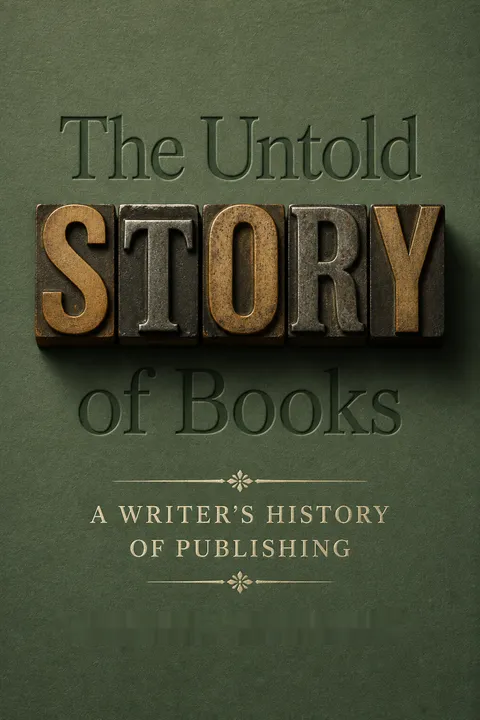

Key Takeaways
1. Book Publishing's Three Distinct Eras: From Hand-Crafted to Digital
This book is my attempt to lift the veil, to demonstrate how the book business actually developed and continues to evolve today.
Three distinct epochs. The history of book publishing is best understood through three major "book businesses," each defined by technological revolutions in printing and unique economic strategies. These shifts consistently led to fewer individuals producing more copies of more books, faster and cheaper per unit. Understanding these eras provides crucial perspective on the industry's current state.
The first business. Beginning with Gutenberg's movable type in 1450 and lasting 450 years, this was an author-centric cottage industry. Authors often acted as entrepreneurs, hiring printers, paying for production, and marketing their own works. Books were incredibly expensive, costing up to $75,000 in today's dollars, making them luxuries for the elite.
The second and third. The second book business, from World War I to 2000, was publisher-centric, with industrial printing allowing publishers to hire authors and cover production costs. This era, often mislabeled "traditional publishing," lasted only about 80 years. The third book business, from the millennium onward, is digital, characterized by unprecedented output, plummeting median sales, and a shift towards sales-and-distribution-centric models, largely dominated by Amazon.
2. Authors' Enduring Struggle: Passion Over Profit Across Centuries
For most authors, writing books has always been a labor of love.
A constant financial tightrope. From ancient scribes to modern digital authors, the dream of making a living from writing has largely remained elusive. Early authors like Thoreau often had "libraries" of their own unsold books, while even prominent figures like Samuel Johnson decried printers as "pirates" for stealing their work and royalties. The industry axiom that 70% of books lose money, 20% break even, and only 10% succeed financially has been a persistent, if often exaggerated, truth.
Declining income in the digital age. The third book business has exacerbated authors' financial woes. Authors Guild surveys reveal a drastic decline in writing-related income since 2009, with full-time authors' median annual income from books alone at a mere $12,000 in 2022. This stark reality means that for the vast majority, book writing is now more of a hobby than a viable career.
The allure of creation. Despite the grim financial outlook, authors continue to write, driven by a profound love for books and the desire to contribute to culture. They seek personal satisfaction, the tangible legacy of a published work, and the joy of expressing themselves, often accepting that financial rewards are a rare bonus rather than an expectation.
3. Piracy: The Unseen Force Shaping Book Economics Since Gutenberg
From the first copyrights to the present day, piracy has been a thread woven through the tapestry of publishing.
An ancient problem. Book piracy is as old as mechanical printing itself. Gutenberg's invention, while revolutionary, immediately led to unauthorized copying. Early copyrights were granted to printers, not authors, and were easily circumvented by rampant smuggling and reprinting across jurisdictions, driven by the public's desire for cheaper books.
Organized theft and legal battles. In America, colonial printers openly pirated English books, and even major publishers like Harper & Brothers were notorious "book pirates." The lack of international copyright until 1891 fueled this practice. Later, the advent of photocopiers and digital technology made piracy easier and more widespread, leading to landmark lawsuits against entities like Kinko's and ongoing battles against digital content theft by AI companies.
The digital dilemma. Today, digital piracy is ubiquitous, with countless websites offering stolen e-books for free or cheap. AI companies have cannibalized millions of copyrighted books to train their large language models without permission or compensation, raising fundamental questions about the meaning of copyright in the digital age. Authors, despite constitutional protection, remain largely powerless against this pervasive theft.
4. Technological Revolutions: The Constant Driver of Publishing Evolution
The printing press spurred literacy and fostered education.
From wood to steam to digital. Each major leap in printing technology has fundamentally reshaped the book business. Gutenberg's movable type democratized information, ending the scribal monopoly. The industrial revolution brought steam-powered presses, iron presses, and linotype machines, dramatically increasing speed and reducing unit costs, making books accessible to the middle class.
The digital transformation. The late 20th and early 21st centuries witnessed the digital revolution, introducing:
- Computerized inventory management
- Digital typesetting and word processing
- E-books and e-readers (Kindle, Nook, iPad)
- Print-on-demand (POD) technology
Profound implications. These innovations have pushed the "fewer people, more copies, faster, cheaper" progression to its limit, allowing individuals to publish globally for next to nothing. This has led to an unprecedented "book glut," with millions of new titles released annually, fundamentally altering the landscape for authors, publishers, and readers alike.
5. The Shifting Landscape of Bookselling: From Salons to Superstores to Community Hubs
Independent booksellers considered wholesale and retail discounting monopolistic and predatory.
Early bookselling. In colonial America, printer-publishers like Samuel Gerrish turned their shops into community centers, offering ale and discussions to attract buyers. As demand grew, dedicated booksellers emerged, but they faced constant pressure from larger entities, first from book fairs and then from department stores.
The rise and fall of chains. Department stores, seeking cultural cachet, became major booksellers by the late 19th century, using deep discounts to undercut independents. This trend continued with the rise of chain superstores like Waldenbooks, B. Dalton, Borders, and Barnes & Noble in the late 20th century, which further decimated independent bookstores through aggressive discounting and market leverage.
The indie revival. After Amazon drove 75% of independent booksellers out of business by 2009, a surprising revival began around 2010. Modern indie bookstores thrive by embracing the "three Cs":
- Community: Hosting author events, writing classes, book groups.
- Curation: Offering carefully selected titles.
- Convening: Creating spaces for literary engagement.
This transformation has made them vital cultural hubs, offering experiences beyond mere transactions.
6. The "Too Many Books" Paradox: A Recurring Lament in Every Era
There is, of course, a great deal of waste in the sending of books for review.… [P]ublishers, as a rule, are inclined to err in the direction of good-naturedly giving copies … instead of refusing requests whose denial may produce an irritation of future inconvenience.
A historical complaint. The lament of "too many books" has echoed through publishing history since the late 19th century, when industrial printing led to a surge in new releases and larger backlists. Publishers worried about overproduction, unsold copies (remainders), and competition from periodicals, often using this complaint to justify rejecting manuscripts or underpaying authors.
The digital deluge. The digital revolution has amplified this paradox to an unprecedented scale. In 2021, 2.7 million new titles were released in the U.S., averaging 7,400 per day. This avalanche of books has led to plummeting median sales per title, with the average new release selling only around 286 copies, and most self-published books selling fewer than 100.
Impact on authors and industry. This glut means that while publishing is easier than ever, gaining visibility and selling books is exponentially harder. Publishers, agents, and booksellers struggle to navigate this crowded market, leading to increased focus on blockbusters and a challenging environment for the vast majority of authors.
7. The Digital Age's Double-Edged Sword: Easy Publishing, Plummeting Income
The digital revolution has enabled authors to express themselves as never before—while pulling the financial rug out from under the vast majority of them and almost everyone else in publishing.
The promise of liberation. Digital publishing promised to eliminate "gatekeepers," allowing authors to connect directly with readers. This has been realized through platforms like Kindle Direct Publishing, which offers quick, easy, and cheap self-publishing for e-books and print-on-demand titles, often with high royalty rates (up to 70% of net sales).
The harsh reality. However, this freedom comes with a crushing impediment: the sheer volume of new releases. With millions of books flooding the market annually, median sales per title have plummeted. This has directly led to a drastic reduction in authors' incomes, making book writing a financially precarious endeavor for all but a tiny fraction of superstars.
The hybrid model emerges. As traditional publishers face existential threats, many are adopting a "hybrid" model, reminiscent of the first book business. They continue to pay for big-name authors but increasingly require others to pay for publication through publishing services companies (PSCs) or in-house imprints. This means authors often pay to publish, even with established houses, blurring the lines between traditional and self-publishing.
8. Amazon's Unrivaled Dominance: A New Gatekeeper in the Digital Realm
Amazon cares less about selling huge numbers of the few blockbusters than about selling any numbers of everything else.
From bookseller to behemoth. Founded in 1994 as an online bookstore, Amazon quickly became the nation's premier bookseller, driving out competitors and eventually controlling 40% of trade sales. Its launch of the Kindle and Kindle Direct Publishing in 2007 cemented its power, giving it a near-monopoly on e-book distribution and a direct pipeline to self-published authors.
Leverage and conflict. Amazon's immense market share grants it unprecedented leverage over publishers, demanding larger wholesale discounts and substantial "promotional fees." This led to conflicts, notably the 2014 battle with Hachette, where Amazon deliberately hampered sales of Hachette titles. This demonstrated Amazon's willingness to sacrifice short-term revenue to assert control over pricing and terms, prioritizing its "long tail" strategy of selling "less of more."
A complex relationship. While Amazon has been a "godsend" for many self-published authors by providing a platform and high royalties, its actions, such as the Kindle Unlimited subscription service, have also significantly reduced authors' incomes. Publishers, despite their reliance on Amazon for sales, view it as a predatory monopoly, constantly struggling against its increasing power and influence over the entire book ecosystem.
9. The Platinum Age of Backlists: Old Titles, New Digital Gold
Big backlists had always been golden. The third book business has turned them into platinum—by offering publishers a lucrative way to cash in on sudden, unanticipated demand.
Consistent value. Backlists—older titles that sell modestly but steadily year after year—have always been a crucial asset for publishers, often providing stability when new releases underperform. Random House, for instance, was built on the steady income from its Modern Library backlist.
Digital amplification. The digital revolution has transformed backlists into "platinum." With all books existing as digital files and the advent of print-on-demand, publishers can maintain vast catalogues indefinitely without warehousing costs. This allows them to capitalize instantly on sudden surges of interest in any niche, efficiently capturing impulse buys through platforms like Amazon.
Strategic importance. The value of backlists was a key, often overlooked, factor in major mergers like Penguin Random House. By combining, publishers amass larger backlists, ensuring a steady, long-term revenue stream that helps offset the risks and declining median sales of new releases in the hyper-competitive digital market.
10. The Conundrum of "Quality": Subjectivity and the Flawed Gatekeepers
Who anointed publishing people gatekeepers, anyway? So, they’re in the book business—so what? They’re just like the rest of us, people with opinions.
The myth of objective quality. The idea that "gatekeepers" (publishers, editors, reviewers) objectively discern literary quality is a persistent myth. Historically, self-publishing was the norm for many celebrated authors like Emerson and Stowe. Publishers often rejected now-canonical works, including Harry Potter, The Diary of Anne Frank, and Catch-22, demonstrating their fallibility in predicting commercial appeal or recognizing artistic merit.
Bias and commercialism. Publishers' decisions are often driven by commercial considerations, fads, and personal connections rather than pure artistic judgment. The stigmatization of self-publishing in the 20th century was a strategic move by traditional publishers to bolster their own authority, not a reflection of inherent quality differences. Studies have even shown self-published e-books sometimes receive higher reader ratings than those from major houses.
Subjectivity of taste. Literary quality is inherently subjective and evolves over time, as seen in the changing veneration of Shakespeare. Awards and reviews, while influential, reflect the opinions of judges and critics, who can be swayed by personal biases or even commercial incentives. In a world where "review bombing" and paid reviews are rampant, discerning genuine quality remains a personal, often challenging, endeavor for readers.
11. Reading's Unyielding Resilience: A Timeless Human Pursuit
When words ignite the intellect and imagination, the result is so compelling that despite the allure of other media, a substantial proportion of the population still chooses to read books.
Defying predictions of doom. Throughout history, new technologies have consistently triggered dire predictions about the demise of books and reading. From the phonograph and radio in the 1920s to movies, television, home video, personal computers, and the internet, each innovation was feared to be the death knell for print. Yet, books have not only survived but thrived.
Unique pleasures. Reading offers a unique, deep, and lasting pleasure that other media cannot replicate. It engages the intellect and imagination in distinct ways, fostering a profound connection between author and reader. This intrinsic value ensures that a significant portion of the population will always choose to read, regardless of competing entertainment options.
Evidence of persistence. Despite concerns like the "Reading at Risk" report, more recent surveys indicate stable or even increasing reading habits among adults. The COVID-19 pandemic, for instance, saw a rise in book sales, demonstrating that even amidst a deluge of digital distractions, people turn to books for comfort, knowledge, and escape.
12. The Future of Publishing: Distribution-Centric and Increasingly Hybrid
The third book business appears headed for domination by distributors.
Shifting power dynamics. The future of the book business points towards increasing dominance by distribution giants like Amazon and Ingram. While publishers once controlled manufacturing and promotion, digital technology has democratized book production, making it cheap and accessible to anyone. This leaves distribution and sales as the critical choke points, giving immense leverage to those who control them.
The distributor battleground. Amazon, with its vast retail platform and direct publishing arms, and Ingram, with its near-monopoly on trade distribution and print-on-demand services, are poised to be the primary contenders for control. Publishers, increasingly vulnerable and unable to grow through traditional mergers, may find themselves further squeezed, potentially becoming acquisition targets for these distribution behemoths.
A hybrid and precarious future. For authors, this means a continued decline in traditional advances and a greater reliance on hybrid publishing models, where they pay for production while retaining more control. The industry will likely see more editors launching their own publishing services companies. While the joy of writing remains, the financial landscape for authors will likely become even more challenging, demanding a realistic understanding of success beyond fame and fortune.
Review Summary
The Untold Story of Books receives an overall rating of 4.03/5, with readers praising its accessible, humorous, and well-researched exploration of publishing history. Most reviewers appreciate its coverage of piracy's role in publishing, the three distinct eras of the book business, and its relevance to modern authors. Common criticisms include its heavy focus on American publishing despite the broad title, occasional dry or disjointed passages, and some readers wishing for deeper coverage of contemporary developments like e-books and AI.
People Also Read

Download PDF
Download EPUB
.epub digital book format is ideal for reading ebooks on phones, tablets, and e-readers.








































