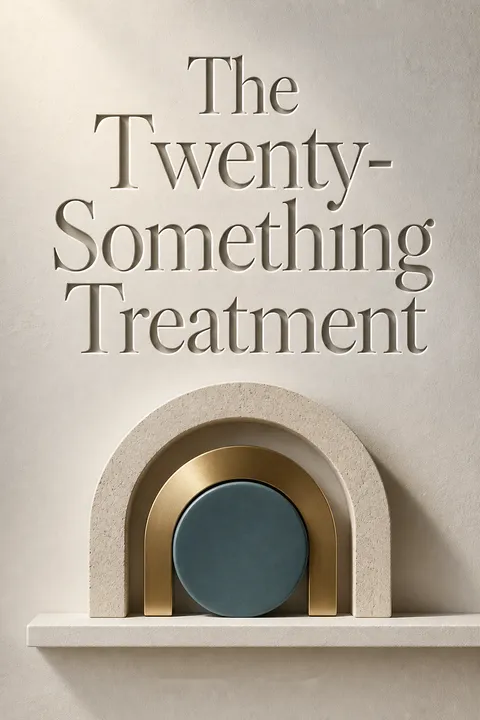

Key Takeaways
1. Embrace Uncertainty as a Catalyst for Growth
The most precious thing in life is its uncertainty.
Uncertainty is inherent. The twenties are inherently the most uncertain years of life, marked by constant shifts in jobs, relationships, and living situations. This period of peak unknowns is interpreted by the brain as danger, triggering stress responses like racing thoughts and a pounding heart. This isn't a flaw; it's an evolutionary mechanism designed to keep us safe, but in modern life, it often leads to chronic stress.
Transdiagnostic stressor. Uncertainty acts as a "transdiagnostic stressor," meaning it contributes to a wide range of mental health issues, including anxiety, depression, and sleep problems. However, our response to uncertainty is key. Instead of viewing it as always awful, learning to tolerate and even embrace unknowns can transform it into a powerful buffer for mental health.
Growth opportunity. Embracing uncertainty means recognizing that unforeseen events can make life exciting and lead to unexpected joys. It's about being open to possibilities and understanding that not having all the answers leaves room for growth and discovery. This shift in mindset can turn a period of potential distress into one of profound personal development.
2. Beware of Over-Diagnosis and Over-Medication
Taking a pill labels you as different and sick, even if you really aren’t.
The medicalization trap. Many twentysomethings are at risk of being overmedicated and overdiagnosed for normal life stressors. When sleepless nights or crying jags are medicalized with a diagnosis or treated with a pill, it often overlooks the significant life changes and uncertainties inherent to this age. This approach can inadvertently label individuals as "sick" when they are simply navigating a challenging developmental stage.
Nocebo effect. Diagnoses, especially self-diagnoses from the internet, can create negative expectations that worsen symptoms—a phenomenon known as the nocebo effect. The DSM, often called the "Bible" of psychiatry, can pathologize common young adult struggles, leading individuals to mistakenly believe they have chronic disorders. For example:
- Major depressive disorder criteria (5 symptoms for 2 weeks) can easily be met during normal life stressors.
- Generalized anxiety disorder (worry for 6 months) is common when life is unsettled.
- Social anxiety disorder (fear of scrutiny) is experienced by over half of twentysomethings.
Skills over pills. While medication can be necessary for severe, brain-based disorders, it often fails to teach essential life skills. Antidepressants, for instance, are often no more effective than placebos for mild-to-moderate symptoms and come with significant side effects and withdrawal challenges. Benzodiazepines are addictive, and stimulants can be counterproductive for neurotypical individuals. The focus should be on building coping mechanisms and life skills, not just symptom suppression.
3. Your Twenties are for Skill-Building, Not Just Suffering
Your twenties may be a mental health low point, but more often than not, they’re a turning point, too.
A developmental turning point. While the twenties are often a mental health low point, they are also a crucial turning point. Longitudinal research shows that mental health typically follows a J-shaped curve, dipping in young adulthood before steadily improving in subsequent decades. By age 35, most individuals report feeling less depressed, anxious, and angry, and more confident, responsible, and decisive.
The brain's final wiring. The prefrontal cortex, responsible for complex problem-solving, decision-making, and emotional regulation, is the last area of the brain to fully wire up, peaking around age 29. This "smart wiring" process means the brain learns from experience. The challenges and "firsts" of young adulthood—first jobs, loves, breakups, mistakes—are not just struggles; they are purposeful training for what's ahead.
Life as the best therapist. Education alone isn't enough; "knowledge is not skill. Knowledge plus 10,000 times is skill." Most client improvement (40%) happens outside of therapy sessions, through real-world experiences. Engaging with life's uncertainties and actively building skills in work, relationships, and self-management is the most effective path to long-term mental well-being.
4. Master Your Mind: Shift from "What If" to "What Is"
You can’t keep the birds of worry from circling your head, but you can prevent them from building nests in your hair.
The default-mode network. When our minds are not actively engaged, they often revert to the "default-mode network," a prediction machine that tends to run mental simulations of worst-case scenarios. This "negativity bias" is a survival mechanism, but it leads to catastrophic thinking, where possible disasters are mistaken for probable ones. Young adults spend more time in this mode and struggle to switch out of it.
Thinking errors. Catastrophizing is just one of several common thinking errors that amplify distress:
- Overgeneralizing: One problem means a lifetime of problems.
- Personalizing: Everything bad is about you.
- Magnifying: Focusing on and enlarging mistakes or flaws.
- Black-and-white thinking: Seeing life in all-or-nothing terms.
- Filtering: Ignoring the positive and noticing only the negative.
Facts over fears. To combat these errors, practice shifting from "what if" to "what is." This involves identifying fear-based statements, naming the thinking error, and replacing fears with facts. "Solving for worst-case scenarios" by playing them out can reveal that even the worst outcomes are often manageable, or simply "a case," not a catastrophe. This trains the brain to move from emotional reactivity to problem-solving.
5. Accept Your Feelings, Don't Suppress Them
Discomfort is a part of life... Mindfulness is not about getting rid of discomfort; it is about accepting discomfort.
The happiness fetish. Society often fetishizes happiness, leading young adults to feel anxious about being anxious or sad about being sad. This pressure to be constantly happy is unrealistic, especially during the twenties, which are statistically the years when people feel their worst. Compared to older adults, young adults experience negative emotions more frequently and intensely.
Personality in flux. The twenties are when personality changes more than at any other time in adult life. Diagnosing "personality disorders" in this age group can be premature and counterproductive, as many "borderline-like" complaints are simply part of a transient developmental stage. Symptoms often lessen with life experience and maturity, proving that "life can change, and you can, too."
Mindful acceptance. Instead of trying to banish uncomfortable feelings, practice mindful acceptance. This means acknowledging feelings without judgment or attempts to suppress them. Neurologically, accepting how we feel reduces activity in the amygdala, leading to less fear and pain. This paradoxical intervention helps feelings pass more quickly and enhances problem-solving, as we become less afraid of our emotions and more capable of handling life's challenges.
6. Work is Your Greatest Teacher (and Stabilizer)
The single biggest driver of positive personality change in adulthood is work.
Growth through occupation. Work is the leading cause of stress in adulthood, but paradoxically, it's also the biggest driver of positive personality change and emotional stability. Engaging in tasks and problems at work activates the "task-positive network," shifting the brain out of default-mode rumination. Work forces growth and change in ways few other experiences can.
Identity capital. Your job is not just about earning money; it's about acquiring "identity capital"—skills and experiences that add value to who you are. In a world of uncertain careers (average of nine jobs by age 35), transportable skills are crucial for stability. Employers expect young workers to learn, so "leaning into what you don't know" and seeking feedback is essential for growth.
The power of proximity. While remote work offers flexibility, it can hinder learning. In-person work provides the "power of proximity," leading to more feedback and on-the-job learning from colleagues. This interaction is vital for young workers, as nearly two-thirds of on-the-job learning comes from co-workers. Showing up for work, even when uncomfortable, exposes you to diverse people and situations, building competence and confidence.
7. Cultivate Real Connections, Not Just Online Validation
Your social media isn’t your social life.
The loneliness epidemic. Young adults are the loneliest demographic, with many reporting no close friends or acquaintances. This isolation is exacerbated by social media, which acts as an "evolutionary trap," hijacking our innate need to be liked. Social media provides a "real-time, grand-scale sociometer" that encourages avoidance of in-person interactions and obsessive impression management.
Social media's downsides:
- Avoidance: Sidestepping anxiety-provoking social interactions.
- Impression Management: Overthinking and overediting posts, monitoring responses.
- Upward Social Comparison: Contrasting personal realities with curated highlights, leading to "compare and despair."
- Social Contagion: Mistakenly diagnosing oneself with disorders seen online.
Closing the liking gap. Most people underestimate how much others like them—a phenomenon called the "liking gap." The only way to build social confidence and close this gap is through repeated, in-person social interactions. Friendship, a "voluntary interdependence," requires effort and time (50 hours for casual, 150+ for best friends). "Be the friend you wish you had" by initiating contact and showing up.
8. Learn to Love (and Recover from Heartbreak)
The pain of grief is just as much a part of life as the joy of love.
Love's dual nature. Love is a powerful drive, activating the brain's pleasure centers, but it also brings profound agony. Romantic uncertainty and heartbreak are universal experiences, especially in young adulthood when relationships are often less stable. Misinterpreting the intense sadness and obsessive thoughts of a breakup as "going crazy" is a common, yet harmful, reaction.
Grief as growth. Heartbreak is a form of grief, and it signifies that your "attachment system—your heart—is working." While painful, breakups can be opportunities for growth, leading to increased self-confidence, independence, and improved conflict-management skills. Making sense of a breakup predicts better mental health and relationship satisfaction years later.
Choosing wisely. To navigate love more successfully, young adults need to "feel less hungry" for love by nourishing themselves through friends, family, and self-care. This allows them to slow down and articulate their values, priorities, and strengths in a partner. Just as one learns what they want from a job through experience, falling in and out of love teaches us how and who to love.
9. Prioritize Movement and Mindful Consumption
The more you move, the better off you’ll be.
Movement as medicine. Physical activity is a powerful, affordable, and accessible intervention for mental health. Studies show that 30 minutes of moderate-to-vigorous activity, 3-5 times a week, can be as effective as psychotherapy or medication in reducing symptoms of depression and anxiety. It releases "happiness hormones" and improves brain connectivity.
Benefits of movement:
- Reduces stress hormones and increases happiness hormones.
- Improves sleep, body image, self-esteem, and social skills.
- Acts as a preventive measure and reduces relapse rates compared to medication.
- "Anything counts"—even small increases in daily activity.
Mindful consumption. How we eat and what substances we consume significantly impact mental health. Unhealthy eating, often a coping mechanism for stress, is normalized in young adulthood. Processed foods are linked to anxiety and depression, while plant-based diets improve well-being. Learning to cook builds "cooking confidence," fostering self-esteem and healthier habits.
Dosage problems. Young adults are most likely to use nonprescription psychoactive drugs regularly or recreationally. These "dosage problems" (using too much or too often) can lead to unintended consequences, from panic attacks to addiction. Changing habits requires making temptations less accessible and replacing them with healthier "replacement behaviors" like new activities or friends.
10. Make Decisions Based on Values, Not Just Data
A good decision is based on knowledge and not on numbers.
Uncertainty paralysis. Twentysomethings face life's most consequential decisions (career, relationships, family) amidst profound uncertainty. This can lead to "uncertainty paralysis," where the inability to know all choices, probabilities, and consequences leaves them unable to act. The desire for perfect information or "algorithms" for life's "large-world problems" is often irrational.
Reassurance is a trap. Seeking constant reassurance from others (parents, friends, therapists) is a common but counterproductive coping mechanism. Like a drug with a short half-life, reassurance provides temporary relief but undermines developing self-assurance, making individuals more anxious over time. It prevents building confidence in one's ability to manage complex, uncertain situations.
Heuristics over algorithms. For large-world problems, where complete information is impossible, decisions are best made using "heuristics"—mental shortcuts guided by personal priorities and values. This means articulating what truly matters to you and letting those criteria guide your choices, rather than agonizing over every possible variable. "When you accept there aren’t any right answers, then you realize there aren’t any wrong answers—there are only your answers."
11. Choose Your Purpose to Anchor Your Life
Nothing contributes so much to tranquilize the mind as a purpose—a point on which the soul may fix its eye.
The rise of the "nones." Many young adults, part of the "rise of the nones" (unaffiliated with religion), seek meaning and structure outside traditional faith. This "purpose anxiety" is a normal feeling of being lost or behind when not knowing one's "personal why." Purpose is a self-organizing form of certainty, a reason for doing that matters to oneself and often beyond.
Beyond the self. Purpose is not found inward but "discovered in the world." It's about engaging with something bigger than oneself, whether through work, relationships, or causes. This outward focus combats self-preoccupation, reduces social anxiety, and even buffers the negative effects of social media on self-esteem. Looking ahead with a "why" provides direction and motivation.
Purpose is a choice. While purpose often takes time and experience to develop, it is ultimately a choice. It's a commitment to something or someone that, once made, feels like an imperative rather than an option. Whether it's teaching, advocating for justice, or building a family, actively choosing and working towards a purpose provides a stable anchor in an uncertain world.
12. Cultivate Hope: Envision Your Future Self
Hope is an expectation greater than zero of achieving a goal.
Life gets better. This isn't just optimism; it's a data-driven truth: life and mental health generally improve with age. While young adulthood is a challenging period, it's followed by decades of increasing well-being, happiness, and satisfaction. This perspective is often missing from the peer-focused narratives of social media.
The power of positive expectations. Hope is a form of positive expectation that acts as a powerful tonic for mental health. It's the belief that efforts can make a difference, leading to goal-setting, perseverance, and achievement. Hope buffers the impact of adverse life events, encourages healthy behaviors, and significantly reduces suicidal thoughts.
Envisioning your future. To cultivate hope, actively envision your "future self" in a positive, detailed way. This practice makes future goals more tangible and motivates present action. Strategies include:
- Making a plan: Identify specific goals and steps.
- Saving money: Investing in your future self makes it feel more real.
- Remembering your future self: Use cues to keep future aspirations alive.
- Spending time with your future self: Interact with older individuals to gain perspective.
- Exchanging letters: Write to and receive letters from your imagined future self.
Hope begins with embracing uncertainty, being open to possibilities, and dedicating oneself to change. It's about recognizing that even a "greater than zero" chance of things going well is enough to keep moving forward.
Review Summary
The Twentysomething Treatment receives mixed reviews (4.14/5). Readers appreciate Dr. Jay's accessible writing and message about embracing uncertainty in one's twenties, though many find the content less groundbreaking than her previous work, The Defining Decade. A major controversy is her bold stance against overprescribing psychiatric medication, advocating "skills over pills," which some found insensitive while others appreciated. Readers valued her no-nonsense therapeutic approach, practical advice on work, relationships, and decision-making, and the book's hopeful, validating tone, though some criticized repetitiveness and condescension.
People Also Read




About the Author

Download PDF
Download EPUB
.epub digital book format is ideal for reading ebooks on phones, tablets, and e-readers.








































