
Plot Summary
Secrets Beneath the Surface
Abby Clark has lived with the shadow of her twin sister Ally's death since childhood. The tragedy shattered their family, leaving Abby with an unbearable secret—one passed between generations of women tied by mysterious gifts and curses. The house, rich with memories and haunted by guilt, is also a home shaped by silence and loss. Abby is now a mother herself, fiercely protective of her daughter, Ava, even as remnants of the past threaten to return. The narrative layers the present with memories, always hinting at something more under the surface—a secret never fully spoken, a truth that may not be what it seems.
Ghosts, Games, and Guilt
In flashbacks, young Abby and Ally, along with their mother Rosemary, fill their home with laughter, sibling bickering, and dress-up games. Their bond is tested by the arrival of mysterious friend Tina, who lures the twins into strange games and unsettling situations—games that blur reality and fantasy. The story of the "Corpse Flower," beautiful but reeking of rot, becomes a dark metaphor for the toxic undercurrents running through the family. The sisters' rivalry and allegiance to Tina foreshadow tragedies to come, all while their mother's own history of trauma and eccentricity lingers at the margins.
The Haunting of Memory
Haunted by what happened to Ally, Abby becomes obsessive in her motherhood, deeply anxious about any threat to Ava. Her daily life is fractured, her relationships strained. Her ex-husband Jared hovers at the periphery—their love marked by loss, misunderstanding, and longing. Ruby, Abby's aunt, is a source of both care and cruelty, her own pain leaking out as bitterness. The old family house becomes a repository for unspoken pain, with its creaking closets and hidden basements. Abby's need for certainty, for controlling her environment, only exacerbates her ghosts, leaving her vulnerable to crippling self-doubt.
Inherited Curses
This is a bloodline where twins, female strife, and tragedy are practically mythic. Tensions between siblings—Rosemary and Ruby, Maria and Sylvia—become rivalries that echo in the youngest generation. The "family curse"—a legacy of one "good" and one "bad" twin—plays out in ritual, rumor, and real catastrophe. The past is layered with unresolved betrayals, failed attempts at escape and forgiveness. These women, bent beneath superstition and hereditary wounds, struggle to distinguish what is "curse" and what is choice, as secrets fester and history threatens to repeat itself through Abby and Ava.
A Family of Mirrors
Characters obsess over mirrored surfaces, family photos, and inherited traits. Abby feels fundamentally altered—her eyes "shifted to match her soul", as if the evil attributed to twins might be literal. Rosemary's descent into muteness and madness is mirrored in Abby's emotional withdrawal; both hide behind silence and compulsive rituals. The house itself is a mirror, reflecting generational trauma. Children reenact traumatic games, sometimes unknowingly repeating the very violence they fear. These fractured women must each confront the reflection they see—not just in glass, but in the faces and fates of their daughters and sisters.
The Invisible Sister
When Abby overhears Ava speaking to "Ally"—the name of Abby's dead sister—she is ripped open by terror. The line between imagination and haunting blurs: both Mia, a new student, and Ava begin to describe "friends" that sound strikingly like the lost Ally, or the sinister Tina. Are these simply children echoing what they sense in adults, or are old wrongs reaching from beyond the grave? Abby's rational mind falters, her certainty crumbles, as she wonders whether she is losing touch with reality—or if the past is demanding to be reckoned with in the present, through her child.
Colliding Timelines
The narrative ping-pongs among childhood, adolescence, and adulthood: Abuse, betrayal, shame repeat in loops. Ruby's memories of envying Rosemary with a poisonous intensity, their mother Maria's descent into dementia, and Rosemary's own struggles with marriage and resentment all color the present crisis. The arrival of disturbing students—Mason and Mia, with their emotional wounds and eerie connections to the Clark family drama—mirrors how every new generation inherits the family's unhealed strife. The central mystery persists: who—if anyone—bears the guilt for Ally's death? Or is this the legacy everyone must, in some sense, carry?
Roses, Thorns, and Grudges
As the story winds through the minds of Rosemary, Ruby, and Abby, we see lives choked by resentment. Rosemary feels cursed by her own "badness," haunted by loss and her mother's disappointment. Ruby, perpetually the "unloved" twin, let her anger fester into sabotage, only to find it hollow and self-consuming. Abby, inheriting all this, cannot forgive herself or anyone else. Attempts at healing—through therapy, Scrabble visits, reconnecting with estranged family—are usually sabotaged by denial and shame. Healing feels impossible until the truth behind Ally's death, and the true "villain," are unmasked.
The Guardian Closets
What is hidden in this novel is as important as what is spoken. Closets are sites of punishment and shame (Ruby locking Abby away), but also of childhood refuge. The basement, in particular, is more than a room; it's a crypt, a hiding place for family skeletons, and the final repository for lost evidence. Drawings, old toys, and a mysterious memory box hint at truths too overwhelming to face in childhood. Objects resurface—an old bunny, a letter, a photograph—just in time to force the adult Abby and her family to confront the ghosts they locked away.
Wrong Sisters, Wronged Daughters
In a series of shocking revelations, the supposed lines between perpetrator, victim, and bystander blur. Tina, once believed to be an imaginary friend or childhood scapegoat, is revealed as real—and far more sinister than anyone guessed. Ruby's manipulation and guilt, and Abby's self-hatred, are given new context: they've been haunted and manipulated by someone driven by her own sense of injury, her own claim to kinship. The "bad twin" myth turns literal, with blood relations spanning across generations and even families. The complex, wicked triangle finally comes into sharp focus.
Playing Pretend with the Dead
As the present-day plot spirals into violence—culminating in Megan and Kris's reveal as allies of Tina/Kristina—truth, illusion, and madness collide. Ghostly visitations, psychic warnings, and literal stabbings occur side by side. Old betrayals are reenacted; closets are breached; family members are menaced and killed; children are nearly lost to the same cycle of trauma and neglect. The haunted house reveals its final secret: sometimes the most dangerous ghosts are living people, fueled by the wounds and lies of the past. Breaking the cycle relies on mutual recognition, courage, and love.
The Other Daughter
Ava, Abby's daughter, and Mia, a new arrival in town, mirror the sisters, cousins, and doubles that came before them. The children's uncanny knowledge and strange visions force the women to finally face what happened. Gifts—poetic or psychic, cursed or magical—become tools of both danger and survival. It's Ava's courage, prompted by the spectral Ally, that breaks the hold of evil. Bonds cross time; mothers, daughters, and grandmothers together confront what was long denied, choosing to act not out of inherited spite, but out of genuine love and protection.
A Web of Blame
The entire family must confront their role—active or passive—in the cycles of loss and violence. Letters, confessions, and direct confrontations unmask long-held secrets. Ruby and Abby, both wounded and wounding, find the possibility of reconciliation. Abby and Jared confront their shared trauma and inheritance of pain, finding a way to love each other and their child without further harm. The true "bad twin" is exposed, but the narrative makes clear: evil is not in blood, but in choices; pain is not fate, but desperately asking for understanding and help.
What's Buried Returns
Just as physical artifacts—bunny, letter, photo, memory box—are retrieved from the earth, so are long-buried truths brought into the light. The dig for evidence mirrors the slow, painful work of admitting the truth to oneself and others. This process is not without pain: it costs family, love, safety. But the result is liberation from a story that, left unexamined, would only continue to destroy. Only by "exhuming" the past can the present be healed, the curse broken, and a new narrative written for self and family.
The House That Holds Us
The physical house, once a locus of pain and secrets, becomes a place for healing. The family, reconfigured and expanded, reclaims ritual and celebration (storytelling, movies, sleepovers) for warmth and comfort. The "bad smells" and haunted spaces are cleansed, not by denial, but by honest confrontation. The children inherit not only the wounds but also the wisdom. Abby and Jared reclaim their love; Ava learns how to understand, not fear, her strange gifts. The house becomes not only a place of old ghosts, but a site of new community and hope.
Breakdown at the Oak
Abby is forced to relive the moment of her sister's death at the ancient oak—the site of so much symbolism and pain. Jared's presence, unconditional and patient, allows her to feel the full weight and complexity of her memories for the first time. As she relives, she finds deeper layers of truth, recognizing how she was manipulated, how blame was wrongly assigned, and how the family myth nearly destroyed her. A moment of breakdown paves the way to a new kind of strength.
The Bad Twin Revealed
In the final revelations, Tina/Kristina's identity is made clear: she is the literal "bad twin," a product of generational trauma, foster care, mental illness, and envy. Her crimes and manipulations are dragged into daylight. The supernatural and the social are intertwined: ghosts, curses, therapy, and law all play a part. The family, at last, stops the cycle of neglect and violence by acting—calling police, intervening, choosing solidarity over shame. The "curse" is revealed as a story that demanded to be rewritten. The dead are given peace. The living, at last, are given a second chance—both in love and in honesty.
Analysis
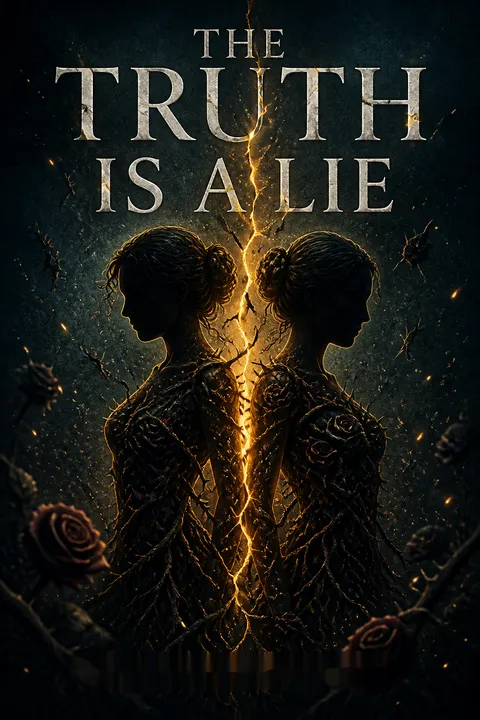
The Truth Is a Lieexplores the tangled roots of family trauma, the myth of the "bad twin," and the struggle to reclaim one's narrative from the grip of guilt, superstition, and inherited shame. At its heart, the novel is both a psychological thriller and a modern gothic, where haunted house and haunted mind are inseparable. Its creative use of multi-generational voices, foreshadowing, and nonlinear structure mirrors the way trauma is actually experienced—not as a neat sequence, but as echoes, obsessions, and repetitions. The book's greatest insight is its insistence that neither guilt nor "curse" are unchangeable fate. By dragging buried truths into the open, facing down the monsters (both literal and metaphorical), and risking honest love, the characters find a way to break the pattern. In contemporary terms, the novel is deeply relevant: it addresses cycles of abuse, the failures of mental healthcare and foster care, the cost of silence, and the possibility—hard won—of intergenerational healing. It reminds readers that while the past may always haunt, the future is still being written.
People Also Read
Characters
Abby Clark
Abby is a woman shaped by loss and guilt, forever marked by the death of her twin sister, Ally. She is fiercely protective of her daughter Ava, haunted by the fear that she might "pass down" the curse of violence or misfortune that seems to haunt the women of her family. Abby's psyche is riven by contradictory needs for control and confession: she represses, denies, and yet aches for forgiveness and release. Her relationships—with Jared, Ruby, Rosemary—are marked by ambivalence, longing, and fear of abandonment. Over the course of the narrative, Abby is forced to face the full complexity of the past and finally unearth what has been buried, both literally and emotionally. She shifts from silent victim to courageous truth-teller, and finally, becomes someone capable of loving herself.
Rosemary (Abby's Mother)
Rosemary is both victim and, at times, a perpetrator in the circle of familial harm. Scarred by her own history as a "bad" or "gifted" twin, she is eccentric, creative, and traumatized. Her breakdown and retreat into silence following Ally's death function as both evasion and atonement. Yet, she possesses a hard-won wisdom: she recognizes, even in her muteness, that secrets and gifts are double-edged. Her re-emergence into Abby's life marks the beginning of true healing for both. She also embodies the lineage of psychically "gifted" women in the family—her visions both curse and lantern.
Ruby (Abby's Aunt)
Ruby, who raised Abby after Rosemary's collapse, is initially the story's antagonistic mother figure—prickly, bitter, manipulative. Her resentment toward her own twin, her jealousy, and her sense of having "missed out" fuel much of the family's dysfunction. Yet, she is also a victim of her circumstances, systematically unloved and undervalued. Her journey is one from unacknowledged regret to public confession, and finally a desire for reconciliation. The triangle of Abby, Ruby, and Rosemary is core to the narrative's drama and its eventual possibility of healing.
Jared (Abby's Ex-Husband)
Jared is defined by his attempts to save or at least steady Abby, all while grappling with his own history of paternal abuse and inadequacy. He attempts to heal the family—arranging meetings, seeking out Rosemary, trying to "fix" what is broken. Yet he is not above his own flaws: his relationship with Kris is a mark of his confusion and longing. Ultimately, his enduring love for Abby is what enables the possibility of a new beginning. He, too, must come to believe that being wounded does not preclude being worthy or capable of happiness.
Ally (Abby's Twin Sister)
Ally appears as a ghost, a memory, an accused victim, and finally—as a voice guiding the living toward truth. Her fate is the rupture around which all else circles. She is both unfairly blamed and deeply mourned. Through her, the story explores sibling rivalry, the volatility of childhood, and the power of misunderstood love. Her presence in Ava's life as an "imaginary friend" destabilizes the boundary between living and dead. Ally is not simply lost—she is a force drawing the family toward honesty, even from beyond the grave.
Tina/Kristina (Tina, aka Dr. Black/Kris)
Once a shadowy, possibly imaginary figure in Abby's childhood, Tina is ultimately revealed as the real antagonist—a traumatized, cunning, and vengeful woman who sought to force herself into the family by any means necessary. Her manipulation of the story's children, her capacity for violence, and her own sense of being cheated echo the worst possibilities of the family legend. Disguised as Kris, she infiltrates the present, nearly repeating tragedy. Tina is not evil by "blood" but by the way trauma, neglect, and rage are folded into a personality left unhealed.
Megan
Initially comic and supportive, Megan is revealed to be a conspirator (and lover) with Kris/Tina, manipulated by love and her own sense of injury. She illustrates how rage and affection can be twisted into complicity with evil. Megan is by turns pathetic, cruel, and tragic—a reminder that the web of hurt spreads outwards, catching new victims.
Ava (Abby's Daughter)
Ava is both a reflection of Abby's lost innocence and the promise of something new. Haunted by "imaginary" friends who are actually ancestral ghosts, she transcends the old curse. Her courage and intuition allow her to act heroically in the story's climax, saving herself and helping break the pattern of familial violence. Ava gives the older generation a reason to hope and repair.
Ewelina and Angie (Angelina)
Ewelina, a gruff, Polish-accented former psychiatric patient, and her daughter Angie, who works at Serenity Oaks, are both surprising sources of wisdom and strength. They are connected by blood and by their own fraught experience of being "the other sister." Their entry into the narrative expands the circle of redemption, linking the fate of many "good" and "bad" sisters across the generations.
Kristina "Kris" Black
Concealed beneath the surface as Jared and Abby's colleague, Kris is the adult incarnation of the story's childhood horror—Tina. Her intelligence, ambition, and charisma hide a deep well of damaging need. She illustrates how the failures of family and society—foster care, scapegoating, untreated illness—can twist gifted children into monsters when their pain goes unaddressed. Her presence brings the story's mythic and psychological themes into sharp, real-world focus, setting the stage for the family's ultimate reckoning.
Plot Devices
Childhood Trauma as Living Entity
The narrative structure relies heavily on the way childhood trauma is not only remembered but relived in adulthood. Supernatural elements—ghosts, visions, psychic warnings—are deployed both as literal possibilities and as metaphors for unprocessed pain and guilt. The closet, basement, and attic become psychological as well as physical spaces: places where memory is stuffed away, where lies ferment, and where reconciliation (or terror) is ultimately found. "Imaginary" friends and objects (like the bunny or mood ring) operate as plot tokens that surface at critical moments to catalyze revelation.
Nonlinear, Multi-Generational Narrative
The novel deftly shifts between the perspectives of children and adults, and between generations. Flashbacks reveal betrayed sisters, parental abuses, and lost children, drawing careful parallels: each generation echoes the last. Letters, photographs, drawings, and oral histories serve as both clues and obstacles to the ultimate truth. The myth of the "bad twin" is at once deconstructed and literalized in the lives of Rosemary, Ruby, Abby, Ally, Tina, Ewelina, and Angie/Angelina.
Foreshadowing through Ritual and Recurrence
Hide-and-seek, closet lock-ins, bedtime stories, the Corpse Flower, and the "magical" lines on hands—all recur as motifs and omens. Present-day behaviors—Ava's games, Abby's anxieties—are foreshadowed by flashbacks and repeated behaviors. The opening of old wounds and the revealing of long-buried objects is echoed structurally by the return of people who were believed gone, and by the echo of language across decades ("I'm sorry, Rosemary," "You have to face your fears," "Face your fears.")
False Confessions, Gaslighting, and Unreliable Memory
The interplay between what happened, what is remembered, and what is confessed creates a shifting ground of truth. Tina/Kristina's manipulations, both in childhood and adulthood, rely on convincing others that she was never really there, or that the wrong person is to blame. Guilt is internalized and weaponized within the family until the evidence—letters, photos, confessions—forces the narrative to reorient. The reader is never able to be certain until the conclusion, as even the protagonists do not know which of their memories can be trusted.
Breaking the Cycle, Reclaiming the Narrative
The climax relies not on supernatural deliverance, but on the characters' willingness to intervene, confess, forgive, and act in solidarity. The "curse" is exposed as a powerful story, one that dictates behavior until it is questioned, revised, or rejected. Rituals—pancake day, group movie night, telling the truth, checking for monsters under the bed—are reclaimed as sources of healing, rather than harm. The final moments, with the next generation playing together, watching movies, and the house reborn, suggest that curses are only as lasting as the stories we are willing to live by.
Download PDF
Download EPUB
.epub digital book format is ideal for reading ebooks on phones, tablets, and e-readers.








































