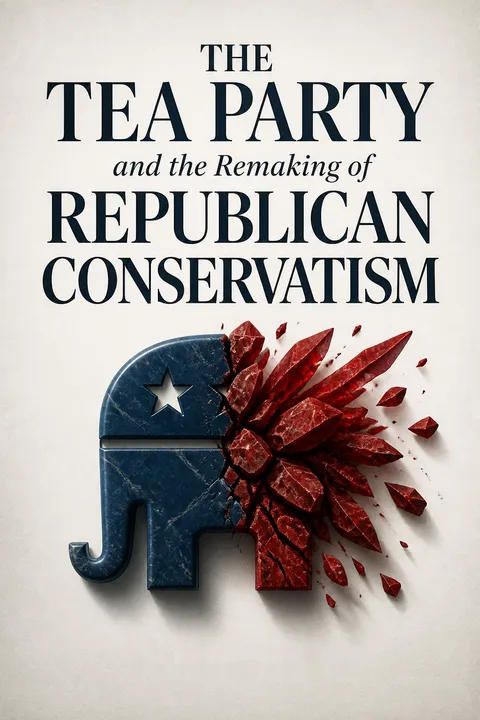

Key Takeaways
1. The Tea Party's Emergence: A Blend of Grassroots and Elite Orchestration
Considered in its entirety, the Tea Party is neither a top-down creation nor a bottom-up explosion.
A unique blend. The Tea Party's rapid rise in 2009 was a dynamic interplay of three forces: energized grassroots activists, well-funded national advocacy groups, and a supportive conservative media. This combination allowed it to quickly gain prominence, challenging assumptions about post-2008 U.S. politics. It defied easy categorization as a traditional social movement or third party, instead leveraging diverse elements for maximum impact.
Initial spark. The movement ignited after CNBC reporter Rick Santelli's televised tirade against mortgage bailouts in February 2009, which conservative bloggers and radio hosts quickly amplified. This rhetorical "Tea Party" call resonated with disgruntled conservatives, leading to initial protests that were then heavily promoted by Fox News, transforming scattered discontent into a visible national phenomenon.
Beyond rallies. While early efforts focused on dramatic protests, the movement soon evolved into sustained, face-to-face community organizing. Thousands of local Tea Party groups formed across the country, demonstrating a remarkable capacity for self-organization and sustained engagement, distinguishing it from mere media-driven outbursts.
2. Demographics: An Older, White, Middle-Class Conservative Base
From all available evidence, active participants and the broader circles of Tea Party supporters come from similar social backgrounds.
Distinct profile. Tea Party participants are overwhelmingly older, white, married, and relatively well-educated and economically comfortable compared to the average American. Most are lifelong Republicans or staunch conservatives, with a significant portion identifying as evangelical Protestants and regular church-goers.
Comfortable, not wealthy. While generally better off economically, most grassroots Tea Partiers are comfortably middle-class rather than truly wealthy. Many are retirees or small business owners, often in sectors like construction or real estate, who experienced economic shocks during the 2008 recession but were not among the hardest hit demographics.
Proudly older. The movement's age profile is a key characteristic, with most attendees at local meetings being in their fifties, sixties, or older. This demographic often views their participation as a duty born of "older and wiser" experience, aiming to "take the country back" to values they believe are eroding, with less emphasis on recruiting younger members.
3. Core Ideology: Unwavering Constitutionalism and Anti-Government Sentiment
Just as Rick Santelli invoked Founding Fathers to excoriate an Obama mortgage-assistance measure, so do Tea Party groups across America link their present-day activities to a constantly restated reverence for the country’s founding documents: the Constitution, the Bill of Rights, and the Declaration of Independence.
Sacred texts. The U.S. Constitution, Declaration of Independence, and Bill of Rights are central to Tea Party identity, treated as sacred, clear-cut documents directly applicable to modern political issues. Pocket-sized Constitutions are ubiquitous, and "Constitution Study Groups" are common, often drawing parallels to biblical interpretation.
Skepticism of expertise. This reverence for foundational documents is coupled with a deep distrust of experts, politicians, and academics who are perceived as misinterpreting or disregarding the Constitution. Tea Partiers believe average Americans can and should interpret these documents themselves, often leading to confident but factually inaccurate claims about legislation.
Selective application. While advocating for "limited government" in abstract, Tea Partiers exhibit inconsistencies. They fiercely oppose regulations on business and property but strongly support government intervention to:
- Police immigrants
- Enforce traditional moral norms (e.g., abortion, gay marriage)
- Maintain strong law enforcement, even at budgetary expense
4. Economic Anxieties: Politically Charged Fears of Decline and Redistribution
For Tea Partiers, however, pessimism about the economy is politically tinged.
Beyond recession. While the Great Recession of 2008 provided a backdrop, Tea Partiers' economic worries are deeply intertwined with their political ideology. They view government intervention, particularly under the Obama administration, as exacerbating economic problems rather than solving them.
"Earned" vs. "unearned" benefits. Tea Partiers are not against all government spending. They strongly support programs like Social Security, Medicare, and veterans' benefits, which they perceive as "earned" through lifetimes of hard work and contributions. However, they vehemently oppose "welfare" and other forms of public assistance for those they deem "undeserving" or "freeloaders."
Fear of tax hikes. A significant concern is the fear of increased taxes on themselves and other "productive" citizens to fund programs for "unworthy" recipients. This fuels their fervent opposition to tax increases and calls for drastic cuts in federal spending, often without specifying which popular programs should be cut.
5. Social and Cultural Fears: Defending "Their Country" from Perceived Threats
This plaintive call is perhaps the most characteristic and persistent theme in grassroots Tea Party activism.
"I want my country back!" This rallying cry encapsulates a profound sense of dread among Tea Partiers that America is rapidly changing in ways they fear. They perceive a decline in traditional values and societal norms, often linking these changes to immigration, younger generations, and liberal cultural elites.
Stereotypes and prejudice. While most Tea Partiers avoid overt racism, racial and ethnic stereotypes often underpin their discussions of "undeserving" groups. Concerns about illegal immigration are widespread, focusing on the perceived burden on public services and the notion of "lawbreakers" unfairly benefiting from American resources.
Generational resentment. Younger generations are frequently portrayed as "overly entitled" and lacking a strong work ethic, contributing to the perception of societal decline. This fuels resentment towards public spending on programs benefiting younger, more diverse cohorts, contrasting with their own perceived hard-earned success.
6. Barack Obama: The Central Catalyst and Symbol of Opposition
Nowhere are Tea Party fears more potently symbolized than in the presidency of Barack Hussein Obama.
The ultimate "other." The Tea Party movement burst onto the scene weeks after Obama's inauguration, with his presidency serving as the primary catalyst for their mobilization. For many Tea Partiers, Obama is an incomprehensible figure, often viewed with immense suspicion and portrayed as "un-American," a "socialist," or even a "foreigner."
Policy and person. Obama's policy agenda, particularly the Affordable Care Act and economic stimulus, was seen as a direct threat to their values and economic security. His background as a community organizer and academic, combined with his racial and ethnic heritage, made him an easy target for portraying him as an elite outsider working against "real Americans."
Conspiracy theories. The distrust of Obama often veers into conspiracy theories, including "Birtherist" claims about his birth certificate and beliefs that his administration is plotting to seize private assets or impose martial law. These fears, amplified by conservative media, solidify Obama's role as the ultimate symbol of everything Tea Partiers oppose.
7. Conservative Media: The Indispensable Megaphone and Cheerleader
Crucially, the conservative media quickly joined and helped to orchestrate the Tea Party, breaking down the barriers between media and movement that have usually been so challenging for protestors to navigate.
Fox News's pivotal role. Conservative media, especially Fox News, talk radio, and influential blogs, were instrumental in the Tea Party's rapid rise. Fox News acted as a "social movement orchestrator," providing:
- Advance publicity for rallies
- Guides to local events
- A platform for Tea Party organizers and politicians
- A constant narrative reinforcing Tea Party messages
Echo chamber effect. This "echo chamber" created a shared community of meaning for conservatives, where messages circulated between national and local sources, amplifying grievances and shaping a distinct worldview. Fox News viewers, predominantly older and conservative, became heavily overlapping with Tea Party participants.
Framing the narrative. Fox News consistently framed the Tea Party as "grassroots," "genuine," "spontaneous," and "mainstream," while portraying its critics as "elite" and dismissive. This narrative helped legitimize the movement and encouraged participation, even as it often presented a simplified or misleading picture of its true nature and goals.
8. Organizational Dynamics: Loose Ties and Mutual Leverage Between Levels
Everyone is trying to leverage something they want from others in the network.
Decentralized structure. The Tea Party is a loose collection of jostling local and national organizations, rather than a unified, centrally controlled entity. This decentralized nature allowed for rapid growth and adaptability, as local groups could form organically while national entities provided support and amplified their message.
National players. Key national organizations include:
- FreedomWorks & Americans for Prosperity (AFP): Billionaire-backed advocacy groups pushing ultra-free-market policies, offering training and speakers to local groups.
- Tea Party Express (TPE): A PAC that funds conservative GOP candidates and stages media-friendly bus tours.
- Tea Party Patriots (TPP): An umbrella group that coordinates local groups through webinars and offers small grants.
Mutual benefits and tensions. Local groups benefit from national resources, publicity, and ideological guidance, while national organizations gain a "grassroots" veneer to enhance their political clout and fundraising. However, tensions arise over control, financial transparency, and the use of the Tea Party label for specific policy agendas, especially when national groups push ideas unpopular at the grassroots.
9. Electoral Impact: Boosting the GOP While Prodding It Rightward
As Tea Party forces make headway in achieving this ideological purification, they spur movement of the Republican Party ever further toward the right, and align the party with a label that principally appeals to older, very conservative white voters.
2010 victories. The Tea Party significantly contributed to the Republican Party's commanding victories in the 2010 midterm elections, helping the GOP regain control of the House and make substantial gains in the Senate and state legislatures. It re-energized the conservative base, set the national agenda, and motivated older, white voters to turn out in disproportionate numbers.
Primary challenges. Beyond boosting turnout, Tea Party funders and kingmakers actively intervened in GOP primaries, often backing ultra-conservative challengers against more moderate Republican incumbents. This strategy, while sometimes costing the GOP winnable general election seats (e.g., Christine O'Donnell in Delaware), successfully pushed the party's ideological center of gravity sharply to the right.
Legislative shift. The influx of Tea Party-aligned legislators in the 112th Congress led to an unprecedented rightward shift in the House of Representatives. These new lawmakers, often guided by ideological elites from groups like FreedomWorks and AFP, adopted radical policy agendas, such as the Ryan budget, which proposed massive cuts to social programs and tax cuts for the wealthy.
10. Paradoxes of Citizenship: Engaged Activism Meets Misinformation and Intolerance
If people actively engage in the political process but on mistaken premises, is that good or bad for democracy?
Active engagement. Grassroots Tea Partiers exemplify active citizenship, voluntarily organizing events, running meetings, and learning the intricacies of political processes at local, state, and national levels. Their "let's pitch in and get it done" attitude is reminiscent of classic American civic engagement.
Factual disconnect. Despite their engagement and savvy about political procedures, Tea Partiers often hold wildly inaccurate beliefs about government policies, financing, and legislative content. This misinformation, frequently propagated by conservative media, creates a paradox where active participation is based on factually ungrounded premises.
In-group solidarity, out-group intolerance. While fostering strong solidarity and mutual understanding among diverse members within their groups, Tea Partiers often exhibit a lack of empathy and resort to demonizing stereotypes for fellow Americans outside their movement. Organized political opponents, immigrants, and younger generations are frequently castigated as unpatriotic or "freeloaders."
11. Lasting Influence: Reshaping Republican Politics Beyond Popularity
For better and worse, Tea Party–style politics is likely to remain, for some time to come, a pivotal part of ongoing, fierce disputes about what U.S. government should do and not do.
Enduring forces. Despite potential shifts in the "Tea Party" label's popularity, the underlying forces—grassroots activists, national advocacy organizations, and conservative media—are likely to remain active. Their organizational capacity, financial resources, and established networks ensure continued influence, particularly within the Republican Party.
Policy overreach risks. The ideological zeal of Tea Party-aligned elites has led to policy proposals (like the Ryan budget) that are unpopular with the broader public, including many independents and even some moderate Republicans. This risks alienating crucial swing voters in future elections, potentially turning the Tea Party from an asset into an electoral liability for the GOP.
Sharpening social tensions. The Tea Party's activism exacerbates existing generational and cultural divides in U.S. politics, pitting older, predominantly white conservatives against younger, more racially diverse cohorts. This "grey" versus "brown" dynamic, fueled by fears of redistribution and cultural change, will continue to shape fierce disputes over government's role and resource allocation.
Review Summary
The Tea Party and the Remaking of Republican Conservatism receives mixed reviews averaging 3.82/5. Reviewers praise Skocpol and Williamson's extensive fieldwork and methodology, describing an older, white, middle-class demographic supporting Medicare while opposing redistribution to "others." The book examines three movement components: grassroots activists, wealthy funders, and media amplification. Critics note its 2012 publication date limits relevance given Trump's rise. Some find it repetitive or lacking cohesive narrative, while others appreciate its balanced, scholarly approach despite liberal academic perspectives showing through occasionally.
People Also Read









About the Author


Download PDF
Download EPUB
.epub digital book format is ideal for reading ebooks on phones, tablets, and e-readers.








































