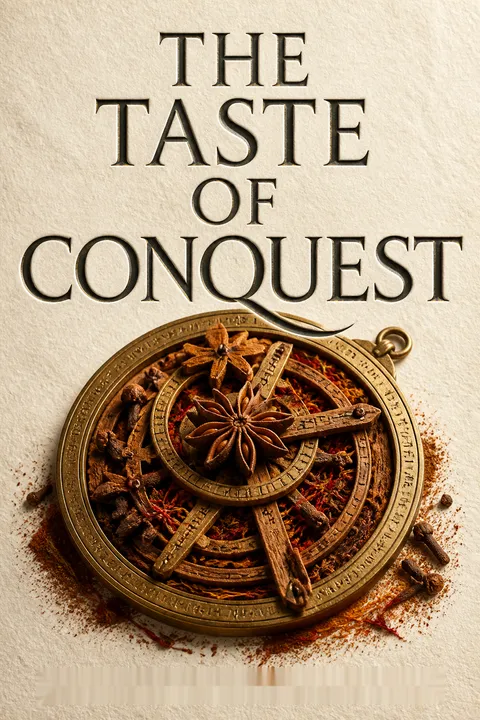

Key Takeaways
1. Spices: More Than Just Flavor – A Symbol of Status and Health
That spices were integral to an opulent lifestyle, even a “necessity” required by one group to set itself apart from another, is incontrovertible.
Luxury and status. For centuries, spices were far more than mere food additives; they were potent symbols of wealth, power, and social standing in Europe. Their high cost, exotic origins, and perceived magical qualities made them essential for the elite to display their affluence, much like designer goods today. The more exotic and abundant the spices, the more it spoke of one's place in the pecking order.
Nutraceuticals and medicine. Beyond status, spices were widely believed to possess significant medicinal and "corrective" properties, deeply integrated into the medieval humoral system of nutrition. Physicians prescribed them for everything from plague to impotence, believing they could balance bodily humors and enhance mental acuity. This perceived therapeutic value further elevated their importance and demand.
Misconceptions debunked. Contrary to popular belief, spices were not primarily used as preservatives or to mask rancid food. Historical cookbooks show spices added late in cooking, negating any preservative effect. Wealthy Europeans who could afford exotic spices could certainly afford fresh meat, and salt was a far more effective and cheaper preservative. The demand was driven by taste, status, and perceived health benefits.
2. The Medieval "Spice Orgy" – A Misunderstood Culinary Trend
I’d love to invite these academics to the Sultan restaurant. Perhaps then they would understand how perfectly credible is the medieval account that records the use of a seemingly spectacular two pounds of spices at a single bash.
Exaggerated claims. The notion of a medieval "spice orgy," where food was drowned in tsunamis of spice, is largely a misinterpretation by modern historians. While medieval recipes often called for "fine spices," the quantities were rarely as excessive as imagined, especially when considering the enormous portion sizes of aristocratic feasts.
Contextualizing consumption. A famous 14th-century wedding feast, for example, listed two pounds of spices for over 600 pounds of meat, translating to less than half a teaspoon per pound. This was an extravagance of the entire event, not just the spices. Compared to modern Balti cuisine, which uses significantly more seasoning per pound of meat, medieval food was likely less intensely spiced than often portrayed.
Taste and availability. While spices were certainly more prominent in elite medieval cuisine than in modern European cooking, their use was also a function of cost and availability. Ginger and saffron were popular, but pepper, though widely imported, was often considered too commonplace for elite cookbooks, suggesting a nuanced approach to seasoning that varied by social class and specific dish.
3. Venice: Europe's First Spice Empire, Built on Byzantine Legacy
Here, money bred money. As a result, the relatively puny republic could take on vastly bigger and more populous powers such as the kingdom of Hungary, which repeatedly (and unsuccessfully) tried to muscle in on Venice’s backyard, and more fatefully, even populous Byzantium.
From marsh to metropolis. Venice, a city built on a bog, transformed itself into Europe's greatest spice entrepôt by leveraging its strategic location and developing ruthless commercial strategies. Its early success in the salt trade provided a template for controlling trade routes, which was later applied to spices.
Byzantine influence and Crusader gains. Venice's culture, law, and culinary tastes were deeply influenced by Constantinople, its former overlord. The Crusades provided a massive windfall, allowing Venice to establish trading colonies across the Levant and eventually sack Constantinople in 1204, securing its dominance over the eastern Mediterranean spice routes.
A merchant republic. Unlike feudal states, Venice was a government of businessmen, by businessmen, for businessmen. The state actively managed the spice trade through armed convoys (the muda) and ensured profits for all, from wealthy investors to small-time merchants. This unique structure allowed a small republic to amass immense wealth and power, making pepper the "lubricant of trade."
4. Portugal's Audacious Quest: Faith, Gold, and the Cape Route to India
The Portuguese approached the spice trade much as they had the attack on Ceuta, flailing their battle lances and yelling out the war cry Santiago e a elles! (“Saint James and at them!”).
Poverty and ambition. Portugal, a small and impoverished nation on Europe's western edge, sought wealth and glory overseas. King João I, with his restless knights, initiated expansion into North Africa, capturing Ceuta in 1415, which revealed the riches of sub-Saharan gold and African melegueta pepper.
Religious zeal and strategic imperative. The Portuguese quest was deeply intertwined with religious fervor, viewing expansion as a continuation of the Crusades against Islam and a search for the mythical Christian ruler Prester John. Circumnavigating Africa was a military maneuver to outflank Muslim powers and establish a direct route to India's "Christians and spices."
The Carreira da Índia. Under King Manuel I, Vasco da Gama's epic voyage in 1497-99 opened the direct sea route to Calicut, India. Despite initial diplomatic blunders and heavy losses, the promise of immense profits from black pepper, cinnamon, and other spices, combined with the crusading spirit, led to the establishment of an annual fleet, the Carreira da Índia, transforming Lisbon into a global spice hub.
5. The Dutch East India Company: A Ruthless Corporation Reshaping Global Trade
In effect, the Dutch government created a state within a state, a paramilitary corporation designed to attack Spanish interests even while making a profit for the shareholders.
Rise from conflict. Amsterdam's ascent as a global power was accelerated by its war of independence against Spain. Cut off from Lisbon's spice market, the Dutch, armed with intelligence from Jan Huyghen van Linschoten's Itinerario, saw an opportunity to seize the spice trade directly from the Portuguese, who were then under Spanish rule.
The VOC: A new model. In 1602, competing Dutch companies merged to form the United Dutch East India Company (VOC), the world's first joint-stock corporation. This paramilitary entity was granted unprecedented powers by the government, including the right to make treaties, build forts, and wage war, effectively becoming a state within a state, driven purely by profit.
Efficiency and ruthlessness. Unlike the Portuguese, whose motives were a mix of religion, dynasty, and commerce, the VOC was singularly focused on maximizing shareholder returns. This led to highly efficient but often brutal business practices, including the systematic elimination of competition and the establishment of monopolies through force, setting a new standard for global corporate power.
6. The Moluccas: A Tiny Archipelago, a Global Battleground for Spice Monopoly
It would appear that Coen had the glimmerings of a final solution to the supply problem at least as early as 1618.
Precious Moluccan spices. Cloves, nutmeg, and mace, growing exclusively on the tiny Moluccan islands, were far more valuable pound for pound than pepper. The Bandanese, in particular, relied on nutmeg as their sole cash crop, trading it for essential food. This concentration of supply made these islands a prime target for European powers.
Jan Pieterszoon Coen's brutal strategy. Jan Pieterszoon Coen, the VOC's governor-general, was determined to secure a complete monopoly. After years of native resistance and English competition, he implemented a "final solution" in 1621, massacring or enslaving nearly the entire Bandanese population (from 15,000 to about 1,000 survivors) to establish Dutch plantations worked by imported slaves.
Extirpation and monopoly. Coen's genocidal tactics, though initially met with some reservations by the Heren XVII, were ultimately rewarded for their effectiveness. The Dutch also systematically burned clove trees on other islands to control supply and maintain high prices. By the late 1660s, the VOC had achieved a near-total monopoly on these "fine spices," driving their prices up significantly in Europe.
7. The Columbian Exchange: Spices and Foods Reshape Continents
It is certainly the most delicious irony of the spice trade that the Portuguese, who had come to India to bring home black pepper, would be the ones to introduce red pepper to most of the world.
Chilies' global journey. Originating in the Americas, chili peppers (capsicums) were discovered by Columbus, who mistakenly called them "pepper." Within 50 years of his voyage, these incendiary spices had circled the globe, primarily carried by Portuguese ships. This "Cabralian exchange" saw chilies introduced to Africa, India, and Southeast Asia.
Impact on global cuisines. Chilies rapidly integrated into local cuisines, often replacing indigenous spices like black pepper, especially among the poor, due to their ease of cultivation and similar "heating" properties in traditional dietary systems. This dramatically transformed the flavor profiles of dishes from India's curries to Korean kimchi.
A complex diffusion. The exact routes and timing of chili diffusion are complex, involving sailors, friars, and even birds. The confusion between New World chilies and African melegueta pepper highlights the intricate, often indirect, paths these new foods took. This transfer of crops profoundly reshaped agricultural landscapes and culinary traditions across continents.
8. The Decline of Spice Allure: From Luxury to Commodity
The trouble was that spices, once they had been turned into an ordinary commodity and lost their symbolic resonance, had only a marginal place in the modern, postmedieval world.
Shifting European tastes. By the 17th century, European culinary fashion, particularly in France, began to move away from heavily spiced, sweet-and-sour medieval dishes. Chefs like La Varenne championed a "nouvelle cuisine" emphasizing local herbs and natural flavors, relegating spices like cinnamon and ginger primarily to desserts.
Rise of new stimulants. New tropical imports like coffee, tea, and chocolate became the fashionable beverages, replacing heavily spiced wines and beers. These new stimulants were seen as modern and rational, lacking the "fusty and sensuous associations" of Oriental spices, further diminishing spices' cultural cachet.
Mercantilism and market saturation. European mercantilist policies encouraged domestic production and reduced reliance on foreign imports, including spices. Furthermore, the Dutch VOC's success in controlling supply and maintaining high prices for fine spices, while simultaneously flooding the market with cheaper pepper, inadvertently contributed to their loss of symbolic value. Spices became ordinary commodities, losing their mystical allure.
9. Modern Spice Consumption: Ubiquitous, Unnoticed, and Processed
As Frank Lavooij, the Dutch spice trader, happily informed me, people are eating more spice, and they aren’t even aware of it.
McCormick's global dominance. Today, companies like McCormick & Company are the heirs to the great spice empires, operating as global "flavor companies." They source spices from diverse regions (e.g., vanilla from Uganda, pepper from Vietnam) and distribute them worldwide, reflecting the ultimate globalization of the spice trade.
The age of "assembly" cooking. Modern consumers increasingly rely on pre-made spice blends and processed foods. McCormick's "Technical Innovation Center" develops custom flavor mixtures for food manufacturers, meaning that decisions about what our food tastes like are made at corporate headquarters, not in home kitchens.
Unconscious spice intake. Despite a perceived decline in home cooking with individual spices, per capita spice consumption is soaring, particularly in processed foods. This means people are consuming more spices than ever, often without realizing it, as flavors are subtly integrated into everything from chips to chicken chains.
10. The Enduring Legacy: Globalization Born from the Spice Trade
What is greatest and most memorable of all, you have brought together under your command peoples whom nature divides, and with your commerce you have joined two different worlds.
Catalyst for global interconnectedness. The quest for spices, initially driven by medieval European desires, acted as a primary catalyst for globalization. It spurred exploration, established vast trade networks, and led to the first sustained interactions between distant continents, fundamentally reshaping human history.
Cultural and biological exchange. Beyond economic impact, the spice trade facilitated immense cultural and biological exchanges. It led to the transfer of New World crops like chilies and potatoes to the Old World, influencing cuisines globally, and fostered the spread of religions, technologies, and ideas across oceans.
A new golden age. From Venice's merchant republic to Portugal's crusading empire and Holland's ruthless corporation, the spice trade continuously transformed societies. Today, we live in a new "golden age of spice," where flavors once considered exotic are commonplace, and the globalized systems born from this ancient trade continue to evolve, connecting us all.
People Also Read







Download PDF
Download EPUB
.epub digital book format is ideal for reading ebooks on phones, tablets, and e-readers.








































