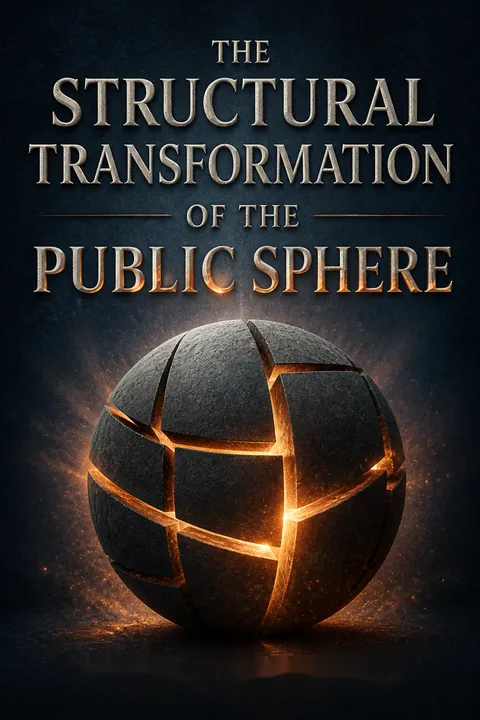

Key Takeaways
1. The Bourgeois Public Sphere: A New Realm of Rational-Critical Debate
If the public sphere did not require a name of its own before this period, we may assume that this sphere first emerged and took on its function only at that time, at least in Germany.
Historical emergence. The bourgeois public sphere, a distinct historical category, emerged in the 18th century, particularly in Western Europe. Unlike ancient "publicness" (polis life) or medieval "representative publicness" (feudal lords displaying power), this new sphere was constituted by private individuals who gathered to engage in critical public discussion. This marked a fundamental shift from a system where power was merely represented before the people to one where state authority was publicly monitored through informed discourse by the people.
Challenging authority. This nascent public sphere positioned itself between civil society and the state, serving as a forum where private individuals, using their reason, debated matters of general interest. Its primary function was to subject state authority to public scrutiny, demanding that governance be rationalized and legitimized through open discourse rather than arbitrary command. This critical function was inherently polemical, challenging the established absolutist order and its reliance on "secrets of state."
Genesis in capitalism. The genesis of this public sphere was intrinsically linked to the rise of early finance and trade capitalism. The expansion of commodity exchange and the traffic in news created a need for regular, accessible information, leading to the institutionalization of postal services and the press. This new communication infrastructure, initially serving merchant interests, gradually became a platform for public discourse, laying the groundwork for a critical public that would eventually confront state power.
2. The Intimate Sphere and Literary Public Sphere: Foundations of Subjectivity
Historically, the latter was the source of privateness in the modern sense of a saturated and free interiority.
New privateness. The modern concept of "privateness" originated in the intimate sphere of the patriarchal conjugal family, distinct from the ancient oikos (household economy). This domestic realm fostered a new form of subjectivity, characterized by emotional depth, self-reflection, and "purely human" relations, seemingly emancipated from societal constraints and economic necessity. This interiority became the wellspring for a unique self-understanding of the bourgeois individual.
Literary precursor. This emerging subjectivity found its first public expression in the literary public sphere, a precursor to its political counterpart. Institutions like coffee houses, salons, and table societies provided spaces where private individuals, transcending social status, engaged in rational-critical debate about cultural products. Here, literature, art, and philosophy became commodities, accessible to a broader public and subject to collective interpretation and judgment, fostering a critical reflection on novel private experiences.
Fictitious identity. The literary public sphere, by cultivating this audience-oriented subjectivity, inadvertently laid the groundwork for a crucial political fiction: the identification of the "property owner" with the "human being pure and simple." This allowed the bourgeois public to claim universal representation, asserting that their class interests in maintaining a private sphere of commodity exchange aligned with the general interest of all autonomous individuals, thereby legitimizing their political demands.
3. The British Model: Press as the Fourth Estate and Parliamentary Publicity
With this journal, followed by the Gentleman’s Magazine, the press was for the first time established as a genuinely critical organ of a public engaged in critical political debate: as the fourth estate.
Pioneering political debate. Great Britain, at the turn of the 18th century, pioneered the emergence of a politically functioning public sphere. This was driven by:
- The rise of manufacturing and industrial capital, creating new interest conflicts.
- The end of censorship (1695), allowing for a free press.
- The establishment of cabinet government, transforming Parliament.
This environment fostered a vibrant political journalism, with figures like Defoe and Bolingbroke using journals to articulate party positions and appeal to public judgment.
Parliamentary transformation. The ongoing commentary and criticism from the press, particularly from opposition journals like The Craftsman, compelled Parliament to legitimize its actions before the public. This pressure gradually led to the publicity of parliamentary deliberations, culminating in the de facto nullification of the prohibition on publishing debates by 1771. This transformation meant Parliament was no longer a closed assembly but an institution subject to public scrutiny, evolving into an organ of public opinion.
Public opinion's power. By the early 19th century, "public opinion" became a recognized force, capable of influencing government decisions and even forcing concessions. Figures like Fox acknowledged the necessity of consulting public opinion and providing the means for its formation. This era saw the rise of political associations and public meetings, further solidifying the public's role as a permanent critical commentator, leading to the first Reform Bill of 1832 and the institutionalization of party platforms.
4. Hegel and Marx's Critique: Public Opinion as Ideology Amidst Societal Conflict
The public opinion of the private people assembled to form a public no longer retained a basis of unity and truth; it degenerated to the level of a subjective opining of the many.
Hegel's skepticism. Hegel, while acknowledging public opinion's role in rationalizing domination, profoundly critiqued its inherent limitations. He saw civil society, the supposed foundation of this public opinion, as inherently anarchic and antagonistic, marked by increasing inequality and the creation of a "penurious rabble." Consequently, the public opinion arising from such a disunified society could not genuinely represent a universal interest or claim objective truth; it was merely the "subjective opining of the many."
State as integrator. For Hegel, the state, as the "actuality of the ethical idea," had to integrate these fragmented subjective opinions from above, rather than being guided by them. The public sphere was demoted to a "means of education," serving to familiarize citizens with the state's rationality, not to critically shape it. This view rejected the liberal ideal of dissolving domination through public reason, instead positing the state's existence as its own guarantee of ethical truth, often through an impenetrable "power of the crown."
Marx's unmasking. Marx radicalized this critique, denouncing public opinion as "false consciousness"—a mask for bourgeois class interests. He argued that capitalism's inherent contradictions (e.g., appropriation of surplus value, concentration of capital, lack of equal opportunity) undermined the very fictions upon which the bourgeois public sphere rested. The "human being" of liberal theory was merely the "property owner," whose interests, far from universal, were particular and maintained through power, not reason. The public sphere, therefore, was an ideological construct perpetuating domination in a new guise.
5. Liberalism's Dilemma: The Tyranny of the Majority and the Call for Elite Publics
The reign of public opinion appeared as the reign of the many and the mediocre.
Expanded public, new problems. As the public sphere expanded to include manual workers, women, and other disenfranchised groups, liberals like Mill and Tocqueville observed a new dilemma. The influx of unreconciled interests and the sheer numerical weight of the "uninformed multitude" threatened the rational-critical character of public debate. Public opinion, once a bulwark against state power, now appeared as a "tyranny of the majority," a coercive force demanding conformity rather than fostering reasoned consensus.
Erosion of rationality. The ideal of a public opinion rooted in rational agreement and universal interest seemed to dissolve as diverse, often conflicting, group interests flooded the public arena. Mill argued that "only through diversity of opinion is there... a chance of fair play to all sides of the truth," advocating for tolerance over the pursuit of a singular, rationally demonstrable truth. This reflected a resignation to the inability to resolve interest conflicts purely through reason, acknowledging irreducible "dogmatic residues" in public discourse.
Call for elite guidance. To counter the perceived "tyranny," liberals proposed a re-stratification of the public sphere. Tocqueville, lamenting the loss of pre-bourgeois "pouvoirs intermédiaires," advocated for new "aristocratic bodies" of "educated and powerful citizens" to guide public opinion. Mill suggested that the public's role should be to judge the "characters and talents" of representatives rather than the issues themselves. This marked a retreat from universal accessibility, seeking to salvage rationality through a restricted, esoteric public of experts and elites, effectively reintroducing elements of "representative publicness."
6. The Mutual Infiltration of Public and Private: Rise of the Repoliticized Social Sphere
Between the two and out of the two, as it were, a repoliticized social sphere emerged to which the distinction between “public” and “private” could not be usefully applied.
Erosion of separation. From the late 19th century, the foundational separation between state and society, crucial for the liberal public sphere, began to erode. State interventionism, driven by unresolved societal conflicts and the demands of newly enfranchised masses, expanded beyond traditional functions. This "neomercantilism" meant the state increasingly regulated and shaped aspects of civil society, blurring the lines of private autonomy.
Societalization of the state. Concurrently, societal forces, particularly organized private interests (e.g., labor unions, business associations), began to assume quasi-public functions. These groups exerted direct political pressure, influencing legislation and administration outside traditional parliamentary channels. This reciprocal permeation created a "repoliticized social sphere" where state and societal institutions fused into a complex functional whole, defying clear categorization as either purely public or purely private.
Refeudalization. This intermeshing led to a "refeudalization" of society, where public functions were taken over by societal powers and vice versa. The classical system of private law fractured, giving way to "social legislation" that restricted property rights and contractual freedoms in the name of social welfare. This transformation fundamentally altered the landscape in which the public sphere operated, undermining its liberal basis and creating a new, ambiguous terrain for political and social interaction.
7. From Culture-Debating to Culture-Consuming: Mass Media and Pseudo-Publicity
When the laws of the market governing the sphere of commodity exchange and of social labor also pervaded the sphere reserved for private people as a public, rational-critical debate had a tendency to be replaced by consumption, and the web of public communication unraveled into acts of individuated reception, however uniform in mode.
Market penetration. The rational-critical debate of the literary public sphere, once a space emancipated from economic necessity, succumbed to the laws of the market. Culture became a commodity not just in form but in content, leading to a shift from a "culture-debating" to a "culture-consuming" public. Leisure activities, now a complement to work, became another arena for private consumption, not public communication.
Mass media's role. The rise of mass media (penny press, radio, film, television) accelerated this transformation. These media, designed for broad accessibility and "psychological facilitation," prioritized entertainment and immediate gratification over critical engagement. News became "human-interest stories," blurring the lines between fact and fiction, while editorial opinions receded behind pre-digested, patterned content. This fostered a "pseudo-public sphere" of individuated, uncritical reception.
Hollowing out privacy. The mass media also inverted the original relationship between the intimate sphere and the public. Instead of a subjectivity cultivated in private and then expressed publicly, the media now produced an illusion of privacy for consumers. They offered "canned goods" of psychologically oriented literature and advice, absorbing private problems into a "superfamilial zone of familiarity." This deprivatized interiority, coupled with the decline of traditional forums like salons and reading societies, shattered the sounding board for rational-critical debate.
8. The Transmuted Function of Publicity: From Critical Control to Managed Acclamation
Publicity once meant the exposure of political domination before the public use of reason; publicity now adds up the reactions of an uncommitted friendly disposition.
Commercialization of the press. The press, once an institution of private individuals engaged in critical debate, transformed into a commercial enterprise driven by advertising. Publishers became "dealers in public opinion," and editorial content became interdependent with advertising space. This commercialization allowed privileged private interests to invade the public sphere, using it as a platform for business advertising and, increasingly, for political influence.
Rise of public relations. Economic advertising evolved into "public relations" (réclame), a sophisticated form of "opinion management" that explicitly claimed the political public sphere. Public relations systematically created or exploited news events, using psychological techniques and "human interest" topics to generate a "reorientation of public opinion." This practice aimed to build an "aura of good will" and "quasi-political credit" for private entities, blurring the distinction between genuine public interest and manipulated consent.
Managed integration. Publicity, once a critical principle, became a tool for "managed integration." Organizations (administrations, interest groups, parties) now generated publicity from above to secure acclamatory consent or benevolent passivity from a mediatized public. This "refeudalized" public sphere, characterized by a display of prestige rather than critical debate, served to legitimate political compromises and power exercises that largely occurred behind closed doors, effectively supplanting rational discourse with symbolic identification.
9. Public Opinion as Constitutional Fiction: The Challenge of Empirical Reality
As a fiction of constitutional law, public opinion is no longer identifiable in the actual behavior of the public itself; but even its attribution to certain political institutions (as long as this attribution abstracts from the level of the public’s behavior altogether) does not remove its fictive character.
Normative ideal vs. empirical fact. The concept of "public opinion" faces a fundamental dilemma: it remains a normative ideal, a "fiction of constitutional law," essential for legitimizing democratic governance, yet it is increasingly detached from empirical reality. Constitutional theory still presupposes an intact public opinion as the source of all authority, but sociological observations reveal a fragmented, mood-dependent populace, far from a rationally debating public.
Liquidation of the concept. Social-psychological research, in its positivist pursuit of empirical data, often liquidates the concept of public opinion altogether. It reduces "public" to "mass" or "group" and "opinion" to mere "attitudes" or "behaviors," detached from principles of public discussion or political function. This approach, while providing data on group dynamics and communication flows, fails to capture the historical and normative significance of public opinion as a critical political force.
The gap persists. Attempts to bridge this gap by equating public opinion with parliamentary consensus or party will also fall short. While these institutions are politically relevant, they do not necessarily reflect a public opinion formed through genuine public communication. The "public opinion" attributed to them remains a fiction if it abstracts from the actual behavior of citizens and the processes (or lack thereof) of rational-critical debate. This highlights the profound challenge of reconciling democratic ideals with the realities of mass society.
10. Democratization's Potential: Reclaiming Publicity in the Social-Welfare State
Institutionalized in the mass democracy of the social-welfare state no differendy than in the bourgeois constitutional state, the idea of publicity (at one time the rationalization of domination in the medium of the critical public debate of private people) is today realizable only as a rationalization—limited, of course, because of the plurality of organized private interests—of the exercise of societal and political power under the mutual control of rival organizations themselves committed to publicity as regards both their internal structure and their interaction with one another and with the state.
Reinterpreting basic rights. The transformation of the liberal constitutional state into a social-welfare state necessitates a reinterpretation of basic rights. Liberal rights, originally negative injunctions against state interference, must now be understood as positive "participatory rights" and "active guarantees" of social claims. This shift acknowledges that equal opportunity and effective participation in public life can no longer be ensured solely by state non-interference but require active state intervention to shape social conditions.
Extending publicity's mandate. To realize the democratic potential of the social-welfare state, the mandate of publicity must be extended beyond state organs to all politically influential societal organizations. This includes:
- Parties
- Mass media
- Special-interest associations
These institutions, which now mediate between society and the state, must themselves be subjected to radical publicity requirements regarding their internal structures and their interactions with each other and with the state.
A new public sphere. This expanded and enforced publicity aims to foster a new kind of political public sphere. Instead of a fragmented public of private individuals, it envisions a "public of organized private people" participating in formal communication through intra-organizational public spheres. This would enable a rationalization of social and political power, subjecting the exercise of domination to mutual control and critical debate, thereby moving towards a more genuinely democratic integration of industrial society.
Review Summary
The Structural Transformation of the Public Sphere receives mixed reactions, with readers praising Habermas's analysis of how the bourgeois public sphere—emerging from 18th-century salons and coffeehouses—evolved through rational-critical debate but later degraded through mass media, capitalism, and state intervention. Many appreciate his historical overview and philosophical insights, though critics note the dense, academic style, exclusionary focus on propertied white males, idealization of an imperfect past, and lack of empirical grounding. Readers acknowledge its foundational importance to critical theory despite questioning its historical accuracy and nostalgic tendencies.
People Also Read





About the Author
Other books by Jürgen Habermas
Download PDF
Download EPUB
.epub digital book format is ideal for reading ebooks on phones, tablets, and e-readers.








































