
Plot Summary
Snowbound Beginnings
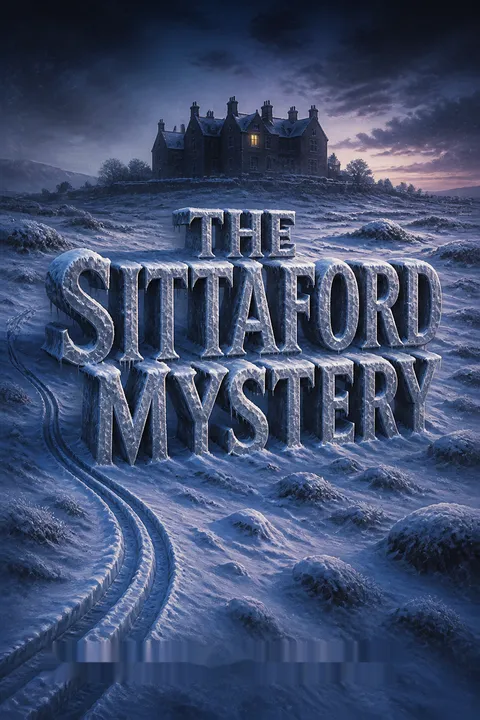
Sittaford, a tiny moorland village cut off by heavy snowfall, sets an eerie and insulated backdrop. Captain Trevelyan, owner of Sittaford House, rents his home to the mysterious Mrs Willett and her daughter Violet, while relocating himself to nearby Exhampton. Curious villagers gather for an afternoon at the Willetts', their isolation amplifying the tension among the cleverly drawn, sometimes uneasy group: Major Burnaby, neighbor and Trevelyan's old friend; local intellectuals Rycroft and Duke; and young Ronnie Garfield. The snow not only sets a scene of traditional English winter, but it encapsulates the characters—trapping them and their secrets within the village, hinting at suspense and the coming darkness as isolation breeds unforeseen events.
Séance of Shadows
After tea, the group chooses table-turning, seeking amusement from the supernatural as snow continues to fall outside. Initially, messages from the "spirits" are playful, but the atmosphere darkens when a message announces that Captain Trevelyan is dead, and then—shocking them further—claims he was murdered. The room chills with fear and unease. What began in laughter ends in trembling suspicion and dread, as Major Burnaby decides to make an impossible trek to Exhampton to check on his old friend, driven by the eerie accuracy and timing of the séance. The sense of play transforms into real apprehension, blurring the line between the psychological and the uncanny.
The Message and a Journey
Burnaby's faithful trek through the raging snow becomes a literal and emotional ordeal, his doubts and fears weighted by the séance's words. He finally reaches Exhampton exhausted and alarmed, finding Trevelyan's house dark and unresponsive. Joined by local Constable Graves and Dr. Warren, they force entry and confirm the séance's grim prophecy: Captain Trevelyan lies murdered, the room staged to mimic a burglary. The timing of death aligns disturbingly with the séance's supernatural pronouncement. Burnaby's haunted sense of fate merges with guilt, as suspicion and reality entwine—the game's message has become deadly truth.
Death at Hazelmoor
Inspector Narracott, methodical and sharp, takes the case. He quickly spots flaws in the "burglary" scene: the forced window is staged, the confusion deliberate, the true entry point misleading. The murder weapon, a sandbag-like draught-excluder, and the snow outside tell him this was not the work of a random thief. Instead, Narracott suspects the killer was known to Trevelyan and possibly entered by the window for a reason—perhaps to avoid being seen. The villagers' routines, the remoteness, and the storm make alibis both easy and suspect, as every local begins to seem both visible and invisible under the mask of snow.
Inspector in the Snow
Through interviews with Evans, Trevelyan's loyal servant, and the talkative Mrs Belling at the Three Crowns inn, Narracott's suspicions move from bumbling villagers to family: Trevelyan's estranged sister Jennifer, nephews and nieces, and the enigmatic new arrivals in Sittaford House. The will reveals substantial inheritance, instantly providing motive for multiple heirs. Meanwhile, an investigative journalist, Charles Enderby, arrives under the guise of a contest winner, stirring gossip. The inspector's inquiries push the locals' hidden tensions to the surface, showing how everyone clings to the routines of village life even as mistrust creeps in.
Inheritance and Suspicions
Narracott traces the next of kin: Jennifer Gardner, struggling in genteel poverty in Exeter with her debilitated husband; the Pearson siblings—James, Sylvia, and Brian, scattered by ambition and geography, but united by Trevelyan's will. The first real suspect emerges when James Pearson is found to have been in town on the day of the murder, behaving nervously, lying poorly about his visit, and fleeing the scene in panic. Emily Trefusis, Jim's devoted (and formidable) fiancée, resolves to prove his innocence. The case shifts from opportunity to psychology, as enemies and motives multiply within the family.
The Pearson Dilemma
With Jim's suspicious visit, hidden desperation for money, and evasive testimony, the police arrest him. Emily, convinced of his innocence by both affection and sharp instinct, launches her own inquiry—methodical, fearless, relentless—in partnership with the eager but bungling Enderby. The investigation turns into a race: the official police line versus a woman's intuition, digging into the family's tangle of rivalries, secrets, and financial woes. Emily's clear-sightedness and refusal to sentimentalize Jim's weaknesses make her an unexpectedly formidable player in the hunt for truth.
Emily Takes Charge
Disguising herself as a fragile but determined fiancée, Emily enlists Charles Enderby's journalistic access and charm. She visits Sittaford and Exhampton, probes the villagers' relationships, and begins assembling her own list of suspects—including Brian Pearson (recently returned from Australia), the artistic and mendacious Martin Dering, and, most curiously, the Willetts, whose past brims with hidden connections. As Emily's theory develops—especially concerning the séance—she transforms from bystander into detective, matching Narracott's methodical approach with her intuition. Each encounter exposes clues—real and misdirecting—about motive, opportunity, and psychology.
Sittaford's Hidden Lives
Emily's investigation exposes the deep loneliness and frustrations of Sittaford's residents: Miss Percehouse, shrewd and sharp-tongued; the mysterious but deeply sympathetic Willetts; Captain Wyatt the surly invalid; even the cheerful but evasive Ronnie Garfield. Emily suspects the social roles and routines of village life are hiding important truths. Meanwhile, Brian Pearson's sudden reappearance and secret presence in Sittaford aligns suspiciously with the family inheritance, and the Willetts' background—supposedly from South Africa, but with hints of Australia—increases the sense that nothing in Sittaford is as it appears.
Shadows in Sittaford House
As Emily visits Sittaford House under the pretext of a favor, she senses the nervous tension in Violet, and witnesses a secretive conversation between mother and daughter that ends in a declaration of dread: "Will tonight never come?" With the servants dismissed, and the women alone, the household seems poised for a secret encounter. Emily's blend of resourcefulness and empathy allows her to realize the Willetts' real terror is not guilt in the murder, but something concealed, perhaps relating to an escape or dangerous connection—the atmosphere in the house thickens with dread and anticipation.
The Strange Willetts
Through more sleuthing and a dramatic midnight incident, Emily uncovers that Violet has a secret lover—Brian Pearson. The Willetts are not from South Africa but Australia, and Violet's father is the escaped convict recently reported loose on the moor. Their move to Sittaford, their secrecy, and dismissal of staff, all hinge on this desperate gamble to rescue and hide him. The murder investigation and the manhunt for the convict converge, and yet the family's drama proves to be a tragic, parallel story rather than the solution to Trevelyan's murder.
Puzzle of the Boots
A new oddity surfaces: Evans the servant notes that a pair of Trevelyan's ski boots is missing, despite the snow. This apparently trivial gap leads Emily to Hazelmoor, where she discovers the boots hidden up the bedroom chimney. Examining Trevelyan's sporting equipment, she realizes there are two pairs of skis—one of which matches the missing boots perfectly. This small, material clue finally aligns the timeline, geography, and means of the murder, undoing the safe-seeming alibis and exposing the mechanics of how the killer traveled unseen and unremarked across the snowbound landscape.
Past and Present Collide
With the clue of the boots and skis, Emily theorizes the murderer was not an outsider, nor an heir, but someone so familiar—so a part of Sittaford's fabric—that no one considered him. Old resentments, buried envy, and a shared obsession with Trevelyan's competitions and the football prize are revealed: Major Burnaby, Trevelyan's lifelong friend, orchestrated the séance as a cover, then skied to the murder, leaving no footprints, wiping out physical evidence with his sporting expertise. Greed and deeper, corrosive rivalry—hidden under the mask of camaraderie—are what ultimately led him to kill.
The Second Séance
With the cast assembled at Sittaford House for a second attempted séance, the atmosphere is heavy with fear, guilt, and unease. It is at this moment—charged with the emotional legacy of the first séance—that Inspector Narracott and Emily expose the solution. Major Burnaby is arrested; the psychological games of the séance are mirrored in the social games the villagers have always played. The echo of the séance—a game that seemed to produce truth supernaturally—turns out to mask human cunning, loneliness, and hidden longing, reminding the community that monsters hide in familiar faces.
Revelation on Skis
Emily's final deduction is revealed: Burnaby engineered the séance to establish an alibi, then used skis to traverse the snow quickly and undetected, murdered Trevelyan for the football prize money and out of long-nursed bitterness, and arranged the scene to appear a burglary. He returned as an exhausted, concerned friend. The stolen boots, hidden away, were the key—overlooked by all but Evans and then Emily, who realized the killer's knowledge of terrain and weather gave him an unmatchable opportunity. The crime was not the work of outsiders, but of routine, familiarity, and a moment's desperate calculation.
Justice for the Innocent
With the crime solved, Jim Pearson is exonerated, the family's wounds begin to heal, and Sittaford itself seeks to return to ordinary life—though altered by revelation and loss. The Willetts' personal tragedy has run its course, their true story proved a melancholy parallel rather than the main mystery. Charles Enderby gains his story, Emily her self-knowledge, and the villagers face the uneasy truth of what their "ordinary" world has concealed. Justice, arduous and unexpected, closes a story that began not with malice but with isolation and the cold loneliness of the moors.
Analysis
The Sittaford Mysterytransforms classic English murder tropes—isolated village, storm-bound setting, family inheritance—into a study of how invisible boundaries (weather, class, loneliness) create the perfect petri dish for violence. Christie demonstrates how the everyday can harbor the deadly, and how suspicion, once seeded, grows unchecked in a closed community. The story casts a cold eye on loyalty, showing how the bitterness bred from persistent second-place living (Burnaby) can fester into murder as surely as greed or ambition. Women, especially Emily, are given center stage: her intelligence and refusal to stay sidelined disrupt not just the crime's solution, but the expectations of gender and class. Through the double mysteries—the murder and the Willetts' secret—Christie explores how truth hides beneath surfaces, and how solving a puzzle demands not just logic, but empathy and nerve. It is a story about the consequences of isolation, the deadly toll of envy, and the subtle ways in which routine masks both trauma and intent. The moor's snow, like the communal silence and complicity of village life, can cover many things—but not, ultimately, the indelible patterns of human psychology.
Review Summary
The Sittaford Mystery is a standalone Christie novel, praised for its atmospheric snowy Dartmoor setting and an engaging séance opening. Readers enjoy the plucky amateur sleuth Emily Trefusis, who investigates to clear her fiancé's name alongside a journalist, while Inspector Narracott conducts a parallel police investigation. Many found the murderer difficult to guess, though some felt the ending was rushed. Without Poirot or Marple, the novel relies on its atmospheric charm and colorful characters, earning a solid 3.77 average rating.
Characters
Emily Trefusis
Emily, Jim Pearson's fiancée, emerges as the true engine of the investigation—brilliant, intuitive, and quick to discard sentiment for logic. While her ostensible role is that of a loving, worried young woman, her pragmatic, direct psychological approach allows her to see through red herrings, social masks, and emotional distractions. She enlists allies, manipulates situations to her advantage, and breaks the conventions of class and gender that would sideline her. Her relationship with Jim is less about helpless romantic loyalty and more about belief in his innocence and a drive to save him from the consequences of his own weaknesses. As much as she solves the case, she asserts a new kind of woman's agency amid the constraints and expectations of village life.
Major John Burnaby
Burnaby is Trevelyan's old army friend and neighbor, a man outwardly defined by stability, loyalty, and punctilious routine; inwardly, however, he is corroded by a lifetime of companionship that has always put him second to Trevelyan—financially, athletically, and in recognition. When fate provides both opportunity (snow, isolation, and the football prize letter) and cover (superstition, the séance, his own reliability), Burnaby's submerged envy overpowers his friendship. His meticulous planning and understanding of the village's physical and social geography enable the crime to go unnoticed. Burnaby's psychology exposes the darkness hidden in routine and loyalty, as familiar affection turns, after years of cumulative frustration, into deadly violence.
Captain Joseph Trevelyan
Although murdered early, Trevelyan's spirit dominates the narrative. A man of routines, hardened by disappointment, and obsessed with money and order, he distances himself from family and neighbors while manipulating those around him with affable coldness (even entering competitions under friends' names for strategic advantage). His inability to connect emotionally sows seeds of discontent and rivalry, both within his family and among friends like Burnaby, who resent a lifetime spent as his foil. Trevelyan's failure to perceive the true emotional undercurrents around him ultimately enables his death.
Mrs Willett
Outwardly a talkative, slightly over-dressed South African widow new to Sittaford; in reality, she is an Australian whose presence in Sittaford hides her effort to orchestrate her husband's escape from prison. Her guile and focus—managing appearances, distracting suspicion, and protecting her daughter—reveal both the strength and cost of maternal devotion. She is neither villain nor victim in the murder, but her family's desperate, dramatic stratagem adds suspense and empathy to the novel's tapestry of deception.
Violet Willett
Violet is at once the emotional heart of the subplot and a symbol of the consequences of secrecy. Her anxiety, nervousness, and barely-disguised fear—manifested in her reactions to Emily and to the séance— signal deeper trauma: her father's criminal past, her romantic entanglement with Brian Pearson, and the unbearable pressure of clandestine domestic drama. Her psychological portrait is one of a young woman facing dangers beyond her control, her story running parallel—and slightly askew—to the main plot.
Inspector Narracott
Unlike the flamboyant detectives of Christie's other works, Narracott is grounded, thorough, and often unsentimental. He is not easily distracted by surface appearances, recognizes the limitations of evidence, and balances psychological insight with empiricism. His partnership and occasional competition with Emily Trefusis drives both the official and off-the-books investigation. Narracott's greatest strength is his willingness to doubt suspects and allies alike; his greatest vulnerability, a certain blind spot regarding social conventions, which Emily often exploits to advance her own line of inquiry.
Charles Enderby
Enderby, initially a literal prizewinner in the football competition, rapidly morphs into Emily's accomplice and sometimes foil. Lively, eager, socially adept, but not particularly deep, he's both useful and slightly out of his depth. His pursuit of the scoop mirrors the villagers' curiosity, but contrasts with Emily's sincerity and insight. His unrequited affection for Emily, and her practical use of his skills, adds both humor and pathos, highlighting class, gender, and ambition in microcosm.
Brian Pearson
The prodigal youngest Pearson, returned secretly from Australia, Brian is passionate, bold, and as much in love with Violet as he is driven by familial duty. His hidden presence in Sittaford, engineered escape plan for Violet's father, and aggressive demeanor towards police and the world at large mark him as both threat and red herring. His relationship with violence and secrecy is the most openly dangerous; yet ultimately his motives, while lawless, are not murderous.
Mrs Jennifer Gardner
Trevelyan's estranged sibling, Jennifer's apparent calm conceals deep anger and disappointment regarding her brother's refusal to assist her family in sickness and poverty. Her complex relationship with her disabled husband, her cold composure under suspicion, and her ultimate inability to kill—even given cause—provide a foil for both Emily's active agency and Trevelyan's emotional neglect. Hers is a portrait of restrained fury, quietly seeking her measure of justice through inheritance, not violence.
Mr Duke / Ex-Chief Inspector Duke
Living under an assumed name in Sittaford, Duke's concealed identity as a famous Scotland Yard inspector allows him to advise and guide Narracott and Emily from the shadows. His psychological insight and patience signal the subtle presence of older, institutional knowledge in the midst of amateur enthusiasm and villagers' naiveté. Unrevealed until the climax, Duke embodies the theme that even the most peaceful settings can hide experienced, watchful eyes—and that justice can come from the most unheralded corners.
Plot Devices
The Séance and Spiritualism
The séance, a popular game turned harbinger of doom, serves not just as a foreshadowing device, but as a catalyst for both the narrative's mystery and its psychological undercurrent. Christie employs it to democratize suspicion—those present are all equally exposed to otherworldly "truth." It blurs the boundaries between chance, subconscious guilt, hysteria, and deliberate manipulation, setting off a chain of reactions and providing Burnaby the narrative cover for his crime.
The Snowbound Village
Sittaford's remoteness—accentuated by blizzard—serves both to focus the plot and heighten paranoia. Travel is difficult, alibis questionable, and the suspect pool compact. The snow also provides both a literal obstacle (erasing footprints, slowing communication) and a metaphorical one (isolation breeds secrets, resentment, desperation).
Red Herrings and Parallel Drama
The Willetts' true reason for being in Sittaford and Brian Pearson's clandestine efforts present plausible alternative villains, creating suspense and distraction. The major suspects are given enough motive, opportunity, and oddity to cast consistent doubt, while their actual stories prove more tragic than criminal. The interplay of "real" criminal acts (the murder) and urgent but unrelated criminality (the prison break) heightens the texture of uncertainty.
Forensic Detail and Psychological Insight
The missing ski boots and the sporting equipment, the forged crime scene, the reactions at the séance, and the timing of events—all are concrete clues. Yet, Christie ensures these only achieve meaning when paired with emotional and psychological analysis (Emily's specialty). The novel repeatedly contrasts hard evidence with intuition, showing how the true solution requires embracing both.
Narrative Shifts and Multiperspective Structure
Christie alternates official police progress (Narracott), amateur initiative (Emily, Charles), and the villagers' collective gossip. Each perspective brings both clues and blind spots. The interplay of outsider (Emily, the Willetts), insular local (Burnaby, Mrs Curtis), and hidden histories (Duke) allows the plot to spiral, rather than simply proceed, toward solution, echoing both the literal labyrinth of the moors and the figurative obscurity of motive.
About the Author
Other books by Agatha Christie




Download PDF
Download EPUB
.epub digital book format is ideal for reading ebooks on phones, tablets, and e-readers.








































