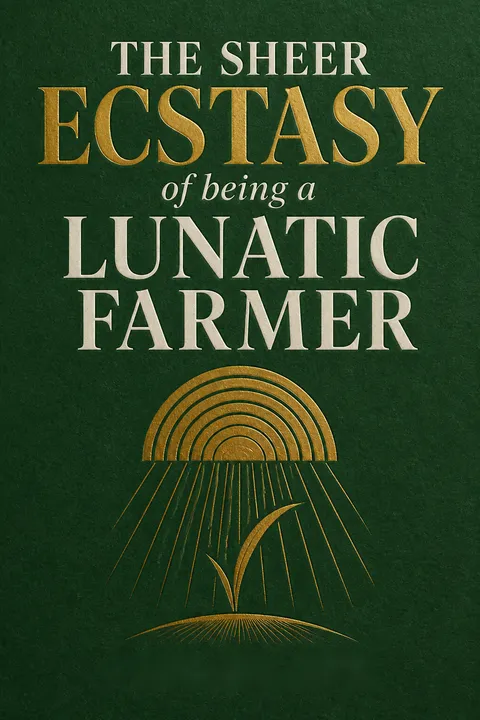

Key Takeaways
1. Embrace the Lunatic Farmer Paradigm
Indeed, I'm having the time of my life.
Redefine "normal." The industrial food system considers anyone prioritizing ecological health, animal happiness, and community over sheer speed, size, and cheapness to be a "lunatic." This book champions this "lunacy" as the path to true ecstasy, contrasting it with the destructive, disconnected "normal" practices of industrial agriculture. The author finds immense joy in making thousands of beings happy daily, from dancing chickens to contented cows.
A different planet. The industrial paradigm, focused on growing faster, fatter, bigger, cheaper, views animals as inanimate protoplasmic structures to be manipulated. This leads to practices like:
- Confining animals without fresh air or sunshine
- Doping animals with hormones and antibiotics
- Suing farmers for patent infringement when GMO pollen drifts
Choose righteousness. Rather than being downtrodden by this industrial mindset, the "lunatic farmer" chooses to encourage and live within a more righteous system. This involves increasing carbon sequestration, reducing petroleum dependence, fostering vibrant health, and dancing with functioning immune systems, all while the industrial system struggles with pathogens and chronic diseases.
2. Nurture the Earth by Growing Soil
True stewards of the land understand that more living organisms are in a double-handful of healthy soil than there are people on the face of the earth.
Soil is life. The earth's soil is a marvelous, teeming community of microorganisms, minerals, decaying biomass, gases, and water—a precious resource that is the only protective veil between humanity and starvation. Historically, the Shenandoah Valley suffered severe erosion due to European-style tillage farming, losing feet of topsoil.
Healing the land. The author's family, upon acquiring their farm in 1961, rejected plowing fragile slopes and instead focused on rebuilding soil through perennials, compost, and animal impact. This approach healed deep gullies and shale galls, transforming barren rock into lush, productive fields.
- Using concrete tire bases for fences where soil was too thin
- Filling gullies with excavated pond silt
- Planting trees on steep, eroded slopes
Carbon is key. Everything on a "lunatic farm" is geared towards growing soil by increasing organic matter. This involves recycling manure, composting tree branches, diverting leaves and sawdust from landfills, and using animals to aerate and fertilize. This contrasts sharply with chemical fertilizers that burn out organic matter, leading to harder soils and decreased water retention.
3. Mimic Nature's Grazing Dance
The primal herbivore-predator-disturbance-rest dance is literally the breath and pulse of the earth.
Ancient wisdom. Grass farming, mimicking the ancient predator-prey relationship of large herbivores (like bison) and their predators (wolves, fire, humans), is the oldest form of carbon sequestration and earth choreography. This systematic disturbance and rest period creates a perfectly suited soil-building landscape.
Mob stocking. The "mob stocking herbivorous solar conversion lignified carbon sequestration fertilization" system involves aggressively moving animals daily to new ground, allowing long rest periods for grass to accumulate carbon and energy. This contrasts with continuous grazing, which stunts grass and weakens palatable species.
- Cows are moved daily to fresh "salad bar" paddocks.
- Forage grows tall, lignifies (turns brown), and builds a carbon bank.
- Uneaten forage is stomped into mulch, feeding the soil.
Beyond hay. This natural grazing model significantly reduces the need for hay feeding, as forage is stockpiled in the field and grazed systematically. This approach is more productive, profitable, and environmentally sound, yielding significantly more "cow-days" per acre than conventional methods and building resilience against drought.
4. Prioritize Terrain Over Germ Theory
Beauchamp was right. It is all about the terrain.
Terrain vs. germs. The author champions Michael Beauchamp's "terrain theory" over Louis Pasteur's "germ theory." While Pasteur focused on killing external "bad guys," Beauchamp argued that sickness arises when the internal "terrain" (hygiene, stress, immune response) allows pathogens to thrive. The author's farm experiences with Marek's disease, curly toe syndrome, and blackleg all pointed to management or nutritional deficiencies, not just external pathogens.
Pathogen cul-de-sacs. Instead of relying on pharmaceuticals, "lunatic farmers" create environments where pathogens struggle to survive. This involves:
- Rest and sunshine: Denying hosts for sufficient periods (e.g., two 21-day host-free periods per year) and maximizing sunlight exposure.
- Vibrant decomposition: Creating balanced microbial communities through deep bedding (8-48 inches) in animal housing, which supports pathogen-fighting nematodes.
- Multi-species diversity: Rotating different animal species to confuse pathogens and break their life cycles.
Beyond fear. This approach fosters optimism, systemic solutions, and optimal health, contrasting with the fear-driven, reactive, and drug-dependent industrial model. By taking responsibility for the "terrain," farmers can prevent disease and reduce reliance on interventions that mask genetic weaknesses or create superbugs.
5. Cultivate Sensually Romantic Farms
Mark it down, if it smells bad or it's not beautiful, it's not good farming.
Sensory integrity. Good farming should appeal to all senses, from production to palate. Stench, ugliness, and obnoxious particulate clouds should not assault visitors. This contrasts sharply with industrial farms, which are often hidden behind "No Trespassing" signs, citing "biosecurity" but truly concealing unsanitary and stressful conditions.
Beauty in wildness. The author advocates for a farm ambiance that attracts, rather than repels, including children. This involves:
- Patchwork landscapes: Fencing out steep hillsides and creating wild zones that provide habitat for wildlife.
- Brushy fencerows: Allowing natural growth to attract cardinals, blue jays, and other wildlife, rather than spraying for a "pristine" look.
- Natural beauty: Appreciating the glow and radiance of fields and livestock, the dew-kissed grass, and the sounds of nature.
Beyond the facade. While well-built structures are appreciated, the true beauty lies in the vibrancy and vitality of plants and animals. A farm should be a place of communion and relish, not a factory. Any farm that requires argument to be considered beautiful or pleasant is fundamentally flawed.
6. Build Flexible, Portable Infrastructure
The problem with a permanent building is that you can't move it.
Freedom through portability. Permanent, single-use, capital-intensive infrastructure (like silos or confinement houses) creates economic and emotional enslavement, hindering innovation and adaptation. Portable infrastructure, by contrast, is lightweight, cheap, and flexible, allowing farmers to:
- Adapt to land: Easily move shelters to new ground for sanitation and optimal grazing.
- Multi-use: Repurpose structures for different animals or seasons (e.g., rabbit runs to broiler shelters, hoophouses for winter layers then summer vegetables).
- Reduce risk: Avoid heavy investment on leased land, offering complete versatility in location.
Critique of static icons. The idyllic image of a red gambrel-roofed barn with a silo is critiqued as fundamentally flawed:
- Silos: Expensive, dangerous, represent desperate answers to poor pasture management, and produce feed that acidifies cow rumens.
- Barns: Often built for human convenience (e.g., bank barns) rather than animal health, leading to dark, damp, stuffy conditions.
Efficiency in flexibility. Portable systems, like Eggmobiles, Roostmobiles, and Harepens, eliminate the need for concrete, rebar, building inspections, and property taxes. They reduce bedding and manure hauling, leading to happier animals and more nutritious products, all while maintaining a light footprint on the landscape.
7. Champion Nativized, Functional Genetics
I'd much rather have one live 50 pound calf than a tractor trailer load of dead 90 pounders.
Beyond production. Industrial agriculture prioritizes volume production per animal (e.g., milk per cow, fast growth in beef), often at the expense of reproductive capacity, eating quality, nutrition, and disease resistance. This leads to assisted births, short-lived animals, and reliance on pharmaceuticals.
Balance and longevity. "Lunatic farmers" seek balanced, functional genetics adapted to their specific region. Key selection criteria include:
- Reproductive ability: Prioritizing fertility and ease of natural birth.
- Longevity: Selecting animals from older, proven mothers (e.g., cows over eight years old).
- Easy keepers: Animals that thrive on forage and natural feedstuffs, rather than requiring expensive supplements.
Nativized breeds. The author advocates for developing "nativized genetics" through linebreeding and functional selection, similar to how heritage breeds were developed in Europe. This creates animals uniquely adapted to local ecologies, like Daniel's resilient rabbit herd developed over 20 years without outside genetics or medication.
Marketability vs. integrity. While the author acknowledges using industrial broiler genetics for marketability, he emphasizes the importance of supporting traditional breeds for layers and hogs, recognizing the ripple effect on independent hatcheries and genetic diversity.
8. Leverage Artistry and Micro-Sites
The more we appreciate and leverage the subtle nuances of a landscape, the more productive, more stable, and more sustainable it will be.
Tiny brushstrokes. Modern industrial farming uses a broad brush, applying single crops across vast, undifferentiated fields, often driven by narrow subsidies and single-use technology. This approach ignores the unique possibilities within a landscape.
Customized ecology. "Lunatic farmers" use a "tiny brush," teasing out every possibility in the landscape and team members. This involves:
- Micro-site observation: Walking the land to identify subtle nuances like warm air tunnels, seeps, or areas conducive to specific plants (e.g., sugar maples, aspens, old apple trees).
- Leveraging natural features: Developing wet weather seeps into reservoirs, damming ravines, or using roof drip lines for high-moisture gardens.
- Stacking functions: Creating multi-tiered production systems (e.g., tree crops with livestock grazing underneath) or floating gardens that offer multiple benefits.
Beyond efficiency. This approach fosters a mosaic of symbiosis and synergy, leading to greater productivity, stability, and sustainability. It prioritizes individualized, customized landscape plans over creating sameness, demonstrating that careful observation and respect for natural patterns yield unexpected dividends and beauty.
9. Demand Honest Pricing and Value
The quality of your diet will be in direct proportion to the value you place on your farmer.
True cost of food. The "lunatic farmer" challenges the notion of "affordable" food by exposing the hidden costs and subsidies embedded in industrial products. Industrial food is dishonestly priced, externalizing costs like:
- Government subsidies for commodity crops
- Taxpayer-funded manure lagoons and disease indemnification
- Environmental pollution (e.g., Gulf of Mexico dead zone)
- Health costs from nutrient-deficient food and foodborne illnesses
Value-driven pricing. Polyface's products carry a higher sticker price because they receive no subsidies, adhere to strict regulations (often punitive to small producers), and internalize all costs. The author believes in charging a price that provides a professional salary, not just "what the market will bear."
Consumer responsibility. The author argues that "I can't afford it" is often an "I don't prioritize it" excuse. By reallocating funds spent on non-essentials (fast food, soda, entertainment, new gadgets), consumers can afford high-quality, local food.
- A pound of grass-finished ground beef costs less than a Happy Meal.
- Homemade granola is cheaper than processed cereal.
- Cooking from scratch at home is more economical than processed meals.
Worth more. Ultimately, local, normal food is empirically worth more in terms of nutrition, ecological impact, and taste. It's an investment in health and community, not just a commodity.
10. Rebuild Localized, Relationship-Based Economies
The only way to restore integrity in the food system is to re-imbed the butcher, the baker, and the candlestick maker in the village.
Beyond globalization. The modern food system is increasingly opaque, centralized, and distance-oriented, with food traveling thousands of miles and only a tiny percentage grown locally. This globalization, driven by corporate welfare and systemic biases, undermines local economies and transparency.
Village integrity. Re-embedding food production and processing in the village fosters transparency, accountability, and integrity. When businesses operate within public view, they are less likely to take environmental, social, and economic shortcuts. This contrasts with industrial food, which cultivates distrust and anonymity.
LOIS alternative. Michael Shuman's "Locally Owned and Import-Substituting" (LOIS) model offers a viable alternative to the "There Is No Alternative" (TINA) mindset of globalists. This involves:
- Local production: Growing food within the community.
- Local processing: Establishing on-farm or village-scale canneries, bakeries, and abattoirs.
- Local distribution: Creating Metropolitan Buying Clubs and other direct-to-consumer channels.
Community resilience. A localized economy builds community resilience, reduces dependence on external systems, and fosters meaningful relationships between producers and consumers. This contrasts with the industrial model, which isolates farmers, pollutes neighborhoods, and prioritizes export sales over local well-being.
11. Empower the White-Collar Farmer
The quality of your diet will be in direct proportion to the value you place on your farmer.
Dignify farming. Historically, farmers were respected professionals, men of letters, and community leaders. Today, the "poor dumb farmer" stereotype marginalizes the profession, deterring intelligent and articulate individuals. The author advocates for farming to be seen as a dignified, intelligent, and well-compensated vocation.
Professional compensation. To attract the "best and brightest" to farming, farmers must earn a professional, "white-collar" salary. This challenges the cultural expectation of farmer poverty and the notion that farmers should work long hours for little pay.
- Farmers receive only 10-18 cents of every retail food dollar.
- Subsidies and regulations disproportionately benefit industrial agriculture, making it hard for independent farmers to compete on price.
Beyond the stereotype. The author encourages farmers to embrace a professional persona, communicate effectively, and continuously learn. He envisions a future where:
- Parents proudly declare their children will be farmers.
- Environmental organizations support local farmers as key stewards.
- Society values farmers as much as heart surgeons, recognizing their critical role in health, ecology, and economy.
A national disgrace. The cultural squandering of sharp minds that could have focused on land healing and sustainable food production is a national disgrace. By elevating the status of farming, society can reverse this trend and cultivate a legion of "lunatic farmers" who heal the land and nourish communities.
Review Summary
Reviews for The Sheer Ecstasy of Being a Lunatic Farmer are largely positive, averaging 4.26/5. Readers praise Salatin's passion, humor, and innovative farming philosophy, with many finding it eye-opening regarding industrial agriculture's shortcomings. Fans appreciate his folksy style and commitment to sustainable, nature-inspired practices. Common criticisms include repetition from his other works, occasional lack of editing, and tangential political and religious commentary. Non-farmers and farmers alike found value, with many inspired to reconsider food sourcing and land stewardship.
People Also Read








About the Author
Download PDF
Download EPUB
.epub digital book format is ideal for reading ebooks on phones, tablets, and e-readers.








































