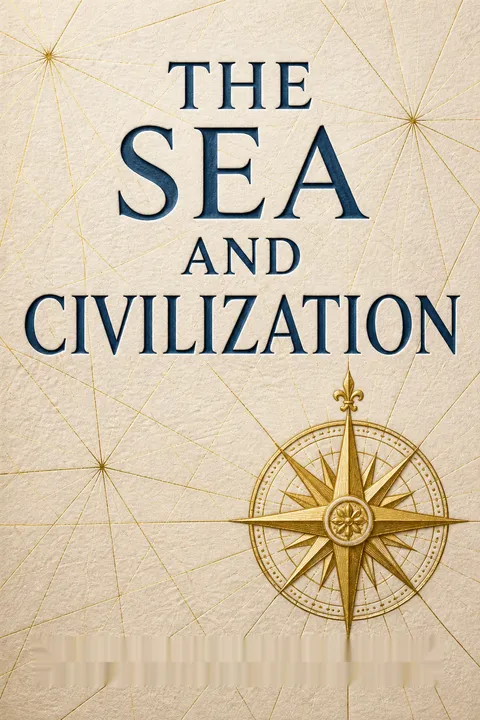

Key Takeaways
1. The Sea Shapes Civilization: A Shift in Perspective
This shift in emphasis from land to water makes many trends and patterns of world history stand out in ways they simply cannot otherwise.
Maritime history's importance. Understanding the sea's influence is crucial because, before the locomotive, maritime routes were faster than land routes for culture, commerce, and conflict. Overlooking this maritime dimension obscures the true drivers of historical change.
Interdisciplinary approach. Maritime history, as a branch of world history, requires a synthetic investigation of complex interactions between people of distinct backgrounds and orientations. It transcends traditional historical focuses by drawing on disciplines like the arts, religion, language, law, and political economy.
Eurocentric bias. The traditional focus on Europe's maritime expansion from the 16th to 18th centuries has distorted our understanding of maritime achievements in other periods and places. This Eurocentric view overlooks the complex realities of maritime development in classical antiquity, Asia, and pre-Renaissance Europe.
2. Oceania: Pioneers of Long-Distance Voyaging
By the start of the common era two thousand years ago, the Indian subcontinent was a point of departure and destination for merchants and mendicants from across the Arabian Sea and the Bay of Bengal.
Early seafaring prowess. The islands of Oceania represent the oldest, most sustained, and perhaps most enigmatic effort of maritime exploration and migration in world history. Pacific navigators were the most advanced in the world 3,500 years ago.
Intentional voyaging. Archaeological, linguistic, and navigational research demonstrates that the settlement of Oceania resulted from intentional voyaging, not accidental drift. Pacific sailors developed unique vessels and techniques for crossing thousands of miles of open ocean.
Navigational techniques. Pacific navigators relied on a combination of celestial navigation, observation of wind and water, and tracing the behavior of birds, fish, and whales. They developed the ability to read ocean swells, cloud patterns, and the "loom" of islands to locate land at a distance.
3. The Americas: Discrete Maritime Traditions
When Christopher Columbus crossed the Atlantic in 1492, he landed in the Bahamas archipelago southeast of Florida.
Diverse maritime cultures. The Americas developed distinct maritime traditions, though they never exploited the sea to the same degree as other parts of the world. These traditions ranged from freshwater navigation on rivers and lakes to coastal voyaging on the Pacific, Atlantic, and Caribbean coasts.
Coastal migration theory. One theory suggests that the first people in the Americas arrived by sea, hugging the coast of Beringia during the last ice age. These coastal migrants would have skirted Beringia as far as the Queen Charlotte Islands off British Columbia, near the southern limit of the ice sheet, before they had the opportunity to turn inland.
Limited saltwater trade. At the time of European contact, there were few long-range saltwater trading regimes anywhere in the Americas. The only instance of long-range maritime trade known from the east coast of Mesoamerica was maintained by the Putun Maya between the thirteenth and fifteenth centuries.
4. Ancient Egypt: A Riverine Civilization's Maritime Prowess
By 2600 BCE, mariners routinely sailed to the Levant for bulk cargoes of cedar and other goods, and Egyptians also took to the Red Sea in search of incense, precious metals, exotic animals, and other marvels from the land of Punt.
Nile as a lifeline. Ancient Egypt's civilization thrived along the Nile, which served as a vital artery for transportation, communication, and trade. The Egyptians' intimate association with boats and ships permeated every aspect of their lives, from their conception of the afterlife to their political organization.
Shipbuilding sophistication. The discovery of the Khufu ship, a 44-meter-long disassembled vessel preserved for 4,500 years, reveals the technological sophistication of the ancient Egyptians. They built a great diversity of vessel types, from papyrus rafts to wooden ships, for fishing, hunting, and carrying passengers and cargo.
Overseas trade. Egyptians engaged in extensive sea trade, sailing to the Levant for cedar and other goods and to the Red Sea in search of incense, precious metals, and exotic animals from the land of Punt. This maritime enterprise brought them into sustained communication with the leading powers of Mesopotamia and Asia Minor.
5. Mesopotamia: Bridging the Gulf and the Mediterranean
The oldest evidence for sails anywhere in the world is no more than seven thousand years old and comes from Mesopotamia.
Crossroads of trade. Mesopotamia, situated at the head of the Persian Gulf, served as a vibrant cultural and commercial crossroads, connecting overland routes from Anatolia and Asia with sea routes to the Indian Ocean. The Tigris and Euphrates rivers provided vital arteries for inland navigation.
Early maritime activity. The Mesopotamians developed watercraft for river navigation, including reed boats, skin floats, and disposable rafts. They also engaged in overseas trade, with ships from Meluhha, Magan, and Dilmun making fast at the dock of Akkad.
Shift to the Mediterranean. After a downturn in trade with the Indus Valley civilization, Mesopotamian merchants and rulers turned their attention to the Mediterranean. This shift may have contributed to the prosperity of Minoan Crete, which traded with Greece, the Levant, and Egypt.
6. Bronze Age Mediterranean: From Minos to Mycenae
No parallels exist for the almost symbiotic relationship between commercial and naval policy—what we might call a “naval-commercial complex”—characteristic of Europe’s maritime expansion.
Minoan thalassocracy. The Minoan civilization of Crete, which flourished from the late third millennium through the fifteenth century BCE, exerted considerable influence in the Aegean. Thucydides believed that Minos controlled the greater part of what is now called the Hellenic [Aegean] Sea.
Mycenaean succession. The Mycenaeans of mainland Greece emulated and eventually succeeded the Minoans as the dominant culture of the Aegean world. The Mycenaean Age lasted until the Sea People swept through their territories en route to the Near East and Egypt.
Maritime trade. The Minoans and Mycenaeans engaged in extensive maritime trade, connecting disparate regions of the Mediterranean. This trade facilitated the exchange of goods, ideas, and cultural practices, shaping the development of civilization in the region.
7. Iron Age Mediterranean: Phoenicians, Greeks, and the Sea
The age of western European expansion was a result of maritime enterprise without which Europe might well have remained a marginalized corner of the Eurasian landmass with its back to what Latinate Europe called Mare Tenebrosum and Arabic speakers Bahr al-Zulamat, “the sea of darkness.”
Phoenician expansion. The Phoenician city-states of the Levant rose to prominence in the ninth century BCE, establishing a sea-based colonial empire that stretched across the Mediterranean. They founded or nurtured ports such as Tyre, Sidon, Carthage, and Cádiz.
Greek maritime enterprise. The Greeks also engaged in extensive maritime trade and colonization, establishing city-states throughout the Aegean and Mediterranean. They developed ships specifically for war and devised strategies for their use.
Interplay of cultures. The Phoenicians and Greeks interacted and competed in the Mediterranean, exchanging goods, ideas, and cultural practices. This interplay shaped the development of maritime culture and commerce in the region.
8. The Medieval Mediterranean: A Shifting Balance of Power
The past century has witnessed a sea change in how we approach maritime history.
Byzantine and Muslim influence. The early medieval Mediterranean was shaped by the rise of the Byzantine Empire and the Islamic caliphates. These powers controlled key trade routes and exerted considerable influence on maritime affairs.
Emergence of new powers. The Italian city-states of Venice, Genoa, Pisa, and Amalfi rose to prominence, challenging the maritime dominance of the Byzantine Empire and the caliphates. These city-states developed innovative forms of financing commerce and legal practices to protect merchant shippers.
Technological and cultural exchange. The medieval Mediterranean witnessed a transition in naval architecture, with shipwrights abandoning shell-first for frame-first hull construction. Interfaith conflict posed obstacles to trade, but merchants found ways to reconcile different religious and legal principles.
9. Northern Europe: From Riverways to Viking Seafaring
The best example of this is the trade networks of the Indian Ocean, the oldest of which were pioneered at least four thousand years ago by navigators sailing between Mesopotamia and the mouths of the Indus River.
Inland navigation. The center of North America became economically productive thanks to its accessibility via the St. Lawrence and Welland Rivers and the Great Lakes, and by the Mississippi River and its tributaries. Neither corridor could have reached its potential without the development of maritime technologies—steam power in the case of the Mississippi, and locks and dams in the case of the Great Lakes.
Viking expansion. The Vikings of medieval Scandinavia spread quickly and widely, altering the political landscape of medieval Europe. Their maritime prowess enabled them to raid, trade, and settle in distant lands.
Integration of Europe. The Vikings helped integrate the extremes of western and eastern Europe and draw Scandinavia into the mainstream of European political development. Their adoption of Christianity and centralized government marked a turning point in northern European history.
10. The Monsoon Seas: A Maritime Silk Road
Only the last were absolute newcomers to the Monsoon Seas that stretch from the shores of East Africa to the coasts of Korea and Japan.
Ancient trade networks. The trade networks of the Indian Ocean, pioneered at least four thousand years ago, connected the shores of East Africa with those of Northeast Asia. This maritime silk road facilitated the exchange of goods, ideas, and cultural practices.
Maritime regions. This book shows many similar examples of maritime regions that were quietly exploited before events conspired to thrust them into the historical limelight.
Maritime enterprise. Mankind’s technological and social adaptation to life on the water—whether for commerce, warfare, exploration, or migration—has been a driving force in human history.
11. The Age of Exploration: A New Global Order
The age of western European expansion was a result of maritime enterprise without which Europe might well have remained a marginalized corner of the Eurasian landmass with its back to what Latinate Europe called Mare Tenebrosum and Arabic speakers Bahr al-Zulamat, “the sea of darkness.”
Maritime enterprise. The age of western European expansion was a result of maritime enterprise without which Europe might well have remained a marginalized corner of the Eurasian landmass.
Mughals, Chinese, and Ottomans. The Mughals, Chinese, and Ottomans would have overshadowed the divisive and sectarian polities of Europe, which would have been unable to settle or conquer the Americas, to develop the transatlantic slave trade, or to have gained an imperial foothold in Asia.
Maritime regions. This book shows many similar examples of maritime regions that were quietly exploited before events conspired to thrust them into the historical limelight.
12. The Enduring Legacy: Maritime Enterprise in the Modern World
Today we see pleasure where our forebears saw peril, and we can savor the fruits of maritime commerce without being remotely aware of its existence, even when we live in cities that originally grew rich from sea trade.
Maritime enterprise. Today we see pleasure where our forebears saw peril, and we can savor the fruits of maritime commerce without being remotely aware of its existence, even when we live in cities that originally grew rich from sea trade.
Ships and shipping lines. Ships carry about 90 percent of world trade and the number of oceangoing ships has grown threefold in the past half century.
Maritime history. In considering the course of maritime history, we must account for this change and remember that our collective relationship with maritime enterprise has undergone a profound metamorphosis in only half a century.
Review Summary
The Sea and Civilization receives mixed reviews, with praise for its comprehensive scope and unique perspective on world history through maritime lens. Readers appreciate the wealth of information but find the dense content challenging. Some criticize the lack of analysis and uneven coverage of different periods. The book is commended for its global approach, particularly in pre-Columbian eras. While some find it dry and tedious, others consider it a remarkable achievement in maritime history, offering fresh insights into human development and global interconnectedness.
People Also Read


FAQ
What is The Sea and Civilization: A Maritime History of the World by Lincoln Paine about?
- Comprehensive maritime history: The book presents a sweeping narrative of world history through the lens of maritime enterprise, tracing how seas, rivers, and oceans have shaped civilizations, trade, culture, and power from prehistory to the present.
- Global and interdisciplinary scope: Paine covers diverse regions including the Mediterranean, Indian Ocean, East and Southeast Asia, the Atlantic, and the Pacific, integrating archaeology, economics, naval warfare, and social history.
- Focus on human interaction with the sea: The narrative explores shipbuilding, navigation, trade networks, piracy, naval power, and the human experience at sea, emphasizing the sea’s role as a conduit for exchange and conflict.
Why should I read The Sea and Civilization by Lincoln Paine?
- Unique maritime perspective: The book challenges land-centric and Eurocentric historical narratives, offering a fresh worldview that places maritime activity at the center of human development.
- Rich detail and scholarship: Paine’s work is grounded in extensive research, drawing on primary sources, archaeological evidence, and technological analysis, making it valuable for both general readers and scholars.
- Relevance to modern issues: The book connects historical maritime developments to contemporary challenges such as globalization, shipping, environmental concerns, and international law.
What are the key themes and takeaways from The Sea and Civilization by Lincoln Paine?
- Maritime trade as a driver: The sea has been a major catalyst for economic growth, cultural exchange, and the spread of religions and ideas, shaping societies and empires.
- Technological innovation: Advances in shipbuilding, navigation, and naval warfare transformed maritime capabilities, enabling longer voyages and military dominance.
- State and sea interplay: States invested in navies and maritime infrastructure to secure trade and project power, with maritime law and diplomacy evolving alongside these developments.
- Human experience at sea: The book highlights the lives of sailors, merchants, and migrants, including the hardships, social hierarchies, and cultural attitudes toward seafaring.
How does Lincoln Paine define maritime history and its importance in The Sea and Civilization?
- Maritime history as perspective: Paine frames maritime history as both a subject—covering shipbuilding, trade, exploration, and naval warfare—and a lens that reveals unique insights into human affairs.
- Contrast with terrestrial history: The book demonstrates that many pivotal historical developments, such as colonization, migration, and empire-building, depended on maritime capabilities.
- Interdisciplinary approach: Maritime history draws on arts, religion, language, law, and political economy, reflecting the multifaceted impact of the sea on societies.
How does The Sea and Civilization by Lincoln Paine challenge traditional and Eurocentric historical narratives?
- Critique of Eurocentrism: Paine argues that focusing solely on Europe’s maritime dominance since 1500 distorts the broader, more complex history of global maritime achievement.
- Highlighting global contributions: The book exposes the limitations of traditional narratives by showcasing the maritime achievements of non-European cultures, such as those in Oceania, Asia, and the Americas.
- Reframing human history: By centering maritime enterprise, Paine reveals how access to navigable waters has been a critical determinant of cultural diffusion, economic development, and political power.
What are the most significant maritime technologies and innovations discussed in The Sea and Civilization by Lincoln Paine?
- Shipbuilding evolution: The book traces the development from ancient reed boats and sewn-plank vessels to Greek triremes, medieval cogs, caravels, steamships, and modern container ships.
- Navigation instruments: Paine details the adoption of the compass, astrolabe, sextant, and marine chronometer, which enabled precise navigation and long-distance voyages.
- Naval warfare advancements: The introduction of gunpowder, broadside cannons, ironclads, submarines, and aircraft carriers transformed naval tactics and global power dynamics.
How does The Sea and Civilization explain the role of maritime trade in shaping world history?
- Trade networks and cultural exchange: Maritime trade connected distant regions, facilitating the spread of goods, ideas, religions, and technologies, and fostering cosmopolitan port cities.
- Economic and political impact: Control over sea routes brought wealth and influence to states and trading companies, stimulating shipbuilding and financial innovations.
- Conflict and cooperation: Maritime trade was often contested, leading to piracy, naval battles, and treaties, but also encouraged cooperation through shared legal frameworks and navigational knowledge.
What are the major maritime regions and cultures highlighted in The Sea and Civilization by Lincoln Paine?
- Oceania and the Pacific: The book details the sophisticated navigation and settlement of the Pacific islands by Austronesian peoples using double canoes and oral wayfinding.
- Indian Ocean and Asia: Paine explores the monsoon-driven trade networks connecting East Africa, Arabia, India, and Southeast Asia, and the maritime innovations of Chinese and Indian shipbuilders.
- Mediterranean and Europe: The narrative covers the Phoenicians, Greeks, Romans, Byzantines, and later the Italian city-states, as well as the Vikings and Hanseatic League in northern Europe.
How does The Sea and Civilization by Lincoln Paine address the relationship between states, empires, and maritime power?
- State investment in navies: States built navies to protect trade, colonies, and national interests, with examples like the British Royal Navy and Dutch naval dominance.
- Maritime law and diplomacy: The book discusses legal frameworks such as the Rhodian Sea Law and Mare Liberum, and treaties regulating navigation and blockades.
- Economic monopolies and companies: State-chartered companies like the Dutch and English East India Companies combined commercial and military functions, enforcing monopolies and acting as agents of state power.
What insights does The Sea and Civilization provide about the human experience of seafaring and maritime labor?
- Life aboard ships: The book describes the harsh conditions faced by sailors, including cramped quarters, disease, and limited provisions, as well as efforts to improve health and safety.
- Migration and diaspora: Maritime routes enabled large-scale migrations, including voluntary settlers, forced movements like the transatlantic slave trade, and indentured labor.
- Piracy and privateering: Paine explores the prevalence and impact of piracy, distinguishing between pirates and state-sanctioned privateers, and analyzing their social and economic dimensions.
How does The Sea and Civilization by Lincoln Paine explore the development and significance of maritime law?
- Origins and evolution: The book traces early maritime legal codes like the Rhodian Sea Law and medieval consulates of the sea, which regulated trade, navigation, and conflict.
- Legal debates on sea ownership: Paine examines the contrasting views of Hugo Grotius’s Mare Liberum (The Free Sea) and John Selden’s Mare Clausum, which shaped international law on navigation and territorial claims.
- Modern conventions: The narrative covers 20th-century agreements like SOLAS and the Law of the Sea, reflecting technological change and new geopolitical realities.
What are the best quotes from The Sea and Civilization by Lincoln Paine and what do they mean?
- On the nobility of sailing: George Pachymeres wrote, “Sailing is a noble thing, useful beyond all others to mankind. It exports what is superfluous, it provides what is lacking, it makes the impossible possible, it joins together men from different lands…”—summarizing the book’s theme of the sea as a unifying force.
- On maritime tragedy: Walt Whitman’s lines on the Arctic disaster evoke the human cost and emotional impact of maritime disasters, highlighting the risks and sacrifices of seafaring.
- On the future of sea power: Admiral Michael Mullen’s vision of a “1,000-ship Navy” as “an international city at sea” underscores the need for global cooperation in maritime security and the evolving nature of sea power.
Download PDF
Download EPUB
.epub digital book format is ideal for reading ebooks on phones, tablets, and e-readers.








































