
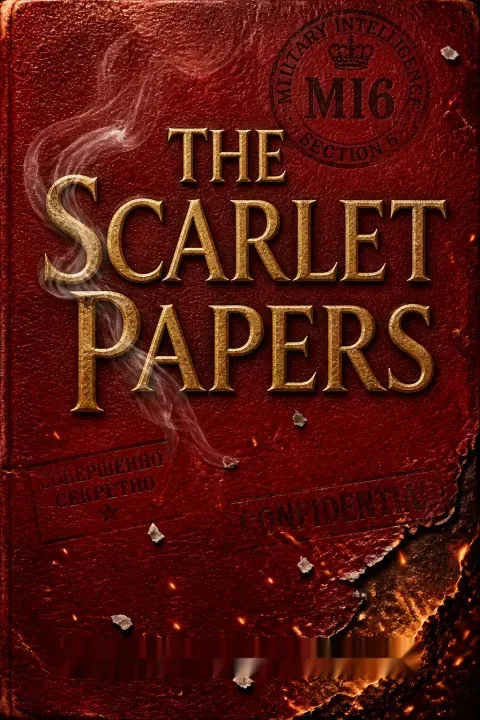


Plot Summary
The Phantom Invitation
Max Archer,1 associate professor of intelligence history at the LSE, finds an old-fashioned calling card in his pigeonhole. Handwritten instructions summon him to a flat in Holland Park, signed by Scarlet King,2 a legendary MI6 officer whose name appears in no public record. Max,1 reeling from a collapsing marriage and stalled career, obeys.
He executes clumsy counter-surveillance en route, feeling absurd. At the flat, a woman with a scar on her arm, Cleo,3 admits him. Inside, a frail, snowy-haired woman in her nineties immediately dissects his life: his impending divorce, his childlessness, his debts. She reveals she has vetted him thoroughly.
Max1 realizes he is not a guest but a potential asset being recruited. Scarlet2 hands him a sheaf of scanned pages: her memoir, written in the third person, beginning in Vienna, 1946. She challenges him to read, to verify, and to decide if he will help her publish a truth that could destroy them both. Max1 leaves, his academic curiosity now entangled with mortal risk.
The novel opens with a classic spy fiction trope (the mysterious summons) but immediately subverts it through the intimacy of Scarlet's interrogation. She weaponizes Max's personal failures, demonstrating that espionage is fundamentally about exploiting human weakness. The card itself is a perfect lure: obscure enough to filter out the unworthy, specific enough to hook an expert. This scene also introduces the meta-layer: a spy story about a spy story, where the teller may be as unreliable as the subject. Max, the historian, is about to become history.
Vienna's Stolen Scientist
Back in his office, Max1 devours the sample pages. They recount Scarlet's2 first field mission: in post-war Vienna, her station chief Archie Grenville orders her to recruit Dr. Otto Spengler,8 a Nazi biochemist hiding under an alias. Scarlet2 poses as an Austrian journalist, encounters Spengler8 at Café Landtmann, and lures him with talk of Beethoven and a record collection.
In her flat, she drugs his drink while the Fifth Symphony plays, then signals a strike team who bundle him onto a boat to England. En route, she softens him into cooperation; he is later given a new identity as 'Thomas Hegel'8 and put to work at Porton Down.
The memoir also recounts a drunken night with an American OSS officer, Caspar Madison,7 who brags about Operation Paperclip and communist sympathies. Max1 cross-references the names and dates against reference books and finds no obvious errors. The possibility of a genuine historical bombshell begins to seem real.
This embedded narrative establishes Scarlet's credentials as a field operative while planting seeds for later revelations. The use of Beethoven (beauty) as cover for kidnapping (brutality) encapsulates the moral ambiguity of espionage. Otto Spengler's recruitment is the original sin that will haunt Scarlet for decades. The name Caspar Madison is a time-release capsule; his drunken confession about Paperclip and communism foreshadows a lifelong entanglement. Max's verification process mirrors the reader's, inviting us to weigh the evidence alongside him.
The Park Bench Confession
Max1 meets Scarlet2 on a bench in St. James's Park. She presses him on the real reason he came, and he finally admits his wife is remarrying after a swift divorce and is pregnant with another man's child. Satisfied, Scarlet2 tells him she herself is the last undiscovered Soviet double agent of the Cold War.
When Max1 demands evidence, she challenges him to decode the secret hidden in her memoir's opening pages, claiming he already has all the clues. She recites his teaching schedule to underline how thoroughly she owns him.
While she talks, Max,1 seizing a reckless initiative, slips a small tracking device into her handbag. He leaves in turmoil. If her claim is true, the memoir is the scoop of a lifetime; if false, she is a fantasist who could destroy his career. But her parting words lodge in his mind: he has the pieces, he just needs to see them.
This is the point of no return. Scarlet’s confession is deliberately theatrical, a performance crafted to hook Max’s desperate ambition. The tracking device marks Max’s first genuine act of tradecraft, a small betrayal that will spiral into catastrophe. Her cryptic riddle transforms the memoir from a passive document into an active puzzle, making Max a co-investigator in his own manipulation. The scene also deepens the Oedipal subtext: Max is trying to prove himself to a father figure by solving a mystery posed by a mother figure, while reaching for the spy career he was denied.
Champagne, Lies, and a Watch
At the Goring Hotel, Max's1 father Oliver,6 a retired journalist and former MI6 stringer, celebrates his eighty-fifth birthday. Max's1 ex-wife Emma5 attends, visibly pregnant and preparing to emigrate to California.
After too much champagne, Max1 brags about his secret project: a memoir by the last Cold War double agent, bigger than Mitrokhin, with a seven-figure advance. He even utters the name Scarlet King.2 Oliver,6 condescending as always, later presents Max1 with a family heirloom: a Rolex Oyster chronograph supposedly worn by Max's grandfather in a WWII POW camp.
Unknown to Max,1 Oliver6 is being blackmailed by MI5 over gambling debts, and the watch contains a sophisticated tracking and listening device. MI5's A Branch, which had bugged the party, now has direct evidence that Max1 intends to breach the Official Secrets Act. The trap is sprung.
The party scene layers personal humiliation over state surveillance. Max’s boast is both defiant and pathetic, the cry of a man who has defined his life by a single failure. Oliver’s gift, wrapped in family mythology, is the ultimate paternal betrayal, making Max an unwitting pawn of the institution that rejected him. The watch becomes a symbol of corrupted inheritance: love weaponized, history falsified. Emma’s serene pregnancy compounds Max’s sense of emasculation, pushing him further toward the reckless conviction that the memoir is his only shot at redemption.
An Open Door, a Corpse
After the party, Max,1 still drunk, tracks Scarlet2 to her Chelsea flat using the device he planted. The door is unlocked. He enters, retrieves the tracker from her handbag, and follows a smear of blood to the bedroom. Scarlet2 lies dead on the bed, a gash on her head, blood pooled.
Panicked, he checks for a pulse, contaminating the scene with his DNA and fingerprints. He bolts, returning to his studio flat where he scrubs blood from his hands. The next morning, he tries to maintain routine by giving a lecture, but Cleo3 intercepts him in the hallway.
She reveals that five MI5 watchers are outside and lays out the case: his financial desperation, the surveillance evidence, his DNA at the scene. She says the only way to survive is to run with her. Max,1 cornered and terrified, agrees. His life as a fugitive begins.
This turning point plunges the academic into the visceral reality of spycraft. The corpse is both a physical shock and a narrative cypher; Scarlet’s death transforms the story from an intellectual puzzle into a survival thriller. Max’s contamination of the crime scene is not merely forensic but psychological: he has literally touched the secret and cannot wash it off. Cleo’s appearance shifts the power dynamic; she is the professional, he the asset. The question of who actually killed Scarlet hangs over everything, implicating MI5, Mossad, and Cleo herself.
Fugitive Scholar
In the lecture hall toilets, Max1 changes into a tracksuit and baseball cap, then escapes through a fire exit into a waiting Range Rover. They switch vehicles in Holborn, ditching the showy car for an old Renault with false plates.
As they drive toward Gosport, Cleo3 reveals her background: she is a Mossad operative who worked for a Mayfair private intelligence firm before becoming Scarlet's2 principal aide. Scarlet2 hired her to run the memoir project, doubling her previous salary.
Max1 demands answers; Cleo3 explains the original notebook is stashed in Paris, and once he authenticates it, the story can be released to clear his name. They board a sport yacht in Haslar Marina and head for the French coast. Max,1 exhausted and out of his depth, can only trust the woman with the scar who may be his savior or his executioner.
The extraction is the bridge between academic thriller and full-blown spy adventure. Max’s costume change symbolizes his shedding of scholarly identity. Cleo’s dual allegiance deepens the geopolitical stakes, introducing the theme that every intelligence service has a vested interest in Scarlet’s legacy. The journey south echoes classic defection narratives while inverting them: Max is not fleeing to an enemy state but toward a truth his own government wants buried. The dynamic between the two—amateur and professional—adds a layer of tension.
The Ana Revelation
On the boat crossing the Channel, Max1 reads the second section of the memoir, covering 1964. It details Scarlet's2 Moscow posting, her affair with Caspar Madison,7 and a brutal counterintelligence interrogation at SIS headquarters. During a clandestine meeting at Oxford, her handler Aunt Maria9 calls her 'Ana.'
Max1 cross-references this with the memoir's opening line, which introduces Scarlet King2 like a fictional character. He suddenly understands: Scarlet King2 was never a British citizen. The real Scarlet King died in Kenya as a toddler; the woman he knew stole her identity.
She was Anastasia Chekova,2 a Russian Jew trained as a KGB illegal by Directorate S and planted in Britain in the 1930s. The third-person memoir is not merely legal cover; it is the confession of someone who never existed. Max1 announces his discovery to Cleo,3 who confirms he has finally learned to think like a spy.
Max’s deduction is the intellectual climax of the novel, transforming him from passive reader to active detective. The “Ana” clue is classic spycraft, rewarding close reading and demonstrating Scarlet’s trust in Max’s ability to see what others missed. The revelation that Scarlet was an illegal recontextualizes her entire life, raising profound questions about identity and loyalty. It also completes a personal journey: by solving the puzzle, Max proves he has the mind of a spy, finally earning the validation denied by MI6 two decades earlier.
The Paris Vault
Cleo3 drives Max1 to the Simon Wiesenthal Centre in Paris, where Scarlet2 hid a safety deposit box with a survivor named Reuben. Inside, they find the original notebook, an Order of Lenin medal, a Russian birth certificate, a photo album, and a fragile letter bearing the 10 Downing Street crest.
Leafing through the album, Max1 freezes at a photo of a young woman and a small child: the woman is Scarlet,2 the child is his own mother, Lily Anderson. He realizes Scarlet2 was his grandmother.
The letter, dated 1940 and signed by Winston Churchill, reveals that Anastasia Chekova2 defected to Britain on moral grounds, was run personally by Churchill as a double agent against the Soviets, and was never a traitor. Her entire life was an ultra-deep-cover operation for Britain. Before Max1 can fully absorb this, MI5 and SIS officers storm the Centre. They are captured.
This scene delivers the novel’s emotional payload and ultimate twist. The familial link personalizes the epic sweep of history, grounding geopolitics in a single photograph. The Churchill letter inverts the moral calculus: Scarlet is not the ultimate villain but the ultimate patriot, a Jewish Russian who risked everything to fight both Nazism and Stalinism. The Wiesenthal Centre setting reinforces themes of memory and justice, while Reuben’s silent presence evokes the unspoken trauma behind the spy games. The capture immediately raises the stakes from discovery to survival.
The Blunt Bargain
At the British embassy in Paris, Saul Northcliffe,4 MI5's Deputy Director-General, interrogates Max.1 He presents a damning file: surveillance photos, DNA evidence, and a profit motive. Max1 counter-accuses MI5 of murdering Scarlet2 to bury her secrets.
He then pivots, invoking the 1964 case of Anthony Blunt, the Soviet spy who received full immunity from prosecution. Max1 demands the same deal: immunity in exchange for his silence on Scarlet's2 identity as an illegal, while retaining the right to publish the story of Operation Hercules, Britain's secret resettlement of Nazi war criminals.
He stakes everything on the threat of a public trial that would expose the Hercules program. After frantic calls to London, the Home Secretary10 agrees. Max1 signs the deal, securing his freedom and the chance to expose the Nazi legacy, but forever bound to silence on his grandmother's true allegiance.
Max weaponizes his academic expertise, turning esoteric knowledge of espionage history into a negotiation tactic. The Blunt precedent is a real piece of British intelligence lore, lending authenticity. The standoff crystallizes the novel’s central conflict: the state’s desire to control the past versus the individual’s power to expose it. Max’s bargaining also demonstrates his evolution from passive academic to active agent, using the tools of his trade (archives, precedents) to win a real-world battle. It is a moment of personal redemption, even as it enmeshes him in a new web of secrecy.
An Old Woman's Scalpel
With the full notebook secured, Max1 reads the 1992 section. It chronicles Scarlet's2 role in managing the defection of KGB archivist Vasili Mitrokhin. While verifying his files, she finds her own dossier and surgically excises all references to Anastasia Chekova2 before the archive is made public.
She also tracks down Otto Spengler,8 now a dying professor threatening to confess his past to a journalist. Visiting him in a hospice at night, dressed as a nurse, she administers a Novichok-based poison. Otto8 dies of an apparent heart attack.
Finally, she covertly feeds information on Caspar Madison7 to a Sunday Times reporter, ensuring his arrest. The section ends with her retirement from SIS, her daughter (Max's1 mother) dead, and her mission to erase all links to her past nearly complete. Only the child of Lily remains unaccounted for.
The 1992 section reframes Scarlet’s earlier actions as clinical execution of a lifelong cover-up. Her cold efficiency in eliminating threats reveals the monstrous side of survival, yet her meticulousness is also a form of penance: she is preserving the fiction of Scarlet King not for glory but to protect the mission Churchill gave her. The poisoning of Otto, the old lover turned liability, brings her initial Vienna operation to its chilling terminus. This section also demystifies the Mitrokhin Archive legend, revealing that the public historical record was shaped by a hidden hand deleting itself.
The Final Poisoned Gift
The 2010 section describes Scarlet's2 reluctant return to the field. The CIA and SIS call her to Vienna for a spy swap, where she is to interrogate Caspar Madison7 before he is exchanged to Russia. She meets him in the embassy gardens, bringing a picnic and a hip flask of Johnnie Walker Blue Label laced with slow-acting poison.
As they reminisce, he drinks deeply. Hours later, aboard the Russian plane, he suffers a fatal heart attack. Scarlet2 has eliminated the last witness to her true identity.
Afterward, she returns to London and begins writing her memoir in a flat without wi-fi, a final confession and a coded inheritance for the grandson she never knew. She obsessively watches Max1 from afar, vetting his life, choosing him as the vessel for her last secret Operation Hercules and, through it, a form of posthumous atonement.
This chapter brings Scarlet’s story full circle: Vienna, where her spy career began, becomes the stage for its final act. The poisoned flask is a perverse Eucharist, a communion that brings death instead of life. Her mixture of tenderness and ruthlessness encapsulates her character. The memoir’s genesis is portrayed as a compulsion, an attempt to turn a fragmented life into a coherent narrative before it is too late. The reader now understands that the entire present-day plot was a puppet show orchestrated by a dying woman seeking to redeem one grandson and expose one great crime.
The Inherited Game
One year after the Paris deal, Max1 has published Operation Hercules: The Secret History, which becomes a global bestseller. He is now a visiting professor at Harvard and a media don. Visiting Oliver's6 grave, he encounters Saul Northcliffe,4 now the Acting Director-General.
Saul4 reveals that he knows Max1 is Scarlet's2 grandson and that Scarlet2 personally vetoed Max's1 MI6 application years ago to protect him from the life she led. Saul4 offers a deal: Max1 will serve as an off-the-books NOC for the Joint Intelligence Committee, using his academic travels to gather intelligence.
In return, the JIC gets copy approval on his future books, and Max1 finally becomes what he always wanted to be. Max,1 seeing a chance to step into the family trade and resolve his lifelong obsession, accepts. He is no longer just a historian of spies; he is one of them.
The ending is a Faustian bargain that completes Max’s arc. He has achieved fame and recognition, but at the cost of his independence. His transformation from victim to asset mirrors Scarlet’s own journey, suggesting that espionage is a hereditary calling. The revelation about the IONEC rejection reframes Max’s entire life as a product of Scarlet’s manipulation, raising unsettling questions about free will. By accepting the offer, Max steps fully into the family trade, but the reader is left to wonder whether he has been liberated or simply co-opted by the very system he once sought to expose.
Ashes in the City of Spies
Max1 travels to Vienna for an intelligence conference and encounters Cleo,3 now operating under yet another academic alias. Over coffee at Café Landtmann, the place where Scarlet2 first met Otto Spengler,8 they discuss the aftermath.
Cleo3 admits that Mossad retains a copy of the full memoir but will never publish it; some secrets gain power by remaining unspoken. Together they walk to a quiet square, where Max1 produces a small urn containing Scarlet's2 ashes. He scatters them on the cobblestones, returning the woman of many names to the city where her double life began.
For an instant, Max1 sees a snowy-haired figure in the shadows, then the vision fades. Cleo3 departs into her own covert existence. Max1 walks away, a secret agent now, ready for his first assignment and carrying the legacy of the grandmother who orchestrated his rebirth.
The scattering of ashes is a ritual of closure, returning Scarlet to the liminal space from which she emerged. Vienna, neutral ground, is the only fitting resting place for a woman who belonged to no single nation. The final vision suggests that Max has internalized his grandmother’s legacy, her ghost now a part of his own identity. The scene also marks a tentative reconciliation with Cleo, the other fractured survivor of this tale. Max’s purposeful exit signals that he has finally learned to live with ambiguity, the essential skill of a spy and now his inheritance.
The Ashes and the Archive
In his Thames House office, Saul4 retrieves a jiffy bag from his wall safe. It contains the Churchill letter, the notebook, the birth certificate, and the photographs. He reads the letter one final time, then methodically feeds each item into the fireplace, consigning the physical truth to ash.
He keeps only the Order of Lenin medal as a private memento. Afterward, he sends a coded text to the Home Secretary confirming that all traces of Scarlet King2 have been expunged. He closes the case file on Operation Tempest. That night at home, he dreams of the stories he can never tell.
The history that nearly rewrote the Cold War is now officially forgotten, preserved only in the memories of a few and in the secret compartments of a grandson's mind. The cycle of secrets and revelations continues, dormant, awaiting the next spark.
Saul’s bonfire is the bureaucratic counterpart to Max’s scattering of ashes. The state erases what it cannot control. The choice to keep the medal is a small act of defiance, an acknowledgment that even the most loyal servant is not immune to the romance of the enemy. The novel ends not with a bang but with a quiet act of suppression, underlining its central theme: history is written by the victors, but truth survives in the margins—in the asides of a memoir, in a grandson’s DNA, in the classified file a spy keeps in his head. The game never truly ends.
Analysis
The Scarlet Papers is a meditation on the nature of espionage as a form of narrative control. At every level, the novel is about who gets to tell the story. Scarlet King's2 third-person memoir is the most obvious example: by writing 'she' rather than 'I,' she both obscures her illegality and performs the ultimate spy trick of self-dissimulation. Yet the novel argues that all history is a form of spycraft: the Mitrokhin Archive was curated by a mole, the public record of Operation Hercules was suppressed, and Churchill's letter was buried so effectively that even the state forgot its own secrets.
The twist that Scarlet2 was a triple agent, not a double, is more than a plot reversal; it is a moral proposition. It asks whether loyalty can exist when it is conducted entirely in the shadows, without witnesses or validation. Scarlet's2 tragedy is that she could never tell anyone the truth; her heroism is that she did her duty anyway. Max,1 by contrast, is the beneficiary of her final confession. He inherits not just her genetic material but her vocation, finally becoming the spy he always wanted to be, but only by accepting that the truth cannot always be spoken.
The novel also functions as a critique of the academic study of intelligence. Max1 begins as a man who believes archives and documents can deliver objective truth. He ends as a man who understands that the most important documents are often the ones that were destroyed, and that every archive is a curated selection. His transition from historian to asset is the ultimate loss of innocence, but also a kind of maturation. To know the secret world, he must join it, and in joining it, he must learn to keep its secrets. The final image of Saul4 burning the Churchill letter is the novel's last word on the matter: history is always a controlled burn.
Review Summary
The Scarlet Papers receives polarized reviews averaging 4.28/5 stars. Supporters praise its intricate plotting, authentic Cold War espionage details, and comparison to John le Carré's work, calling it a compelling page-turner with surprising twists. Critics cite overreliance on clichés, predictable plot developments, superficial research with historical errors, and underdeveloped characters. The dual-timeline structure following an academic and a legendary spy's memoir divides readers—some find it cleverly complex while others consider it overly ambitious and slow-paced. Most agree the book is well-researched but opinions split sharply on execution.
People Also Read

Characters
Max Archer
Academic turned covert assetA forty-two-year-old associate professor of intelligence history at the LSE, Max is a man haunted by a single failure: his rejection from MI6 in his youth, which diverted him into academia as a permanent second-best. His twenty-one-year marriage to Emma5 has collapsed, leaving him financially precarious and emotionally adrift. He is the son of Oliver6, a charismatic journalist and covert MI6 operative, and Lily, whose early death still aches. Max's expertise in Cold War double agents makes him the perfect candidate to authenticate Scarlet's2 memoir, but his desperation for a breakthrough clouds his judgment. Intellectually brilliant yet operationally naive, he has spent his life studying spies without ever becoming one. His arc moves from passive observer to active participant, ultimately discovering that he is the grandson of Britain's most secret triple agent2 and inheriting the family trade.
Scarlet King / Anastasia Chekova
Legendary triple agentA frail woman in her nineties who was once the most powerful female officer in MI6 history, rising to Controller for Central and Eastern Europe and nearly becoming Chief. In public, she is Scarlet King, a natural-born Briton and Cold War warrior. In reality, she is a palimpsest of identities: born Anastasia Chekova, a Russian Jew in Moscow, recruited by the NKVD as an illegal and planted in Britain as a child; she later defected to Winston Churchill, who ran her personally as a double agent against the Soviets for over forty years. She is ruthless, brilliant, and deeply manipulative, capable of murder to protect her cover. Yet she is also driven by a desire for atonement, and her memoir—written in the third person—is her final operation, designed to expose a state crime and provide a posthumous inheritance for the grandson she never knew1.
Cleo Watson
Mossad operative and handlerA British-Israeli dual national in her late thirties with a degree from Princeton and a decade of covert work in the Middle East. She bears a long scar on her left arm from a past combat encounter. Her cover is as a consultant at Grosvenor Strategy, a Mayfair private intelligence firm; in reality, she is a Mossad agent tasked with assisting Scarlet's2 memoir project. Cleo is pragmatic, cynical, and highly trained in counter-surveillance and exfiltration. She becomes Max's1 protector and de facto handler during their flight across Europe. Her dual heritage and multiple aliases make her a mirror to Scarlet2, while her operational competence exposes Max's1 amateurism. Though her ultimate loyalty is to Tel Aviv, she develops a grudging respect for Max1, and the two share the secret of what really happened in Paris.
Saul Northcliffe
MI5 Deputy Director-GeneralThe blunt, working-class second-in-command of MI5, in his early sixties and nearing retirement. Saul is a career Security Service officer who rose through the ranks on competence rather than connections, nursing a permanent grudge against the posh boys of SIS. He is haunted by an earlier failure: in the 1990s, while investigating Cold War penetrations, he approached Scarlet King2 under journalistic cover and was comprehensively outmaneuvered. When her name resurfaces in Operation Tempest, he sees a chance to redeem his career and settle old scores. Saul is ruthless in defense of the state, willing to blackmail civilians and bend laws, but he operates from a genuine, if ossified, sense of duty. His final act of burning the evidence is both an erasure and a reluctant tribute to an opponent he could never defeat.
Emma Archer
Max's ex-wife with a hidden pastA sharp, successful lawyer who met Max1 at Harvard when she was a Kennedy Scholar. Their twenty-year marriage withered under the pressures of her career ascent and his stalled ambitions. Unknown to Max1 throughout their life together, Emma spent her early years not just at the Treasury but also as a legal adviser for MI5, a secret she kept at the insistence of Max's father6. She is now pregnant by her new partner and preparing to emigrate to California. Her reappearance during Max's1 interrogation in Paris forces a reckoning with the deceptions that underpinned their relationship. Despite the betrayal, she remains the only person who can get Max1 to see reason, and her final intervention helps broker the immunity deal that saves him.
Oliver Archer
Max's father, former MI6 NOCMax's1 octogenarian father, a rakish former foreign correspondent who secretly spent his career as a non-official cover operative for MI6, filing stories from Cold War flashpoints while running agents. He abandoned Max's1 mother Lily for another woman, leaving a wound that never healed. In old age, he gambled away his savings and is now blackmailed by MI5 into betraying his son. Under the guise of a family heirloom, he passes Max1 a bugged Rolex, enabling the Security Service to track his every move. Oliver's charm masks a profound moral weakness, yet his final act of contrition helps set in motion the events that will finally reveal the truth about the Archer family's secret lineage.
Caspar Madison
CIA double agent and Scarlet's loverA charismatic American intelligence officer who first meets Scarlet2 in 1946 Vienna, where his drunken boasts reveal communist sympathies. Over the decades, he rises to become Deputy Director of Operations at the CIA while secretly working for Moscow, betraying over eighty Soviet assets to their deaths. He and Scarlet2 reconnect in Moscow in 1964, conducting an affair that produces a daughter (Max's1 mother Lily). Madison is a sociopath who betrays not for ideology but for the thrill of the game. After his arrest in 1992, he serves eighteen years in solitary confinement. In 2010, during a spy swap in Vienna, Scarlet2, sent to interrogate him, gives him a poisoned flask of whiskey, ensuring he takes her secrets to the grave aboard the Russian plane.
Otto Spengler / Thomas Hegel
Nazi scientist turned British assetA brilliant German biochemist who worked at IG Farben's Auschwitz III camp, conducting experiments on human inmates. After the war, Scarlet2 kidnaps him in Vienna and he is renditioned to Britain under Operation Hercules. Given the new identity 'Thomas Hegel', he becomes a professor at Imperial College and a secret asset for MI6, spying on scientific conferences worldwide. Otto is cultured yet morally hollow, viewing his war crimes as merely professional duties. His decades-long relationship with his handler Scarlet2 is a toxic mix of dependency and mutual loathing. In 1992, terminally ill and threatening to confess to a journalist, he is visited by Scarlet2 in his hospice room, where she administers a Novichok poison disguised as a heart attack.
Maria Kazakova (Aunt Maria)
Oxford professor and KGB handlerA White Russian émigrée who becomes a Regius Professor of Russian History at Oxford and a fixture of the academic establishment. She acts as Scarlet's2 guardian after the death of her supposed parents, raising her in a bohemian Jericho household alongside her mathematician husband Maurice. In reality, Maria is the KGB's principal handler for the illegal Anastasia Chekova2, maintaining her cover through a life of scholarly respectability. She is a woman of fierce intellect and ideological conviction, whose maternal affection for Scarlet2 is intertwined with her operational role. When the Soviet Union collapses, she warns Scarlet2 that Moscow can no longer protect her. She dies of leukaemia in 1992, leaving Scarlet2 without her handler and anchor for the first time since childhood.
Lucas Harper
Home Secretary caught in the webThe Rt Hon Lucas Harper MP, a weary Cabinet minister who authorizes the SIGINT warrants for Operation Tempest and is later forced to approve the immunity deal for Max1. Harper is a political survivor, acutely aware that any scandal involving rogue spies could end his career. He provides the legal and political cover for Saul's4 operations while privately nursing ambitions beyond the Home Office. His pragmatic willingness to bend rules to protect the state makes him a perfect foil to Saul4, and his late-night phone calls from his home office embody the tension between public accountability and secret government.
Plot Devices
The Scarlet Papers (Memoir)
Confession and coded inheritanceA handwritten, third-person memoir by Scarlet King2, covering the years 1946, 1964, 1992, and 2010. Written on featherweight paper in a Smythson notebook, it details her recruitment of a Nazi scientist8, her affair with a CIA double agent7, her cover-up of her illegal identity, and her final acts of murder and atonement. The memoir functions simultaneously as a confession, a legal self-protection, and a puzzle for her grandson Max1. By encoding her truth in the distance of the third person and seeding clues within its opening line, Scarlet2 ensures that only someone with Max's1 specific expertise could decipher her true identity. It is the engine of the entire plot, the object over which nations collide.
The Bugged Rolex
Tracking and surveillance deviceA stainless-steel Rolex Oyster chronograph, purportedly a family heirloom from Max's1 grandfather who was a POW in Stalag Luft III. In reality, it is a sophisticated surveillance device manufactured by Hanslope Park, containing both a GPS tracker and an audio bug. Given to Max1 by his father Oliver6 at the Goring Hotel party, the watch is the linchpin of MI5's Operation Tempest. It allows Saul Northcliffe4 to track Max's1 movements to the Chelsea flat where Scarlet's2 body lies, and later to the French coast. The watch embodies the novel's theme of corrupted inheritance: the myth of a heroic grandfather is replaced by a father's betrayal, weaponized by the state.
The Tracking Device
Amateur tradecraft with fatal consequencesA small digital disc, the size of a polo mint, which Max1 purchases from a hardware shop in Fitzrovia and slips into Scarlet's2 handbag during their meeting in St. James's Park. It is Max's1 first act of real espionage, a naive attempt to discover where Scarlet2 lives and whether she is genuine. The tracker works perfectly, leading Max1 to her Chelsea flat, but his drunken entry results in him contaminating the murder scene with his DNA. The device thus transforms from a tool of investigation into the key piece of evidence that frames him for Scarlet's2 death. It also gives MI5 a second vector of surveillance, as they have already been tracking Max1 via the Rolex.
The Immunity Deal
Historical precedent as legal escape hatchA formal immunity from prosecution, drafted by the Crown Prosecution Service and approved by the Home Secretary, modeled on the secret deal given to Soviet spy Anthony Blunt in 1964. Max1, during his interrogation at the Paris embassy, invokes this historical precedent to negotiate his freedom. He trades silence on Scarlet's2 identity as an illegal (thereby protecting MI5 and SIS from catastrophic embarrassment) for the right to publish the truth about Operation Hercules, the British program that resettled Nazi war criminals. The deal is the novel's climactic resolution mechanism, allowing Max1 to achieve his professional redemption while binding him permanently to the secrets of the state he once sought to expose.
The Churchill Letter
Retcon of a traitor into a patriotA 1940 memorandum on 10 Downing Street stationery, drafted by Winston Churchill and found in Scarlet's2 Paris safety deposit box. The letter states that Anastasia Chekova2 voluntarily defected to Britain, was run personally by Churchill and the Director of Naval Intelligence as a double agent against the Soviets, and was never a traitor but a woman of the highest courage who accepted that no official acknowledgment would ever be made. This document upends the entire narrative, transforming Scarlet2 from the last undiscovered Soviet mole into Britain's most secret and loyal servant. It is the ultimate twist, reframing every action in the memoir as duty rather than treason. Saul4 burns the original, preserving the official fiction while privately acknowledging the truth.
Download PDF
Download EPUB
.epub digital book format is ideal for reading ebooks on phones, tablets, and e-readers.








































