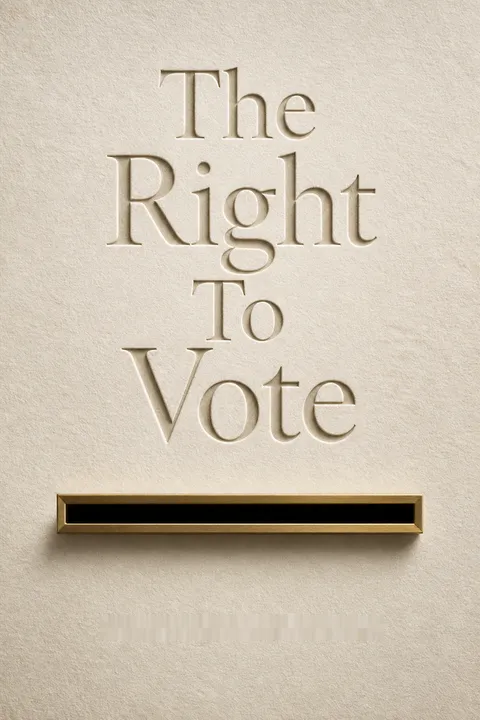

Key Takeaways
1. Suffrage in the US was never a guaranteed right from the start.
Remarkably, this new constitution, born in celebration of “republican government,” did not grant anyone the right to vote.
Founding ambiguity. At its inception, the United States was not a democratic nation, and the very word "democracy" often carried negative connotations, evoking images of mob rule. The U.S. Constitution, a blueprint for republican government, notably omitted any explicit grant of the right to vote, instead deferring this crucial power to individual states. This foundational silence meant that who could vote was a patchwork of state-specific rules, rather than a uniform national standard.
Colonial legacy. State suffrage laws were largely shaped by colonial precedents and traditional English thought, which restricted voting to adult men who owned property. This property requirement was justified on two main grounds:
- "Stake in society": Property owners were seen as committed members of the community with a personal interest in state policies.
- Independence: Only property owners were believed to possess sufficient economic independence to vote without being swayed by others.
Conversely, those deemed economically dependent, such as paupers, servants, and women, were explicitly or implicitly excluded.
Limited participation. Consequently, in the early republic, only a small fraction of the population could cast ballots. Beyond property, other restrictions included:
- Residency requirements
- Citizenship (of England or the province)
- Exclusion of women, African Americans, and Native Americans
- Religious tests (e.g., Catholics and Jews disfranchised in some states)
This initial framework established a system where political participation was a privilege, not an inherent right, setting the stage for centuries of struggle over who truly belonged to "We, the people."
2. The path to universal suffrage was not linear, but contested and often reversed.
The history of suffrage in the United States is a history of both expansion and contraction, of inclusion and exclusion, of shifts in direction and momentum at different places and at different times.
A zigzagging journey. Contrary to a "Whig" or triumphalist view of history, the evolution of voting rights in the U.S. was far from a steady, inevitable march toward universal suffrage. Instead, it was a complex, often contradictory process marked by periods of significant expansion followed by retrenchment and new forms of exclusion. This dynamic reflected ongoing debates about the meaning of democracy and who was deemed worthy of political participation.
Early gains, later losses. The period from the Revolution to roughly 1850 saw a notable broadening of the franchise, primarily for white men, as property and taxpaying requirements eroded. However, this era also witnessed the disfranchisement of women in New Jersey and a widespread movement to bar free African Americans from voting in many Northern states. Later, in the late 19th and early 20th centuries, new barriers emerged:
- Southern disfranchisement: Systematic legal and extralegal tactics to exclude African Americans and many poor whites.
- Northern restrictions: Literacy tests, lengthy residency requirements, and complex registration procedures targeting immigrants and the urban poor.
These contractions demonstrate that gains were not permanent and required constant vigilance and struggle.
Contingency and conflict. The trajectory of suffrage history was shaped by a confluence of factors, including social movements, economic changes, and political maneuvering, making its outcome far from predetermined. The "Pandora's box" argument—that expanding suffrage to one group would logically lead to demands from all—was a recurring conservative fear. This fear often fueled efforts to limit the franchise, highlighting that the expansion of democracy was a hard-won project, not a natural destiny.
3. Economic status was a primary barrier to voting for centuries.
The true reason of requiring any qualification, with regard to property, in voters, is to exclude such persons as are in so mean a situation that they are esteemed to have no will of their own.
Property as privilege. From the colonial era, property ownership was the bedrock of voting qualifications, rooted in the belief that only those with a "stake in society" and economic independence could be trusted with the ballot. This Blackstonian ideal, though seemingly about independence, often masked class apprehensions, as elites feared the propertyless would vote against their interests. Benjamin Franklin famously questioned this, asking whether the right to vote belonged to "the man or the jackass" if a man's vote depended on owning a fifty-dollar animal.
Shifting economic barriers. While property requirements largely disappeared for white men by the mid-19th century, other economic barriers persisted or were resurrected:
- Taxpaying requirements: Replaced property qualifications in many states, linking suffrage to contributions to government.
- Pauper exclusions: Explicitly barred individuals receiving public relief, reinforcing the idea that economic dependence negated political independence. These were often new constitutional provisions, not just colonial relics.
- Municipal property tests: Some cities and states maintained property or tax qualifications for local elections, particularly those involving financial matters, arguing that only taxpayers should decide on public expenditures.
Class-based control. The persistence of these economic restrictions, especially in the late 19th and early 20th centuries, reveals a consistent effort by propertied classes to maintain political control. The fear of a "large, propertyless, and dangerous urban proletariat" fueled arguments for limiting the franchise, particularly as industrialization progressed. Even when direct property tests were abolished, indirect economic hurdles, like poll taxes in the South, continued to disproportionately exclude the poor, both black and white.
4. War consistently acted as a catalyst for suffrage expansion.
Nearly all of the major expansions of the franchise that have occurred in American history took place either during or in the wake of wars.
Military service and civic rights. The demands of war, and preparedness for it, repeatedly created powerful pressures to enlarge the right to vote. It was rhetorically and practically difficult to compel men to bear arms while denying them the franchise. This argument, linking military service to the rights of citizenship, resonated from the American Revolution through the Vietnam War.
Key historical instances:
- American Revolution: Franklin argued against property qualifications, noting the patriotism of common people who fought. Militiamen in Pennsylvania and Maryland demanded voting rights.
- War of 1812: Accelerated protests for suffrage extension, as propertyless men were asked to risk their lives.
- Civil War: The service of over 180,000 black soldiers became a powerful moral and pragmatic argument for their enfranchisement, leading to the Fifteenth Amendment.
- World Wars I & II: Prompted states to enact laws for absentee voting for soldiers and, in WWII, led to the abolition of poll taxes for servicemen and a re-evaluation of racial discrimination.
- Vietnam War: The unpopularity of the war and the drafting of 18-year-olds who couldn't vote directly led to the 26th Amendment.
Ideological shifts. Wars also served as ideological crucibles, forcing the nation to confront the contradictions between its democratic ideals and its exclusionary practices. The anti-totalitarian rhetoric of World War II and the Cold War, for instance, highlighted the hypocrisy of racial discrimination at home, strengthening the civil rights movement and the push for universal suffrage.
5. Race and ethnicity were central to both expanding and restricting the franchise.
The American equivalent of the peasantry was not going to be enfranchised in any case, and the social landscape included few industrial workers.
A peculiar peasantry. The presence of enslaved African Americans profoundly shaped the early history of suffrage. When economic barriers to voting were dropped in the South, it was with the implicit understanding that millions of black men, considered the region's "peasantry," would remain outside the political calculus. This racial exclusion allowed white political leaders to liberalize suffrage for poor whites without threatening the existing social order.
Post-Civil War transformation. The Civil War and Reconstruction brought a temporary, but revolutionary, shift. The 14th and 15th Amendments, though limited, constitutionally prohibited racial discrimination in voting. This led to the enfranchisement of over a million black men in the South, transforming the political landscape and sparking fierce white opposition. However, the narrowness of the 15th Amendment allowed Southern states to devise new, ostensibly race-neutral tactics to disfranchise blacks.
Immigrant anxieties. In the North and West, ethnic and racial anxieties focused on immigrants. The Know-Nothing movement of the 1850s, fueled by anti-Irish Catholic sentiment, sought to restrict immigrant voting through literacy tests and extended naturalization waiting periods. Later, anti-Chinese sentiment in the West led to explicit bans on Chinese voting. These efforts were often rooted in:
- Class fears: Immigrants were seen as a "dangerous urban proletariat."
- Cultural prejudice: Concerns about foreign languages, religions, and "un-American" values.
- Partisan interests: Belief that immigrants would vote for opposing parties.
The history of suffrage is thus deeply intertwined with the nation's evolving racial and ethnic demographics, revealing how difference was often weaponized to justify exclusion.
6. Gender roles and societal fears significantly delayed women's suffrage.
If that word ‘male’ be inserted, it will take us a century at least to get it out.
A long and intimate struggle. The movement for women's suffrage, launched at Seneca Falls in 1848, faced unique challenges. Unlike other disfranchised groups, women shared intimate relationships with the men who held political power, yet were excluded based on deeply ingrained beliefs about their "nature" and "sphere." They were deemed dependent, unfit for the public world of politics, and "virtually represented" by men. Elizabeth Cady Stanton's prophetic warning about the word "male" in the 14th Amendment proved accurate, as it took over 50 years to remove.
Betrayal and regrouping. Suffragists initially hoped to ride the post-Civil War wave of democratic sentiment, linking their cause to black suffrage. However, Republican leaders prioritized black male enfranchisement, leading to a painful schism. The defeat of early federal and state efforts forced suffragists to regroup, leading to:
- Organizational consolidation: Formation of the National American Woman Suffrage Association (NAWSA).
- Strategic shifts: Focus on state-by-state campaigns and "partial" suffrage (e.g., school board elections).
- Ideological evolution: Moving from universal rights arguments to emphasizing women's unique virtues and their role in purifying politics, and even, controversially, using racist and nativist arguments to appeal to white male voters.
Overcoming entrenched opposition. Despite growing support, opposition remained strong, rooted in fears that women's political participation would:
- Degrade women: Pull them from their "exalted sphere" into the "filth and mire" of politics.
- Destroy family life: Create dissension between husbands and wives.
- Threaten social order: Especially from liquor interests who feared women's temperance activism.
It took a massive, multi-faceted movement, shrewd political maneuvering, and the unique circumstances of World War I (where women's wartime contributions countered the "no arms, no vote" argument) to finally secure the 19th Amendment in 1920.
7. Political parties often prioritized self-interest over democratic principles in suffrage debates.
The two major parties have displayed a consistent willingness to let partisan interest overwhelm matters of principle: each party has been adamantly committed to the voting rights of its supporters—and not quite sure about everyone else.
Strategic calculations. Throughout American history, political parties, while sometimes championing democratic ideals, frequently approached suffrage reform with an eye toward partisan advantage. The dynamics of electoral competition meant that parties were constantly assessing how changes to the electorate might benefit or harm their chances of winning. This often led to shifting alliances and contradictory positions on who should vote.
Examples of partisan maneuvering:
- Early Republic: Federalists generally opposed broader suffrage, while Jeffersonian Republicans favored it, seeing potential new voters.
- Know-Nothings: This anti-immigrant party gained power by appealing to nativist fears and proposing restrictions on foreign-born voters, often aligning with Whigs and later Republicans.
- Reconstruction: Republicans pushed for black male suffrage, not only out of principle but also to secure an electoral base in the South and counter Democratic power.
- Southern Disfranchisement: Redeemer Democrats systematically excluded black voters to solidify one-party rule, often with tacit Northern acquiescence.
- Women's Suffrage: Democratic machines, initially resistant, eventually supported women's suffrage when it became clear it would not necessarily harm their interests and could even be advantageous.
The "endgame" dynamic. As a suffrage movement gained momentum and victory seemed likely, parties that had previously resisted reform often capitulated. This "endgame" dynamic was driven by the desire to avoid antagonizing a new bloc of voters who would soon wield political power. This pragmatic shift, rather than a sudden embrace of democratic principle, often sealed the fate of suffrage reforms.
8. "Reform" efforts like literacy tests and registration laws often served to restrict the electorate.
The great danger of the proposed reform (?) is that it strikes at the root of free government by substituting a qualification of acquirement for the qualification of nature, i.e., Manhood, the only qualification that can safely be set upon the republican franchise.
Disguised exclusion. In the late 19th and early 20th centuries, as faith in universal suffrage waned among elites, new "reforms" were introduced that, while ostensibly aimed at preventing fraud or ensuring a "competent" electorate, effectively restricted the franchise. These measures were often championed by middle and upper classes, particularly Republicans, and disproportionately impacted poor, uneducated, and immigrant voters.
Key "reform" mechanisms:
- Literacy tests: Required voters to read and write (often in English), effectively barring large numbers of foreign-born and Southern black voters. Proponents argued this would elevate the electorate and encourage assimilation, but opponents saw it as a revival of Know-Nothingism.
- Australian (secret) ballot: While promoting voter privacy, its complexity could disenfranchise illiterate voters who relied on party-provided ballots.
- Lengthy residency requirements: Aimed at "vagrants and strangers" (often mobile manual workers), these rules made it difficult for transient populations to establish eligibility.
- Complex registration systems: Required in-person registration, frequent re-registration, and strict documentation, creating procedural hurdles that disproportionately affected the poor and mobile.
Class and ethnic bias. These reforms were not merely administrative; they were deeply intertwined with class and ethnic tensions. Claims of widespread electoral fraud, though often exaggerated, were readily believed when directed at "untrustworthy, ignorant" immigrant or working-class voters. The goal was not just to purify the ballot box, but to shape the electorate, ensuring that political power remained in the hands of those deemed "worthy" and "American."
9. The federal government's role in suffrage expanded dramatically in the 20th century.
The National Government of the United States must take the lead in safeguarding the civil rights of all Americans.
From state prerogative to national concern. For most of American history, suffrage was largely a matter of state control, with the federal government playing a limited, often indirect, role. However, the mid-20th century witnessed a "legal revolution" that fundamentally nationalized voting rights, driven by the Civil Rights Movement, Cold War ideology, and an activist Supreme Court.
Key federal interventions:
- 14th and 15th Amendments (Reconstruction): Prohibited racial discrimination, but their enforcement was weak for decades.
- 24th Amendment (1964): Banned poll taxes in federal elections, a direct attack on a Southern disfranchisement tactic.
- Voting Rights Act of 1965: A landmark law that suspended literacy tests, authorized federal examiners to register voters, and required federal "preclearance" for any changes to electoral procedures in historically discriminatory areas. This was a direct assertion of federal authority over state voting laws.
- Supreme Court rulings: Decisions like Harper v. Virginia (1966) abolished economic qualifications, Dunn v. Blumstein (1972) drastically cut residency requirements, and Oregon v. Mitchell (1970) banned literacy tests nationwide.
- 26th Amendment (1971): Lowered the voting age to 18, largely in response to the Vietnam War.
A new constitutional landscape. These cascading actions effectively dismantled nearly all formal restrictions on adult citizens' suffrage rights. The Supreme Court, particularly the Warren Court, embraced democracy as a core constitutional value, using the Equal Protection Clause of the 14th Amendment as a powerful tool to protect voting rights. This era marked a decisive shift, establishing that the federal government had both the authority and the responsibility to ensure a truly universal franchise.
10. Universal suffrage is a necessary but insufficient condition for full democracy.
The current state of American politics makes clear that universal suffrage is a necessary but not sufficient condition for a fully democratic political order.
Formal rights vs. actual power. While the legal revolution of the 1960s and 70s achieved nearly universal suffrage, it did not automatically translate into a vibrant, fully democratic political order where all voices are heard equally. The persistence of low and class-skewed voter turnout, particularly among the poor and less educated, highlights that formal access to the ballot box does not guarantee equal political influence.
Lingering impediments:
- Procedural obstacles: Despite reforms like the "Motor Voter" Act of 1993, registration laws can still disproportionately impact the poor and uneducated.
- Vote dilution: Conflicts over districting, apportionment, and electoral structures (e.g., at-large elections) continue to dilute the voting power of minority groups, even when they are enfranchised.
- Money in politics: The enormous cost of campaigns and the reliance on wealthy donors and organized interest groups create a system where the voices of the privileged are heard more loudly than those of ordinary citizens.
- Two-party system: Rules governing ballot access and campaign financing often limit choices, narrowing the ideological spectrum and discouraging new parties.
Democracy as a project. The history of suffrage reveals that democracy is not a static condition but an ongoing "project" that demands continuous effort and vigilance. Even with universal suffrage, anti-democratic forces can find new ways to circumvent or undermine political equality. The struggle over campaign finance, for instance, is the latest battle in a two-century-old war over the democratization of politics. Achieving genuine political equality requires not just the right to vote, but also fair electoral structures, equitable access to political influence, and a commitment to ensuring that all citizens' voices truly matter.
Review Summary
The Right to Vote: The Contested History of Democracy in the United States receives strong reviews (4.04/5) for its comprehensive examination of American voting rights. Readers praise Keyssar's thorough documentation of how suffrage expanded and contracted non-linearly throughout history, covering property requirements, racial restrictions, women's suffrage, and 1960s reforms. Many appreciate learning surprising details about voting restrictions and the lack of constitutional guarantees. While some find it dense or dry, most consider it essential reading for understanding American democracy's complex evolution and current debates over voter access.
People Also Read





Download PDF
Download EPUB
.epub digital book format is ideal for reading ebooks on phones, tablets, and e-readers.








































