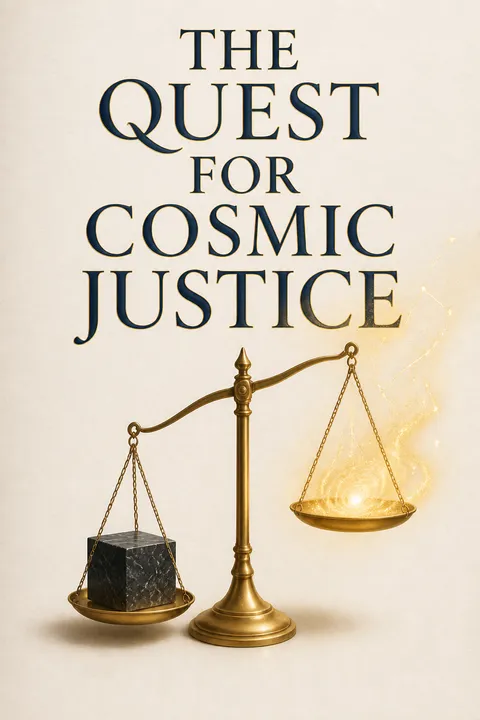

Key Takeaways
1. Cosmic Justice: A Fundamentally Different Concept from Traditional Justice
Cosmic justice is not simply a higher degree of traditional justice, it is a fundamentally different concept.
Defining Justice. While everyone agrees on the need for "justice," the term often goes undefined, leading to vastly different interpretations. Traditional justice focuses on the impartiality of processes—ensuring fair rules and unbiased application, regardless of the outcome. For instance, a fair trial means adherence to rules, not a guaranteed acquittal or conviction.
Beyond Social Justice. The modern concept of "social justice" extends beyond correcting societal biases to mitigating all undeserved misfortunes, whether from social decisions, physical disabilities, or even genetic endowments. This expansive view seeks to "make more just the undeserved misfortunes arising from the cosmos, as well as from society," thus becoming "cosmic justice." It aims to equalize prospects, not just processes.
Incompatible Ideals. The core conflict lies in their mutual incompatibility. Traditional justice upholds universal rules and standards, while cosmic justice often requires setting aside these very rules to achieve specific, predetermined outcomes for selected groups. This fundamental divergence means that pursuing one often necessitates abandoning the other, leading to profound societal trade-offs.
2. The Unattainable Ideal of Rectifying All Undeserved Misfortunes
Far from society being divided into those with a more or less standard package of benefits and others lacking those benefits, each individual may have both windfall advantages and windfall disadvantages, and the particular combination of windfall gains and losses varies enormously from individual to individual.
Staggering Complexity. The quest for cosmic justice implicitly assumes a superhuman capacity to identify and rectify all "undeserved inequalities." However, human lives are a complex tapestry of both advantages and disadvantages, varying immensely from person to person and changing over a lifetime. Attempting to quantify and balance these myriad factors—from beauty and brains to family wealth and emotional support—is a daunting, if not impossible, task.
Hubris of Intervention. To intervene and "correct" these cosmic imbalances requires an omniscience that human beings simply do not possess. For example, a beautiful young woman may gain many advantages early in life but struggle later when her looks fade, while someone less fortunate initially may develop resilience. Determining the "net balance" of such shifting fortunes for broad categories of people, let alone individuals, suggests an intellectual arrogance that far exceeds actual knowledge.
No "Standard" History. Furthermore, the idea of restoring groups to where they "would have been" but for some misfortune assumes a "standard" historical path that never existed. Every group's history is a product of innumerable, unpredictable cross-currents. Unraveling these to assign blame or determine hypothetical outcomes is a task beyond human capability, making the pursuit of cosmic justice an inherently flawed endeavor.
3. The High Societal Costs of Pursuing Cosmic Justice
We cannot simply 'do something' whenever we are morally indignant, while disdaining to consider the costs entailed.
Unacknowledged Trade-offs. The pursuit of cosmic justice often prioritizes moral indignation over practical consequences, disregarding the significant costs imposed on innocent third parties or society as a whole. A trivial example is a San Francisco law forcing pizza companies to deliver to high-crime neighborhoods, ignoring the increased risk to delivery drivers. This "justice" for some comes at the cost of others' safety.
Crippling the Justice System. In the criminal justice system, attempts to achieve cosmic justice—such as mitigating a murderer's sentence due to an "unhappy childhood"—can undermine deterrence and slow down the entire system. Resources are diverted to psychological speculation, delaying other cases and allowing more criminals to remain on the streets, ultimately increasing crime at the expense of innocent victims.
Sacrificing Productivity. In education, setting aside academic standards for "disadvantaged students" in the name of "fair equality of opportunity" may make some feel better, but it sacrifices the overall productivity of the educational system. It disregards the interests of taxpayers and donors who fund education, and the long-term societal benefits of maximizing educational returns.
4. Equality: A Multidimensional Mirage Beyond Simple Definition
Since human beings are even more multidimensional, defining equality among them becomes even more problematical and ultimately arbitrary, quite aside from the subsequent difficulties of achieving whatever equality might be defined.
Beyond Simple Numbers. Unlike numbers, which have a single dimension (magnitude), human beings are multidimensional. Defining "equality" among them is inherently problematic and often arbitrary. For example, comparing national GNPs can yield different results depending on the chosen common denominator, highlighting the subjective nature of such comparisons.
Economic Transience. Economic equality is particularly elusive. Statistics on "the rich" and "the poor" often refer to income strata at a given moment, not enduring classes. Most Americans do not remain in the same income quintile for long; many "poor" are temporarily so due to age, career changes, or business losses, and often possess significant assets. This transience makes policies based on static income snapshots misleading and potentially counterproductive.
Performance Disparities. Equality of performance is equally difficult to define and achieve. Differences in skills, talents, and interests are pervasive, even within families. Furthermore, geographical, historical, cultural, and demographic factors (like median age differences between groups) create vast, non-discriminatory disparities in performance and representation across societies. To expect "even or random representation" in the absence of discrimination is to ignore these fundamental realities.
5. Envy-Driven Policies: A Destructive Force Masquerading as Social Justice
Envy was once considered to be one of the seven deadly sins before it became one of the most admired virtues under its new name, 'social justice.'
The Cost of Envy. While envy can sometimes spur achievement, it more often engenders social strife and counterproductive policies. When framed as "social justice," envy encourages the less fortunate to attribute their position to "exploitation" or "social barriers," rather than focusing on self-improvement or acquiring human capital. This ideology can isolate groups from potential sources of prosperity, including successful members of their own community who are branded as "traitors."
"Dog-in-the-Manger" Attitudes. This destructive form of envy manifests in "dog-in-the-manger" policies, where benefits are denied to others simply out of resentment, even if it means a net loss for society.
- Historical Examples: Post-WWI Romania forcing Germans and Hungarians out of universities, or Nigeria's post-independence leaders expelling skilled southerners, even if it meant hiring less competent Europeans or suffering service declines.
- Modern Examples: Tax policies designed to "soak the rich" (like estate taxes) often yield trivial revenue but serve the political purpose of striking a blow against inherited wealth, regardless of broader economic impact.
Undermining Merit. In education, envy can lead to biases against privileged students or the rejection of ability-grouping, even for the gifted. This "non-judgmental" attitude, while ostensibly promoting "self-esteem," can lower standards and ultimately harm the very students it purports to help, especially those from disadvantaged backgrounds who rely on schools for foundational skills.
6. The Tyranny of Visions: When Dogma Overrides Empirical Reality
The more sweeping the vision—the more it seems to explain and the more its explanation is emotionally satisfying—the more reason there for its devotees to safeguard it against the vagaries of facts.
Visions as Dogmas. Unlike scientific theories that are tested against facts, cosmic visions often become dogmas, cherished and protected from contradictory evidence. Leaders like Lenin, Hitler, and Mao exemplify this, adjusting people to their visions, even at the cost of millions of lives, rather than adjusting their visions to reality. This self-flattering role as "anointed visionaries" makes them resistant to empirical challenges.
Lenin's Imperialism. Lenin's theory of imperialism, which claimed that capitalist nations exploited less developed countries to ameliorate domestic class struggle, is a classic example of a vision overriding facts. His use of broad, heterogeneous categories for foreign investments (e.g., "America" encompassing everything from jungles to industrial centers) concealed the reality that industrial nations primarily invested in each other.
- Concealed Facts: Britain's largest investments were in the United States, not its colonies. Germany exported more to Belgium than to its entire colonial empire.
- Propaganda's Triumph: Despite its logical flaws and factual misrepresentations, "Imperialism" succeeded as propaganda because it offered a compelling, emotionally satisfying explanation that resonated with existing desires to believe in exploitation.
Primitive Misconceptions. Marxism-Leninism represents a sophisticated defense of the primitive misconception that the rich are rich because the poor are poor—a zero-sum view of wealth. This vision persists despite overwhelming evidence of increasing global wealth and the fact that wealth creation is not a zero-sum game.
7. The Peril of Disarming in the Face of Aggression: Lessons from History
There never was a war in all history easier to prevent by timely action than the one which has just desolated such great areas of the globe.
Two Paths to Peace. History presents two contrasting theories for preventing war: military deterrence (building strength and alliances) and disarmament (mutual peace pacts and de-escalation). Proponents of disarmament often claim moral superiority, labeling opponents as "militarists" or "merchants of death," rather than acknowledging honest disagreement.
The Road to World War II. The interwar period saw the ascendancy of disarmament, epitomized by Neville Chamberlain's conciliatory approach. International agreements like the Washington Naval Agreement (which Japan ignored) and the Kellogg-Briand Pact (renouncing war) were celebrated for their symbolism, while their practical efficacy was ignored.
- Moral Disarmament: Figures like Bertrand Russell advocated for "complete pacifism" and the disbanding of military forces, echoing sentiments in the British Parliament and the U.S. Congress.
- Fatal Consequences: This moral and material disarmament of the West, coupled with the belief that war was "futile" and that aggressors like Hitler merely needed "personal contacts" to resolve "misunderstandings," led to a catastrophic underestimation of the Axis powers.
Reagan and the Cold War. In contrast, Ronald Reagan's military buildup during the Cold War, despite widespread disdain from the intelligentsia, was based on the deterrence theory and a clear understanding of Soviet economic limitations. His strategy ultimately forced the Soviets to the bargaining table and contributed to the collapse of the Soviet Union, demonstrating the effectiveness of deterrence when applied with resolve.
8. Social Reforms: Well-Intentioned Actions with Counterproductive Outcomes
Human beings are sacrificed to the tyranny of visions because those sacrificed are not the same as those exhilarated by the vision.
Housing Reform's Unintended Harm. Reform movements, often driven by a vision of cosmic justice, can impose policies that, while morally satisfying to observers, harm the very people they intend to help. Nineteenth-century housing reforms, for example, mandated higher standards for slum dwellings. While conditions were appalling, many immigrants chose to live in overcrowded, "sub-standard" housing to save money for food, to bring family over from Europe, or to invest in their children's future.
Reducing Options, Not Expanding Them. By legally mandating more expensive housing, reformers reduced the options of the poor, forcing them to spend more on amenities they didn't prioritize, rather than addressing their underlying poverty. Slum-dwellers often resisted eviction, demonstrating their preference for their own trade-offs. Similarly, "sweatshop" critiques today, while morally appealing, can price Third World workers out of their few opportunities, reducing their options and hindering their economic advancement.
Sacrificing the Beneficiaries. The core issue is that these reforms prioritize the moral satisfaction of the reformers over the actual well-being and choices of the ostensible beneficiaries. The long-term improvement in housing for Southern blacks, for instance, came from rising incomes, not from housing reform crusades, suggesting that economic empowerment is often more effective than imposed "justice."
9. The Erosion of the Rule of Law: Vagueness and Retrospective Judgment
If general rules, known in advance, are at the heart of the rule of law, then such rules are inherently incompatible with cosmic justice.
Rule of Law Defined. The rule of law implies predictable, generally applied rules that constrain rulers and ruled alike. It means laws known in advance, allowing citizens to plan their actions. However, cosmic justice, which seeks to achieve specific outcomes or equal prospects, cannot operate under such general rules because they produce indiscriminate results, not predetermined "just" ones.
"Disparate Impact" and Vagueness. Modern legal doctrines like "disparate impact" exemplify this erosion. Policies applying the same standards to everyone can be deemed discriminatory if they have unequal effects on different groups. This means employers, for example, cannot know in advance if their actions are legal; legality is determined retrospectively by statistical outcomes or subjective interpretations of "reasonable accommodation" for disabilities.
- EEOC Guidelines: Employers cannot ask about prior mental hospitalization and must "reasonably accommodate" mentally ill workers, even if it means overlooking a "lack of judgment."
- Racial Discrimination: Treating all applicants the same does not prevent charges of discrimination if "disparate impact" statistics are unfavorable, leading to legal uncertainty and the absence of a clear rule of law.
Inherent Incompatibility. The quest for cosmic justice necessitates vague, outcome-oriented edicts rather than clear, prospective rules. This shift transforms "discrimination" from a clear act of unequal treatment into a retrospective judgment based on statistical results or subjective "hostile environments," fundamentally undermining the predictability and fairness central to the rule of law.
10. Judicial Activism: Overstepping Boundaries in Pursuit of Cosmic Justice
It is my job to apply the law.
Judges as Law-Makers. Traditionally, judges apply existing law, as famously stated by Justice Oliver Wendell Holmes. Their role is to ensure the "game is played according to the rules," not to "do justice" directly by imposing their personal notions of fairness. This separation of roles is crucial for the rule of law, as it ensures predictability and prevents arbitrary decisions.
Eroding Legal Principles. Judicial activism, driven by the quest for cosmic justice, blurs this distinction. When judges interrupt legal arguments to ask "But is it right? Is it good?" (Chief Justice Earl Warren), they act as "representatives on mission," overriding established laws and local governance to impose their vision of social engineering.
- Examples: Judges running school systems, changing voting laws, or ordering tax increases to fund their social initiatives.
- Ex Post Facto Laws: Judge-made innovations are, in effect, ex post facto laws, which are constitutionally forbidden and antithetical to the rule of law, as they punish or restrict actions that were legal when committed.
Concentration of Power. Cosmic justice, by making judges "roving second-guessers" of individual behavior and societal outcomes, vastly expands judicial power. This concentration of power undermines the constitutional framework of checks and balances, reducing a free people to subjects of unelected judges enforcing "evolving standards" based on their own moral presumptions.
11. Shifting Burdens of Proof: Jeopardizing Fundamental Rights
Otherwise, the ability of government to throw people in jail, or to ruin them financially, because of its own vast powers and resources that can be put behind any trumped-up charges, would render all other freedoms meaningless.
Presumption of Innocence. A cornerstone of traditional justice is the presumption of innocence in criminal cases and the burden of proof resting on the accuser in civil cases. This safeguard prevents the government from arbitrarily destroying individuals through its immense power and resources, ensuring that other freedoms remain meaningful.
Erosion of Safeguards. However, the quest for cosmic justice has led to a systematic erosion of this principle, shifting the burden of proof to the defendant. This began with antitrust law and has expanded dramatically into civil rights, environmental law, tort liability, sexual harassment, and family law.
- Antitrust Examples: The Sherman Antitrust Act and subsequent legislation used vague terms like "monopolization" or "substantially lessen competition." Businesses were forced to prove their innocence against prima facie cases (e.g., offering discounts), often losing because the concepts were too elusive to disprove.
- Civil Rights Expansion: "Civil rights" cases, originally about discrimination, now extend to areas like tenant evictions for misconduct, allowing private attorneys to collect taxpayer-funded fees for "pro bono" work, regardless of the client's actual merit.
Dangerous Precedents. Each instance of shifting the burden of proof, while seemingly minor in isolation, cumulatively creates dangerous legal precedents. It jeopardizes the rights of all citizens by making them vulnerable to charges where they must prove a negative, undermining the very foundation of a free society.
12. The Quiet Repeal of American Freedom: Trading Liberty for Subsidies
Thus hard-earned freedoms for which many have fought and died have now been bought and sold for words or money, or both.
Undermining Federalism. The American Revolution established a government with limited, delegated powers, reserving all other powers to the states or the people (Tenth Amendment). This decentralization was a bulwark of freedom. However, this constitutional protection has been quietly eroded, primarily through judicial reinterpretation and the federal government's expansion of "aid."
Buying Freedom with Tax Money. The federal government increasingly attaches conditions to its vast subsidies to states and private institutions. These conditions impose regulations that the national government lacks direct constitutional authority to enact. States and institutions, dependent on these billions, are often compelled to accept these conditions, effectively selling their autonomy and freedom for their own tax money.
- "Interstate Commerce" Clause: This clause was expanded by the judiciary to justify federal regulation of virtually anything, even a farmer growing food in his own backyard, effectively nullifying the Tenth Amendment.
- Education and Healthcare: Federal aid to education dictates curriculum and discipline, overriding local control. Hospitals accepting Medicare funds face federal controls over their entire practice, regardless of patient payment source.
The Illusion of Noble Goals. These expansions of federal power are rarely advertised as such; instead, they are framed as achieving "universal health care," "investing in our children's futures," or "insuring a level playing field." This rhetoric masks the gradual erosion of constitutional limits and individual liberty, replacing a government of laws with one of arbitrary edicts and centralized control, fundamentally altering the nature of American freedom.
Review Summary
The Quest for Cosmic Justice presents Thomas Sowell's critique of "cosmic" or social justice versus traditional justice. Reviewers praise Sowell's distinction between equality of outcomes and equality before the law, noting his use of historical data and logical arguments. Many find his analysis of unintended consequences compelling, particularly regarding affirmative action, judicial activism, and constitutional erosion. Supporters appreciate his defense of individual freedom and the rule of law. Critics argue he oversimplifies progressive thought, uses anecdotes selectively, and exhibits ideological bias. Most agree the core concept is thought-provoking, though some find the book repetitive of his other works.
People Also Read









About the Author
Other books by Thomas Sowell





Download PDF
Download EPUB
.epub digital book format is ideal for reading ebooks on phones, tablets, and e-readers.








































