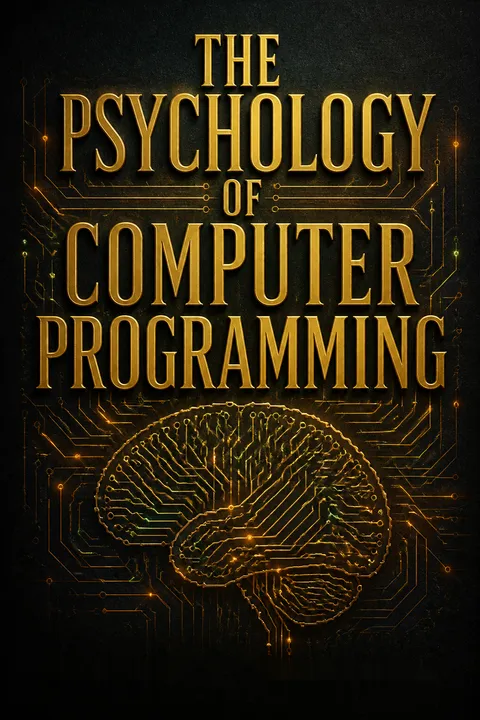

Key Takeaways
1. Programming is a Human Endeavor, Not Purely Technical.
"Yes, programming is not just a matter of hardware and software. I shall have to look at things in a new way from now on."
Shift perspective. The core premise of this book is to fundamentally alter how we view computer programming. It argues against the prevailing notion that programming is solely a technical or mathematical exercise, asserting instead that it is a complex human activity. This psychological viewpoint is crucial for understanding why projects succeed or fail, and for designing better systems and environments.
Beyond machines. For too long, the focus has been on the machine's capabilities and limitations, or the elegance of mathematical constructs. However, the human element—the programmer—is the true source of both problems and solutions. Executives, often seeking to eliminate programmers, ironically fund schemes concocted by programmers themselves, highlighting a deep-seated misunderstanding of the human factor.
Unveiling mystique. By studying programming through a human lens, we can demystify its processes and uncover the underlying psychological realities. This involves examining how human limitations, biases, and social interactions shape the code we write, the errors we make, and the systems we build. It's about recognizing that the programmer is not just another machine, but a complex individual whose performance is influenced by a myriad of human factors.
2. "Good" Programs are Defined by Context and Trade-offs.
"If a program doesn’t work, measures of efficiency, of adaptability, or of cost of production have no meaning."
Correctness first. The paramount criterion for any program is that it must work correctly, meeting its specifications. Without this fundamental quality, all other considerations like efficiency or adaptability become irrelevant. The story of the Detroit car parts program vividly illustrates this: a program that was "faster" but produced cars with eight tires was ultimately worthless.
Beyond correctness. Once a program functions, other factors come into play, but they are rarely absolute measures of "goodness." These include:
- Schedule: Timely delivery is often critical, as delays can incur massive costs. Consistency in meeting deadlines is often valued more than occasional lucky shots.
- Adaptability: The ease with which a program can be modified over its lifespan is vital, as most programs undergo changes. However, adaptability often conflicts with efficiency (Fisher's Fundamental Theorem).
- Efficiency: Measured in terms of CPU time, memory usage, or even human time saved. This is a complex metric, often traded off against other goals.
No universal standard. There is no single "good program" or "good programmer" universally agreed upon. Evaluation must be relative to the specific situation, goals, and constraints under which the program was developed and will be used. Managers and programmers must understand these trade-offs and communicate objectives clearly to avoid working at cross-purposes.
3. Behavioral Science is Essential to Understand Programmers.
"The important thing is not to stop questioning."
New field, new methods. To study programming as a human activity, we must turn to the methods of human behavioral sciences. Early insights can come from introspection, but true scientific understanding requires rigorous observation and experimentation. This is a nascent field, and we must be open to new approaches.
Diverse methodologies. Key methods include:
- Introspection: Provides initial ideas and identifies common difficulties (e.g., debugging a complex PL/I statement).
- Observation: Reveals what people actually do, but must account for observer interference (Hawthorne Effect) and can be unobtrusive (computer logging).
- Experimentation: Allows for controlled study, but is costly, risks over-constraining behavior, and must carefully select subjects (avoiding trainee bias).
Measurement challenges. Psychological measurement is complex, with thousands of variables. The challenge is knowing what to measure, not just how. Unjustified precision (e.g., "correlation of 0.72") is misleading. Insights from behavioral science are for understanding, not direct answers, as programming problems are far more complex than typical lab "problems."
Anthropological lens. Viewing programming as a "culture" with shared beliefs and activities offers a useful model. This perspective helps us examine social structures, individual personalities, and the tools (material culture) that shape programmers' daily lives, ultimately aiming to challenge unfounded myths.
4. Ego Hinders Quality; Collaboration Fosters It.
"A programmer who truly sees his program as an extension of his own ego is not going to be trying to find all the errors in that program."
The ego problem. Programmers often develop a strong personal attachment to their code, viewing it as an extension of their ego. This "property-oriented" programming creates cognitive dissonance when errors are found, leading to denial, blame (keypunch operators, system, etc.), or simply failing to see glaring mistakes. This is a formidable barrier to improving program quality.
Egoless programming. The solution lies in restructuring the social environment to foster "egoless programming," where code is seen as a shared artifact, not personal property. This involves:
- Shared criticism: Programmers actively seek out others to review their code, and readily offer to review others'.
- Openness: Errors are treated as facts for investigation and improvement, not personal attacks.
- Mutual learning: The process of reviewing and being reviewed enhances individual skills and collective competence.
Benefits of egolessness. Beyond improved error detection, egoless programming leads to:
- Reduced variation in debugging time.
- More realistic progress estimates.
- Increased program adaptability (multiple people understand the code).
- Greater project stability (less dependent on any single individual).
This approach transforms programming from a solitary, defensive act into a collaborative, growth-oriented activity.
5. Effective Teams are Built on Shared Goals and Adaptive Leadership.
"To achieve true consensus on group goals, there is no better method than having the group set the goals itself."
Beyond individual effort. Large programming tasks necessitate teams, introducing new social dynamics. Conflicts, if not resolved, can translate into technical problems, as seen in the case of Joe R. who sabotaged a system due to unaccepted goals.
Goal consensus is vital. Teams must establish a genuine consensus on project goals, not just a superficial agreement. This ensures clarity, commitment, and increased productivity. Key aspects include:
- Participation: Involving team members in goal-setting enhances understanding and acceptance.
- Clarity: Goals must be meaningful and placed within a broader framework, not just "bit-picking" specifications.
- Evaluation: Competence is needed to evaluate if a group is adhering to its mandate, preventing drift into unproductive "fascinating but useless" projects.
Adaptive leadership. Effective leadership in programming teams is not authoritarian but democratic or "technocratic," shifting based on expertise and situational needs. A designated leader's role is to facilitate, not dictate, and must earn influence through technical competence and trust. Managers must resist pressuring leaders to make unrealistic promises, as this leads to a "game of musical chairs" where accountability is avoided.
Team resilience. Democratic teams are more adaptable to crises (member changes, technical difficulties) because knowledge and responsibilities are shared. Managers should adopt a "hands-off" policy regarding internal team structure, trusting the team to self-organize and resolve conflicts, even if it appears "traumatic."
6. Programming Tasks Demand Diverse Skills and Flexible Approaches.
"The job of system design calls for an eye which never loses sight of the forest, whereas the job of debugging may require that every tree—even every branch or leaf—be seen with utmost clarity."
Programming's varied nature. "Programming" is not a monolithic activity but a collection of diverse tasks requiring different talents and mindsets. Assuming a uniform effort leads to misallocation of talent and inefficient processes.
Distinct stages, distinct skills:
- Problem Definition/Analysis: Requires a broad, conceptual view.
- System Design: Creativity and selectivity to generate and screen ideas.
- Coding: Attention to detail, efficiency, and structure.
- Debugging (Detecting): A "conniving mind," delighting in uncovering flaws, perhaps a touch of paranoia.
- Debugging (Locating): Persistence, collecting instincts, ability to shift perspective when stuck.
- Debugging (Correcting): A "synthetic mind," sense of fitness, and repertoire of tricks.
- Documentation: Verbal and graphical expression, patience for ambiguities.
Beyond linear progression. The programming process is rarely linear; stages overlap and iterate. Forcing a lock-step progression can lead to underexploited talents, frustration when facilities are overloaded, and a lack of adaptability to daily variations. Good programmers consciously or unconsciously switch tasks when encountering obstacles.
Exploiting diversity. Recognizing these variations allows for better project organization, where work is allocated according to individual strengths. It also highlights why extreme performance differences (e.g., 30-to-1) can be observed in specific phases, but average out over larger projects requiring a mix of skills.
7. Motivation and Learning are Complex, Individual Processes.
"Programming, like chess, women, and music, has the power to make men happy."
The elusive "motivation." After accounting for task, individual differences, training, and experience, psychologists are left with "motivation" as the unexplained residue of performance. Managers often mistakenly assume lack of performance equals lack of motivation, sometimes applying "outer driving force" when programmers are already overmotivated.
Optimal arousal. Research shows that increasing "driving force" boosts performance only to a point, after which it rapidly declines, especially in complex tasks like programming. Pressuring programmers to eliminate bugs quickly can be counterproductive. Programmers are often intrinsically motivated by the work itself, especially if they have autonomy and a chance to apply their skills.
Learning is personal. Effective learning is highly individual and depends on:
- Self-awareness: Knowing one's own assets and liabilities.
- Preferred modes: Auditory vs. visual learning, doing vs. discussing.
- Work habits: Optimal physical environment, time of day.
- Active engagement: Learning from both success and failure, constructing "critical cases" to understand errors.
Formal schooling often fails by imposing uniform methods, creating barriers (like JCL syntax) that impede deeper understanding. The computer itself, as a patient teacher, is often the most effective learning tool.
8. Language Design Shapes Thought and Influences Error.
"Calling it OLDX doesn’t make it the old X; but no matter how often we deliver this admonition, the fallacy seems to perpetuate itself."
Language as a psychological tool. Programming languages are not just mathematical constructs; they are psychological tools that profoundly influence how programmers think, learn, and make errors. Their design should prioritize human propensities and limitations.
Key design principles:
- Uniformity: "The same things should be done in the same way wherever they occur." Deviations (e.g., FORTRAN subscripts, PL/I parentheses rules) increase difficulty and error rates. Psychological ambiguity (e.g.,
A = B/C*D) is as critical as physical ambiguity. - Compactness: Leveraging "chunking" (combining small units into larger, easily handled ones) through abbreviations, functions, and data structuring reduces cognitive load. Defaults can also aid compactness, but must be carefully designed to avoid confusion.
- Locality and Linearity: Supporting synesthetic (whole-picture) and sequential (step-by-step) memory. Locality means relevant parts are together; linearity (e.g., avoiding excessive
GO TOs) aids sequential understanding.
Tradition vs. innovation. Language design often balances tradition (consonance with natural or prior programming languages) with innovation. While similarity can speed initial learning, it can also cause "inhibition" (proactive or retroactive interference). Ultimately, a language should be adaptable, allowing users to define functions, data types, or even operators to fit their idiosyncratic thought processes, without becoming a "private language."
9. Tools Beyond Code Critically Impact Programmer Performance.
"The proper compromise—at least on psychological grounds—seems to be a certain amount of extension to the basic programming language which faces up to the realities of the operating environment."
Beyond language. While programming languages receive much attention, other tools—debugging aids, operating systems, and documentation—are equally critical to programmer performance and satisfaction. These areas are often neglected from a psychological perspective.
Debugging tools. Effective testing tools should:
- Build confidence: Provide feedback on code coverage and estimated error rates (e.g., by introducing "bebugging" or random errors).
- Promote uniformity: Encourage structured, localized, and compact code, as these qualities inherently reduce errors and increase confidence per test.
- Guide attention: Help programmers get "unstuck" from wrong debugging paths by forcing them to look at new areas or take breaks.
Advance test preparation, automatic test reruns, and comparison of results are crucial for efficient debugging.
Operating systems. These are often designed without psychological considerations, leading to:
- Inconsistent interfaces: Job control languages (like OS/360 JCL) often use formats (e.g., positional parameters) that increase error rates for infrequent users.
- Lack of feedback: Insufficient accounting or performance evaluation data prevents programmers from learning to optimize their code.
- Suboptimal turnaround: Both excessively fast and excessively slow turnaround can hinder learning and productivity.
Programmers adapt to the operating environment, even exploiting its quirks (e.g., rubber-banding decks for priority), highlighting the "law of effect."
Documentation. Often seen as "castor oil," documentation has no intrinsic value unless well-done and perceived as beneficial by the programmer. It should:
- Be reasonable: Not expect untrained users to understand complex systems instantly.
- Provide depth: Offer different levels of detail for different users, with clear navigation.
- Be integrated: Ideally, generated or interrogated by the computer itself, ensuring consistency with the code and adapting to user needs.
The illusion that "anyone can do a good job of documentation" is a significant problem, underscoring the need to elevate documentation to a professional status.
10. The Entire Computing System is a Psychological Ecosystem.
"This complexity means, on the one hand, that experimental evidence is doubly essential, but, on the other hand, that it is doubly difficult to obtain and interpret."
Interconnected components. A computer system is far more than just hardware and software. It's a complex, intertwined ecosystem comprising:
- Hardware: Physical machines and their limitations.
- Software: Operating systems, programming languages, applications.
- People: Programmers, managers, users, operators.
- Procedures: Formal rules and informal practices.
- Environment: Social climate, load on components, attitudes, and experience.
These elements merge and influence each other, making clear lines of separation artificial and misleading.
Challenges of complexity. This inherent complexity makes studying and improving programming incredibly difficult. Experimental evidence is vital, yet hard to gather and interpret due to numerous interacting variables. For instance, comparing time-sharing and batch systems reveals that individual differences often overshadow system differences, and "factors" cannot be neatly separated.
Adaptive systems. Programmers constantly adapt to their environment, whether it's a language, an operating system, or a social structure. This adaptation can be beneficial or detrimental, depending on how the system is designed and managed. The goal is not to "solve" programming problems definitively, but to continuously learn and adapt, recognizing that the system itself is always evolving.
Beyond myths. We must shed simplistic myths about programming and replace them with insights derived from rigorous behavioral study. Understanding the psychological ecosystem allows us to design systems that work with human nature, rather than against it, leading to more effective and satisfying programming experiences.
11. Programmers Bear Ethical Responsibility for Their Creations.
"Can there be any doubt that somewhere in our country today some human beings are using computers as just another, finer weapon in their arsenal of ways to subjugate other human beings to their wishes—to their conception of the proper life of man?"
Beyond technical mastery. The ultimate question for programmers is not merely "Can we do it?" or "Can we do it right?" but "Is what we are doing with computers worth doing?" The fascination of computing and the joy of programming can blind us to the ethical implications of our work.
The power of tools. Computers are powerful tools, and like any tool, they can be used for good or ill. The author poses chilling rhetorical questions about historical atrocities (Hitler, Pilate) and contemporary abuses, highlighting the potential for computers to be used for subjugation and control. Programmers, in their pursuit of "fun and profit," risk becoming unwitting pawns in these endeavors.
Personal accountability. The author shares a deeply personal anecdote about a student working in chemical warfare research, underscoring the shared responsibility that comes with creating powerful technologies. Writing a book, or developing software, is not merely teaching means to unknown ends; it carries an ethical weight.
A call to conscience. This book is an effort against tyranny and ignorance, urging programmers to consider the broader societal impact of their work. It's a call to be "pure at heart" in one's intentions, recognizing that even good-hearted people can build "bad systems." The journey of making a "man" (or a responsible professional) is a lifelong one, and programmers must actively engage with the ethical dimensions of their craft.
Review Summary
The Psychology of Computer Programming receives mostly positive reviews (4.06/5) for its timeless insights into programming as a human activity, particularly concepts like egoless programming and team dynamics. Readers appreciate that despite being written in 1971, most observations about programmer behavior remain relevant today. Common criticisms include dated technology references, lack of empirical evidence supporting claims, tedious writing style, and some outdated social views. Many reviewers note the book focuses more on programmers than programming itself, examining how people collaborate, learn, and organize around software development rather than technical aspects.
People Also Read









About the Author


Download PDF
Download EPUB
.epub digital book format is ideal for reading ebooks on phones, tablets, and e-readers.








































