

Key Takeaways
Every ritual you perform without believing cements the system you resent
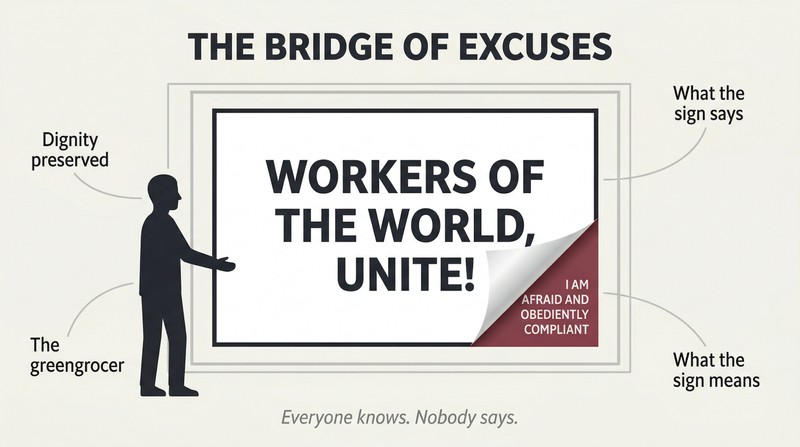
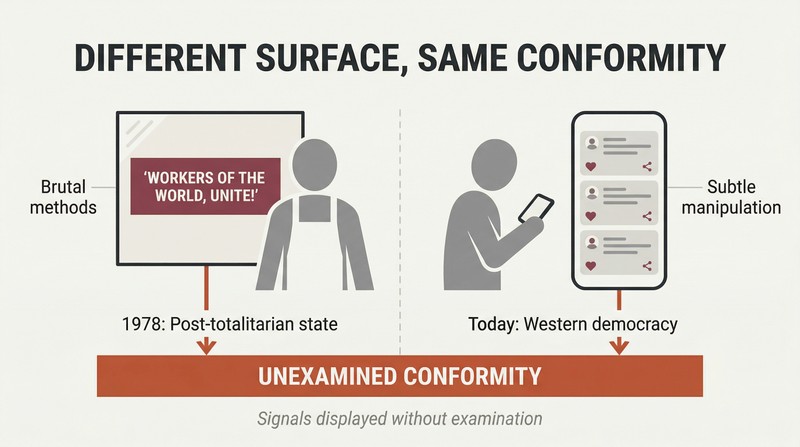
Havel's greengrocer is everyman. A Czechoslovak shopkeeper places "Workers of the World, Unite!" in his window among onions and carrots. He doesn't believe in proletarian unity. The sign was delivered from headquarters along with the vegetables. He displays it because everyone does, because refusing would mean trouble. The sign's real message: "I am obedient and therefore I have the right to be left in peace."
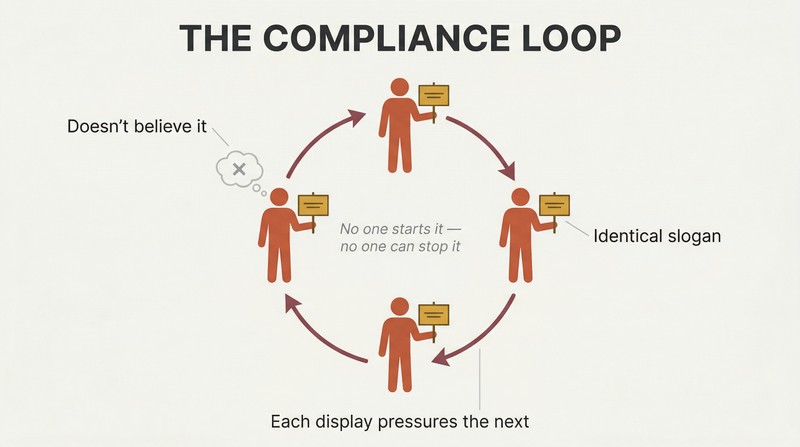
Nobody reads the sign — and that's the point. Thousands of identical slogans blanket every shop, lamppost, and apartment building, forming what Havel calls a "panorama" that reminds everyone what's expected. A woman ignores the grocer's sign but hung her own at work an hour earlier. Each compels the other to conform. Each creates the conditions they've merely adapted to.
Ideology works not as belief but as everyone's shared alibi
The sign can't say what it means. If the greengrocer were told to display "I am afraid and unquestioningly obedient," he'd refuse — he has dignity. So ideology provides cover. He can shrug: "What's wrong with workers uniting?" The party official can claim "service to the working class." Havel calls this a "bridge of excuses" between the system and the individual, allowing both sides to avoid confronting reality.
Almost nobody in 1978 Czechoslovakia believed in Marxist orthodoxy. But Marxist vocabulary gave everyone — greengrocer to general secretary — a dignified language for their complicity. Ideology in the post-totalitarian system functions less like a faith and more like a shared social ritual. The price of this low-rent existential shelter is the abdication of reason, conscience, and personal responsibility.
The line between oppressor and victim runs through each person
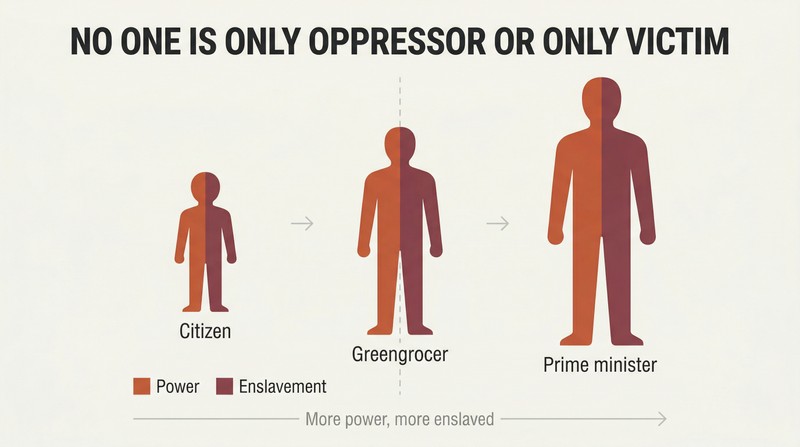
There's no clean division between rulers and ruled. In a classical dictatorship, a small armed group seizes power and is easily identified. In Havel's post-totalitarian system — a term he coins for the evolved communist order built on ritual rather than brute force — power is distributed through everyone's participation. The greengrocer has minor involvement but also minor power. The prime minister has greater power but is far more deeply enslaved to the rituals that keep him there.
Even leaders are puppets of the system's automatism. When Czechoslovak leader Husák or Poland's Gomułka tried to assert independent will, the system's inertia absorbed or ejected them. The system selects for faceless operators who use empty phrases — because empty phrases are the best fuel for the machine.
One truthful act threatens a system built entirely on universal lies
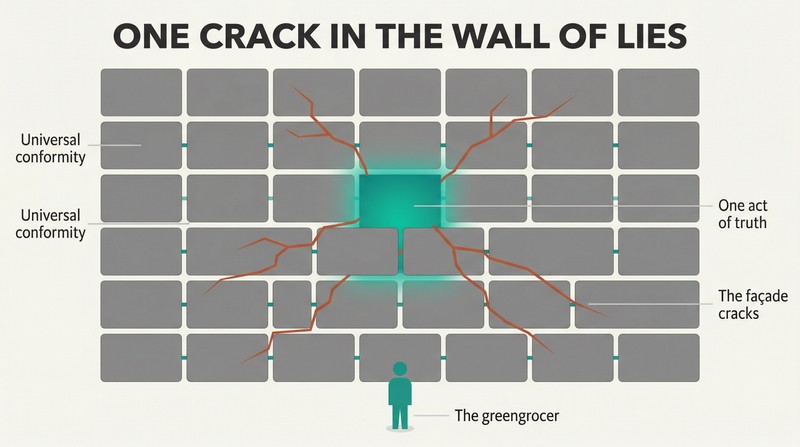
Imagine the greengrocer stops. He removes his sign, speaks his mind at meetings, refuses farcical elections. The consequences are swift: demotion, pay cuts, his children barred from university. But the real threat isn't to the greengrocer — it's to the system. By breaking the rules of the game, he has exposed it as a game. He has said the emperor is naked. This is the essay's central thesis — the "power of the powerless."
The lie only works if it's universal. Living within the truth cannot coexist with living within a lie, because the moment an alternative appears, the entire façade becomes visible. The greengrocer's power isn't physical — it's illuminative. His act speaks to what Havel calls the "hidden sphere": the suppressed longing for authenticity beneath every conformist surface.
Nobody chooses dissidence — it erupts from trying to do honest work
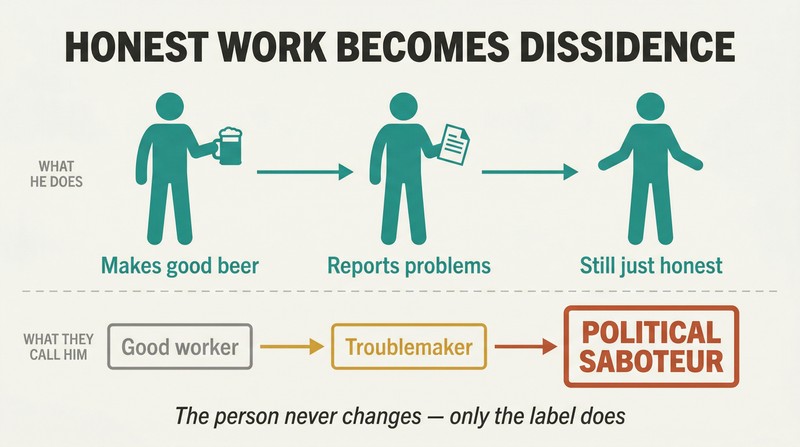
The brewery dissident. In 1974, Havel worked alongside a man called Š — a master brewer who simply wanted to make good beer. While the socialist system encouraged slovenly indifference, Š spent all his time devising improvements. His politically connected but incompetent managers grew hostile. When Š wrote a detailed letter analyzing why the brewery was the worst in the district, the manager had it labeled a "defamatory document." Š was branded a "political saboteur" and given unskilled work.
A dissident is simply an honest worker in a dishonest system. A physicist, a poet, or a brewer follows the inner logic of their honest thinking until it collides with the regime. The conflict comes not from political ambition but from the stubborn refusal to do bad work or stay silent about it.
Political upheaval starts in concert halls, not parliaments
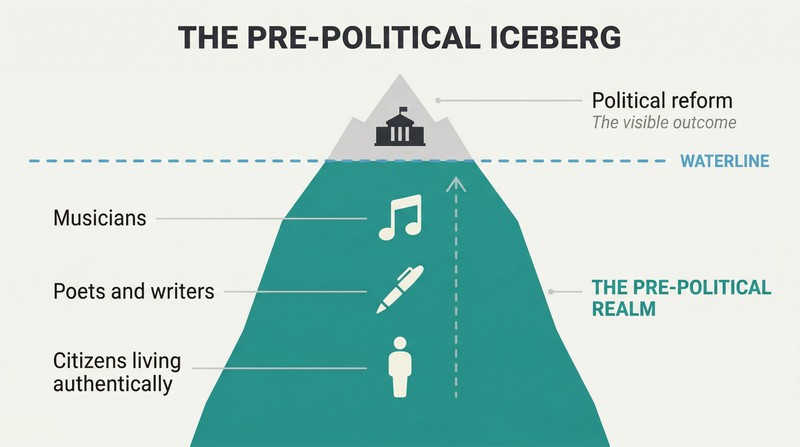
A rock band ignited a revolution. The Plastic People of the Universe, a Czech group influenced by The Velvet Underground, were arrested in 1976 for playing unauthorized music. Havel barely knew their music but recognized them as people who simply wanted to live freely. Their trial galvanized disparate groups who suddenly realized freedom is indivisible — an attack on musical freedom was an attack on all freedom. Three months later, Charter 77 was born.
Havel calls this the "pre-political" realm — where authentic life collides with the system long before anything becomes conventionally political. The Prague Spring of 1968 similarly wasn't caused by reformist politicians; it was the final outcome of years of poets, musicians, and ordinary citizens refusing to suppress their dignity.
Build parallel institutions to live differently, not to seize power
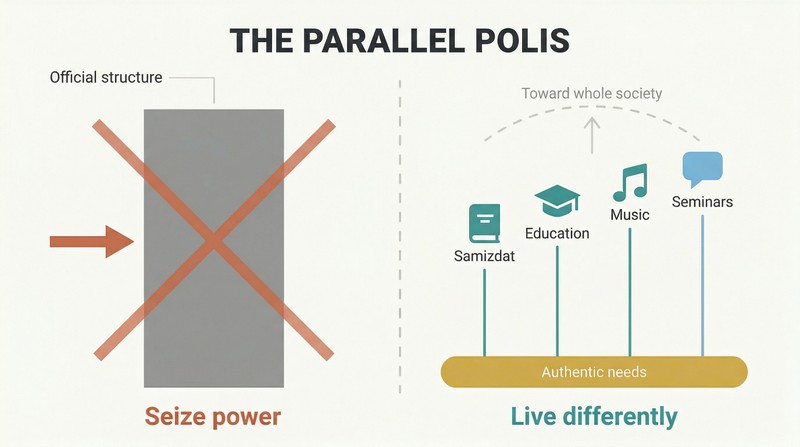
Create, don't conquer. When people living within the truth are denied any role in official structures, they build their own. In Czechoslovakia, this meant samizdat publishing, private universities, underground concerts, and independent seminars. Václav Benda called this emerging shadow society a "parallel polis" — not a retreat into a ghetto, but a demonstration that different life is possible. In Poland, the parallel world grew even further, with independent publishing houses and political periodicals.
These structures grew from authentic needs, not from blueprints. Ivan Jirous coined the term "second culture" for independent creative life. Crucially, Havel insists the parallel polis must not become self-enclosed — it makes sense only as an act of responsibility toward the whole society. Only by creating a better life can a better system be developed.
Consumer comfort is the raw material of modern unfreedom
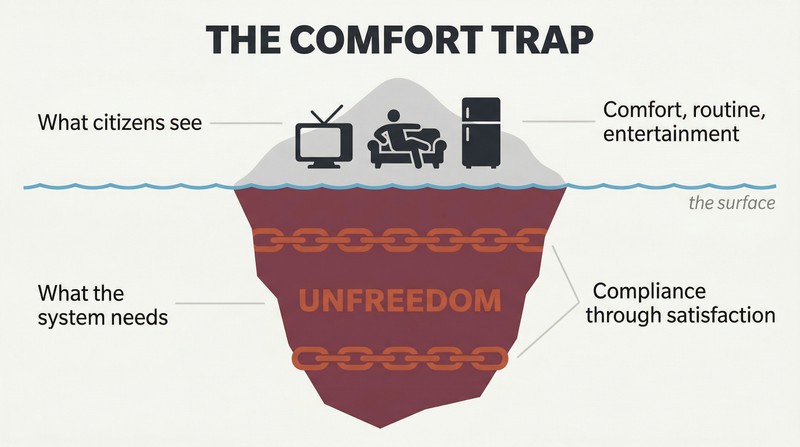
Comfort breeds compliance. Havel argues the post-totalitarian system doesn't rely primarily on tanks — it relies on refrigerators, televisions, and predictable routines. Citizens who prioritize material security over moral integrity become exactly what the system needs: demoralized individuals dissolved in consumer life with no sense of higher responsibility.
Television was normalization's most potent weapon. After the Prague Spring was crushed, screenwriter Jaroslav Dietl created hugely popular TV serials that turned Soviet policies — forced farm collectivization, demolition of historic town centers — into sympathetic soap opera backdrops. Viewers wanted buildings demolished because it served a character's personal journey. When Dietl's shows aired, Czechoslovak streets emptied. Havel saw this as the fatal confusion of public and private life.
Demand the system honor its own rules — that's its weakest point
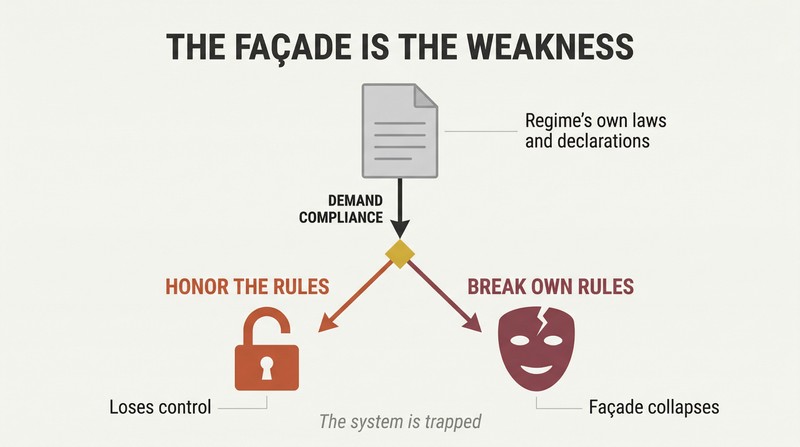
The regime's trap is its own façade. The post-totalitarian system obsessively wraps itself in legal codes, constitutions, and human rights declarations. It pretends to respect rights, pretends to persecute no one, pretends to fear nothing — it "pretends to pretend nothing." This elaborate theatrical legality is a vulnerability. Charter 77 appealed to rights already codified in Czechoslovak law through international agreements, not to revolutionary ideology.
Insisting on legality makes the ritual visible. When dissidents take the system at its word, it must either honor its proclaimed rules or expose the ritual as hollow. Havel watched judges grow anxious when dealing with experienced Chartists under public scrutiny — they couldn't discard the rules of their own game without undermining the excuse that kept them in power. Demanding that the laws be upheld is thus an act of living within the truth that threatens the whole mendacious structure at its point of maximum mendacity.
Western democracies face the same unfreedom, with subtler tools
Havel's 1978 warning proved prophetic. He argued the post-totalitarian system was merely an extreme version of a global crisis: technological civilization operating beyond human control. Western democracies, he wrote, were dragged along by mass political parties run by professional apparatuses, the dictatorship of consumption, and floods of information preventing citizens from taking genuine responsibility.
Timothy Snyder's 2018 introduction connects the essay to our era. Social media algorithms do what Havel described: they force life into its most probable states, eliciting conformity and rewarding banality. The signs we post online are today's version of the greengrocer's slogan — signals of tribal belonging displayed without examination. Unlike the greengrocer, however, we could change what we do without paying any real penalty.
Analysis
Havel's 1978 essay accomplishes something rare in political philosophy: it diagnoses power so precisely that its framework outlasts the system it describes. Written about Soviet-era Czechoslovakia, The Power of the Powerless now reads as a more accurate description of 21st-century liberal democracies than of any surviving communist state. This is because Havel's real subject isn't communism — it's the mechanics of conformity in any complex, technologically mediated society.
The essay's most radical intellectual move is dissolving the binary between oppressor and oppressed. Drawing on the phenomenological tradition of his mentor Jan Patočka (and, further back, Heidegger and Husserl), Havel reframes totalitarianism not as the imposition of one group's will on another but as a system everyone co-creates through daily rituals of compliance. This makes his analysis portable to any context where people perform belief they don't hold — which is to say, everywhere. The greengrocer placing a Party slogan in his window and the social media user sharing a politically safe sentiment they privately doubt are structurally identical acts.
Where Havel is most prescient is in refusing to exempt Western democracies from his critique. His claim that consumer societies generate their own unfreedom anticipates by decades the critiques of algorithmic manipulation, attention economies, and manufactured consent that dominate contemporary media theory. What Shoshana Zuboff would later call 'surveillance capitalism,' Havel was glimpsing in 1978.
The essay's limitation is also its strength:' living within the truth 'is deliberately non-programmatic. Havel offers no institutional blueprint. This frustrates pragmatic readers but is philosophically consistent — any prescribed program would simply become a new ideology, a new bridge of excuses. The revolution he advocates is existential, beginning when a single person stops performing and starts being. The essay's enduring power resides in this paradox: the most politically consequential act available to any individual is not seizing power but refusing to participate in its theater.
Review Summary
The Power of the Powerless is widely praised as an insightful analysis of totalitarian regimes and strategies for nonviolent resistance. Readers find it particularly relevant to current political situations, appreciating Havel's emphasis on living in truth as a form of resistance. The book is seen as thought-provoking and hopeful, though some note its concepts may not fully apply to all contexts. Many reviewers recommend it as essential reading for understanding power dynamics and the potential for change in oppressive systems.
People Also Read



Glossary
Post-totalitarian system
Evolved totalitarianism through ritual complianceHavel's term for the mature communist system of 1970s Eastern Europe. Unlike classical dictatorships based on naked force, it operates through ideology, consumer distraction, ritual, and the willing participation of nearly all citizens. The prefix 'post-' does not mean totalitarianism has ended, but that it has mutated into a more stable, comprehensive, and insidious form where power is anonymous and everyone is complicit.
Living within a lie
Performing compliance without believingHavel's phrase for the condition of participating in the system's ideological rituals without genuine belief. Citizens need not believe the lies; they must merely behave as though they do, tolerate them in silence, or cooperate with those who enact them. By doing so, they confirm and perpetuate the system. It is the default state of existence in the post-totalitarian order.
Living within the truth
Acting from authentic personal convictionHavel's term for any act that breaks with the ritual of conformity and reflects an individual's authentic sense of responsibility—from removing a propaganda sign to playing banned music to writing honest scholarship. It is simultaneously an existential, moral, and political act, and represents the fundamental threat to any system built on universal mendacity. Its power lies not in physical force but in illumination.
Bridge of excuses
Ideology as mutual alibiHavel's metaphor for ideology's primary function in the post-totalitarian system. Rather than operating as genuine belief, ideology serves as a mutually convenient fiction allowing both rulers and citizens to avoid confronting the reality of their arrangement. It provides dignified cover for obedience on one side and domination on the other, spanning the gap between the system's aims and the aims of authentic life.
Social auto-totality
Citizens enforcing their own conformityHavel's term for the self-perpetuating mechanism by which the post-totalitarian system makes every citizen both an object and a subject of control. People are drawn into the system's power structure to surrender their identity and become agents of its automatism, who in turn create norms and bring pressure on fellow citizens to conform—making the system's totality self-generating rather than externally imposed.
Parallel structures
Independent institutions outside official systemTerm developed by Václav Benda for the independent institutions built outside the official post-totalitarian structures: samizdat publishing, private universities, underground concerts, independent seminars and trade unions. Benda's broader concept of a 'parallel polis' describes an entire shadow society growing organically from authentic human needs as the most developed expression of living within the truth.
Second culture
Underground independent creative sphereTerm coined by Ivan Jirous for the entire sphere of independent and repressed culture in Czechoslovakia. Initially referring to nonconformist rock music and related artistic events, it rapidly expanded to encompass all independent creative and intellectual life—literature, art, humanities, social sciences, and philosophical thought—operating outside official channels through samizdat editions, private performances, and seminars.
Normalization
Enforced acceptance after crushed reformThe official name for the period following the 1968 Soviet invasion that crushed Czechoslovakia's Prague Spring reform movement. Under the Husák leadership, citizens were expected to accept the post-invasion status quo, abandon reform aspirations, and be pacified by consumer goods and television. Havel saw normalization as a model for how societies accept unfreedom through comfort, routine, and the deliberate confusion of public with private life.
Pre-political
Authentic life before formal politicsHavel's term for the broad realm of genuine human activity—making good beer, playing honest music, living in dignity—that precedes conventional politics but becomes the real breeding ground for political change. In the post-totalitarian system, seemingly apolitical acts carry the most political significance because they represent authentic confrontations between the aims of life and the aims of the system, from which all genuine political movements ultimately emerge.
FAQ
What's "The Power of the Powerless" about?
- Overview: "The Power of the Powerless" is an essay by Václav Havel that explores the nature of political dissent under a totalitarian regime, particularly focusing on the Soviet-style systems in Eastern Europe.
- Central Theme: The essay examines how individuals can resist oppressive systems by "living in truth," a concept that involves rejecting the lies and rituals imposed by the regime.
- Historical Context: Written in 1978, the essay became a manifesto for dissident movements, particularly influencing the Solidarity movement in Poland.
- Philosophical Inquiry: Havel delves into the moral and existential dimensions of dissent, questioning the nature of power and the role of ideology in maintaining totalitarian control.
Why should I read "The Power of the Powerless"?
- Insight into Dissent: The essay provides a profound understanding of how individuals can resist oppressive regimes through personal integrity and truth.
- Historical Significance: It offers a historical perspective on the dissident movements in Eastern Europe, particularly during the Cold War.
- Philosophical Depth: Havel's work is not just political but also philosophical, exploring themes of identity, morality, and the human condition.
- Relevance Today: The concepts of truth and power discussed are applicable to contemporary issues of political and social justice.
What are the key takeaways of "The Power of the Powerless"?
- Living in Truth: The central idea is that individuals can resist totalitarian regimes by refusing to participate in the lies and rituals that sustain them.
- Power of the Individual: Havel argues that even powerless individuals can effect change by living authentically and truthfully.
- Critique of Ideology: The essay critiques how ideology is used to manipulate and control societies, creating a facade of legitimacy.
- Moral Responsibility: It emphasizes the moral responsibility of individuals to act according to their conscience, even in oppressive systems.
How does Václav Havel define "living in truth"?
- Personal Integrity: Living in truth involves maintaining personal integrity and authenticity, refusing to conform to the lies of the regime.
- Everyday Actions: It is about making choices in daily life that reflect one's true beliefs and values, rather than succumbing to societal pressures.
- Political Act: Havel sees living in truth as a political act because it challenges the foundations of a totalitarian system.
- Universal Relevance: This concept is not limited to political contexts but applies to any situation where individuals face pressure to conform.
What is the significance of the greengrocer in "The Power of the Powerless"?
- Symbol of Conformity: The greengrocer represents the average citizen who participates in the rituals of the regime to avoid trouble.
- Act of Defiance: By choosing not to display the regime's slogans, the greengrocer can disrupt the system and assert personal autonomy.
- Illustration of Power Dynamics: This example illustrates how power is maintained through everyday compliance and how it can be challenged.
- Moral Choice: The greengrocer's decision to live in truth is a moral choice that highlights the individual's role in perpetuating or resisting oppression.
How does "The Power of the Powerless" critique Western democracies?
- Comparison with Totalitarianism: Havel suggests that Western democracies also face challenges of conformity and manipulation, albeit in subtler forms.
- Consumer Society Critique: He critiques the consumerist culture in the West, which can lead to a different kind of apathy and disengagement.
- Moral Responsibility: The essay calls for individuals in democracies to also live in truth and take responsibility for their societies.
- Universal Themes: Havel's critique extends beyond political systems to address broader issues of human freedom and authenticity.
What role does ideology play in "The Power of the Powerless"?
- Tool of Control: Ideology is portrayed as a tool used by totalitarian regimes to maintain control and justify their actions.
- Facade of Legitimacy: It creates a facade of legitimacy, allowing individuals to deceive themselves and others about the nature of the regime.
- Bridge of Excuses: Ideology serves as a bridge of excuses, enabling people to conform without confronting their own complicity.
- Challenge to Truth: Havel argues that living in truth involves rejecting the ideological lies that sustain oppressive systems.
What are the best quotes from "The Power of the Powerless" and what do they mean?
- "Living in truth...": This phrase encapsulates the central theme of the essay, emphasizing the power of personal integrity in resisting oppression.
- "The system is built on lies...": Highlights how totalitarian regimes rely on deception and conformity to maintain power.
- "The greengrocer's sign...": Illustrates the everyday choices that contribute to the perpetuation or disruption of oppressive systems.
- "The power of the powerless...": Suggests that even those without traditional power can effect change through moral courage and truth.
How did "The Power of the Powerless" influence dissident movements?
- Manifesto for Change: The essay became a guiding document for dissident movements, particularly in Eastern Europe.
- Solidarity Movement: It played a significant role in inspiring the Polish Solidarity movement, which challenged Soviet control.
- Moral Framework: Provided a moral and philosophical framework for individuals resisting totalitarian regimes.
- Legacy of Resistance: Havel's ideas continue to influence activists and thinkers advocating for truth and justice worldwide.
What is the "post-totalitarian system" as described by Václav Havel?
- Beyond Classical Dictatorship: Havel describes it as a system that is more complex and stable than traditional dictatorships.
- Ideological Control: It relies heavily on ideology to maintain control and manipulate society.
- Social Automatism: The system functions through a kind of social automatism, where individuals unconsciously perpetuate the regime.
- Universal Relevance: Havel's analysis of the post-totalitarian system has implications for understanding modern forms of control and manipulation.
How does "The Power of the Powerless" address the concept of normalization?
- Adaptation to Oppression: Normalization refers to the process by which individuals adapt to oppressive systems, accepting them as normal.
- Cultural Conformity: It involves cultural and social conformity, where people participate in rituals that sustain the regime.
- Challenge to Individuality: Normalization suppresses individuality and critical thinking, making resistance more difficult.
- Living in Truth: Havel argues that living in truth is a way to resist normalization and reclaim personal and collective freedom.
What is the relevance of "The Power of the Powerless" today?
- Contemporary Issues: The essay's themes of truth, power, and resistance are relevant to contemporary political and social issues.
- Moral Courage: It calls for moral courage and personal integrity in the face of modern forms of manipulation and control.
- Universal Lessons: Havel's insights into the nature of power and dissent offer valuable lessons for individuals and societies worldwide.
- Inspiration for Activism: The essay continues to inspire activists and thinkers committed to truth, justice, and human dignity.
Download PDF
Download EPUB
.epub digital book format is ideal for reading ebooks on phones, tablets, and e-readers.








































