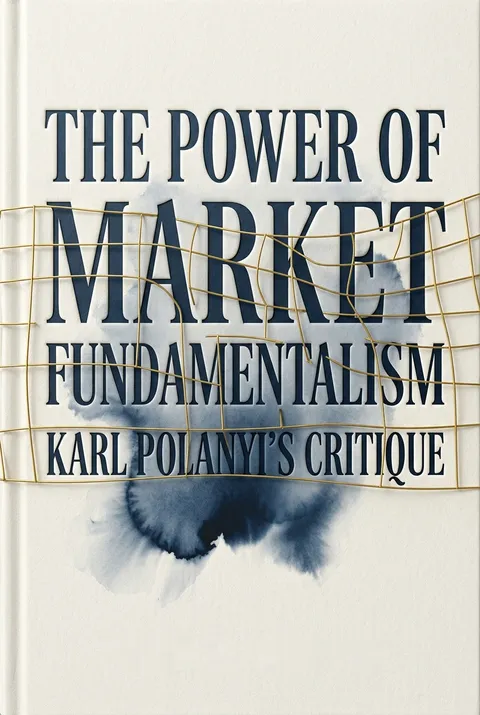

Key Takeaways
1. Market Fundamentalism: A "Stark Utopia" with Dystopian Outcomes
Our thesis is that the idea of a self-adjusting market implied a stark Utopia.
A dangerous illusion. Market fundamentalism, often presented as the natural and optimal state of economic affairs, is in reality a "stark Utopia"—an impossible ideal that, if pursued, inevitably leads to catastrophic social and environmental destruction. This utopian vision promises a world free from the complexities and conflicts of politics, where self-regulating markets efficiently allocate resources and ensure prosperity. However, this promise is a deceit, masking a system that cannot exist without annihilating human and natural substance.
Historical lessons ignored. The 20th century offered stark proof of this utopian folly. The collapse of the global economy in the 1930s, the rise of fascism, and two World Wars were direct consequences of attempts to impose a self-regulating market system. Despite these historical traumas, the same free-market ideas resurfaced in the 1970s and 80s, leading to renewed deregulation, soaring inequality, and the 2008 financial crisis.
From utopia to dystopia. The pursuit of this market utopia is not a harmless fantasy; it actively creates a dystopia characterized by human misery, squalor, oppression, and disease. This tragic outcome stems from the fundamental misunderstanding that society can be governed solely by economic laws, ignoring the intricate social, political, and ecological interdependencies that sustain human life.
2. The Economy is Always Embedded, Never Autonomous
The human economy, then, is embedded and enmeshed in institutions, economic and noneconomic.
Beyond the economistic fallacy. Polanyi fundamentally challenges the notion of an autonomous, self-governing economy separate from society. He argues that all economies, even "free" market ones, are inherently "embedded" within a complex web of cultural understandings, shared values, legal rules, and governmental actions. The idea of a disembedded market is a theoretical construct, not a reflection of reality.
Social foundations of economic life. Economic activity is not driven by universal, innate self-interest, but by socially constructed motivations and institutional arrangements. Polanyi identifies three primary patterns of economic integration—reciprocity, redistribution, and exchange—all of which are deeply intertwined with social relations. To view the economy as autonomous is to commit the "economistic fallacy," reducing all aspects of human life to economic determinism.
Re-embedding, not disembedding. When market fundamentalists advocate for "deregulation" and "smaller government," they are not freeing the market from the state. Instead, they are actively re-embedding it within different political, legal, and cultural arrangements that often favor wealth and corporate interests, while disadvantaging the poor and middle class. This process is a political act, not a natural evolution.
3. Fictitious Commodities: The Fatal Flaw of Market Society
To allow the market mechanism to be sole director of the fate of human beings and their natural environment, indeed, even of the amount and use of purchasing power, would result in the demolition of society.
The illusion of commodification. The core of a self-regulating market system relies on the premise that land, labor, and money can be treated as "true commodities"—things produced solely for sale on a market. Polanyi argues this is a fundamental fiction.
- Labor: Human activity, inseparable from life itself, cannot be produced for sale.
- Land: Nature, the environment, is not a manufactured good.
- Money: A unit of account and store of value, not a product.
Treating these as commodities is "fictitious" and inherently destructive.
Demolition of society. Because these are not true commodities, subjecting them entirely to market mechanisms would inevitably lead to the "demolition of society." Unfettered markets for labor would exploit humans beyond sustainable limits, commodified land would lead to environmental devastation, and unregulated money would cause catastrophic financial instability. The market's logic, when applied to these vital elements, is inherently self-destructive.
The need for management. To prevent this societal collapse, even market economies must constantly manage the supply and demand of these fictitious commodities through political and social means. Governments intervene to structure labor markets, protect the environment, and stabilize financial systems. This ongoing management reveals the inherent impossibility of a truly self-regulating market.
4. The Double Movement: Society's Inevitable Self-Protection
Inevitably, society took measures to protect itself, but whatever measures it took impaired the self-regulation of the market, disorganized industrial life, and thus endangered society in yet another way.
Market expansion meets social resistance. Polanyi's "double movement" describes the inherent tension within market societies. As market fundamentalists push to expand the reach of self-regulating markets, the destabilizing consequences inevitably trigger countervailing movements from various social groups seeking protection. This protective countermovement is a spontaneous, unplanned response to safeguard human and natural substance from market forces.
A continuous struggle. This is not a one-time event but an ongoing, dynamic process. The drive for laissez-faire generates a counter-drive for social protection, creating a perpetual push and pull. Examples include:
- Labor movements demanding better wages and working conditions.
- Environmental groups advocating for ecological preservation.
- Governments implementing social safety nets and financial regulations.
These protective measures, while necessary for societal survival, often "impair" the market's self-regulation, leading to further economic dislocations and intensifying the cycle of conflict.
Beyond class struggle. While often involving the working class, these countermovements are more complex than simple class struggle. They mobilize diverse constituencies—landed elites, farmers, religious groups, and even segments of business—who recognize the need to protect society from unchecked market forces. This broad-based resistance highlights that the market's destructive potential threatens society as a whole, not just specific economic classes.
5. The Perversity Thesis: Blaming the Victim Through "Natural Laws"
The Poor Laws of England tend to depress the general condition of the poor in these . . . ways. Their first obvious tendency is to increase population without increasing the food for its support.
A powerful rhetorical weapon. The "perversity thesis" is a potent argument used by market fundamentalists to discredit social welfare policies. It claims that well-intentioned policies designed to alleviate poverty will, paradoxically, have the opposite effect, exacerbating the very problems they aim to solve by creating perverse incentives for dependency and moral degradation. This rhetoric frames assistance as cruel, and its denial as compassionate.
Malthus's "natural" explanation. Thomas Robert Malthus famously deployed this thesis in his Essay on the Principle of Population, arguing that poor relief encouraged the poor to marry young and have more children, outstripping food supply and leading to greater poverty. He invoked "social naturalism," asserting that society, like nature, is governed by immutable biological laws of scarcity and instinctual drives (hunger and sex). Any political intervention, like poor relief, was seen as an unnatural interference with these self-regulating laws.
Epistemological infrastructure. The perversity thesis gains its "epistemic privilege" from a three-part infrastructure:
- Social Naturalism: Conflates society with nature, making scarcity and biological drives the ultimate determinants of human behavior.
- Theoretical Realism: Prioritizes unobservable, abstract "laws" (like population growth) over empirical evidence, allowing proponents to dismiss contradictory facts as mere "appearances."
- Conversion Narrative: Presents a story of a harmonious past disrupted by misguided policies, offering a bleak future if policies persist, and a utopian future if "natural laws" are restored.
This framework allows market fundamentalism to redefine reality and justify radical policy shifts.
6. Speenhamland: A Mythical Cautionary Tale for Welfare Reform
The worst effects were on the rural population. It [Speenhamland] completed the work done by the enclosures and the engrossing of farms. Destitution and idleness broke the last link that bound the countryman to the land.
A distorted history. The Speenhamland Act of 1795, a local English poor relief measure, has been widely cited for two centuries as a cautionary tale against government intervention in labor markets. Polanyi, while critical of its effects, also highlighted its role in shaping classical economic thought. However, modern historical scholarship reveals that the traditional narrative of Speenhamland—that it universally depressed wages, fostered idleness, and caused widespread demoralization—is largely a myth.
The reality of rural distress. The bread scale, a key feature of Speenhamland, was not as pervasive or continuous as once believed. Rising poor relief outlays were primarily a response to structural economic changes, such as:
- The decline of rural craft industries.
- Enclosures that stripped families of land for self-provisioning.
- Increased seasonal unemployment due to agricultural mechanization and post-Napoleonic War depression.
Poor relief, far from causing poverty, often served as a vital buffer, sustaining family incomes in the face of forces beyond their control.
Legitimizing political economy. The Speenhamland myth was strategically constructed by classical economists like Malthus and Ricardo, and amplified by the 1834 Royal Commission Report, to divert blame for rural distress from macroeconomic policies (like the return to the gold standard) onto the poor themselves. This narrative served to legitimate the nascent science of political economy and its laissez-faire principles, framing government intervention as inherently perverse and destructive.
7. Ideas as Causal Forces: The Power of Ideational Embeddedness
The discovery of economics was an astounding revelation which hastened greatly the transformation of society and the establishment of a market system.
Ideas shape reality. Polanyi emphasizes that economic theories and social science models are not merely descriptive; they are "performative," actively shaping and creating the markets and social practices they purport to describe. This concept, which we call "ideational embeddedness," highlights that markets are always embedded not just in institutions, but also in the prevailing ideas, public narratives, and explanatory systems that define and normalize them.
Epistemic privilege of market fundamentalism. Market fundamentalism possesses "epistemic privilege" because its ideas come equipped with internal claims to veracity, making them remarkably resilient to empirical disconfirmation. Its reliance on social naturalism and theoretical realism allows it to:
- Redefine crises: Blame societal problems on "unnatural" interventions rather than market failures.
- Explain dissent: Portray opponents as misguided idealists who fail to grasp fundamental economic "truths."
- Immunize itself: Dismiss contradictory data as superficial or irrelevant to its deeper, logical truths.
This allows market fundamentalism to "make itself true" by altering the social world to fit its abstract models.
Conversion narratives. To achieve ideational regime change, a challenging idea must offer a compelling "conversion narrative" that reframes reality. Malthus's narrative, for instance, moved from a crisis of poverty to a harmonious past, then projected two futures—one bleak (if old policies continued) and one utopian (if "natural laws" were obeyed). This storytelling power, combined with its epistemological infrastructure, enables market fundamentalism to delegitimize existing ideas and establish itself as the only rational path forward.
8. The State's Indispensable Role: Markets are Politically Constructed
The road to the free market was opened and kept open by an enormous increase in continuous, centrally organized and controlled interventionism.
Laissez-faire is state-made. Contrary to the myth of spontaneous market emergence, Polanyi demonstrates that the "free market" is a deliberate political construct, requiring extensive state intervention to create and maintain. Governments actively remove old regulations, establish new legal frameworks, and build administrative bodies to facilitate market operations. This continuous "reregulation," rather than deregulation, is essential for markets to function.
Managing fictitious commodities. The state's role is particularly crucial in managing the "fictitious commodities" of land, labor, and money.
- Labor: Governments structure labor markets through education, migration policies, and unemployment assistance.
- Land: States establish property rights, zoning laws, and infrastructure to create and enhance land value.
- Money: Central banks manage money supply and credit to stabilize financial systems and prevent boom-bust cycles.
These interventions are not "meddling" but constitutive elements of any functioning market economy.
Power is inevitable. Polanyi rejects the utopian ideal of a society without political power. He argues that power and compulsion are inherent and necessary in any complex society to ensure social order and protect citizens from market tyranny. The question is not whether power exists, but how it is exercised, by whom, and for whose benefit. A robust human freedom, therefore, depends on a coalition of state and civil society capable of protecting society against destructive market forces.
9. The US Divergence: Right-Wing Alliance and Market Fundamentalism
The enduring strength of free market conservatism in the United States.
A unique trajectory. Since the 1970s, the United States has diverged significantly from Western Europe in social policy, inequality, and cultural attitudes. While Europe has maintained more robust welfare states and lower inequality, the US has seen welfare retrenchment, soaring income disparities, and a religious revival fueling intense social polarization. This divergence is driven by a powerful alliance between big business and a grassroots conservative movement.
The rise of movement conservatism. This autonomous, durable right-wing social movement, encompassing groups like the Moral Majority, Christian Coalition, and Tea Party, combines traditional values with market fundamentalism. It is characterized by:
- Organizational autonomy: Maintains independence from the Republican Party to exert continuous pressure.
- Ongoing funding: Catalyzed by the Powell Memo (1971), business interests heavily fund conservative think tanks and organizations.
- Ideological fusion: Blends traditional moral dogma with anti-government, anti-tax, pro-market rhetoric, often recycling Malthusian "perversity" arguments.
- Regional concentrations: Strongest in the South, leveraging historical narratives of states' rights and evangelical Christianity.
Business's strategic shift. In the 1970s, US business leaders, disillusioned by the failures of the Johnson and Nixon administrations and facing economic turmoil, abandoned their "corporate liberal" stance. They formed a strategic alliance with the conservative right, seeking tax cuts, deregulation, and reduced labor power. This alliance, initially dominated by business, saw power shift towards movement conservatism over time, leading to a more extreme, short-term-focused, and ideologically rigid political landscape.
10. The Reality of Society: A New Philosophy for Freedom and Democracy
Uncomplaining acceptance of the reality of society gives man indomitable courage and strength to remove all removable injustices and unfreedom.
Beyond obsolete market mentality. Polanyi calls for a profound philosophical shift: an "acceptance of the reality of society." This means rejecting the "obsolete market mentality" that reduces human nature to homo economicus and society to market laws. Instead, it embraces the understanding that individuals are fundamentally social beings, constituted by their relationships and cultural practices, and that society is a complex, interdependent web of institutions.
An enlarged conception of freedom. Against Hayek's narrow, individualistic view of freedom as freedom from government, Polanyi proposes an "enlarged conception" of freedom. True freedom in a complex society requires:
- Socioeconomic rights: Beyond civil and political rights, including rights to a job, decent education, and protection from want.
- Institutional foundations: Freedoms are not natural but are actively produced and sustained through politics and law.
- Recognition of interdependence: Acknowledging that individual actions affect others, and that collective well-being is paramount.
This vision aims to expand freedom for all, not just the privileged few.
Democratic self-governance. To achieve this, Polanyi advocates for subordinating the economy to democratic politics. This involves:
- Empowered citizenry: Active participation in shaping economic decisions at local, national, and global levels.
- Radical democracy: Extending democratic governance into everyday life, including workplaces and local economic institutions.
- Countervailing power: Using political power, guided by democratic will, as the essential force against the relentless expansionary drive of market forces.
Embracing the reality of society means recognizing the necessity of government and continuously striving to deepen democratic control over economic life to secure genuine freedom and justice for all.
People Also Read





Download PDF
Download EPUB
.epub digital book format is ideal for reading ebooks on phones, tablets, and e-readers.








































