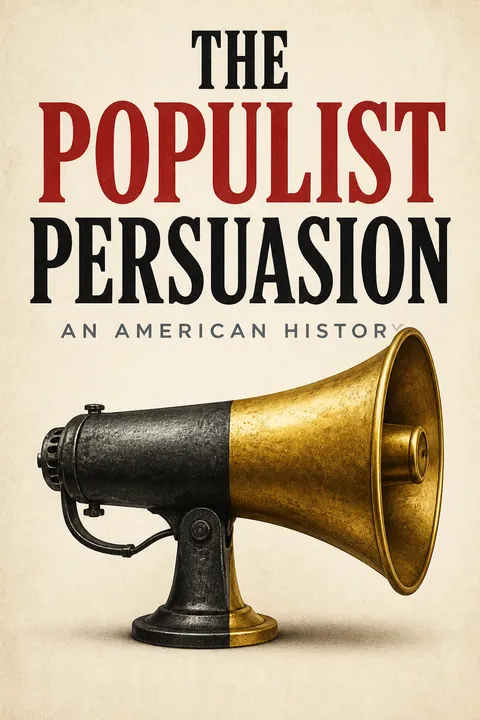

Key Takeaways
1. Populism: An Enduring Language of the People Versus the Elite
That is the most basic and telling definition of populism: a language whose speakers conceive of ordinary people as a noble assemblage not bounded narrowly by class, view their elite opponents as self-serving and undemocratic, and seek to mobilize the former against the latter.
A persistent political argument. From the nation's birth, American civic life has been filled with images of conflict between the powerful and the powerless. Populism is the enduring language used by those who claim to speak for the "vast majority of Americans who work hard and love their country" against a variety of "bureaucrats," "fat cats," and "Big Men" perceived as self-serving and undemocratic. This rhetorical optimism suggests that once mobilized, ordinary Americans can accomplish anything, avoiding deeper systemic critiques.
Evolving language, durable frame. This language has evolved over two centuries, adapting to changing historical contexts while maintaining its core structure. It binds Americans by fighting over the very meaning of "Americanism" itself, accusing elites of transgressing the nation's founding creed. This allows for protest against social and economic inequalities without questioning the entire system, fostering change while dreading revolution.
Two critical transitions. The populist persuasion underwent two significant shifts:
- Post-1890s: A split between economic populism (labor movements) and religious populism (evangelical crusades).
- Post-WWII: A migration of populist rhetoric from the Left to the Right, as conservatives began to champion "the people" against a perceived liberal establishment.
These transitions highlight how the language adapted to strengthen certain political forces and debilitate others, shaping the course of American politics.
2. America's Dual Populist Inheritance: Faith and Enlightenment
Through populism, Americans have been able to protest social and economic inequalities without calling the entire system into question.
Roots in two traditions. Early American populism drew from two distinct yet intertwined streams: the pietistic impulse of Protestant revivalism and the secular faith of the Enlightenment. Both agreed that high-handed rule by the wealthy was sinful and unrepublican, believing in America's millennial promise as a beacon of liberty. This blend of religious fervor and rational thought allowed for a powerful, idealistic discontent.
A common grammar of dissent. This shared heritage articulated four core beliefs:
- Americanism: A creed of equality, individual liberty, and self-governance, where the will of the people must decide. To mock the majority was un-American.
- "The People": Defined by a "producer ethic" – those who created tangible wealth (farmers, craftsmen, urban workers) were virtuous, hardworking, and trustworthy. This "middling sort" was typically white and male, excluding women and often demonizing African Americans and certain immigrant groups as dependent or servile.
- "The Elite": Portrayed as condescending, profligate, artificial, and parasitic, betraying republican principles. They were a "morbid growth" on the democratic body politic, often linked to "money power" and "monopoly."
- Mass Movements: Essential for nonviolent combat against tenacious foes, framed as "crusades" or "battles" to restore national ideals.
Heroes and their legacies. This era produced enduring populist heroes:
- Thomas Jefferson: The philosopher of first principles, whose elegant prose provided maxims like "Equal rights for all, special privileges for none."
- Andrew Jackson: The ruthless fighter, "Old Hickory," who championed "the productive and burdenbearing classes" against the "money power" and symbolized tough, self-defensive manhood.
- Abraham Lincoln: The "railsplitter as president," admired for his lucid eloquence and explicit sympathy for working people, embodying the common man who stayed true to his roots.
These figures provided a glorious past for future reformers to claim, legitimizing their struggles against perceived injustice.
3. The Original Populists: A Grand Vision Undone by Division
"The People’s Party is the protest of the plundered against the plunderers—of the victim against the robbers."
A broad coalition's birth. The People's Party, formed in 1892, aimed to unite debt-ridden small farmers, urban workers, prohibitionists, and socialists against the corporate order that had emerged since the Civil War. Ignatius Donnelly's Omaha Platform declared the nation "brought to the verge of moral, political, and material ruin," seeking to restore government to the "plain people." This was a messianic call for a "righteous commonwealth."
Crusade against plutocracy. The Populists' enemy was the "money power" and "plutocrats" – a malignant force of unprecedented strength intertwined with large corporations. They were seen as nonproductive, immensely wealthy, and corrupt, manipulating the economy and state. This critique, often laced with Christian language, framed the struggle as a moral battle against an "anti-Christ" that defiled the American dream.
- Key demands: Graduated income tax, unlimited coinage of silver and gold, government ownership of railroads.
- Moral community: Defined by self-governing citizens, not strict class lines, welcoming anyone against "monopoly and plutocracy."
- Racial dilemma: Sought alliances with black farmers based on shared economic interests, but ultimately upheld white supremacy, minimizing the profound meaning of race-divided history.
Defeat and enduring legacy. Despite initial electoral successes in the South and West, the Populists failed to bridge the cultural gap with urban workers and were ultimately defeated in 1896 when their presidential candidate, William Jennings Bryan, lost. Bryan's "Cross of Gold" speech, while powerful, polarized voters along cultural and religious lines. The party's demise marked the end of a national farmer-worker alliance, but its significance transcended its electoral fate. Populism left a rich, if contradictory, amalgam of dreams and demands, demonstrating that a blend of missionary zeal and pragmatic method could challenge established power.
4. Labor's Evolving Populism: From Craft Pride to Industrial Power
"We represent the part of the nation closest to the fundamentals of life."
A narrower, yet potent, voice. In the early 20th century, organized labor, dominated by the American Federation of Labor (AFL), became the primary claimant to the producer ethic. Unlike the broad Populist coalition, the AFL focused on wage earners, defining them as the most capable defenders of "average" Americans and republican principles. Samuel Gompers, the AFL's long-serving president, shifted from early Marxist leanings to a pragmatic, Americanist rhetoric, rejecting "un-American" socialism and emphasizing unions as "embodiments of democracy."
Defining the "average man." The AFL's "average man" was a craftsperson, indispensable to production, standing between an unworthy elite and an unfortunate poor. This image was:
- Masculine and white: Exalting physical strength and self-reliance, largely ignoring women workers and often viewing new immigrants with suspicion, though welcoming them if they showed "militant independence."
- Anti-Asian: Demonizing Chinese, Japanese, and Filipino immigrants as "slavish" and incapable of "American manhood."
- Ambivalent on race: Largely silent on African Americans, or advocating unity based on shared economic conditions rather than social equality.
The AFL's populism sought to appeal beyond class, portraying unions as altruistic forces curing national ills, while strategically aligning with progressive politicians.
From "industrial democracy" to "business unionism." The rise of the Congress of Industrial Organizations (CIO) in the 1930s marked a decisive break. The CIO embraced a multicultural, ethnically diverse "new people," with "Joe Worker" as its archetype. It championed "industrial democracy" – workers' rights and control over production – as an extension of Americanism. John L. Lewis, the CIO's charismatic leader, used biblical rhetoric and pragmatic shifts to define "labor on the march" against "financial and economic dictatorship."
- Inclusive Americanism: Welcomed immigrants and blacks, viewing racism as a malignant belief, and advocating for civil rights.
- Consumer identity: Linked union strength to the "American Standard of Living," embracing mass culture.
- Alliance with New Deal: The CIO became the "main driving force" of liberal elements, dependent on the state for legislative gains and legitimacy.
However, post-WWII, this insurgent spirit waned. Labor's success in securing contracts and benefits led to a shift towards "collective bargaining" and a "responsible" image, dissipating its broader populist appeal as workers increasingly identified as middle-class consumers.
5. Moral Crusades: When Christian Piety Defined the People's Fight
"If our republic is to be saved, the liquor traffic must be destroyed."
A righteous uprising. The prohibition movement, particularly the Anti-Saloon League (ASL), viewed itself as a selfless crusade to save America from moral ruin. Unlike the Populists, prohibitionists explicitly rooted their cause in Christian faith, believing that cleansing the nation meant bringing it back to Christ. This movement, dominated by evangelical Protestants, aimed to ensure that a "moral majority" would rule, not immoral "parasites."
The Woman's Christian Temperance Union (WCTU). The WCTU, a mass movement of respectable housewives, pioneered this moral populism.
- "Home Protection": Used maternal love and piety to justify actions against saloons and advocate for social reforms like child-care centers.
- Broad reform: Under Frances Willard, the WCTU embraced "Do Everything," linking temperance to women's rights, labor, and anti-monopoly causes, even supporting the People's Party.
- Post-Willard shift: After 1898, the WCTU narrowed its focus to prohibition, viewing workers and immigrants with condescension and emphasizing "Christian Patriotism."
The Anti-Saloon League's aggressive campaign. The ASL, founded in 1893, adopted a tough, masculine, war-like rhetoric, targeting the "Liquor Trust" as a parasitic elite.
- Nonpartisan strategy: Backed any candidate supporting prohibition, leveraging church networks and public pressure.
- "Productive" vs. "nonproductive": Framed the liquor industry as wasteful and immoral, preying on the public.
- Nativism: Depicted saloon keepers as "alien Mephistopheles" and linked prohibition to "Americanization," alienating ethnic workers.
- Racial exclusion: Largely ignored or used racist stereotypes against African Americans, aligning with Southern segregationists.
- Billy Sunday: The evangelist's slangy showmanship and fundamentalist sermons appealed to the "rubes" against "the diamond-wearing bunch."
Victory and decline. Prohibition's swift victory, aided by WWI's "Americanism" fervor (linking liquor to German spies), transformed the ASL into an unofficial state apparatus. However, its single-issue focus and authoritarian stance alienated many, including ethnic workers and the AFL. The ASL's later attempts to portray its opponents as "subversive movements" like "Communism, gangsterism, [and] free love" failed to resonate. The repeal of the 18th Amendment, coupled with the Scopes trial's cultural divide, left evangelical Protestants without a unifying political cause, creating a vacuum later filled by the Ku Klux Klan and other conservative groups.
6. The Cold War Right: Forging a Conservative Populism Against Subversion
"The common man…can grasp the idea of treason without reading about it in a book, and he values his citizenship in a free country enough to fight for it."
A new conservative identity. The Cold War provided conservatives with a historic opportunity to marry anti-statist convictions with moral anxieties. They shifted from defending unregulated capitalism to mobilizing "ordinary Americans" against a perceived liberal establishment that fostered secular decadence and harbored "un-Americans." This new Right, learning from past failures, adopted a more inclusive, yet morally fervent, populist language.
The enemy within. The primary foe was a "conspiratorial elite" organized within government and culture, secretly abetting foreign Communists. This elite included:
- Liberal intellectuals: Accused of hatching dangerous ideas and being "soft" on communism.
- Wealthy celebrities: Translating subversive ideas into alluring images.
- High government officials: Secretly aiding the "reds," betraying national security.
This demonology, reminiscent of earlier "money power" critiques, framed the struggle as a defense of "free people" against a "creeping revolution" that threatened traditional liberties and values.
Intellectuals and the "tyrant State." A new group of conservative intellectuals, including ex-Marxists like John T. Flynn and young conservatives like William F. Buckley, Jr., articulated this vision. Flynn's best-selling "The Road Ahead" warned of "National Socialist Planners" in Washington, substituting state worship for the "American system." These thinkers, often pious Catholics, found in the Church a stable ideological alternative to secular liberalism and atheistic communism, appealing to millions of working-class and lower-middle-class Americans.
Veterans as moral exemplars. Military veterans, particularly the American Legion, became key figures in this anti-Communist crusade. They presented themselves as combat-hardened exemplars of civic virtue, uniquely qualified to identify and rout "Commies."
- "Community action": Legionnaires engaged in local efforts to purge "reds" from schools, workplaces, and media, using tactics like boycotts and protests.
- "Housewife routed the Reds": Josephine Baker's story of mobilizing neighbors against "pro-Soviet peace pledges" highlighted the grassroots nature of the movement.
This rhetoric, while often aggressive and intolerant, presented itself as a defense of "normal" Americans against a treacherous, effeminate elite.
7. The White Backlash: George Wallace and the Politics of Resentment
"I think that if the politicians get in the way…, a lot of them are going to get run over by this average man on the street, this man in the textile mill, this man in the steel mill, this barber, the beautician, the policeman on the beat, they’re the ones—and the little businessman—I think those are the mass of people that are going to support a change on the domestic scene in this country."
The "forgotten Americans" emerge. By the late 1960s, white working-class Americans, feeling ignored by liberal authorities and besieged by angry minorities, became a crucial target for conservative populism. George Wallace, governor of Alabama, skillfully tapped into this resentment, positioning himself as the champion of the "average man" against "limousine liberals," "pointy-headed intellectuals," and "unpatriotic protesters."
Southern populist roots. Wallace's political style drew heavily from the Southern populist tradition, blending hostility toward elites with a defense of white racial norms. His early career, influenced by "Big Jim" Folsom, involved attacking corrupt politicians and "Big Mules" while appealing to labor and farmers. However, with the rise of the Civil Rights Movement, Wallace pivoted to defending segregation, framing it as a fight for "local democratic institutions" against federal overreach.
"Segregation forever" and national appeal. Wallace's defiant "schoolhouse door" stand in 1963 transformed him into a national symbol of resistance against federal tyranny. His ability to bait and joke with liberal college students, while simultaneously appealing to white working-class voters in the North, demonstrated his mastery of media and populist rhetoric.
- "Fighting judge" persona: Attacked unelected judges for controlling the lives of the majority.
- "Working man" identity: Portrayed himself as a "former truck driver" and championed specific blue-collar occupations, contrasting with "pseudo-intellectuals."
- Cultural resonance: Embraced country music and evangelical Protestantism, appealing to traditional values.
- "Law and order": Advocated for a more severe, yet populist, state that would restore safety and defy "permissive" elites.
Limits of the "Great Inciter." Despite his strong showing in the 1968 presidential primaries, Wallace's abrasive style and association with racial backlash ultimately limited his national appeal. His campaign, while effective at inciting resentment, lacked a positive agenda and alienated women voters and organized labor. Wallace's failure to build a lasting movement left the door open for the Republican Party to co-opt his message and channel white working-class discontent into a broader conservative coalition.
8. The Conservative Capture: Nixon, Reagan, and the Middle American Majority
"They called it the Reagan Revolution. Well, I’ll accept that, but for me it always seemed more like the Great Rediscovery—a rediscovery of our values and our common sense."
Nixon's strategic populism. Richard Nixon, a pragmatic politician with deep-seated resentment against the "Eastern establishment," skillfully adopted a populist message to win the presidency in 1968. He appealed to the "silent majority" – "the non-shouters, the nondemonstrators" – who were "good people...decent people; they work and they save and they pay taxes and they care." This rhetoric, while avoiding Wallace's caustic sting, targeted:
- "Criminal forces": Blamed urban violence on "government programs" and promised a crackdown.
- "Media elite": Attacked television networks and liberal dailies as a "tiny and closed fraternity of privileged men" with a "radical-liberal" agenda, creating a "media" bogeyman.
- "Middle America": A unifying metaphor for the unstylish, traditionalist, and economically squeezed white majority, contrasting with "slick cosmopolitans."
Nixon's strategy, informed by Kevin Phillips's "Southern Strategy," aimed to unite white working-class Democrats with traditional Republicans, laying the groundwork for a new conservative majority.
The Christian Right's moral revival. The post-Watergate era saw the rise of the religious Right, which infused conservative populism with a powerful moral dimension. Leaders like Jerry Falwell and Pat Robertson mobilized evangelical Protestants (and sympathetic Catholics) against "secular humanism" and a liberal elite that tolerated abortion, homosexuality, and atheism.
- "Traditional values": Championed the patriarchal family, biblical morality, and self-reliant entrepreneurship.
- Education as battleground: Fought against textbooks promoting relativism and judges forbidding school prayer, seeing these as state intrusions on community values.
- Women's role: Women like Phyllis Schlafly led campaigns against the ERA and abortion, articulating a "pro-family" rhetoric of resistance.
- Alternative media: Utilized direct mail, talk radio, and cable TV to bypass the "liberal media" and reach "moral Americans."
Reagan's "Great Rediscovery." Ronald Reagan perfected conservative populism, becoming the most effective communicator since FDR. He reconciled disparate conservative strands, making them sound like common sense.
- FDR's vernacular: Adopted Roosevelt's affable, anecdotal style to "undermine the New Deal in its own vernacular," appealing to "Reagan Democrats."
- "Special interests" vs. "the people": Redefined "special interests" to target liberal insiders, bureaucrats, and welfare recipients, contrasting them with hardworking taxpayers.
- Tax revolt: Aligned with the "mad as hell" sentiment against high taxes, framing tax cuts as a defense of "productive Americans."
- Optimistic Americanism: Offered glittering tributes to the "indispensable masses" and a vision of a harmonious, small-town America, while largely omitting racial issues.
Reagan's success demobilized the grassroots Right, as his "common touch" and optimistic rhetoric made conservatism a "mass cultural experience," effectively capturing the language of populism for the Republican Party.
9. The New Left's Ambivalent Populism: Identity, Idealism, and Disillusionment
"The powers of ordinary men are circumscribed by the everyday worlds in which they live, yet even in these rounds of job, family, and neighborhood, they often seem driven by forces they can neither understand nor govern…[they] accordingly feel that they are without purpose in an epoch in which they are without power."
A rebellion from within. The white New Left, largely composed of liberal, educated youth, emerged in the 1960s to challenge the hypocrisy of the liberal establishment. Appalled by racial injustice, poverty, and the Vietnam War, they sought to create a "participatory democracy" where "the individual share in those social decisions determining the quality and direction of his life." Their populism was unique, springing from within the dominant order and rejecting its "corporate liberalism."
Black liberation as a model. New Leftists modeled themselves on the black freedom struggle, particularly SNCC, viewing African Americans as the vanguard of authentic democracy. This marked a significant break from past white-dominated movements, acknowledging "white skin privilege" and seeking to learn from the oppressed. However, this focus on racial injustice, especially as the movement embraced "black power" and Third Worldism, alienated many white working-class Americans.
Ambivalence towards the white majority. Despite efforts like the Economic Research and Action Project (ERAP) to build an "interracial movement of the poor," white radicals struggled to connect with the white working class. They often viewed these groups as "cheerful robots" or "grade-worshiping sheep," too complacent or racist to join a radical movement.
- Cultural gap: New Leftists' hip slang, anti-conformist dress, and embrace of counterculture (drugs, rock music) clashed with the values of many working-class whites.
- "Amerika" vs. "Third World": Some radicals' condemnation of the "mother country" and support for the Vietcong further alienated patriotic Americans.
- "Little Boxes": Satirized suburban life, failing to empathize with the aspirations of those seeking upward mobility.
The limits of campus populism. While campuses like Berkeley became "liberated areas" for student power, the New Left struggled in less prestigious universities where working-class students resented disruptions and anti-war sentiments. The GI movement, with its focus on the draft and military resistance, offered a brief opportunity to bridge class divides, but it too faced mistrust from many servicemen.
- Feminist critique: Women's liberation, while emerging from the New Left, challenged its male-dominated rhetoric and focus, creating a separate movement that further fragmented the Left's populist potential.
- Lost grounding: By rejecting the myth of a hardworking, patriotic white people and failing to articulate a compelling economic critique of big business, the New Left left a vacuum that conservative populism would eventually fill.
10. Spinning the People: Populism in an Age of Globalism and Cultural Fragmentation
"Our rhetoric speaks in the terms of another day, another age. It does not seem to express our present reality. And yet our politicians and those to whom they speak are surprised and troubled by the lack of fit, concerned less to find a new rhetoric than to find an easy formula to make the old rhetoric apt again."
Populism as a fashion statement. By the 1990s, "populism" became a ubiquitous, almost meaningless, label applied to politicians, talk-show hosts, and even consumer products. This reflected a widespread disillusionment with traditional political terms and a cynical recognition that being "popular" was synonymous with being "populist." The term's freedom from historical baggage made it a convenient signifier for anyone claiming to be on the side of "the real people" against "elite enemies."
New suitors for the middle class. The end of the Reagan era saw a continued focus on antigovernment sentiment, with figures like Ross Perot emerging as champions of the "owners" of the country. Perot, a wealthy businessman, blended conservative themes (budget cuts, government run like a business) with populist rhetoric (ridiculing "country clubbers," praising veterans).
- Perot's appeal: His direct communication style, anti-establishment stance, and focus on economic distress resonated with voters "mad as hell" about the political system.
- NAFTA debate: Perot's opposition to NAFTA highlighted the conflict between a middle class fearing job losses and a global elite, but his failure to articulate a consistent critique of corporate power limited his impact.
Democrats' "new populism." Democratic politicians, including Bill Clinton and Jesse Jackson, also adopted populist language to woo the "middle class" and address economic inequality.
- Clinton's strategy: Focused on "working families" and "the privileged few," borrowing from both New Deal and Reagan-era rhetoric to appeal to white swing voters.
- Jackson's "Rainbow Coalition": Championed workers and farmers of all races, highlighting "economic violence" and the plight of the poor, but struggled to bridge racial and cultural divides with white voters.
Against the "New World Order." The late 20th century saw a shared opposition to global capitalism from both Left and Right, reminiscent of the original Populists' critique of banks and corporations.
- Right-wing anti-globalism: Pat Buchanan and others echoed Father Coughlin, linking economic nationalism to traditional values and anti-immigrant sentiment, often with conspiratorial undertones.
- Left-wing anti-globalism: Organized labor and liberal activists focused on "American-based multinational corporations" and the need for international labor standards, but struggled to mobilize a mass movement.
The persistence of populist language, despite its often contradictory and fragmented applications, underscores a fundamental insight: no major problem can be addressed without the participation of "productive and burden-bearing classes" – Americans who work hard, build communities, and cherish national ideals. The challenge remains to forge an inclusive, hopeful populism that can transcend historical prejudices and effectively challenge entrenched power.
Review Summary
The Populist Persuasion receives mostly positive reviews (3.75/5 stars) for its examination of populism throughout American history. Readers praise Kazin's clear writing and comprehensive historical analysis, noting the book's continued relevance despite being written in the 1990s. Reviewers appreciate his treatment of both left and right populist movements, from agrarian populists to labor movements to modern figures. Some critics find the definition of populism somewhat loose and the book occasionally too political. Many recommend it as essential reading for understanding American political rhetoric and the evolution of populist movements.
People Also Read
Download PDF
Download EPUB
.epub digital book format is ideal for reading ebooks on phones, tablets, and e-readers.








































