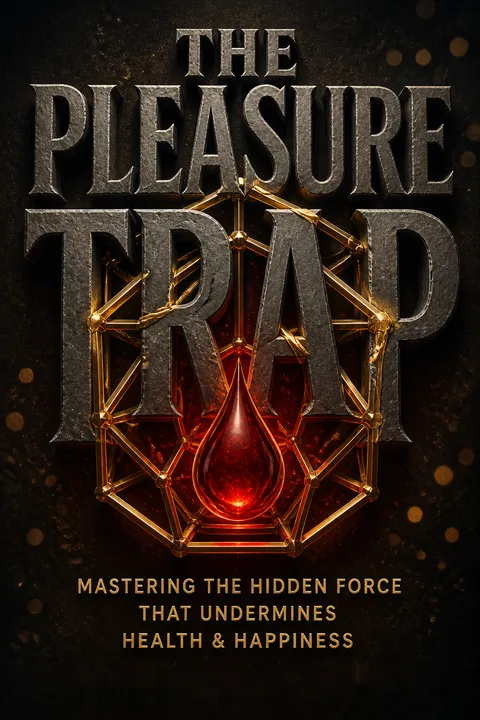

Key Takeaways
1. Our Core Drives: Survival, Pleasure, Pain, and Energy
The purpose seems to be to feel good (and to avoid feeling bad) as much of the time as possible.
Biological imperative. At a fundamental biological level, the purpose of all life is survival and reproduction, or more precisely, the replication of genes. Every creature, from sharks to gazelles to humans, is a superbly crafted machine designed for this singular goal. Our bodies and minds are equipped with innate tools and motivations to ensure our lineage continues.
The Motivational Triad. Nature guides us towards survival and reproduction through a powerful, three-part motivational system embedded in our genes: (1) seeking pleasure, (2) avoiding pain, and (3) conserving energy. In a natural environment, what feels good is good, signaling that we are fulfilling our biological purpose. Eating, sleeping, and sexual activity are pleasurable because they are essential for life.
Happiness as guidance. Beyond immediate pleasure and pain, nature also evolved a secondary system of "moods" – happiness and unhappiness – which act as feedback. These moods, driven by neurochemicals like serotonin, are not the ultimate goal but subtle signals that we are making progress towards worthwhile goals (like pleasure opportunities or pain avoidance). Happiness is the feeling of being on the right track, a continuous reinforcement for effective behavior, unlike the short, intense bursts of pleasure.
2. The Pleasure Trap: When Instincts Betray Us
His senses could be fooled by artificial feedback, resulting in choices that seem right but are self-destructive.
Instincts deceived. Our motivational triad, once an infallible compass in the natural world, can be tricked by modern "magic buttons." These are artificial stimuli that hyper-activate our pleasure centers (e.g., drugs, highly processed foods) or offer extreme pain avoidance with minimal effort. The brain receives a powerful signal that "something very good is happening," even if it's detrimental to long-term health and happiness.
The dopamine hijack. Substances like cocaine, caffeine, or even highly concentrated foods cause intense dopamine releases, creating an illusion of success and well-being. This artificial pleasure is often more potent and easier to obtain than natural rewards, leading to addiction. Animals, given a choice between cocaine and food or sex, often choose cocaine, illustrating how these artificial stimuli can override fundamental survival drives.
Widespread self-destruction. The pleasure trap is the root of most disease, disability, and unhappiness in Western civilization. Our ingenuity in creating easy pleasure and pain avoidance has inadvertently led us into self-destructive behaviors. We are trapped by our own motivational machinery, making choices that feel right in the moment but undermine our true well-being, because our internal compass was not designed for such deceptive stimulation.
3. Modern Medicine: A Miracle with a Dangerous Blind Spot
The greatest danger comes from an altogether different quarter—a threat that is purely psychological.
Pain as a warning. Pain is a miracle, the nervous system's vital warning signal that something is wrong, motivating us to alter behavior and promote healing. Natural healing involves three steps: sensing the connection between pain and error, stopping the harmful behavior, and taking corrective action. This process is instinctive and promotes health.
The pain relief dilemma. Modern medicine excels at the "Pain Relief Goal"—alleviating symptoms—but often neglects the "Healing Goal" of removing the underlying causes of disease. Potent pain-reducing medications can mute the body's natural warning system, encouraging continued dangerous behavior and creating "side effects" that are often more harmful than the original pain.
- Fever: A natural defense mechanism, often suppressed irresponsibly.
- Diarrhea/Nausea/Vomiting: Body's way to expel toxins, inhibited by drugs.
- Inflammation: Signals injury or dysfunction, suppressed by anti-inflammatories that impede healing.
Awe and false security. The true danger of modern medicine lies in our collective awe of its spectacular, yet limited, triumphs. This leads to a false sense of security, believing that doctors and high-tech procedures can rescue us from any disease. However, for the majority of chronic diseases (heart disease, cancer, diabetes), modern medicine offers surprisingly little in terms of cure or extended lifespan, as it rarely addresses the root causes, which are predominantly dietary and lifestyle choices.
4. The "Diseases of Kings" Are Now Everyone's Burden
Our modern diet—excessive in fat, protein, and refined carbohydrates—is the primary cause of disease and disability within industrialized civilizations.
From scarcity to excess. For hundreds of thousands of years, human ancestors struggled for enough food. The agricultural revolution (starting ~8500 B.C.) transformed this, allowing efficient food production and animal husbandry. This led to civilization, but also to new problems: infectious diseases from domesticated animals and, for the first time, diseases of dietary excess.
The royal road to ruin. Historically, calorically dense foods like animal products and refined sugars were expensive luxuries, consumed only by the wealthy elite. This indulgence led to "Diseases of Kings" such as heart attacks, strokes, diabetes, obesity, and gout. These conditions were rare among the general population, who still ate a largely plant-based, whole-food diet.
Modern abundance, universal disease. With industrialization and mass production, these once-exclusive "delicacies" became cheap and ubiquitous. The modern Western diet, rich in high-fat animal products, processed foods, sugar, and salt, now makes the "Diseases of Kings" the leading causes of death and disability for the common person. Our innate preference for calorie-dense foods, once a survival advantage, now leads us into a dietary pleasure trap.
5. Why We Get Fat: The Law of Satiation Hijacked
In a natural setting of caloric abundance, animals will consume the correct amount of food needed for optimal function.
Nature's perfect balance. The "Law of Satiation" dictates that in a natural environment, animals effortlessly consume the precise amount of food for optimal function, never consistently overeating or undereating to the point of health compromise. This is managed by sophisticated innate machinery that balances caloric intake with expenditure, ensuring fitness for survival and reproduction.
Satiation mechanisms fooled. Humans in industrialized societies appear to defy this law, with over half the population overweight or obese. This isn't a genetic flaw, but a consequence of our modern diet's artificial concentration. Our calorie-counting machinery, designed for whole natural foods, consistently underestimates the caloric value of high-fat, low-fiber processed foods, leading to inevitable overeating.
- High Fat: Modern foods (e.g., cheeseburgers, ice cream) are far fattier (35-80% fat) than ancestral foods (wild game ~15% fat). Fat is calorically dense (4,000 calories/pound vs. 1,800 for carbs/protein), overwhelming our nutrient receptors.
- Low Fiber: Refined carbohydrates (white bread, pasta, soft drinks) have fiber removed, reducing bulk per calorie. This lessens stretch receptor activity, signaling the brain to eat more for the same caloric intake.
The "yowel" circuits. Our bodies possess "yowel" circuits (e.g., leptin, diet-induced thermogenesis) that signal the brain to reduce appetite when fat stores are excessive. These mechanisms work perfectly on a natural diet, but are overwhelmed by the extreme caloric density of modern processed foods. The solution to weight management is not conscious restraint, but eating a whole, natural, plant-based diet to satiety, allowing these innate mechanisms to restore optimal weight.
6. Magic Food: The Addiction You Don't Realize You Have
The consumption of magic food is responsible for most premature death within industrialized society.
Neuroadaptation to taste. Our senses, including taste, are subject to "neuroadaptation"—they respond to changes in stimulation, not absolute levels. Consistent exposure to highly stimulating "magic foods" (high fat, sugar, salt) desensitizes our taste buds. Like a smoker oblivious to their own odor, most people are unaware how extraordinary their diet is, and how dulled their natural taste perception has become.
Food as a drug. Modern foods, like recreational drugs, artificially stimulate the brain's pleasure centers, creating intense, short-term gratification. This leads to a cycle of craving and consumption, where natural, whole foods seem "boring" or "intolerable." This is because the nervous system has adapted to the hyper-stimulation, and normal pleasure chemistry is blunted without the "magic food."
- Taste nerves adapt to higher stimulation levels.
- Normal pleasure chemistry is compromised when not consuming "magic food."
- Recalibration requires 30-90 days of abstention.
The boiling frog. We are like frogs in slowly boiling water, unaware of the danger. The gradual increase in artificial caloric density and taste stimulation in our diet has led to widespread addiction to unhealthy foods. This "dietary pleasure trap" is subtle, pervasive, and devastating, making it difficult to resist even when aware of the dangers, as it requires overcoming a deeply ingrained neuroadaptation.
7. Navigating Social Pressure: Integrity in a Pleasure-Trapped World
It is they who are the most likely to coerce you into sacrificing your health in exchange for their approval.
The power of conformity. Humans are instinctively sensitive to social pressure, seeking to avoid embarrassment or rejection. This once-useful trait for social stability now poses a challenge in a world where most people are caught in the pleasure trap. Maintaining health-promoting behaviors often means being "different," which can trigger psychological discomfort and social conflict.
The Milgram lesson. Stanley Milgram's obedience experiments revealed the astonishing power of social pressure and authority, showing that over 60% of subjects would inflict "lethal" shocks on a stranger when pressured by an authority figure. This highlights how easily individuals can act against their conscience under duress, especially when unprepared for an "integrity crisis" under time pressure.
- Subjects wanted to stop but couldn't figure out how.
- Lack of a clear alternative choice led to compliance.
- Preparation is key to resisting social pressure.
Managing social discomfort. To navigate social pressure, prepare strategies for two types of people:
- The Misinformed: Those ignorant of health facts. Use the "Seem Strategy" – present your choices as an experiment, admit you don't have all answers, and avoid appearing judgmental. "It seems to be working for me right now."
- The Irritated: Friends/family who understand your choices but don't want to join you. Their irritation stems from embarrassment and perceived status loss. Bolster their status (e.g., ask their opinion, praise their talents) and use "integrity with humility" ("I don't have the greatest self-control, and if I let myself get off track, I have trouble getting back").
8. The Path of Least Resistance: Why Healthy Choices Feel Hard
Overcoming the hidden force of this third and final component—energy conservation—is for many the single most difficult challenge they face in escaping the pleasure trap.
Nature's efficiency drive. All animal life, including humans, is hardwired to conserve energy. This means we instinctively follow the "path of least resistance," seeking the most pleasure and avoiding the most pain with the least possible effort. This drive, once crucial for survival (e.g., cheetahs hunting the weakest prey), now heavily influences our modern choices.
Fast food's triumph. Our technological civilization is built on energy conservation. Fast food, for example, perfectly serves this drive: it's quick, cheap, calorically dense, and requires minimal effort (e.g., drive-throughs). This convenience makes it incredibly appealing to our ancient energy conservation mechanisms, making healthy food preparation seem like a significant "hassle" by comparison.
Designing for health. To counter this powerful instinct, we must consciously design our lives to make healthy choices easier and unhealthy ones harder. This means creating systems that work with our energy conservation drive, rather than against it.
- No junk food in the house: Eliminates easy access to temptations.
- Weekly menu planning: Reduces daily decision-making effort for healthy meals.
- Cook in quantity: Mass production for home meals saves time and energy.
- Create a "car pack": Healthy snacks readily available to avoid fast food on the go.
9. The Myths of Moderation: Why Half-Measures Fail
For materials that do not have a natural and healthy relationship to the body, the "healthy and moderate" amount is none whatsoever.
Moderation's limits. While "everything in moderation" is often wise in many life domains, it fails when confronting the pleasure trap. This philosophy assumes that all substances have a natural, healthy relationship with the body, allowing our nervous system to self-regulate. However, artificial stimuli like cigarettes, cocaine, or highly processed foods do not. For these, the "healthy and moderate" amount is zero.
The illusion of benignity. Minor transgressions of unhealthy behaviors may seem to have only minor consequences, leading people to believe moderation is acceptable. A little coffee, a few French fries, or occasional alcohol might not immediately cause severe illness. However, every unhealthful behavior, even in moderation, impacts the body destructively to some degree, moving us away from optimal health.
- Coffee: Increases blood pressure, stroke risk, nervousness.
- Refined flour: Contributes to excess body fat, increased mortality.
- Alcohol: Kills brain cells, increases risk of liver disease.
Radical change for freedom. Unlike other goals where slow, steady progress works, breaking free from pleasure traps often requires radical, comprehensive change. Like an alcoholic needing complete abstinence, half-measures with addictive-like foods or drugs typically fail, prolonging agony and physical damage. An extreme, short-term commitment to healthful living provides the invaluable experience of freedom from the trap, recalibrating senses and restoring natural pleasure in healthy choices.
10. Fasting: Your Body's Most Powerful Self-Healing Tool
The most powerful way to restore health is often to do nothing—intelligently.
An ancient adaptation. Water-only fasting (prolonged periods of no food, just water) is an extraordinary, yet largely unrecognized, healing technique. It's an innate adaptive system, evolved over millions of years to help our ancestors survive famine and illness. When acutely ill, animals instinctively fast and rest, a finely coordinated strategy to restore health.
The body's wisdom. The human body possesses complex physiological machinery for prolonged fasting, including shifting from glucose to ketones (derived from fat) as the brain's primary fuel source after about three days. This muscle-sparing mechanism is indisputable evidence of our evolutionary history with caloric deprivation.
- Glycogen depletion: First 24-48 hours, body uses stored glucose.
- Muscle sparing: Body converts fat to fatty acids for most organs.
- Ketone production: Brain shifts to fat-derived ketones, preserving muscle.
Miraculous results. Supervised water-only fasting creates an optimal environment for the body's self-healing machinery to fully express itself. Our TrueNorth Health Center has observed "medical miracles" in thousands of patients, with conditions like arthritis, adult-onset diabetes, heart disease, and hypertension often resolving or significantly improving.
- Hypertension study: Average 37/13 mmHg blood pressure reduction in 10 days, off all medications.
- More severe cases (160/100+): Average 45/18 mmHg reduction, from 173/99 to 128/81.
Escaping the dietary pleasure trap. Beyond specific disease reversal, fasting is the most effective method for recalibrating taste buds and breaking free from the dietary pleasure trap. After days of water-only fasting, simple, healthful foods taste incredibly delicious, making the adoption of a whole natural foods diet enjoyable and sustainable.
11. Reclaiming True North: Conscious Mastery for Health and Happiness
Our animalistic nature, combined with our burgeoning technological abilities, is propelling us toward potential disaster.
The disrupted compass. Our ancestors' internal compass—the motivational triad integrated with mood regulation—reliably guided them towards health and happiness in a natural environment. However, civilization, with its relentless pursuit of pleasure, pain avoidance, and energy conservation, has created an artificial world that disrupts this compass. We now face the "pleasure trap," where our instincts lead us astray.
Ancient wisdom, modern science. Throughout history, religious and philosophical traditions have warned against the dangers of excess, echoing the scientific findings of today. An unbiased examination of current evidence emphatically supports these ancient prescriptions: a whole natural foods diet, regular exercise, drug abstention, sleeping to satiety, and fasting. These are not radical ideas but a return to how our ancestors naturally lived.
The road home. Reclaiming "True North" requires conscious recognition of the pleasure trap's many faces and a willingness to act against our deceived instincts. This means embracing radical, comprehensive changes, understanding that short-term discomfort is a necessary transition to long-term well-being.
- No junk food/recreational drugs in the home.
- Daily, enjoyable exercise.
- Consistent bedtime for 9-10 hours of sleep.
- Planned weekly menus of whole, natural foods.
A difficult, rewarding journey. The path to health and happiness in a pleasure-trapped world is challenging but profoundly rewarding. It's about living in harmony with our biological design, maximizing our potential for vitality, optimism, and resilience. By mastering our instincts with knowledge and determination, we can navigate the complexities of modern life and secure our birthright of true health and happiness.
People Also Read


Download PDF
Download EPUB
.epub digital book format is ideal for reading ebooks on phones, tablets, and e-readers.








































