
Key Takeaways
1. The "One-Straw Revolution" is a Philosophy of Non-Action
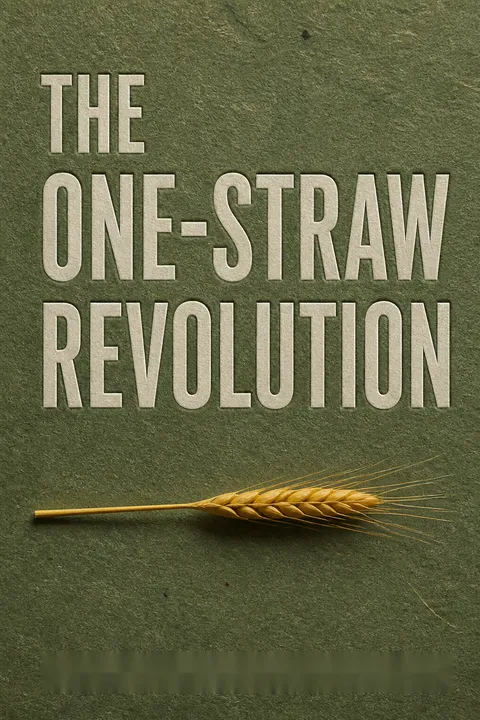
I believe that a revolution can begin from this one strand of straw.
A profound realization. Masanobu Fukuoka's journey into natural farming began with a sudden, life-altering insight: "Humanity knows nothing at all. There is no intrinsic value in anything, and every action is a futile, meaningless effort." This realization, born from a period of illness and existential doubt, led him to question conventional wisdom and seek a path of "do-nothing" – not idleness, but non-interference with nature's inherent perfection. He sought to demonstrate this truth through farming, believing that practice was the best way to prove his philosophy.
Beyond conventional farming. His method, which he calls "natural farming," "do-nothing farming," or "one-straw revolution," is a radical departure from modern agricultural techniques. It challenges the deeply ingrained belief that human intervention is necessary for successful cultivation. Instead, it proposes that by observing and cooperating with nature, one can achieve yields equal to or greater than those of conventional methods, with significantly less labor and environmental impact. The "one straw" symbolizes the profound power of simple, natural processes when left undisturbed.
A lifelong experiment. Fukuoka spent over thirty years refining his approach, not by adding techniques, but by systematically eliminating unnecessary practices. He started by abandoning his father's pruned citrus orchard, only to see it wither, teaching him that "abandonment" is not "natural farming." This led to a continuous process of questioning: "How about not doing this? How about not doing that?" This relentless pursuit of simplicity eventually revealed that many agricultural practices, once thought essential, were only necessary because previous human interventions had disrupted nature's balance.
2. Four Principles Guide Natural Farming
All my fumblings have run along this line of thought. It is the heart of my method of growing vegetables, grain, and citrus.
Core tenets. Fukuoka's natural farming is guided by four fundamental principles, each challenging a cornerstone of modern agriculture. These principles are not merely techniques but expressions of a deeper philosophy that respects nature's self-organizing capacity. They aim to restore the natural balance of the ecosystem, allowing the land to maintain its fertility and productivity without human-imposed dependencies.
The four principles are:
- No Cultivation: No ploughing or turning of the soil, as the earth cultivates itself through roots, microorganisms, and small animals.
- No Chemical Fertilizer or Prepared Compost: The soil maintains its fertility naturally through the cycle of plant and animal life, with green manure and returned straw being sufficient.
- No Weeding by Tillage or Herbicides: Weeds are controlled, not eliminated, through straw mulch, clover ground cover, and temporary flooding, as they contribute to soil fertility.
- No Dependence on Chemicals: No pesticides or other chemicals, as nature, left alone, is in perfect balance, and strong crops in a healthy environment resist disease and pests.
A return to the source. These principles represent a "return to the source" of farming, where human effort is minimized, and nature's inherent wisdom is trusted. Fukuoka emphasizes that these are not just methods for growing crops, but a way of living that aligns with the natural order. He believes that by adhering to these principles, farmers can achieve high yields while simultaneously enriching the soil and fostering a healthy, balanced ecosystem.
3. Nature Cultivates and Fertilizes Itself
If left to itself, the soil maintains its fertility naturally, in accordance with the orderly cycle of plant and animal life.
Soil's inherent vitality. Fukuoka argues that the assumption that soil needs to be ploughed or fertilized by humans is a misconception. When left undisturbed, the earth cultivates itself through the intricate network of plant roots, the burrowing of earthworms and other small animals, and the ceaseless activity of microorganisms. This natural process creates a healthy, aerated soil structure far superior to anything achieved by mechanical tillage.
The natural fertility cycle. The fertility of the soil is not a finite resource that needs constant replenishment from external sources. Instead, it is a dynamic, self-sustaining system. Organic remains of plants and animals decompose on the surface, their nutrients carried deep into the soil by rainwater, feeding a vibrant underground ecosystem. Plant roots then draw these nutrients back to the surface, completing a continuous cycle of enrichment.
- Evidence: Giant trees in wild mountainsides grow without human intervention, demonstrating nature's immense fertility.
- Contrast: Cutting down natural forests and planting monocultures depletes soil and leads to erosion.
- Restoration: Barren land can be restored by planting nitrogen-fixing trees (like Morishima acacia) and ground covers (clover, alfalfa), enriching the topsoil and deep strata.
Beyond human intervention. For agricultural crops, Fukuoka demonstrates that prepared fertilizers are unnecessary. A permanent green manure cover (like white clover) and the return of all straw and chaff to the soil provide ample nutrients. He even used ducks to provide manure and control weeds, later switching to chicken manure when circumstances changed. He observed that excessive fertilizer can lead to problems, such as blast disease in rice, proving that nature's balance is delicate and easily disrupted by human "improvements."
4. Weeds and "Pests" are Part of Nature's Balance
Nature, left alone, is in perfect balance.
Re-evaluating "weeds." Fukuoka challenges the conventional view of weeds as agricultural enemies. He asserts that weeds play a vital role in building soil fertility and maintaining the biological community. His approach is not to eliminate them, but to control them through natural methods, allowing them to coexist with crops.
- Methods: Straw mulch, white clover ground cover, and temporary flooding effectively suppress weeds without chemicals or tillage.
- Timing: Sowing seeds while the preceding crop is still ripening gives the new crop a head start over weeds.
- Consequence of tillage: Cultivating the soil brings dormant weed seeds to the surface, inadvertently promoting their growth and creating a continuous "battle against the weeds."
Understanding "pests." Similarly, Fukuoka views insect damage and plant diseases not as problems to be eradicated with chemicals, but as indicators of an imbalanced ecosystem. He argues that "harmful" insects and diseases are always present but do not become problematic to an extent requiring poisons in a healthy, balanced environment.
- Natural predators: His fields, free of insecticides, teem with natural predators (spiders, toads, frogs) that keep "pest" populations in check.
- Interconnectedness: The complex web of insect relationships is beyond human comprehension; chemical intervention destroys this delicate balance, often leading to worse problems.
- Plant strength: Strong, naturally grown plants are inherently resistant to disease and insect attacks, unlike weak, "improved" varieties dependent on chemical inputs.
The illusion of control. Fukuoka illustrates how human attempts to control nature often backfire, creating new dependencies and greater problems. The pine bark weevil outbreak, for example, is treated with aerial spraying, but the ultimate cause (fungus, nematodes, viruses) remains unknown, and the "remedy" only sows seeds for future catastrophes. He concludes that the use of chemicals is the most inept way to deal with such problems, as it ignores the intricate, holistic nature of the ecosystem.
5. Modern Science and Agriculture are Fundamentally Flawed
The irony is that science has served only to show how small human knowledge is.
Fragmented understanding. Fukuoka is deeply critical of modern scientific agriculture, which he sees as inherently limited by its reductionist approach. Scientists divide nature into tiny, isolated pieces for study, conducting experiments that often bear little resemblance to real-world conditions. This fragmented understanding, he argues, prevents them from grasping the holistic, dynamic nature of ecosystems.
- Specialization: An entomologist sees only insect damage, a nutritionist only plant vigor, missing the interconnectedness of all factors.
- Changing conditions: Nature is in perpetual motion; conditions vary year to year, making fixed scientific conclusions often irrelevant to a farmer's field.
- Irrelevant research: Research on plant metabolism or light rays, while academically interesting, often fails to translate into practical, sustainable improvements in yield or health.
The illusion of improvement. Modern agriculture, driven by scientific "advancements," often creates problems that it then purports to solve. For example, "improved" seed varieties, grown in unnatural conditions, become weak and dependent on chemical fertilizers and insecticides. This leads to a cycle where science is needed to "rescue" nature, not because nature is insufficient, but because its natural fertility has been destroyed by previous interventions.
- "Good Rice Movement" / "Green Revolution": These movements, while aiming for higher yields, rely on chemical inputs that destroy soil life and create dependency.
- Hidden data: Research results showing negative outcomes from chemical use are often discarded or not published, creating a biased view of scientific efficacy.
Beyond the intellect. Fukuoka believes that true understanding of nature lies beyond the reach of human intellect and discriminating knowledge. He suggests that scientists should first become philosophers, questioning the fundamental goals of humanity. The more people try to understand and control nature through science, the further they separate themselves from it, leading to pollution, resource exhaustion, and spiritual disintegration.
6. Natural Food is Local, Seasonal, and Consumed with "No-Mind"
A natural diet lies right at one's feet.
Defining "natural food." Fukuoka addresses the confusion surrounding the term "natural food," distinguishing between discriminating knowledge (analytical, intellectual) and non-discriminating knowledge (direct intuition, "no-mind"). He argues that true natural food is acquired without intentional action, through a unity with nature, encompassing wild-gathered foods, natural farm crops, and naturally caught fish. The use of fire and salt, he concedes, can be seen as natural wisdom bestowed by heaven.
Nature's food mandala. He illustrates this concept with "Nature's Food Mandala," showing the vast array of seasonal foods available locally. This diagram emphasizes that if people acquire food through "no-mind," they can attain a perfect natural diet without needing complex theories like yin-yang.
- Seasonal abundance: From spring herbs and sea vegetables to summer fruits and autumn grains, nature provides a balanced diet throughout the year.
- Local wisdom: Villagers traditionally follow nature's prescription by selecting seasonal foods from their immediate area, instinctively knowing what is good.
- Beyond taste: Natural foods, biologically closest to their wild ancestors, possess richer flavors and higher nutritional value, often serving as medicine.
Critique of modern diet. Modern diets, driven by commercialism and artificial preferences, lead to an imbalance in body chemistry and a craving for unnatural foods. Processed, out-of-season, and chemically grown foods lack true flavor and nutritional value, creating a dependency on supplements and medicines.
- Appearance over quality: Consumers' demand for large, shiny, unblemished produce drives the use of chemicals, coloring agents, and waxes, sacrificing quality for aesthetics.
- Out-of-season indulgence: Growing foods out of season (e.g., summer mandarins in hothouses) is economically driven but yields nutritionally inferior produce at exorbitant prices.
- Loss of instinct: Modern people have lost their clear instinct for wholesome food, becoming estranged from nature's subtle flavors and relying on elaborate seasonings and cooking techniques.
7. Commercialism and Human Desire Drive Environmental Degradation
Extravagance of desire is the fundamental cause, which has led the world into its present predicament.
The root of pollution. Fukuoka asserts that environmental pollution, including food contamination, stems not from isolated incidents but from humanity's "extravagance of desire" and the relentless pursuit of material gain and "progress." He criticizes the fragmented approach to solving pollution, where symptoms are treated without addressing the underlying cause.
- Agricultural chemicals: Chemical fertilizers, for instance, leach into rivers and seas, causing red tides, making farmers and chemical companies major contributors to water pollution.
- Industrial solutions: Large-scale engineering projects (e.g., pumping Pacific water into the Inland Sea) to "solve" pollution only create new, more complex problems, often requiring nuclear power and further resource depletion.
- Consumer demand: Consumers' preference for aesthetically perfect, out-of-season produce drives farmers to use more chemicals, coloring agents, and artificial growing methods, perpetuating the cycle of contamination.
The failure of commercial agriculture. Fukuoka views commercial agriculture as inherently unstable and ultimately unprofitable for the farmer. Farmers become dependent on externally fixed prices for inputs (fertilizer, equipment) and outputs, leaving their income at the mercy of forces beyond their control.
- Loss of self-sufficiency: The shift from growing food for sustenance to growing for profit leads farmers away from basic agricultural principles.
- "Modernization" paradox: Agricultural cooperatives expand and integrate to carry out "unnecessary activities" like waxing and sorting, increasing labor and costs while diminishing food quality.
- Animal farming: Commercial raising of animals (e.g., white leghorns in cages) prioritizes profit over natural well-being, producing inferior products (e.g., "synthetic" eggs) and relying on imported, artificially enriched feed.
A reversal of values. The solution, Fukuoka argues, lies in a fundamental "reversal of the sense of values" – prioritizing quality, naturalness, and local self-sufficiency over size, appearance, and profit. He believes that if natural food were sold cheaply and locally, and if farmers returned to simple, non-chemical methods, the entire system could be transformed, benefiting both producers and consumers.
8. Simplicity and "Doing Nothing" Lead to a Richer Life
To be here, caring for a small field, in full possession of the freedom and plenitude of each day, every day - this must have been the original way of agriculture.
The joy of non-work. Fukuoka provocatively states that "human beings are the only animals who have to work, and I think this is the most ridiculous thing in the world." He advocates for a life of simplicity where "work is not work," but simply doing what needs to be done to produce daily necessities. This approach, inherent in natural farming, frees up time for leisure and spiritual contemplation, contrasting sharply with the relentless busyness of modern life.
Reclaiming leisure. He laments the loss of leisure in modern farming, recalling a time when farmers had months-long New Year's holidays and time to compose haiku. The shortening of these periods signifies a spiritual impoverishment, where agriculture has become solely concerned with material development.
- Small-scale farming: Ideal for spiritual well-being, allowing farmers to contemplate "the Great Way" by deeply understanding their immediate surroundings.
- Community: Natural farming fosters community, as seen in the young people living communally in his huts, learning to live self-sufficiently.
- Spiritual breathing space: Reducing the scale of operations and material desires creates ample time for personal growth and connection with nature.
The path to happiness. Fukuoka believes that a happy, pleasant land can be achieved if people return to small-scale, self-sufficient farming. If each person had a quarter-acre of arable land, practicing natural farming, they would have more than enough food and plenty of time for leisure and social activities. This vision contrasts with the modern agricultural policy that aims to reduce the number of farmers and expand farm size, leading to increased mechanization and spiritual dissipation.
Beyond material gain. The ultimate goal of farming, for Fukuoka, is not merely growing crops but "the cultivation and perfection of human beings." By serving nature and living simply, one finds joy in the daily rituals of sowing and caring for plants, regardless of the harvest's outcome. This approach transcends the pursuit of profit and material possessions, leading to a life of freedom and plenitude.
9. True Understanding Transcends Human Intellect
To believe that by research and invention humanity can create something better than nature is an illusion.
The limits of discrimination. Fukuoka consistently emphasizes that human intellect, or "discriminating knowledge," is inherently limited and cannot grasp the true nature of reality. It divides the world into dualities (life/death, yin/yang, good/bad), creating an incomplete and often distorted understanding. True understanding, he argues, comes from "non-discriminating knowledge" or "no-mind," which arises when one abandons the ego and intellectual striving.
The endless hell of the intellect. He illustrates this by showing how scientific inquiry, starting from a simple observation like a drop of dew, leads to an "endless hell of the intellect," delving into subatomic particles and galaxies, yet never reaching a complete understanding. This pursuit of fragmented knowledge, he contends, makes the world frighteningly abstract and distant, rather than simple and at hand.
- Atomic physics vs. children's wonder: Scientists dissecting moon rocks have less grasp of the moon's wonder than children singing to it or a poet reflecting on its image in a pond.
- Technological paradox: "Advanced" machinery like electric mills, while seemingly efficient, break down whole grains into incomplete by-products, making people dependent on supplements and weakening their bodies.
- Fuel analogy: Burning kerosene, a product of complex industrial processes, is not inherently "better" or "quicker" than burning local wood, which follows a more direct natural path.
Embracing unknowing. The path to true wisdom, for Fukuoka, is to realize that one "knows nothing at all." This abandonment of the desire to understand allows non-discriminating knowledge to arise spontaneously. He challenges the notion that humans are born with a purpose, suggesting that this belief itself creates struggle and sorrow. Instead, he advocates for simply living in the present moment, experiencing and savoring the continuous cycle of life and death, like the rice plant.
Serving nature. Ultimately, Fukuoka's message is one of humility and surrender to nature's wisdom. He believes that people are struggling precisely because they try to accomplish something, to improve upon nature. By simply serving nature, aligning with its inherent perfection, and letting go of the illusion of control, humanity can find joy, health, and a profound connection to the source of all things.
Review Summary
The One-Straw Revolution receives widespread praise (4.33/5) for its philosophy of "do-nothing" farming and Zen-influenced approach to agriculture and life. Readers appreciate Fukuoka's four principles: no tilling, no chemicals, no weeding, and no pesticides, while achieving comparable yields. Many find his critique of modern agriculture and emphasis on living harmoniously with nature inspirational. However, some criticisms emerge: his dismissal of science feels extreme to some readers, his methods may not translate to different climates, and his philosophical tangents can feel preachy or repetitive. Vietnamese readers particularly engaged with the book's environmental and spiritual messages, though reactions varied from deep admiration to skepticism.
People Also Read




About the Author
Other books by Masanobu Fukuoka
Download PDF
Download EPUB
.epub digital book format is ideal for reading ebooks on phones, tablets, and e-readers.








































