
Key Takeaways
1. America's Identity Crisis: Beyond Multiculturalism and Universalism
The United States has been, is, and should continue to be a liberal and democratic nation-state.
A fundamental question. At the close of the twentieth century, America grapples with the question, "Are we a nation?" Two dominant, yet flawed, schools of thought—multiculturalism and democratic universalism—answer in the negative, leading to a profound identity crisis. Multiculturalists see the U.S. as a "nation of nations," a federation of distinct racial or ethnic cultures, while democratic universalists view it as an "idea-state," bound only by abstract liberal democratic principles.
Flawed premises. Both perspectives fundamentally misunderstand the nature of American identity. Multiculturalism errs by equating conventionally defined races with distinct cultures and nationalities, ignoring the shared vernacular culture that transcends racial lines. Democratic universalism, on the other hand, is absurd in its premise that a nation can be founded solely on an idea, neglecting the concrete historical community shaped by common language, folkways, and memories.
The nationalist alternative. A straightforward American nationalism offers a compelling alternative, asserting that the U.S. is, and always has been, a liberal and democratic nation-state. This perspective recognizes a concrete historical community, defined by a common language (American English), shared folkways, and a common vernacular culture, which most Americans, regardless of race, are born into and assimilated by. This nationalism, often inarticulate in public discourse, is the true sentiment of the majority.
2. The Three American Republics: A History of Evolving National Identity
Constitutional continuity in America disguises the discontinuities in national history between what can be described as the three “republics” of the United States.
Beyond surface continuity. Despite the enduring federal constitution since 1789, America's national identity has undergone profound transformations, manifesting as three distinct "republics." Each republic redefined the fundamental building blocks of the nation-state: race, culture, and citizenship, establishing its own consensus on national community, civic ethic, and political creed. This framework reveals that American history is not a smooth, linear progression but a series of cataclysmic, often violent, shifts.
Defining each era. The First Republic, Anglo-America (1789-1861), identified the national community with Anglo-Saxon Protestants, a Protestant ethic, and federal republicanism. The Second Republic, Euro-America (1875-1957), broadened this to include European-descended Christians, embracing a "melting pot" ideal for whites and federal democracy. The Third Republic, Multicultural America (1972-present), fragmented the nation into five official racial communities, promoting an ethic of authenticity and centralized multicultural democracy.
Revolutions, not evolution. These transitions were not gradual evolutions but genuine revolutions, marked by significant domestic violence and societal upheaval. The War of Independence, the Civil War, and the Civil Rights Revolution fundamentally reshaped the nation's social and political fabric, demonstrating that America's identity is forged through intense struggle and redefinition, rather than a simple unfolding of founding ideals.
3. Anglo-America: The First Republic's White Protestant Foundation
The ultimate origins of the American nation are found in sixteenth-century England.
An Anglo-Saxon vision. The First Republic (1789-1861), or Anglo-America, was founded on the belief that the American people were a branch of the Anglo-Saxon tribe, destined to expand across North America. This identity was a compound of three elements: an Anglo-Saxon national community, a Protestant Christian ethic, and a federal-republican political creed. This vision, shared by most Founding Fathers, saw America as a "modified England," not a diverse amalgam.
Racial and religious exclusivity. This era's nationalism was explicitly racial and religious.
- Anglo-American Race: White Americans viewed themselves as "modified Englishmen," with theories of Aryan or Germanic racial superiority justifying their dominance. The 1790 naturalization act limited citizenship to "free white persons."
- Protestant Christianity: Evangelical Protestantism became the informally established religion, often viewing Enlightenment deism and Catholicism with suspicion. This fueled social reforms like abolitionism, but also anti-Catholic sentiment.
- Federal Republicanism: The U.S. was a collection of subsidiary republics, with a weak central government. Suffrage was largely limited to white males, and black Americans were excluded, either as slaves or outcasts, with colonization often seen as the solution.
The grand compromise. Anglo-America's stability rested on a grand compromise: the South would remain in the Union as long as federal power did not threaten slavery. This was enshrined in constitutional guarantees, legislative compromises, and the maintenance of a balance between slave and free states, ensuring Southern political predominance until the Civil War.
4. Euro-America: The Second Republic's White Melting Pot
The “melting pot” has worked—for white Americans.
A transformed narrative. By the mid-twentieth century, the Anglo-American narrative of a white Protestant nation gave way to Euro-America (1875-1957), a new mainstream vision of the U.S. as a "melting-pot" nation-state. This identity blended old-stock white Americans with new European immigrants, symbolized by Ellis Island and the Statue of Liberty. The national story shifted to the formation of a new white Christian nation, united by democratic ideals.
Northeastern elite dominance. This Second Republic was largely shaped by a powerful Northeastern elite, often indistinguishable from the Republican Party leadership. This elite, predominantly Anglo-American and Protestant, established itself as a de facto aristocracy, influencing:
- Economic power: Foundations of great fortunes laid during the Civil War, with close ties between banking, corporations, and law firms.
- Political influence: Domination of the Republican Party and federal administrative elite, resembling a "government as the executive committee of the bourgeoisie."
- Cultural Anglicization: Elite education (Ivy League), social clubs, and cultural tastes emulated British aristocracy, leading to institutionalized antisemitic and anti-Catholic prejudice.
White supremacy's new form. While broadening the definition of "whiteness" to include Irish and German Catholics, Euro-America maintained white supremacy through a "second grand compromise." This informal agreement between white upper classes and white masses ensured that non-whites would not compete economically or politically with whites. This led to:
- Anti-Asian laws: Chinese Exclusion Act and other restrictions, often mirroring policies in other white-settler nations like Australia and Canada.
- Jim Crow: Formal segregation and disfranchisement of blacks in the South, and informal segregation in the North.
- Labor protection: White working-class racism, fueled by fears of economic displacement by non-white labor, was a key pillar of this compromise.
5. Multicultural America: The Third Republic's Flawed Racial Federalism
Multicultural America is a repellent and failed regime, from the point of view of members of the wage-earning American majority.
A new, contested orthodoxy. Multicultural America, the Third Republic (1972-present), emerged from the Civil Rights Revolution, but not as its original color-blind proponents intended. It is characterized by a quasi-official ideology of multiculturalism and a system of racial preferences, which, despite claims of radicalism, serve the interests of the white overclass. This regime lacks popular legitimacy and a coherent national story.
The five official races. The core of Multicultural America is the federal government's recognition of five official racial categories: white, black, Hispanic, Asian and Pacific Islander, and Native American. These categories, formalized by OMB Statistical Directive 15, are arbitrary bureaucratic constructs, not genuine cultural realities, yet they determine legal and material consequences, including eligibility for racial preferences. This system has led to:
- "Passing" for minority: Whites claiming minority ancestry to gain advantages.
- Arbitrary classification: Cases where "ethnic committees" or government fiat determine racial identity.
- Hispanic redefinition: Mexican-Americans, historically considered white, were redefined as a distinct race to fit the preference system.
Ethic of authenticity and racial federalism. The common ethic shifted from generalized Christianity to a secular ideal of "authenticity," demanding conformity to one's official race-culture. Politically, federal democracy was replaced by "multicultural democracy," a new form of federalism where race rights supersede states' rights, exemplified by racially gerrymandered districts designed to ensure minority representation.
6. The White Overclass: Architects of Racial Preference and Economic Inequality
The white overclass in the United States since the sixties has specialized in ruling by fraud.
A hidden oligarchy. The contemporary United States is dominated by the white overclass—a small, affluent group of executives, professionals, and rentiers, largely with advanced degrees, constituting about a fifth of the population. This class, the first truly national oligarchy, controls both Democratic and Republican parties through campaign finance and staffing of elite offices. They maintain a myth of a classless society, while subtly advancing their own interests.
Class, not just income. This is a social class, not merely an income bracket, defined by shared subculture, intermarriage, and predominance in certain professions and political offices.
- Distinctive culture: Common accent ("NBC standard"), pseudo-British tastes, specific folkways (squash over bowling, jogging over pool), and a secular, libertarian worldview.
- Family patterns: Delayed marriage, cohabitation, and the "three-parent family" (two professionals plus a maid) are structured to facilitate credential acquisition and career advancement.
- "High-status diseases": Anorexia, bulimia, and co-dependency reflect anxieties about lower-class "vulgarity" and the blurring of traditional gender roles.
The third grand compromise. The white overclass has co-opted potential black and Hispanic dissent by creating small, artificial non-white overclasses through racial preference policies. This "third grand compromise" ensures social peace by diverting attention from class divisions to racial squabbles, effectively using "divide and rule" tactics. This tokenism is far less costly than genuine efforts to uplift the broader disadvantaged population.
7. The Revolution of the Rich: Regressive Taxation and Globalism's Impact
The class war of the white overclass against the multiracial middle class is not limited to the downward redistribution of taxation.
A bipartisan class war. Since the 1960s, the white overclass has waged a subtle, bipartisan class war against wage-earning Americans of all races. This war operates on three fronts: regressive taxation, free-market globalism, and a "new feudalism," all designed to benefit the affluent at the expense of the majority. The redefinition of liberalism and conservatism now sees both parties largely agreeing on economic fundamentals while focusing on symbolic cultural disputes.
Economic policies favoring the rich:
- Regressive taxation: The "Reagan Revolution" shifted the tax burden from the rich to the middle and working classes through payroll tax increases and deficit spending, while cutting taxes for the wealthiest.
- Free-market globalism: Unrestricted global trade and investment, coupled with mass immigration, drive down American wages and weaken unions, benefiting corporations seeking cheap labor abroad and at home.
- "Free trade plus" fallacy: The idea that American workers can overcome low-wage competition through higher skills and productivity is undermined by declining real wages despite rising productivity, and the expatriation of even high-skill jobs.
The new feudalism. This trend involves the privatization of public amenities and services, making them luxuries accessible only to the affluent.
- Private enclaves: Gated communities, private police, and private roads for the wealthy.
- Education: Proposals for school vouchers would subsidize private education for the rich, further segregating society by class.
- Military: A "volunteer" (mercenary) force disproportionately drawn from lower-income Americans, creating a growing divide between civilian and military elites.
8. Liberal Nationalism: A Vision for a Transracial American Nation
There is a transracial American nation which, like the Polish people, would continue to exist, even if the American nation-state, the United States of America, were wiped off the map.
America as a cultural nation. Liberal nationalism posits that America is a conventional nation-state, defined by a transracial cultural nation rather than by arbitrary racial categories or abstract ideals. This "Trans-American" nation is united by American English, a shared, evolving national culture, and a common ethic of civic familism, transcending superficial racial distinctions.
Rejecting false identities. This philosophy rejects:
- Multiculturalism's five races: These are seen as arbitrary castes, not genuine nationalities.
- Cultural pluralism: Its vision of a federation of static ethnic groups is deemed unrealistic and ultimately divisive.
- Democratic universalism: The idea of an "idea-state" is too flimsy a bond for national unity.
The transracial melting pot. Liberal nationalism embraces the "melting pot" metaphor, extending it beyond European immigrants to all races. It advocates for:
- Cultural fusion: The blending of diverse cultural elements into a unique American mainstream.
- Racial amalgamation: The ultimate goal of intermarriage to blur racial boundaries and overcome the legacy of a caste society.
- Civic familism: A non-sectarian ethic emphasizing family duties, middle-class virtues, and a balance between individual liberty and social order, as an alternative to the ethic of authenticity.
9. Trans-America: The Fourth Republic's Blueprint for National Democracy
Nothing less than a radical reconstruction of the American class hierarchy is required to reduce the diminished but still significant correlation between class and color that is the enduring legacy of three centuries of caste law and caste politics.
A Fourth American Revolution. The vision for Trans-America, the Fourth Republic, is built on national democracy, combining individual rights, equal voting power, and a social market. This requires a generation-long, bloodless revolution to dismantle Multicultural America's racial preferences, plutocratic politics, and free-market globalism.
Pillars of national democracy:
- Individual Rights: Abolish all government racial labeling and racial preference policies. Civil rights law should be strictly color-blind and victim-specific, expanding protections for new categories like homosexuals, and nationalizing basic individual rights across all states.
- Equal Voting Power: Separate "check and state" by outlawing paid political advertising, promoting multiparty democracy through proportional representation for the House, and transforming the malapportioned Senate into a national body elected by PR.
- Social Market Contract: Implement a new contract between government, employers, and workers to raise living standards. This includes restricting immigration, imposing social tariffs on offshore production, and governmental redistribution of automation gains to prevent social polarization.
War on oligarchy. This blueprint also entails a "war on oligarchy" to democratize access to wealth and power. This means:
- Professional reform: Breaking up monopolistic professional guilds (law, medicine) into specialized fields with lower entry barriers.
- Educational reform: Revitalizing public schools, equalizing funding, and transforming higher education into a universal entitlement with tuition caps and the abolition of legacy preference.
- Ghetto elimination: Rehabilitating the black underclass through acculturation and dispersal, not by simply reupholstering ghettos.
10. Reclaiming American Heroes: Hamilton, FDR, and Douglass as National Icons
Frederick Douglass must be the central figure in the pantheon of a new American liberal nationalism.
A new pantheon for a new nation. The Trans-American nation requires a national story and a pantheon of heroes that reflect its multiracial, melting-pot identity and its commitment to national democracy. The traditional veneration of figures like Jefferson, whose views were deeply rooted in white supremacy and anti-industrial agrarianism, must be re-evaluated.
Hamilton: Architect of the Nation-State. Alexander Hamilton, often overlooked, should replace Jefferson as a central figure. He championed:
- Strong national government: Advocated for a centralized nation-state, a powerful presidency, and an independent judiciary.
- Economic nationalism: Promoted industrial policy, a national bank, and fiscal infrastructure.
- Anti-slavery: Was a fervent opponent of slavery and racism, advocating for black freedom and citizenship.
FDR: Modernizer of the Social Market. Franklin Delano Roosevelt, the greatest of the "New Hamiltonians," modernized the nation-state and established the social market contract. His pragmatism, leadership during crisis, and expansion of government's role in economic security make him a crucial figure for a liberal nationalist vision.
Douglass: Prophet of the Transracial Nation. Frederick Douglass, the self-emancipated slave, stands as the ultimate symbol of the Trans-American nation. He was a tireless advocate for:
- Color-blind individual rights: Denounced racial preferences and any form of racial separatism.
- Racial amalgamation: Predicted and advocated for the eventual blending of races into a single American people.
- American identity: Rejected the notion of black Americans as an African diaspora, insisting on their identity as Americans. Douglass's vision of a racially amalgamated, color-blind nation remains a powerful, unfulfilled promise.
Review Summary
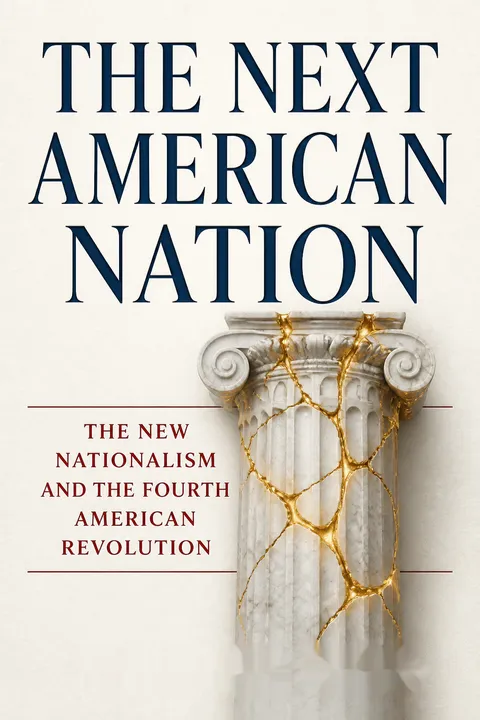
The Next American Nation receives largely positive reviews (3.95/5) for its ambitious reinterpretation of American history through three distinct republics: Anglo-America, Euro-America, and Multicultural America. Readers praise Lind's concept of liberal nationalism and his critique of identity politics and the "white overclass." Many appreciate his proposal for a Fourth Republic based on class solidarity and transracial unity. Common criticisms include his controversial stances on affirmative action and immigration, occasional paternalism, and some dated 1990s perspectives. Reviewers find the book prescient, well-organized, and relevant to understanding contemporary populism and political divisions.
About the Author


Download PDF
Download EPUB
.epub digital book format is ideal for reading ebooks on phones, tablets, and e-readers.








































