
Key Takeaways
1. America's Unique Identity is Rooted in Chosen Ideals of Freedom.
The essence of America is freedom.
A Nation of Choice. Unlike most countries defined by territory, language, or ethnicity, Americans became Americans by actively choosing a set of ideals: freedom, self-reliance, and limited government. This foundational choice, made by early settlers seeking freedom of conscience, established a unique civic nationalism where allegiance is to principles, not just blood and soil. This "Miltonian vision of liberty" emphasizes virtuous application of informed judgment, not merely an absence of rules.
Founding Principles. The U.S. Constitution codified these long-standing customs of self-government and decentralization, making it a libertarian archetype. Loyalty to the nation implies allegiance to these ideas, making American patriotism a political statement. Those who reject these ideals are "un-American," not in an ethnic sense, but in their opposition to the republic's founding vision.
- Freedom of conscience: Ability to worship without coercion.
- Self-reliance: Individuals regulating their own lives.
- Limited government: Power dispersed, not concentrated.
Beyond Stereotypes. While critics often project European myths onto America—like boorishness, lack of history, or environmental pollution—these stereotypes often misrepresent America and more accurately describe Europe. For instance, Americans are measurably more charitable than Europeans, and the U.S. Constitution is older than most European state constitutions. The "American dream" is about the opportunity to shed an old identity and embrace a new, optimistic one, a product of these unique circumstances.
2. American Democracy Thrives on Localism, Accountability, and Citizen Engagement.
American political institutions have developed according to what we might loosely call Jeffersonian principles: the belief that the concentration of power leads to malfeasance; that decisions should be taken as closely as possible to the people they affect; and that decision-makers, wherever practicable, should be answerable through the ballot box.
Faith in the System. Despite common grumbles, Americans generally maintain an underlying confidence in their political system, a stark contrast to the deep cynicism prevalent in Europe. This optimism stems from a history of meaningful citizen participation and accountability, where ballots can effect real change. Unlike European political dramas that portray politicians as petty and corrupt, American narratives like The West Wing often depict them as patriots.
Jeffersonian Institutions. The U.S. political system is pluralist, offering numerous opportunities to vote beyond just national elections, ensuring that power remains diffused. Key institutions that foster accountability and local control include:
- Open primaries: Guarantee a free and independent parliament, forcing politicians to answer to constituents, not just party leaders.
- Direct election of officials: Sheriffs, district attorneys, school boards are elected, ensuring public servants align with local priorities, not just expert consensus.
- Referendum and initiative procedures: Allow direct citizen input on laws.
- Term limits and recall mechanisms: Further constrain political power.
Contrast with Europe. In Europe, declining voter turnout reflects a sense of powerlessness, as decision-making has shifted from elected representatives to unelected "quangos" (Quasi-Autonomous Non-Governmental Organizations) and central bureaucracies. This concentration of power leads to a political class detached from the electorate, where politicians have "responsibility without power," fostering contempt rather than respect. The American system, by contrast, keeps the state smaller and the citizen commensurately bigger.
3. The European Union's Centralized Model is a Cautionary Tale of Undemocratic Power.
Bertolt Brecht’s words apply eerily to the ratification of the European Constitution and, indeed, to the story of European integration more broadly: “Wouldn’t it therefore be easier to dissolve the people, and elect another in their place?”
A Constitution of Control. The EU Constitution (Lisbon Treaty), a sprawling 76,000-word document, stands in stark contrast to the concise 7,200-word U.S. Constitution. While the U.S. text focuses on individual liberty and dispersed power, the EU's emphasizes state power, detailing everything from space exploration to social rights. Its adoption process, marked by the rejection of referendums in France and the Netherlands, and the subsequent re-submission of a "unreadable" text, reveals a profound contempt for public opinion.
Designed for Centralization. The EU's founders, traumatized by World War II, prioritized political integration and stability over democratic accountability, fearing that voters might fall prey to demagogues. This led to a system where supreme power is vested in an appointed European Commission, which holds a monopoly on initiating legislation. This extraordinary concentration of power in unelected officials is a deliberate design choice, ensuring that the project of integration could proceed without being derailed by popular dissent.
- No European Demos: Unlike the U.S., there is no shared "European" identity or public opinion, making genuine pan-continental democracy impossible.
- Top-down governance: Decisions are made by unelected Eurocrats, not by citizens.
- Disregard for referendums: Public opinion is seen as an obstacle to overcome.
Abandoning Pluralism. Europe's historical strength lay in its diversity and competition among states, which fostered innovation and political freedom. However, the EU is abandoning this pluralism, moving towards uniformity and central control, with an estimated 84% of German laws now originating from Brussels. This shift not only undermines democratic accountability but also stifles economic prosperity, as competition among nations is crucial for limiting government overreach and encouraging efficiency.
4. Federalism is America's Essential Bulwark Against Overbearing Central Government.
The powers delegated by the proposed Constitution to the federal government are few and defined. Those which are to remain in the State governments are numerous and indefinite.
Founders' Foresight. The Founding Fathers, particularly James Madison and Thomas Jefferson, understood that decentralization was a crucial "auxiliary precaution" against dictatorial central government. They intuited that large administrations would become prey to vested interests, leading to corruption, plunder, and waste. The Tenth Amendment explicitly reserves powers not delegated to the federal government to the states or the people, safeguarding state sovereignty.
Centralizing Tendencies. Despite these precautions, the U.S. has not been immune to the centralizing forces observed in other federations. The 20th century saw a significant shift of power from states to the federal government, driven by:
- Theodore Roosevelt: Expanded White House powers through executive decrees, citing foreign policy contingencies.
- Woodrow Wilson: Regulated industries and pushed constitutional amendments (16th, 17th, 18th, 19th) that strengthened federal authority, particularly through income tax and direct election of senators.
- Franklin D. Roosevelt's New Deal: A massive expansion of executive power during the Great Depression, which critics now argue prolonged the recession by burdening businesses and creating unwieldy federal agencies.
Lessons from History. The New Deal era offers critical warnings for today:
- Permanence of federal programs: Agencies are easier to establish than to discontinue.
- Inefficiency of state agencies: Often slow to react and can have pro-cyclical effects.
- Perpetual debt: Emergency policies become permanent drains on the treasury.
- Expansion for show: Governments expand to demonstrate action, not always to meet the crisis effectively.
- Damage of one-party dominance: Most harmful when carried out without checks and balances.
This historical trajectory highlights the constant threat to federalism, emphasizing that once power shifts from elected representatives to appointed officials, it is exceedingly difficult to reclaim.
5. Europeanizing the Economy Leads to Stagnation, Not Prosperity.
Since 1974, the United States has comprehensively outgrown the EU. Indeed, between 1980 and 1992, if you exclude the United Kingdom, the EU failed to create a single net new private sector job.
The Myth of the "Social Market." President Obama's desire to align America with a "European political and social model" overlooks a critical economic reality: the supposed success of the "Rhineland model" or "social market" is largely a folk memory from 1945-1974. Since then, the U.S. economy has consistently outperformed the EU, which has suffered from slow growth, high taxes, and structural unemployment. The EU's ambitious "Lisbon Agenda" to become the world's most dynamic economy by 2010 failed spectacularly, with capital migrating to Asia and the EU's share of world GDP shrinking.
Burdensome Regulation. European leaders often justify their economic sluggishness as a trade-off for a higher "quality of life," citing shorter working days and longer vacations. However, this comes at a significant cost:
- Statutory maximum working weeks: Like France's 35-hour week or the EU's 48-hour limit, create immense bureaucracy and deter hiring.
- High social security contributions and accrued rights: Make employees expensive and difficult to fire, leading businesses to minimize payrolls.
- Declining competitiveness: The EU's share of world GDP is projected to decline sharply, from 26% today to 15% in 2020.
The Cost of "Big is Beautiful." The EU's founding belief that large regional blocs would outweigh reduced competition has proven technologically obsolete in an interconnected world. The wealthiest nations are often small, diffuse states like Switzerland or Liechtenstein, which benefit from efficiency, limited bureaucracy, and proximity to the electorate. The U.S. has succeeded as a macro-state by governing like a confederation, allowing substantial autonomy to its parts. Europeanization, with its emphasis on state ownership, regulation, and higher spending, risks sacrificing prosperity for uniformity.
6. State Control Over Welfare and Society Erodes Personal Morality and Family.
The expansion of the state doesn’t just reduce economic growth. More damagingly, it tends to squeeze out personal morality.
The Welfare Trap. European "Euro-sophists" often equate decency with high taxes and generous welfare payments, believing government action is morally superior to individual benevolence. However, this approach has created structural dependency, trapping millions in "the squalor of disincentives and low expectations." Welfare budgets in Europe are enormous, yet have little impact on poverty or inequality, as benefits intended to be transformative become permanent.
American Welfare Reform. The U.S. offers a contrasting success story with the 1996 Personal Responsibility and Work Opportunity Act. This reform, championed by Republicans and signed by President Clinton, devolved social security to the states, incentivizing them to reduce caseloads. This led to:
- Dramatic reductions: Welfare caseloads fell from 5 million to 2 million families.
- Poverty alleviation: 1.6 million children lifted out of poverty.
- Empowerment: Former claimants reported increased self-esteem and hope.
- Innovation: States like Wisconsin and Florida developed tailored, locally-controlled programs that focused on employability and accountability.
Erosion of Society. Beyond economics, Euro-statism has a profound impact on the private sphere. As the state assumes monopolistic responsibility for social policy (health, education, day care, elderly care), traditional authority figures like parents and clergy are sidelined, and society itself dwindles. This expansion of government functions has coincided with a dramatic decline in European birthrates, threatening depopulation or unprecedented immigration.
- Declining birthrates: European fertility rates (1.5) are well below replacement level (2.1), unlike the U.S. (2.05).
- Loss of civic responsibility: Citizens complain about authorities not clearing driveways, rather than taking action themselves.
- Weakened family structures: The first generation raised with cradle-to-grave welfare also saw a decline in parenthood.
The U.S. approach, rooted in the Miltonian vision that virtue cannot be coerced, fosters personal responsibility and private philanthropy, which are generally more efficient and morally preferable.
7. European Foreign Policy Prioritizes Pragmatism Over Principle, Undermining Democracy.
The EU, Leonard contends, is a force for “democracy, human rights and the protection of minorities.” Really? Where exactly? In Iran, where it is cozying up to murderous ayatollahs who, among other things, recently ordered the execution of a teenage girl?
Mars vs. Venus. Robert Kagan's metaphor of "Americans are from Mars, Europeans are from Venus" captures a fundamental divergence in foreign policy. Europeans, having shed the need for U.S. military protection, assert a foreign policy based on "compassion," "peace through integration," and "rules-based international systems," often implying American policy is the opposite. However, this "tremendously appealing thesis" often clashes with reality.
Hypocrisy and Self-Deceit. The EU's stated commitment to "democracy, human rights, and protection of minorities" is frequently contradicted by its actions:
- Iran: Cozying up to ayatollahs.
- Cuba: Withdrawing support from dissidents.
- China: Willingness to sell weapons and collaborate on satellite systems.
- Palestine: Funneling subsidies to Hamas despite its own ban on funding terrorist organizations.
- Internal democracy: Adopting a new constitutional settlement despite citizen rejection in referendums.
Unelected Diplomacy. The EU's foreign policy is shaped by unelected officials like Baroness Ashton, its first High Representative, whose career exemplifies the "quangocracy" and contempt for the ballot box. Such officials, who have never faced voters, naturally feel more kinship with ruling elites than with democratic movements. This contrasts sharply with the U.S., whose foreign policy, rooted in its founding democratic revolt, generally aims to foster democratic alternatives to tyrannical regimes, even with occasional pragmatic exceptions.
International Law and Judicial Overreach. The EU model of supranational law, which binds individuals and creates a superior legal order, has been copied by other international bodies. The rise of "universal human rights" doctrines has led to a "tyranny of judges" who, often unelected and left-leaning, impose laws and values that would never pass national parliaments. The International Criminal Court (ICC), for example, claims jurisdiction over non-signatory states, overturning centuries of jurisprudence and potentially entrenching autocrats by removing their safe exit options. This global judicial activism, often targeting conservatives while ignoring figures like Arafat or Castro, represents a dangerous transfer of power from elected representatives to unaccountable international institutions.
8. Popular Movements, Like the Tea Parties, Are Vital for Reclaiming American Ideals.
Burke, a conservative in every sense, disliked mass protest movements. Sympathetic as he might have been to the oxen, he became nervous at the thought of them stampeding. But America was founded in a popular uprising, and the modern Tea Party patriots were in no doubt that they represented the majority.
A Popular Uprising. At the end of 2008, conservative America seemed defeated, with a consensus forming around policies that expanded federal government, increased taxation, and nationalized industries. However, this "pays légal" (political and media elites) was divorced from the "pays réel" (everyone else). The Tea Party Movement emerged as a spontaneous, popular "fronde" against Big Government, consciously emulating the 18th-century Boston patriots. They reminded leaders of constitutional duties, shifting the parameters of public discourse.
Republican Transformation. The Tea Party's rise coincided with a Republican Party rediscovering its anti-Big Government roots. The GOP's journey from a patrician, East Coast party to a populist, anti-Washington force, epitomized by the Bush family's migration from Kennebunkport to Texas, was driven by aligning with the masses against elites and championing local prerogatives.
- Think tanks: Free-market institutes like Heritage and Cato provided intellectual ammunition.
- Conservative coalition: Gun clubs, home-school associations, evangelical churches formed a vibrant, ideologically committed alliance.
- The Contract with America (1994): A short, measurable list of promises focused on congressional reform, balancing the budget, and welfare reform, proving politicians could keep their word and leading to a Republican congressional majority after 40 years.
Reversing Course. The second Bush administration saw the GOP drift back towards big government, centralization, and crony capitalism, expanding federal spending, education roles, and security powers. This reversal alienated the base. The Tea Partiers, by taking their message directly to the streets, created an atmosphere where candidates opposed to Big Government could win, as seen in the Massachusetts Senate seat victory in 2010, which rejected state-run health care. This demonstrated that when organized opposition falters, Americans take opposition into their own hands, living up to their highest ideals.
9. America Preserves Traditional British Liberties Better Than Modern Britain.
The men who made the Revolution didn’t develop their doctrines in a vacuum. They were drawing on centuries of English political thought and, more to the point, political practice.
A Shared Heritage. The American Revolution was not merely a national uprising but a civil war within a common polity, a successor to the English Civil War of the 1640s. American patriots saw themselves as conservatives, defending their birthright as Englishmen against a tyrannical Georgian Court that sought to impose a new, oppressive settlement. British parliamentarians like William Pitt the Elder, Edmund Burke, and Charles James Fox openly supported the colonists, viewing their cause as a defense of British liberties.
From Runnymede to Philadelphia. Both states drew on a common political heritage, tracing a lineage back through the Glorious Revolution to Magna Carta (1215). Americans, if anything, placed greater store by Magna Carta, with the American Bar Association erecting a memorial at Runnymede. This shared culture, language, religion, and "kindred blood" eventually led to the Anglo-American imperium, fighting side-by-side against autocracy and totalitarianism in the 20th century.
Britain's Lost Liberties. Ironically, the grievances the Americans laid against George III are now coming to pass in modern Britain, largely due to European integration. Power has shifted from Parliament to unelected quangos and central bureaucracies, and most damagingly, from Westminster to the EU.
- Loss of parliamentary control: Colossal sums commandeered without proper authorization; legislation through "Standing Orders" to implement EU standards.
- Elections drained of purpose: Falling turnout as local councils surrender prerogatives.
- Erosion of sovereignty: Foreign treaties signed by Prime Minister under "Crown prerogative" without parliamentary approval.
The United States, by contrast, has maintained a more robust system of dispersed jurisdiction, limited government, and personal freedom, preserving the "highest conception of British liberty" that was committed to paper in Philadelphia.
10. The Anglosphere Offers a Better Path for Global Influence Than European Integration.
America doesn’t have to choose between Europeanization and isolation. There is another option: the Anglosphere.
Beyond Geography. The idea that states are defined by geographical proximity and regional blocs is technologically obsolete. The internet has made distance irrelevant, and capital surges globally. Businesses often find it easier to deal with "Anglosphere" firms—sharing language, common law, commercial practices, and accountancy rules—than with geographically closer EU businesses. The U.S. does not need to sacrifice sovereignty or democracy to prove its internationalist credentials or participate in the comity of nations.
A Union of Values. Instead of pursuing harmonization through rules and bureaucracies, as Europeans do, the Anglosphere offers an "organic and wholly voluntary association of free peoples." This is a union of shared values, not governments, where nations inspire by example and collaborate based on common culture and outlook. Countries like the UK, Canada, Australia, and New Zealand consistently align with the U.S. in foreign policy, reflecting a shared "Martian orbit" of principles.
- Common culture: Shared language, legal systems, and commercial practices.
- Voluntary association: Collaboration between individuals and businesses, not forced integration.
- Inspiration by example: U.S. cleaving to its constitutional precepts inspires other nations.
Jefferson's Vision for the World. Thomas Jefferson believed America's genius lay in its system of government, and that any country adopting republican principles could achieve similar happiness and prosperity. President Obama echoed this, stating that America's true strength comes from "the enduring power of our ideals: democracy, liberty, opportunity, and unyielding hope." The world watches. If the U.S. repudiates its past and abandons the design that brought it greatness, it will lose something profound. By honoring its founders, respecting its constitution, and preserving its freedom, America benefits not only itself but also serves as a beacon for other nations seeking liberty.
Review Summary
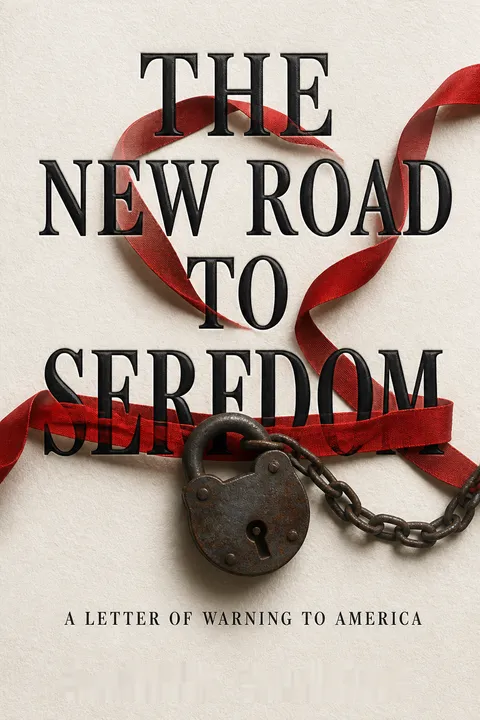
The New Road to Serfdom receives an overall rating of 4.03/5, with most reviewers praising its insightful comparison of American and European political systems. Positive reviews highlight Hannan's eloquent arguments for federalism, limited government, and American exceptionalism, appreciating his unique outsider perspective as a British MEP. Many found it a compelling warning against adopting European-style centralization. Critical reviews dismissed it as conservative propaganda filled with unsourced claims and revisionist history. Most readers, regardless of rating, acknowledged the book's core argument about governmental centralization as thought-provoking.
People Also Read






Download PDF
Download EPUB
.epub digital book format is ideal for reading ebooks on phones, tablets, and e-readers.








































