
Key Takeaways
1. The Illusion of Self-Improvement: The Ego is a Thought, Not a Thing
The essence of this work is that the “me” that all of us see when we look in a mirror or look inward and would like to improve upon doesn’t exist the way we were taught it does.
Effort backfires. The pursuit of self-improvement is often a futile endeavor because the "self" we aim to improve is an illusion, a mere thought rather than a concrete entity. This effort can paradoxically strengthen the very ego it seeks to diminish, as practices like meditation, if approached with a goal of self-improvement, can reinforce the illusion. The "egoic mind" encompasses all thoughts, beliefs, emotions, memories, and future projections that define who you think you are.
Thoughts are tricks. Our minds are experts at organizing perceptions into patterns and categories, leading us to mistake processes for genuine things. Just as we see animals in constellations, we mistakenly perceive an "ego" as a solid thing within ourselves. This "self" is merely a persistent thought, a story we tell ourselves, which can change entirely while still feeling like the same consistent "you."
No self to lose. The goal is not to eliminate egoic thoughts, which is impossible, but to recognize them as simply thoughts—servants, not masters. Trying to eliminate the ego is like trying to create silence by yelling "Be quiet!" Instead, the aim is to experience the self differently, recognizing that the "me" is an idea, and therefore, there is nothing to improve or lose.
2. The Left-Brain Interpreter: Your Mind's Master Storyteller
Gazzaniga discovered that the left side of the brain created explanations and reasons to help make sense about what was going on.
The interpreter's role. Pioneering split-brain research by Dr. Michael Gazzaniga revealed the left-brain's primary function: to act as an "interpreter," constantly generating plausible, coherent, but often incorrect explanations for our experiences. This interpreter defines our emotions, preferences, and even our sense of self, based on available evidence, even if that evidence is incomplete or misleading.
Stories over reality. The left-brain excels at creating narratives, turning random events into meaningful patterns and stories. For instance, if a patient's right brain is prompted to "walk," the left brain, unaware of the command, will invent a reason like "I needed to get a drink." This mechanism is always active, transforming raw reality into a categorized, story-driven perception, making us believe our interpretations are objective truths.
Categorical thinking. The interpreter's core function is to categorize, creating distinctions like "this vs. that," "right vs. wrong," and most importantly, "me vs. everything else." This categorical nature is why the ego feels divided and why paradoxes "trip up" the interpretive mind. It's a pattern-seeking machine that, when turned inward, "finds" the most convincing pattern of all: the story of who we are.
3. The Law of Invincible Opposition: Why Effort Often Backfires
The reason you want to be better is the reason why you aren’t.
The universe opposes. A fundamental principle, the "law of invincible opposition," dictates that trying to achieve a desired state often produces the opposite effect. This is evident in everyday experiences: trying not to worry makes you worry more, trying to fall asleep keeps you awake, and trying to relax creates conflict. This law is as crucial to the universe's functioning as gravity.
Ego's futile quest. The ego's desire for self-improvement, peace of mind, or enlightenment is inherently self-defeating because the very act of "trying" activates the oppositional mechanism. If the ego is an illusion, it cannot genuinely "do" anything, especially not eliminate itself. This creates an impossible position where both trying and not trying seem to fail, leading to endless games of self-conflict.
Playful design. This oppositional architecture isn't cruel but playful. It's like a game where the only way to win is not to play, but you can't pretend not to play to secretly win. The universe, in its playful nature, ensures that the closer one gets to "enlightenment," the more intensely the ego will try to reassert its reality, making the closest point also the farthest.
4. Beyond "What" and "How": Experiencing Reality Directly
You don’t have time to think up there, if you think, you’re dead.
Two brain systems. The brain operates with two distinct systems: the "what" system (left-brain interpreter) which labels and categorizes, and the "how" system (parietal lobe) which knows where objects are in space and facilitates action without interpretation. While the "what" system is associated with conscious thought and labels, the "how" system, often called a "zombie" by philosophers, is actually closer to direct reality.
Direct experience. The "how" system operates without labels, categories, or the law of opposition. It's the part of you that effortlessly reaches for a cup without "thinking" about it. This system is not fooled by illusions that trick the "what" system, such as the perceived size difference in optical illusions. Examples of "how" system consciousness include:
- An archer's shot that "just happens"
- A fighter pilot's split-second reactions in combat
- The "flow" state described by Mihaly Csikszentmihalyi, where the ego falls away and time flies
Unlabeled awareness. Becoming more conscious of the "how" system involves shifting awareness from interpretive thought to direct, unmediated experience. This is difficult to communicate verbally because it lacks labels and categories, which are the domain of the "what" system. However, practices like focusing on the breath or engaging in activities that demand full absorption can provide glimpses of this non-interpretive awareness.
5. The Transparent Interpreter: Mistaking Maps for Territory
The pattern perceiver can never perceive itself because it itself, isn’t a pattern, just like the house builder isn’t a house.
Invisible mechanism. The left-brain interpreter is "transparent," meaning we don't perceive its workings directly. It makes its interpretations seem like reality itself, not just ideas. This transparency is why we mistake our thoughts about reality for reality, like eating a menu instead of the food, a concept Alfred Korzybski called "mistaking the map for the territory."
Patterns in randomness. The interpreter's core function is apophenia—seeing patterns in randomness. This bias, which likely had survival value (e.g., mistaking a rustle in the bush for a predator), now leads us to "see" faces in clouds, or an "ego" where there is only a thought. The ego is the ultimate "man in the moon," a perceived pattern that only exists in the act of perception.
The flashlight analogy. The interpreter is like a flashlight that illuminates everything but itself. It points outward, creating the illusion of external patterns and an internal self, but it cannot shine on its own source. This makes the quest to "find" or "expose" the ego an endless chase, as it is not a pattern to be found, but the very act of perceiving patterns.
6. The Drama of Discontent: Our Addiction to Complaining and Conflict
All complaints take the form of this shouldn’t be, or this shouldn’t have happened and are simply the left-brain interpreter doing what it does best, be in opposition to, rather than embrace what is.
Complaining as a habit. Complaining is a pervasive human activity, often providing a fleeting sense of pleasure, even when it changes nothing. This habit stems from the left-brain interpreter's inherent tendency to find fault with reality, to oppose "what is" with "what shouldn't be." This constant opposition creates a ripple effect, influencing other beliefs and generating negative emotions.
The need for drama. Our minds are addicted to drama and conflict, a pattern evident in entertainment, news, and personal interactions. This addiction is rooted in the ego's need for "more" and its oppositional nature. A movie without conflict would be a "record-setting flop," reflecting our collective inability to tolerate peace, even in fiction.
Observing the complainer. To lessen the grip of complaining, one must become the observer of the complainer, rather than being caught within the complaint. This practice exposes the mechanics of drama and the law of opposition in action. By recognizing complaints as natural manifestations of the interpretive mind, we can reduce their emotional charge and momentum.
7. Myths and the Endless Quest for "More": The Unsatisfied Mind
The need for more worked in our past when basic survival was the essential human issue and the biggest and best weapons determined who passed on their genes.
Evolutionary roots of discontent. The ego's "need for more" is an evolutionary relic that once conferred survival advantages. An ancestor perpetually discontent would build better shelters, find more food, and develop superior tools. This drive, while beneficial for survival in the past, now manifests as an insatiable desire for material possessions or endless self-improvement, leading to unhappiness in modern times.
The grail myth. This "need for more" is reflected in universal mythical patterns, such as the quest for the Holy Grail. Stories always begin with unrest, a problem to be solved, and a difficult journey to find the "thing" that will fix everything. This structure, deeply embedded in our interpretive minds, ensures that every "ending" is merely an invitation for a new beginning, a new conflict, and a renewed quest.
Happiness hurts. In contemporary society, where basic needs are often met, the "need for more" can backfire, leading to misery among those who "have everything." This is because the interpretive mind, accustomed to seeking and solving problems, creates new ones when none exist. True peace and happiness come from embracing "what is" in the present moment, rather than constantly striving for a future "more."
8. Consciousness Beyond the Brain: Awareness as a Cosmic Dance
While a dancer brings a dance to life they do not own it as one owns a thing.
Challenging assumptions. Mainstream neuroscience assumes consciousness is solely a product of the material brain, confined within the skull. However, this view is challenged by the idea that consciousness might be a verb, a "doing" or "dancing" of awareness, rather than a "thing" possessed by the brain. The brain, body, and environment are all interconnected, making it difficult to isolate consciousness to a single organ.
Illusions of location. Experiments like the "rubber hand illusion" demonstrate how easily our perception of consciousness can be "misdirected" outside the skull. Subjects can experience their consciousness as being in a fake hand, a table, or even the entire cosmos. These are often dismissed as mere illusions, but they hint at a more expansive nature of awareness, suggesting that the confinement of consciousness to the head might itself be an illusion.
Awareness as emptiness. If consciousness is not a "thing," it might be closer to the emptiness or space that constitutes the vast majority of the universe. Astronauts like Edgar Mitchell have reported profound experiences of "universal connectedness" when viewing Earth from space, suggesting that awareness can transcend the interpretive mind and the confines of the skull, perceiving the cosmos as conscious.
9. Embracing "What Is": The Power of Acceptance
With happiness and pleasure there is pure acceptance instead of ideas of escape and non-acceptance.
Breaking feedback loops. Anxiety, anger, and worry are fueled by the ego's attempts to escape or resist "what is." When the interpretive mind perceives a threat, it triggers the primitive fight-or-flight response, energizing the body. However, in modern life, this energy often has no physical outlet, creating a feedback loop where the inability to escape or fight intensifies the negative emotion.
The paradox of acceptance. Unlike negative emotions, happiness and pleasure are met with pure acceptance, immediately breaking any potential feedback loop. The key to disarming anxiety and anger is to embrace them, rather than push them away. This is the essence of "paradoxical intention": trying to sweat more to stop sweating, or trying to be nervous to alleviate nervousness.
Beyond control. The ego, as a mere thought, has no genuine control over other thoughts or emotions. Trying to control them only activates the "law of invincible opposition." Recognizing this powerlessness is crucial. When we stop trying to control, the "foot" comes off the arousal pedal, and the emotion dissipates. This shift from resistance to acceptance is a profound way to navigate the mind's turbulent waters.
10. The Playful Universe: Life as a Game of Hide-and-Seek
The grand game of all games is the game of life and death. If death didn’t seem real, the game board could never have been put on the table.
Cosmic playfulness. The universe, in its essence, is engaged in a grand game of hide-and-seek, pretending to be what it isn't. This "irreducible rascality" means that everything, including the ego and its dramas, is part of a cosmic play. To truly play, the universe had to forget its all-powerful, immortal nature and create the illusion of separation, vulnerability, and the possibility of defeat.
Drama as a game. Our human dramas—conflicts, struggles, and the pursuit of goals—are reflections of this universal play. Just as a child enjoys being chased by a "monster" but not so fast that they can't be caught, we engage in life's challenges, needing the illusion of real stakes (like death) to make the game interesting. Without the risk of failure, success would be meaningless.
Shifting perspective. The practice is to observe drama not as a serious reality, but as the playful nature of the cosmos. This involves moving from being in the drama, to observing it from a distance, and finally, to seeing it as a benign, enjoyable game. This perspective lessens the grip of suffering, transforming monsters into comedians, and revealing that the "real you" has always been wearing the mask of the "axe man."
Review Summary
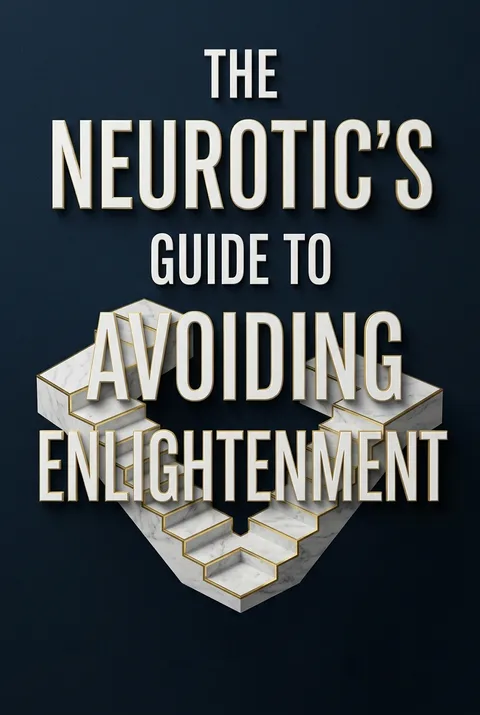
The Neurotic's Guide to Avoiding Enlightenment receives positive reviews for its thought-provoking exploration of neuroscience, Eastern philosophy, and self-improvement. Readers appreciate Niebauer's challenging ideas about the left brain's role in interpreting reality and the concept of no-self. While some find the writing style difficult, many praise the book's ability to stretch their thinking. Reviewers note its unique blend of scientific and spiritual perspectives, offering insights into mindfulness and acceptance. The book is seen as enlightening despite its intentionally paradoxical title.
About the Author

Download PDF
Download EPUB
.epub digital book format is ideal for reading ebooks on phones, tablets, and e-readers.








































