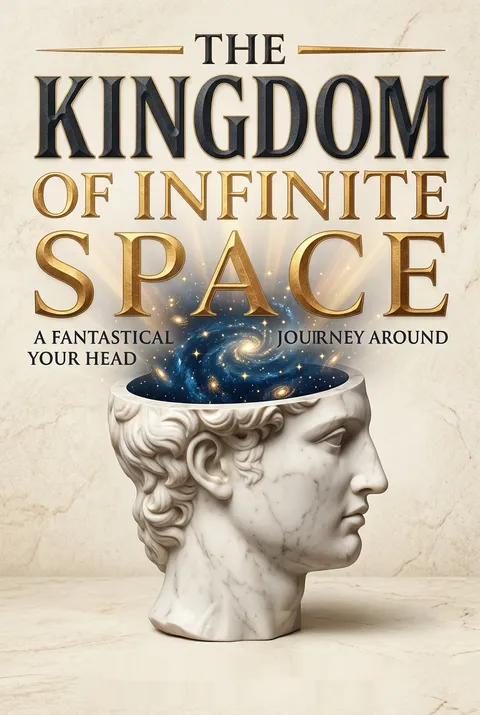

Key Takeaways
1. The Paradox of Embodiment: Being and Having a Head
‘My head and I’ is a more problematic marriage than anything that August Strindberg or Edward Albee could have dreamed up.
Intimate yet alien. Our head is simultaneously the most intimate part of ourselves—what we feel ourselves to be—and an external object we own and observe. This dual relationship is evident when we look in a mirror, seeing an opaque object that is "me" yet also a possession. We suffer its pains, use it as a tool, and present its appearance, highlighting a profound self-division.
Limited self-awareness. Much of our head remains outside our direct experience. Microscopic structures, internal organs like the brain, and even large areas of skin are only intermittently or faintly present to our consciousness. This "darkness at your heart" means we are not most of our heads, challenging the notion of complete self-identification with our physical form.
Existential ground. Despite this detachment, the head serves as the "existential ground" of our being. It's the reference point for our "here and now," the convergence point of our attention. This fundamental assumption of being our body, though never fully explicit or stable, underpins all other relationships we have with ourselves and the world.
2. The Head's Unwilled Functions & Cultural Appropriation
Our collective heads liberate us from the tyranny of our individual heads, so that biological mechanisms are suborned to our human – sometimes all-too-human – purposes.
Biological necessities, human meanings. The head performs numerous involuntary biological functions, such as secreting saliva, sweat, tears, and mucus. These are essential for survival, yet humans uniquely transform them into complex social and symbolic acts. We don't choose to secrete, but we choose how to use or interpret these secretions.
Examples of transformation:
- Saliva: From a digestive fluid to spit, a social missile of insult or a marker of distance.
- Sweat: From thermoregulation to a sign of effort, anxiety, or even a measure of exercise.
- Tears: From eye lubrication to expressions of profound emotion, joy, grief, or even manipulation.
- Yawning: From a lung reflex to a signal of boredom or social agreement.
Transcending the organic. These transformations illustrate humanity's capacity to transcend its organic origins. We appropriate involuntary bodily events, weaving them into the fabric of culture, communication, and personal identity. This process highlights the unique human condition of using biological givens for purposes far beyond their original evolutionary design.
3. Speech: The Ultimate Transformation of Air
Speech, which embodies collective consciousness, is greater than any one of us.
Air sculpted into meaning. Speech is the most profound human achievement, transforming exhaled air into an intricate system of sounds, words, and grammar. This "exquisitely sculptured head-zephyr" allows for boundless complexity in communication, expressing meaning, intent, and abstract possibilities. It creates a "new kind of connectedness," a shared human world woven from voices.
The mystery of origin. The emergence of speech, perhaps 40,000 years ago, remains a profound mystery. Theories like "ding-dong" or "bow-wow" fail to explain the leap from animal calls to human discourse, which involves abstract reference, grammar, and meta-language. Speech is not merely a response to stimuli but a conscious assertion "That something is the case."
Collective consciousness. Language embodies and propagates collective human consciousness, allowing each generation to build upon the wisdom and experience of previous ones. It enables us to assert facts, deny them, and imagine possibilities, creating a "world not of things but of facts." This boundless "ocean of speech" is a testament to the head's unique power to shape reality.
4. The Watchtower: Vision and the Birth of Knowledge
Vision lifts us up above the sea of things. We do not have to mingle with the seen to be aware of it.
Elevated perspective. The evolution of bipedalism elevated the human head, making vision the dominant sense. This "watchtower" position provides a unique vantage point, fostering a sense of distance from objects and the world. Unlike other senses, vision explicitly reveals objects "over there," distinct from ourselves, and a continuous visual field with hidden depths.
Foundation of inquiry. This visible distance and the sense of "more to come" in what is seen drive human inquiry. From dazed looking to scrutinizing, vision facilitates the transition from passive experience to active investigation. Our metaphors for knowledge—"clearsighted," "insight," "world view"—are predominantly visual, reflecting its foundational role in cognition.
Self as viewpoint. Vision establishes the self as an explicit viewpoint within the world, aware of seeing from a particular angle and that other viewpoints are possible. This "impure viewpoint" underscores our embodied subjectivity and our unique capacity to transcend immediate experience, leading to the development of language and the assertion "That x is the case."
5. The Sensory Room: Unity Amidst Multiplicity
The question of unity and control amid diversity and passive openness to the continual rain of the half-expected unexpected picks out a deeper problem: that of accounting for the fact that there is such a thing as ‘the first person’ – the I, here, now – to which all this variety is ultimately referred.
Coherent consciousness. Our head acts as a "sensory room," integrating a cacophony of sights, sounds, smells, tastes, and bodily sensations into a single, coherent moment of consciousness. This unity is crucial for us to function as responsible agents, navigating a complex world with a structured past and future.
Neuroscience's challenge. Conventional neuroscience struggles to explain this integration. Breaking consciousness into discrete brain modules fails to account for how diverse experiences come together without becoming "mush," while holistic models struggle with maintaining distinctness. The "first person"—the "I, here, now"—remains an elusive concept for neuro-reductionist explanations.
Miracle of perception. The precision of our senses, like hearing a specific conversation in a noisy room ("cocktail party problem") or localizing a sound within milliseconds, is miraculous. Yet, the ultimate mystery persists: how physical energy transforms into subjective experience, and why specific nerve impulses correlate with distinct sensations like sound or light.
6. The Social Face: Communication Without Air
If, as Wittgenstein said, ‘the human body is the best portrait of the human soul’, then the face is the essence of that portrait – as portrait painters acknowledge.
A canvas of meaning. The human face is the most expressive surface in the universe, capable of conveying immense meaning without uttering a single word. We are exquisitely attuned to reading faces, identifying individuals, discerning emotions, and inferring character in less than a second.
Non-verbal signals:
- Nodding: From simple agreement to complex acquiescence, conveying messages across abstract contexts.
- Winking: A transient, monocular occlusion that signals benignity, solidarity, or sexual innuendo, often subverting seriousness.
- Smiling: The "most immediately expressive muscular contraction," ranging from genuine mirth to cruel, enigmatic, or forced expressions, revealing inner states and social intentions.
- Blushing: An involuntary physiological response to undesired social attention, acting as a "pre-emptive physiological mea culpa" or a sexualizing flush.
The burden of appearance. Our awareness of our own appearance, and the judgments it provokes, is a constant preoccupation. We manipulate our faces with make-up, expressions, and even surgery, striving to control how we are perceived. This highlights the profound social dimension of our embodied existence, where our face is both "ours" and subject to the "General Other's" gaze.
7. Head Traffic: Cultural Layers on Biological Needs
The more carefully we look, the wider yawns the gulf between the way humans and all other animals interact with food.
Beyond animal drives. While eating, vomiting, and smoking are rooted in biological processes, human engagement with them is profoundly cultural. Eating, for instance, is transformed by cooking, meal times, social rituals, and complex technologies, creating "food miles" that span continents and histories.
Ritualized consumption:
- Eating: From a primitive act to a highly ritualized social occasion, governed by table manners, class markers, and symbolic meanings (e.g., the Eucharist).
- Vomiting: From an involuntary expulsion to a totalizing experience of helplessness, or a source of metaphors for disgust and even dark humor.
- Smoking: From "sticking burning leaves in their mouths" to a complex social signal of adulthood, rebellion, elegance, or addiction, intertwining personal identity with a manufactured desire.
The paradox of choice. These activities demonstrate the peculiar nature of human agency. We deliberately engage in behaviors that may be harmful (smoking) or unpleasant (vomiting), often driven by cultural norms or manufactured desires, ultimately influencing our biological destiny. This highlights the circuitous relationship humans establish with their own bodies.
8. The Head in Conflict: Vulnerability and Weaponry
The mechanical destruction of one head by another is an absolute betrayal of the human world that heads, collectively, have created, howsoever this is laundered by legalistic language, or ‘justified’ by the reasons of state.
Weapon and target. The head, though the seat of intelligence, is also a formidable weapon (e.g., head-butting) and incredibly vulnerable. Its robust bony casing offers protection, but it is susceptible to devastating injury, revealing the fragility of consciousness.
Vulnerability of the self:
- Traumatic Brain Injury: Damage to the brain, as in the case of Phineas Gage, can irrevocably alter personality, memory, and the very sense of self, demonstrating our profound dependence on this organ.
- Violence: Acts like sledgehammer killings or beheadings, though primitive, starkly illustrate the ease with which an entire world of consciousness can be extinguished.
- Psychological impact: The pain of a banged head, the humiliation of looking foolish, or the terror of a hostile gaze can be as debilitating as physical injury, affecting our social and emotional well-being.
Betrayal of humanity. The deliberate destruction of a head, whether in street fights or state-sanctioned executions, represents a profound betrayal of the human world. It reduces individuals to mere material objects, undermining the collective achievements of consciousness and culture that heads have painstakingly built.
9. The Dwindles: Aging, Sleep, and the Awareness of Mortality
We are accidents waiting, sometimes fearfully, to unhappen.
Inevitable decline. The head, an exquisitely ordered structure, is ultimately subject to the Second Law of Thermodynamics, tending towards disorder. Aging brings a gradual "dwindling" of senses, cognitive functions, and physical appearance, reversing the "kindling into life and light."
Manifestations of decline:
- Physical: Wrinkles, thinning hair, opaque lenses, reduced hearing, and "coffin spots" on the skin, largely due to photo-aging.
- Cognitive: Fatigue, narrowing interests, loss of discrimination, and a shrinking "life-space" as the world closes in.
- Sleep: The "little sleep" of daily repose, a universal affliction, foreshadows the "Big Sleep" of death, a mandatory interruption of wakefulness.
Awareness of transience. Humans uniquely make death explicit, transforming transience into a "black blush of tragedy." This awareness, though often suppressed, haunts our lives and drives our search for immortality, whether through eternal life, fame, or delaying decay. However, even these "proxies for immortality" offer little comfort against the ultimate effacement.
10. The Thinking Head: The Elusive Nature of Thought
A thought is a supreme example of an item of consciousness that reaches beyond itself: it is about something other than it is.
The inner monologue. Thoughts ceaselessly occupy our heads, often as an "endless flow of more or less bad prose." This internal "chattering darkness" is uniquely audible to the thinker, yet inaccessible to others, creating a sense of private mental space. The audibility of thoughts, even if silent, is crucial for their individuation and comprehension.
Location and meaning. While thoughts are "in our head" as occurrences, their meanings are not confined to the brain. The language we use to formulate thoughts, and the objects they refer to, extend beyond our individual heads into a shared system of signs and a vast "space of possibility." This "Janus-face" of thoughts—both token events and general types—makes their location puzzling.
Slippery and elusive. Thinking is often a "chasing after itself," a mobile process rather than a static arrival. Thoughts are frequently "given to us" rather than actively generated, making thematic control difficult. This inherent mobility and the constant influx of new ideas prevent thoughts from fully conforming to the self, leaving thinking feeling "hollow" or "existentially thin."
11. Head and World: The Contained and the Containing
My head, in short, is located in the world it contains within itself. The world my head inhabits is, in an important sense, located in my head.
Reciprocal relationship. Our head is physically located in the world, yet it also contains a vast, complex "world" within itself. This inner world is a tapestry of personal experiences, memories, knowledge, and cultural heritage, constantly interacting with the external physical reality.
Dynamic reality:
- Egocentric space: Our location is initially defined by "here" and "my," but expands to shared, impersonal terms like "Manchester" or "England," which are themselves constructs of collective minds.
- Multitudes within: Each moment of our head's existence is a "huge packed sphere," encompassing past journeys, future plans, countless interactions, and a near-infinity of facts and know-how.
- Cognitive shortcuts: We navigate this complex world by making rapid generalizations and "necessary prejudices," transforming disparate data into coherent understanding, even if sometimes flawed.
Beyond computation. This "world in my head" is not merely a computational model. It is permeated by awareness, meaning, and the "first-person" perspective, which computers lack. The coherence of our inner world, and its ability to make sense of the outer, remains a profound mystery that transcends neuro-reductionist explanations.
12. Humanity's Transcendence: Lifting Ourselves by Our Hair
Our heads have lifted themselves above the organic material of which they themselves are made.
Beyond beasts and zombies. Contrary to modern intellectual trends that reduce humans to mere "beasts or zombies," our collective achievements are astounding. We have transformed raw sentience into a shared, explicit consciousness, creating civilizations, knowledge, and culture that transcend our biological origins.
The miracle of self-creation:
- From organism to embodied subject: The journey from an infant's dazed awareness to a self-conscious being, intuiting other selves and an independent world, is a monumental feat of cognitive evolution.
- Collective intelligence: By "putting our heads together," we've built a vast cognitive heritage, enabling us to achieve what no individual or animal could, lifting ourselves "up by our hair" from purely organic existence.
- Meaning from matter: We have created "social facts as robust as things" and infused the material world with meaning, purpose, and moral constraints, shaping a human world that is far more than the sum of its biological parts.
A cause for praise. Despite our "crooked timber" and inherent flaws, the human head has fashioned a unique form of transcendence. We are not merely living our lives but actively leading them, making ourselves at home in bodies that could not have conceived of the rich, complex lives they now permit.
Review Summary
The Kingdom of Infinite Space receives mixed but generally positive reviews (3.37/5). Readers praise Tallis's exceptional writing style, described as eloquent, intelligent, and entertaining. The book explores the physical head through philosophical, biological, and cultural lenses, covering topics from secretions to consciousness. Many appreciate his critique of neuroscience reductionism and phenomenological approach. However, some find the prose overly verbose and difficult to follow. A recurring criticism involves Tallis's assertions about human exceptionalism without adequate support. Reviewers note the book's unique interdisciplinary nature, blending humanities with hard sciences, though some struggled with its digressive style and dense language.
People Also Read

About the Author
Other books by Raymond Tallis
Download PDF
Download EPUB
.epub digital book format is ideal for reading ebooks on phones, tablets, and e-readers.








































