
Key Takeaways
1. Free Speech as an Indispensable Human Right, Not Just a Democratic Tool
The indispensable reference itself comes from a case that captures the rivaling views of free speech as well as divergent intellectual strains in American society in the early twentieth century.
Beyond democracy. Free speech is often justified in functionalist terms, as a necessary component for a democratic process and the protection of other rights. However, a deeper, more fundamental understanding views free speech as an essential part of being human—a natural right, whether divinely gifted or an inherent human quality. This broader perspective treats speech as indispensable, manifesting a creative and expressive impulse regardless of subject matter, and allowing fewer "trade-offs" through balancing tests.
Human essence. The human brain is hardwired for expression, with the frontal lobe, the last part to evolve, enabling complex cognitive functions like language, imagination, and abstract thought. Cases like Phineas Gage, who lost part of his frontal lobe and was described as "no longer Gage" due to personality changes and a lack of creative expression, illustrate how the ability to create and express is fundamental to human identity. This drive to create, from ancient cave drawings to modern art, is an irresistible impulse that defines our interaction with the world.
Philosophical roots. Philosophers like John Locke emphasized "unalienable" natural rights, including freedom of thought, which necessarily embodies freedom of speech. Spinoza argued that the state's purpose is to guarantee the exercise of natural rights, not limit them, asserting that humans are meant "to think what he likes and say what he thinks." This autonomous view, rooted in the inherent human capacity for reason and creativity, contrasts with narrower functionalist views that protect speech only for its utility to democratic governance.
2. America's "Original Sin": The Rapid Erosion of Free Speech After the Revolution
The United States was premised on a clear break from its English antecedent.
A quantum shift. The First Amendment, drafted by James Madison, represented an unprecedented commitment to free expression, declaring that "Congress shall make no law… abridging the freedom of speech." This absolutist language was a radical departure from the British tradition, which narrowly protected speech only within Parliament and punished criticism of the Crown as seditious libel. Madison and other Framers, having experienced the denial of free speech under British rule, aimed to establish a new republic where such abuses would be impossible.
Colonial hypocrisy. Despite this revolutionary promise, the new Republic quickly reestablished prosecutions for seditious and dissenting speech under the same rationales used by the British. Colonial laws had banned a wide array of expression, and sedition trials were common, often targeting criticisms of high officials. Even after the Declaration of Independence, the Continental Congress called on states to pass laws punishing dissenting views, mirroring the Crown's defense of seditious libel to protect the public from "erroneous opinions."
The Zenger trial. The 1735 trial of John Peter Zenger, a publisher accused of libeling New York's governor, highlighted the dangers of government censorship. Despite English law not allowing truth as a defense, Zenger's lawyer, Andrew Hamilton, appealed to the jury's sense of natural rights, arguing for the right to speak "the truth." The jury's acquittal, defying Crown authority, was a pivotal moment, yet the underlying Blackstonian view of free speech as a conditional right, enjoyed at the government's sufferance, would quickly reassert itself in the new American legal system.
3. The "Monster" of Sedition: A Recurring Threat in Times of National Panic
Madison described sedition prosecutions in his 1798 letter to Thomas Jefferson as the “monster that must forever disgrace its parents.”
A cyclical pattern. Throughout American history, periods of political discord and "rage" have consistently led to the reemergence of sedition laws and speech crackdowns. From Shays' Rebellion and the Whiskey Rebellion to the Fries Rebellion, economic grievances and protests against government policies were met with accusations of treason and sedition, often by the very revolutionaries who had once defied British authority. This pattern demonstrates a persistent tendency to criminalize dissenting speech, particularly when it challenges established power or perceived national unity.
Adams's betrayal. President John Adams, who once celebrated the Boston Tea Party as a "magnificent Movement," became one of the most anti–free speech presidents, signing the Alien and Sedition Acts in 1798. These laws criminalized "false, scandalous, and malicious writing" against the government, directly mirroring British seditious libel. The acts were used to target Jefferson's supporters, leading to the prosecution of journalists like Matthew Lyon and James Callender, often under biased judges like Justice Samuel Chase, who viewed "licentiousness of the press" as an existential threat.
Jefferson's inconsistency. Even Thomas Jefferson, a champion of "unalienable rights," proved an unreliable ally for free speech once in office. While opposing the federal Sedition Acts, he supported state sedition prosecutions against his opponents, believing that "a few prosecutions of the most prominent offenders would have a wholesome effect." This selective application of free speech principles, where one's own dissent is righteous but opponents' dissent is seditious, has been a recurring hypocrisy throughout American history, demonstrating how easily power corrupts the commitment to free expression.
4. Holmes's "Shouting Fire" Analogy: A Damaging Legacy for Free Speech
The most stringent protection of free speech would not protect a man in falsely shouting fire in a theater and causing a panic.
A judicial soundbite. Justice Oliver Wendell Holmes Jr.'s "shouting fire in a crowded theater" analogy, articulated in Schenck v. United States (1919), became arguably the most damaging line on free speech in Supreme Court history. This phrase, often misquoted as simply "shouting fire," created the "clear and present danger" test, which allowed speech to be criminalized if it had a "natural and probable tendency" to bring about a substantive evil Congress had a right to prevent. This subjective and malleable test effectively cloaked the same "bad tendency" rationale used in earlier sedition cases.
Intellectual regression. Holmes, a positivist who rejected natural law, viewed free speech as a space defined by law rather than abstract principles. His opinions in Schenck, Frohwerk v. United States, and Debs v. United States upheld convictions for political speech opposing World War I, even when there was little evidence of direct harm or incitement. He dismissed the idea that the First Amendment abolished seditious libel, instead channeling Blackstone's narrow view that speech could be criminalized based on its potential to "kindle a flame" of dissent.
A muddled redemption. While Holmes later expressed regret and dissented in Abrams v. United States (1919), advocating for a "free trade in ideas," his earlier decisions had already set a dangerous precedent. His continued endorsement of the Schenck, Frohwerk, and Debs trilogy, even in his dissent, left his free speech jurisprudence muddled. The "clear and present danger" test, despite being later refined by Brandenburg v. Ohio (1969) to require "imminent lawless action," continues to be invoked today to justify censorship, demonstrating its enduring and problematic influence.
5. The Rise of "State Rage": Government's Response to Dissent Throughout History
The effort to deter public rage has often been an excuse for state rage.
Escalating abuses. Throughout American history, government responses to public dissent, often fueled by "rage rhetoric," have frequently escalated into "state rage," leading to widespread abuses of power. From Andrew Jackson's imposition of martial law in New Orleans during the War of 1812, where he arrested a state senator for questioning his authority, to Abraham Lincoln's suspension of habeas corpus and crackdown on "Copperheads" during the Civil War, presidents have repeatedly prioritized perceived national security over fundamental civil liberties.
Targeting "dangerous" ideas. The Gilded Age saw the rise of vigilante violence and mob rule, particularly against Black citizens and their supporters, with figures like Ida B. Wells-Barnett facing destruction of her newspaper for exposing lynchings. Anthony Comstock, as a postmaster, used the Comstock Act to suppress "obscene" material, including contraception advocacy and "free love" publications, leading to arrests and even suicides. These crackdowns often targeted not just violent acts, but ideas deemed immoral or corrupting, demonstrating a consistent pattern of government seeking to control public discourse.
Wartime intolerance. World War I and II, and the subsequent Red Scare, intensified state rage against socialists, anarchists, unionists, and antiwar activists. President Woodrow Wilson, despite his earlier defense of "agitation," used the Espionage Act to punish dissent, while Attorney General A. Mitchell Palmer conducted mass arrests during the Palmer Raids. Later, Senator Joe McCarthy's blacklisting campaigns, supported by government and private entities, targeted perceived communists. These periods illustrate how easily the government, often with public and media support, abandons free speech principles in times of perceived crisis, justifying repression as necessary for national survival.
6. Censorship by Surrogate: The Modern Alliance Against Free Speech
The use of misinformation, disinformation, or malinformation is a modern conceit used to protect the sensibilities and self-image of those denying free speech.
"Fake news" reborn. The modern era has seen a resurgence of "false news" rationales, now repackaged as "misinformation," "disinformation," or "malinformation," to justify censorship. This echoes the 1275 English sedition law that criminalized "false news or tales" causing discord. Today, this concept is used to silence dissenting voices on topics from COVID-19 to climate change, often by an unprecedented alliance of academic, media, and corporate interests working with the government.
The Twitter Files. Recent revelations, such as the "Twitter Files," exposed extensive coordination between federal agencies—including the FBI, CIA, DHS, and ODNI—and social media companies to identify and suppress accounts and narratives. This "censorship by surrogate" allowed the government to achieve indirectly what it could not legally do directly under the First Amendment. Examples include:
- The suppression of the Hunter Biden laptop story before the 2020 election.
- The blacklisting of scientists questioning pandemic policies, such as those behind the Great Barrington Declaration.
- The use of "keyword searches" and "flagging" to target large numbers of postings for removal.
Blacklisting and financial pressure. This alliance extends to blacklisting operations, like the Global Disinformation Index (GDI), which, partially funded by the U.S. State Department, aims to steer advertisers away from "risky" sites, predominantly conservative or libertarian outlets. This economic pressure, combined with threats from politicians to social media companies if they don't expand censorship, creates a de facto state media where dissenting viewpoints are marginalized or silenced, undermining the "marketplace of ideas" and public discourse.
7. Academic Orthodoxy: The Decline of Free Inquiry in Higher Education
In the last decade, we have watched a new orthodoxy emerge on our campuses and, with it, an intolerance for opposing views or values.
Betrayal of the academy. Higher education, once a sanctuary for free inquiry, has increasingly become a site of enforced ideological orthodoxy, where dissenting views are deemed "harmful" or "violent." This trend, often justified by a "perverse harm principle," leads to the silencing or "deplatforming" of speakers and the targeting of professors for expressing opinions that challenge prevailing narratives on issues like systemic racism, gender identity, or diversity policies. Many faculty members, fearing "cancel campaigns," remain silent or engage in compelled speech, such as "land acknowledgment statements."
Erosion of academic freedom. Academic freedom, historically protected as essential for the "freedom to teach" and "freedom to learn," is being challenged or abridged. While the Supreme Court has tied academic freedom to the "marketplace of ideas" and "democratic competence," some scholars now argue for a narrower view, asserting that academic freedom is about developing "regimes of expertise" and that "unworthy" ideas should be suppressed. This functionalist approach gives license to faculty to reject ideological diversity and bar speakers, undermining the core pedagogical purpose of fostering critical thinking and exposing students to a variety of viewpoints.
Speech hypersensitivity. The result is a generation of "speech phobics" raised in "echo chambers of learning," exhibiting hypersensitivity to opposing views. Incidents like the shouting down of Judge Stuart Kyle Duncan at Stanford Law School, where a dean questioned the "worth" of his speech, illustrate this intolerance. This environment, where even true statements can be censored if deemed "harmful" or "triggering," contradicts the Lockean proviso that individuals should have "enough, and as good, left in common for others" in terms of free speech, leading to a decline in intellectual richness and creative thought.
8. Slaying Madison's Monster: The Imperative to End Sedition and Speech Prosecutions
The elimination of the crime of sedition would represent one of the most powerful statements in favor of free speech since the ratification of the First Amendment.
Ending a dark legacy. The crime of sedition, described by James Madison as a "monster," has plagued American history, emerging during periods of "panic politics" to punish political dissent. Despite its redundancy with other criminal charges like conspiracy to obstruct an official proceeding, seditious conspiracy continues to be used, as seen in the January 6th prosecutions, to stigmatize political opponents and amplify culpability based on extremist views rather than solely overt acts. It is time to finally slay this monster and make a clean break from centuries of speech criminalization.
Bright lines for liberty. A return to an autonomy-based understanding of free speech demands clear, bright lines, minimizing government intrusion. This means rejecting "bad tendency" rationales and focusing on speech that is directly tied to overt criminal acts, such as fraud or conspiracy to commit specific violence, rather than merely inflammatory rhetoric or "false news." The "harm principle" of John Stuart Mill, narrowly interpreted, would protect speech unless it causes concrete, external harm to others, not merely offense or the spread of "bad ideas."
A leap of faith. Ending sedition and other speech prosecutions, like those for obscenity beyond child pornography, would reaffirm the original purpose of the First Amendment: to protect the inherent human right to expression. This requires a leap of faith that a republic can withstand the competition of ideas, even those deemed vile or dangerous. While a global anti–free speech movement gains traction, the United States can serve as a beacon by re-establishing robust free speech protections, recognizing that censorship, even with good intentions, ultimately undermines both individual liberty and the health of democracy.
Review Summary
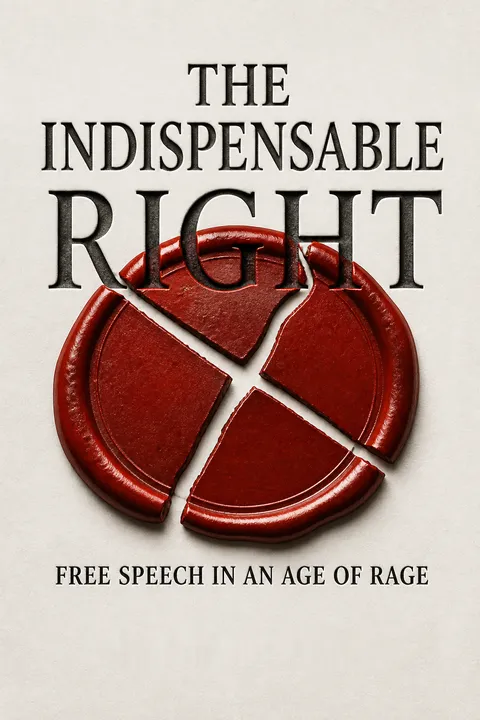
The Indispensable Right: Free Speech in an Age of Rage by Jonathan Turley examines free speech history from colonial America to present day. Most reviewers praise Turley's thorough historical analysis showing how leaders who championed free speech often suppressed dissent once in power. The book covers the Alien and Sedition Acts, wartime censorship, and contemporary issues including COVID-19 restrictions, January 6th, and campus censorship. Critics appreciate his balanced, non-partisan approach, though some find the writing dry or overly legalistic. Several reviewers note Turley's defense of absolutist versus functionalist interpretations of the First Amendment and his argument that free speech faces unprecedented modern threats.
People Also Read



Download PDF
Download EPUB
.epub digital book format is ideal for reading ebooks on phones, tablets, and e-readers.








































