

Key Takeaways
Dye the margarine yellow — context steers choices more than quality
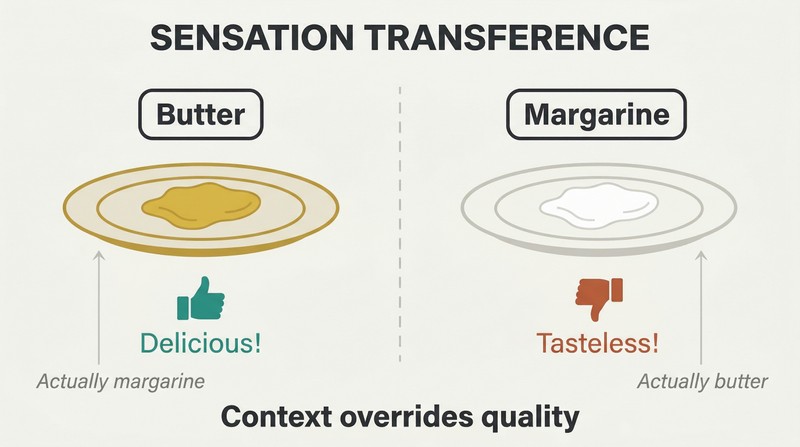
Taste is shaped by expectation. In the 1940s, psychologist Louis Cheskin served housewives margarine dyed yellow and labelled as butter, alongside butter dyed white and labelled as margarine. The diners disparaged the "margarine" — which was actually butter. Cheskin called this "sensation transference ": context, color, and packaging override the product itself. He recommended dyeing margarine yellow; within a decade it outsold butter — a lead held for 50 years.
This book catalogues 16½ such biases. Wendy Wood's research found 43% of daily behavior is habitual, executed on autopilot. Since people are "cognitive misers" who ration their thinking, these psychological shortcuts quietly steer purchases, perceptions, and loyalty. Each bias is backed by peer-reviewed experiments and paired with commercial applications.
Release the handbrake — cut friction instead of boosting motivation
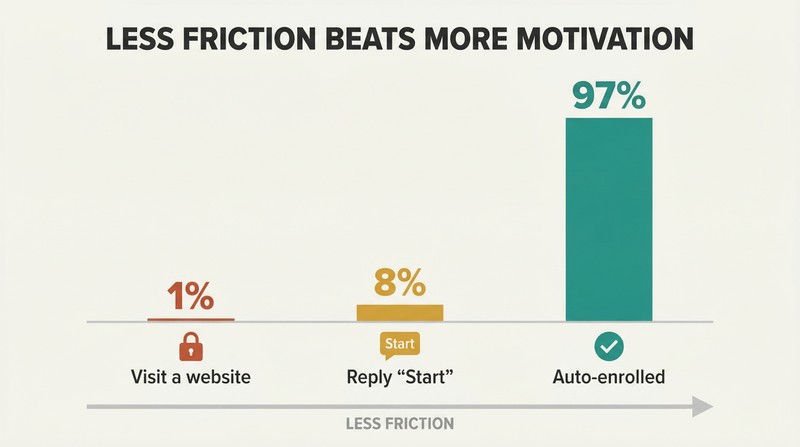
Most marketing pumps the accelerator. Kurt Lewin's force field analysis argues the bigger lever is removing barriers instead. A Columbia/Harvard study proved this: when parents had to visit a website to sign up for an educational text service, just 1% enrolled. Simplifying to a reply of "Start" raised it to 8%. Auto-enrolling parents hit 97%. Teachers predicted the gap would be 27 percentage points; the actual gap was 96.
Even tiny frictions suppress demand. London's Bob Bob Ricard restaurant installed a "Press for Champagne" button at every table — eliminating the need to flag down a waiter — and now sells more champagne than any other UK restaurant. Conversely, restricting paracetamol pack sizes added friction that cut related overdose deaths by 43%.
Target fresh starts to break habits, then pair cues with motivation
Habits weaken at temporal landmarks. Katherine Milkman found gym visits jumped 33% at the start of a week and 47% after a new academic term. The West Midlands police timed reform letters to criminals' birthdays and saw response rates rise from 2.6% to 4.1%. You can even manufacture fresh starts: labeling March 20th as "first day of spring" instead of "third Thursday in March" tripled sign-up rates for goal reminders.
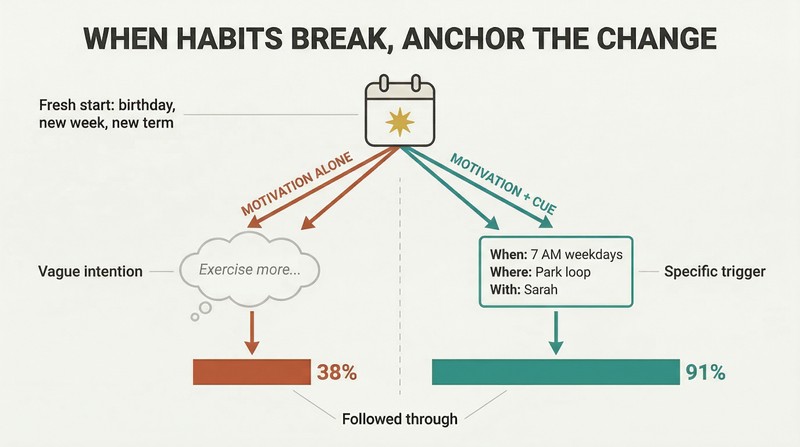
Motivation alone rarely changes behavior. Sarah Milne found a motivational exercise leaflet barely moved the needle (38% exercised), but asking people to state when, where, and with whom they'd exercise pushed compliance to 91%. Pepsodent's legendary campaign didn't say "brush twice daily" — it anchored brushing to "after breakfast and before bed."
Add a dash of effort to boost value — then make it visible
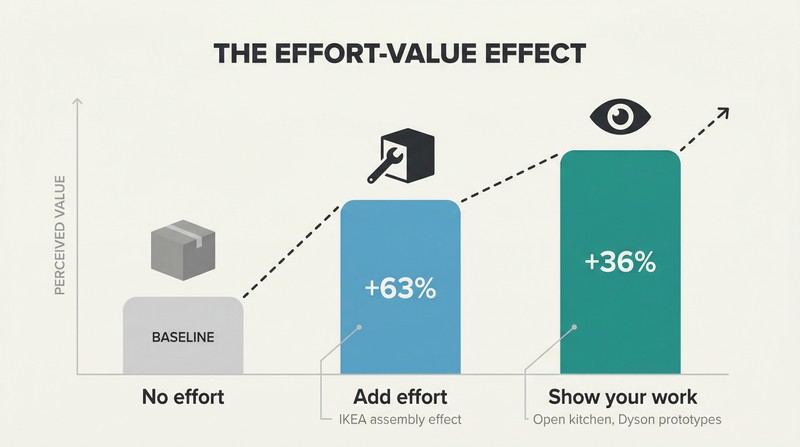
Labor leads to love. The IKEA effect — named by Harvard's Michael Norton — shows people bid 63% more for an IKEA box they assembled versus an identical pre-built one. Betty Crocker's instant cake mix flopped until they added one step: cracking an egg. Wine drinkers rated the same Malbec 10% higher in quality when they opened it with a cork versus a screw cap.
Show your work. An estate agent who spent nine hours creating a property shortlist was rated 36% higher than one who spent an hour using a computer — even when the lists were identical. Dyson promotes testing 5,127 prototypes. When restaurant diners could see their food being prepared, they rated it 22% higher. Effort must be transparent to count.
Replace abstract copy with concrete words for 10x better recall
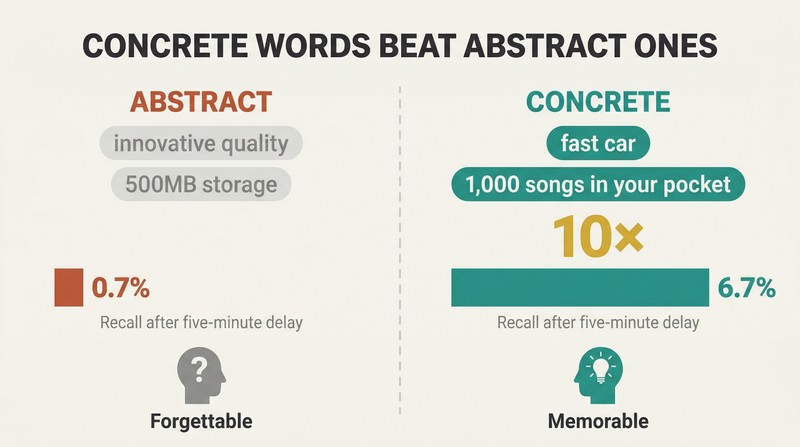
Abstract language is forgettable. When Shotton tested phrases like "fast car" against "innovative quality," participants remembered 6.7% of concrete phrases but just 0.7% of abstract ones after a five-minute delay — a ten-fold difference. Concrete words conjure mental images, and visual memory vastly outperforms verbal processing.
Apple understood this. While rivals advertised storage in megabytes, Apple said "1,000 songs in your pocket." The same principle powers charity appeals: a story about seven-year-old Rokia from Mali generated $2.83 in average donations — more than double the $1.17 from statistical appeals about millions affected. Oppenheimer showed that simple language also signals intelligence: readers rated authors using plain words 13% smarter than those using needless jargon.
Rhyming copy is 17% more believable — yet ads barely use it now
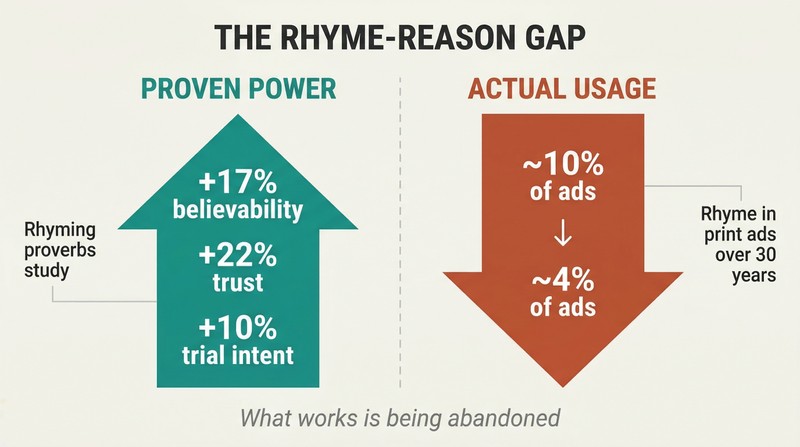
People conflate fluency with truth. McGlone and Tofighbakhsh found rhyming proverbs like "woes unite foes" were rated 17% more believable than equivalent non-rhyming versions. O.J. Simpson's defense leaned on this: "if the gloves don't fit, you must acquit." Norwegian researchers showed rhyming brand slogans were rated 22% more trustworthy and increased willingness to try the brand by 10%.
Yet rhyme is disappearing from advertising. Shotton's archival analysis of The Times and The Sun found prominent rhymes in ads halved — from roughly 10% of print ads to about 4% over three decades. Alliteration offers a lighter-touch alternative, boosting memorability by 22%. Easy-to-pronounce brand names reduce perceived risk by 11%, and easy-to-read fonts halve the perceived effort of tasks described in them.
Swap round numbers for precise ones to look more credible
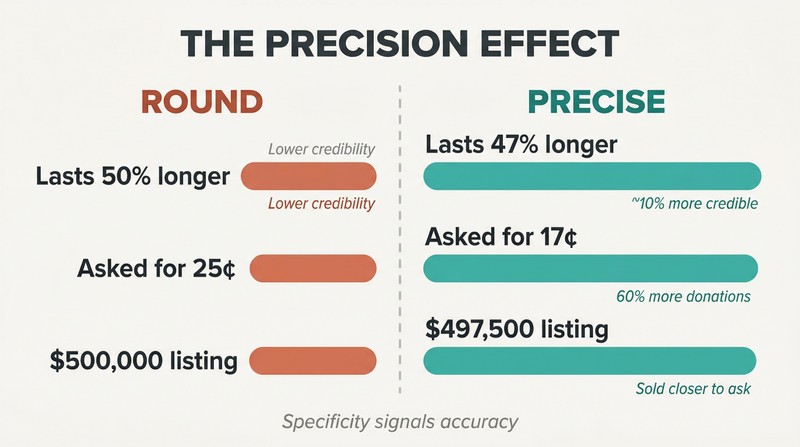
Precision signals confidence. Schindler and Yalch found that ad claims like "lasts 47% longer" were rated roughly 10% more accurate than rounded equivalents like "lasts 50% longer." We learn that knowledgeable people give exact figures while uncertain ones round off — and this association overrides logic. A beggar who asked for 17 cents received 60% more donations than one requesting a quarter. Heinz has emblazoned "57 varieties" on its labels since 1896 for the same reason.
Precise pricing also conveys value. Janiszewski and Uy showed that consumers mentally adjust down from round prices in large increments but from precise prices in tiny ones. Analysis of 25,564 Florida home sales confirmed that sellers who listed at precise figures sold closer to their asking price.
Add a super-premium option to make your premium look reasonable
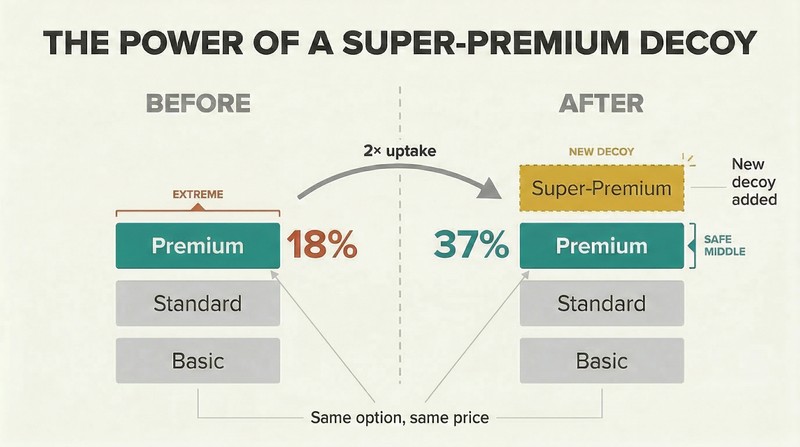
People flee the extremes. Faced with three price tiers, consumers gravitate toward the middle. Shotton tested this with B2B buyers choosing cleaning services: when "every weekday" was the top option, 18% chose it. Adding a pricier "full-day" tier above it doubled uptake of the same option to 37% — without changing its attributes. A meta-analysis of 142 studies confirmed the robustness of extremeness aversion, especially for utilitarian products and older consumers.
Order and decoys amplify the effect. Listing beer prices from highest to lowest raised average spend by 4%, because the first price anchors expectations. The decoy effect works differently: adding a dominated option — same price, fewer features — shifted preference toward the target product by up to 47% in Huber's original beer study.
Swap one word — noun for verb, loss for gain — to shift behavior
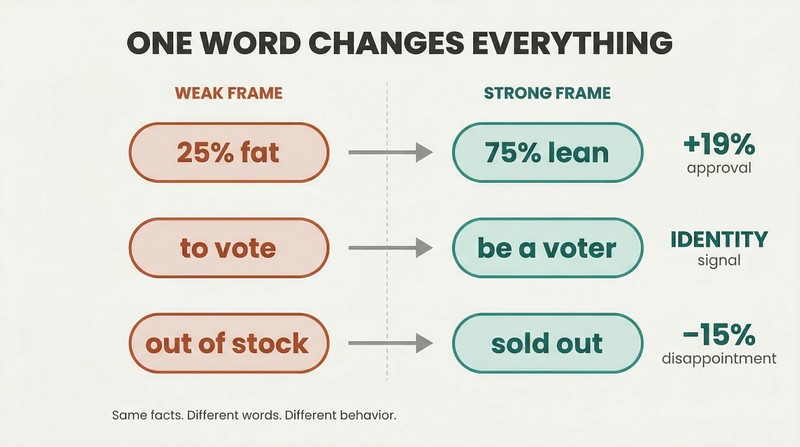
The same fact, reframed, changes reactions. Students rated identical beef 19% higher when told it was "75% lean" versus "25% fat." Loftus and Palmer showed that swapping one verb — "smashed" for "contacted" — made participants estimate cars traveled 27% faster. Auto manufacturers coined "jaywalking" to shift blame for pedestrian deaths from drivers to walkers.
Three high-leverage copy tweaks:
1. Losses over gains: framing insulation savings as money you'll "lose" without it increased sign-ups by 56%
2. Nouns over verbs: "be a voter" increased registration intent more than "to vote" — nouns signal identity
3. "Sold out" over "out of stock": the former triggered 8 – 15% less customer disappointment by implying popularity rather than logistical failure
Say 'but you are free' to nearly quintuple compliance rates
Forceful demands trigger reactance. Psychologist Jack Brehm found that threatening people's autonomy makes them reassert their freedom — often by doing the opposite. Pennebaker showed authoritarian "Do NOT write on walls!" signs generated nearly twice as much graffiti as polite ones. Committed brand customers rated assertive "Buy Now!" ads 20% lower than neutral versions.
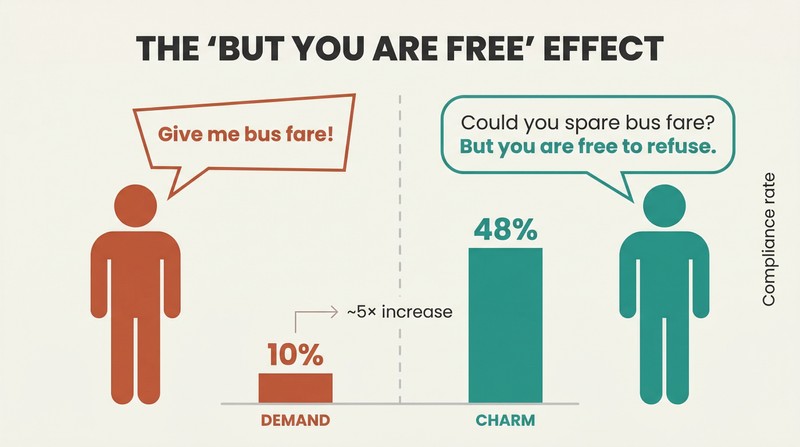
The antidote is elegantly simple. Guéguen asked strangers for bus money. The blunt request got 10% compliance. Adding "but you are free to accept or refuse" boosted it to 48% — a nearly five-fold increase. A meta-analysis of 42 studies confirmed this principle works across charitable and commercial contexts. Reminding people they can say no — which they already know — paradoxically makes them far more likely to say yes.
Don't improve everything — fix the worst moment, then amplify the best
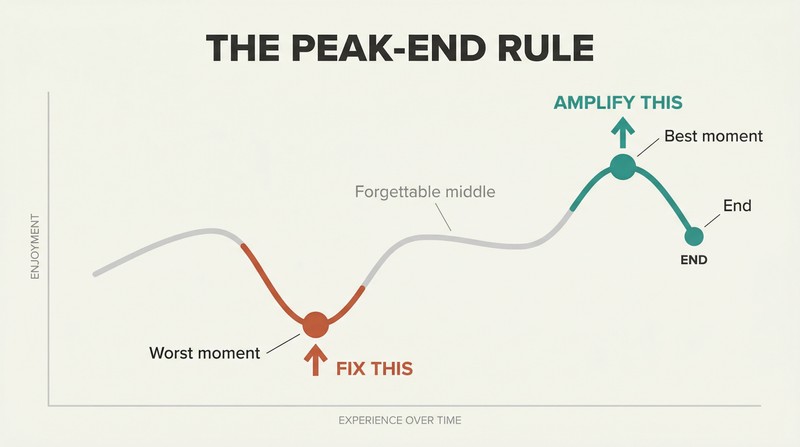
Negative moments are remembered twice as often. Redelmeier and Kahneman's colonoscopy study showed that patients' retrospective pain ratings were predicted not by average discomfort but by two moments: peak intensity and the final seconds. This peak-end rule extends to commerce: ads with a pronounced peak at the end achieved 33% recall versus 23% for flat-profile ads.
Winners concentrate their resources. Houston airport eliminated baggage complaints not by speeding up luggage but by rerouting passengers to walk eight minutes to the carousel — filling an idle trough. The Magic Castle hotel in L.A., with dated décor at £254 per night, ranks among Tripadvisor's top ten thanks to a poolside "popsicle hotline" staffed by a white-gloved attendant. Disney overestimates queue times so every ride ends on a high.
Funny ads are vanishing — even as evidence proves they outperform
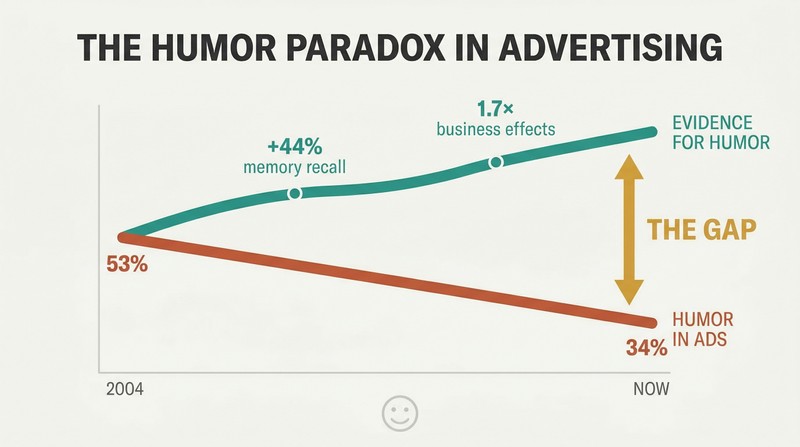
Humor boosts every metric that matters. Eisend's meta-analysis of 38 studies found humor significantly improved attention, brand attitudes, positive emotions, and purchase intent. IPA Effectiveness Award analysis of 243 campaigns showed humorous ones generated 1.7 very large business effects versus 1.4 for serious ones. A Loma Linda University study found comedy viewers improved memory recall by 44%, more than double the 20% improvement for a control group.
Yet the industry is abandoning it. Kantar's analysis of 200,000+ global ads found funny ads dropped from 53% in 2004 to just 34%. Melbourne Metro's morbidly funny "Dumb Ways to Die" proves humor tackles even grave topics — rail accidents fell 21% in three months. The caveat: humor amplifies existing brand perceptions, so it works best when your brand is already liked.
Analysis
Shotton's book occupies a distinctive niche in the behavioral science-to-marketing pipeline. Where Kahneman catalogues biases for academics and Cialdini frames them for generalists, Shotton writes exclusively for the practitioner who needs to ship a campaign by Friday. The structure — mundane daily scenario, peer-reviewed evidence, numbered applications — reflects this pragmatic orientation with unusual discipline.
The most valuable contribution isn't any single bias but Shotton's insistence on lateral application. He repeatedly demonstrates that the academic experiment is a starting point, not a template. The generation effect doesn't mean every ad needs missing letters; it means making the audience exert any form of cognitive effort boosts memorability. This principle of abstracting from study to strategy is the meta-skill the book quietly teaches, and the one most readers will undervalue.
A productive tension runs through the work. Several cited studies — Iyengar's jam experiment, Langer's 'because' study — have faced replication scrutiny since their original publication. Shotton mitigates this thoughtfully by presenting his own commercial replications with larger samples and modern contexts. His Christian Aid experiment is perhaps the book's most intellectually honest passage: seven evidence-based messaging variants were tested, and behavioral science experts couldn't predict which would backfire. The lesson — always test — is more important than any individual bias.
One limitation: the book treats biases as independent levers when in practice they interact, sometimes destructively. Adding IKEA-effect friction can trigger choice paralysis. Extremeness aversion and the halo effect may pull in opposite directions for a new brand. A more experienced practitioner will want guidance on resolving conflicts between biases.
Still, in an industry where multi-million-pound decisions rest on gut instinct and PowerPoint aesthetics, Shotton's evidence-first approach is a necessary corrective. The book's real argument isn't that any single bias is transformative — it's that the cumulative habit of asking 'what does the evidence say?' compounds over a career into a formidable competitive advantage.
Review Summary
Readers find The Illusion of Choice informative but somewhat superficial. Many appreciate its concise explanations of psychological biases in marketing, backed by research. Some criticize the outdated studies and lack of depth. The book is praised for its readability and practical applications, especially for marketers and business owners. Critics suggest it's not as strong as Shotton's previous work. Overall, readers find it a good introduction to behavioral science in marketing, though some prefer more comprehensive alternatives.
People Also Read
Glossary
Sensation transference
Context shapes product experienceCoined by psychologist Louis Cheskin in the 1940s. The phenomenon whereby expectations about a product—shaped by its color, smell, packaging, and other contextual cues—influence the actual experience of consuming it. Demonstrated when housewives preferred margarine dyed yellow and labelled as butter over actual butter dyed white and labelled as margarine.
Fresh start effect
New periods weaken old habitsIdentified by Katherine Milkman of the Wharton School. The finding that people are significantly more likely to adopt new behaviors at the beginning of new time periods—such as the start of a week, month, year, or after a birthday. This occurs because entering a new period weakens the connection to one's past self, making behavior change feel more achievable. Gym visits increased 47% after a new academic term.
IKEA effect
Labor increases perceived valueNamed by Harvard's Michael Norton, Daniel Mochon, and Dan Ariely in their 2012 paper. The bias whereby people assign disproportionately high value to products they have partially created or assembled themselves. Participants who built a plain IKEA box bid 63% more for it and liked it 52% more than those shown a pre-assembled identical box. Explains why Betty Crocker's cake mix only succeeded after requiring cooks to add an egg.
Generation effect
Self-generated information is stickierFirst reported by Norman Slamecka and Peter Graf at the University of Toronto in 1978. The memory bias showing that information people actively generate—such as filling in missing letters or solving a puzzle—is significantly more memorable than information passively read. In Shotton's commercial replication, generated brand names were 14% more likely to be remembered. Applied laterally, it means any ad that makes the audience exert a little cognitive effort will be stickier.
Keats heuristic
Rhyme boosts perceived truthAlso called the 'rhyme as reason effect,' identified by Matthew McGlone and Jessica Tofighbakhsh in 2000. The finding that rhyming statements are rated as more believable than non-rhyming ones conveying the same meaning. Rhyming proverbs scored 17% higher on believability. Named after the poet John Keats, the effect occurs because rhyme enhances processing fluency, and people conflate ease of processing with accuracy.
Extremeness aversion
People choose the middle optionA robust behavioral science finding confirmed across 142 studies in Ulf Böckenholt's 2015 meta-analysis. When presented with three options, people tend to avoid the extremes and gravitate toward the middle, assuming the cheapest is low quality and the most expensive is overpriced. The effect is stronger for utilitarian products and older consumers. Marketers can exploit it by introducing a super-premium tier to boost sales of the premium line.
Decoy effect
Dominated option shifts preferenceAlso known as asymmetric dominance. First studied by Joel Huber, John Payne, and Christopher Puto at Duke University in 1982. Adding a clearly inferior option that resembles one target product makes that target appear obviously superior by easy comparison, shifting preference toward it. In the original study, adding a dominated Beer C shifted preference for Beer A from 43% to 63%.
Peak-end rule
Peaks and endings dominate memoryDemonstrated by Donald Redelmeier and Daniel Kahneman. The finding that people's retrospective evaluation of an experience is disproportionately determined by two moments: the point of peak intensity (most positive or negative) and the final moments—rather than the average experience across the entire duration. Practical implication: brands should prioritize fixing their worst moment, amplifying their best, and ensuring the experience ends on a high.
Red sneakers effect
Norm-breaking signals high statusCoined by Silvia Bellezza, Francesca Gino, and Anat Keinan at Harvard Business School in 2014. The phenomenon whereby individuals or brands that deliberately break conventions are perceived as having higher status and competence. The effect only works under three conditions: the person or brand already possesses a degree of status, the nonconformity appears intentional rather than accidental, and the audience is familiar with the norm being violated.
Rule of 100
Discount format depends on priceAttributed to Wharton professor Jonah Berger. A guideline for communicating discounts based on denominator neglect—people's tendency to fixate on headline numbers. For products priced under $100, percentage discounts appear larger (e.g., '25% off' sounds bigger than '$12 off'). For products over $100, absolute discounts appear larger (e.g., '$120 off' sounds bigger than '25% off'). The key is that consumers compare the raw numbers without adequately considering the base.
'But you are free' technique
Stating freedom boosts complianceStudied by Nicolas Guéguen and Alexandre Pascual in 2000. A persuasion tactic in which, after making a request, the speaker reminds the listener they are free to refuse. In the original study, adding this phrase boosted compliance from 10% to 48% and more than doubled average donation size. A meta-analysis of 42 studies confirmed it reliably increases compliance by preempting the psychological reactance that forceful demands trigger.
Foot-in-the-door technique
Small ask enables big askIdentified by Stanford psychologists Jonathan Freedman and Scott Fraser in 1966. A two-step persuasion method: first request a very small commitment (which nearly everyone accepts), then follow up with the genuine, larger request. Of homeowners who first displayed a tiny road-safety sticker, 76% later agreed to erect a large 'Drive Safely' sign, versus only 17% who were asked directly. Works because people feel pressure to remain consistent with their self-image.
FAQ
What's "The Illusion of Choice" about?
- Author and Focus: "The Illusion of Choice" by Richard Shotton explores 16½ psychological biases that influence consumer behavior and decision-making in marketing.
- Core Concept: The book delves into how these biases create an illusion of choice, affecting what consumers buy and how marketers can leverage these insights.
- Practical Application: Shotton provides practical advice on applying these biases to improve marketing strategies and consumer engagement.
- Structure: Each chapter focuses on a specific bias, explaining its psychological basis and offering real-world examples and applications.
Why should I read "The Illusion of Choice"?
- Behavioral Insights: Gain a deeper understanding of the psychological factors that drive consumer behavior and decision-making.
- Marketing Strategies: Learn how to apply behavioral science to enhance marketing effectiveness and consumer engagement.
- Practical Examples: The book is filled with real-world examples and case studies that illustrate the application of psychological biases in marketing.
- Expert Endorsements: The book is praised by industry experts like Rory Sutherland and Jonah Berger for its practical and insightful approach.
What are the key takeaways of "The Illusion of Choice"?
- Behavioral Biases: Understanding and leveraging psychological biases can significantly impact consumer behavior and marketing success.
- Practical Application: The book provides actionable strategies for marketers to apply these biases in their campaigns.
- Consumer Decision-Making: Insights into how consumers make decisions can help marketers craft more effective messages and offers.
- Scientific Approach: The book emphasizes the importance of evidence-based marketing strategies, grounded in behavioral science research.
How does Richard Shotton define "Habit Formation" in marketing?
- Cognitive Misers: People are "cognitive misers," preferring to rely on habits to conserve mental energy.
- Breaking Habits: Marketers should target moments when habits are weak, such as fresh starts or life changes, to encourage new behaviors.
- Creating Cues: Establishing cues can help embed new habits, making it easier for consumers to adopt desired behaviors.
- Repetition and Rewards: Repetition and uncertain rewards can reinforce habits, making them more likely to stick.
What is the "Make It Easy" principle in "The Illusion of Choice"?
- Reducing Friction: The principle emphasizes removing obstacles that hinder consumer behavior, making it easier for them to act.
- Foot-in-the-Door Technique: Start with small requests to build compliance and gradually increase the ask.
- Choice Overload: Offering too many options can lead to decision paralysis; simplifying choices can improve decision-making.
- Psychological Barriers: Addressing psychological barriers, such as worldview conflicts, can enhance the effectiveness of marketing messages.
What is the "Door-in-the-Face" technique according to Richard Shotton?
- Initial Large Request: Start with a large, likely-to-be-rejected request to make a subsequent smaller request more appealing.
- Reciprocity Principle: The technique leverages the reciprocity bias, where people feel compelled to reciprocate concessions.
- Behavioral Change: It can be used in negotiations and marketing to encourage compliance and behavior change.
- Comparison with Foot-in-the-Door: While both techniques involve two steps, the Door-in-the-Face changes the perceived size of the request rather than the actual size.
How does "The Illusion of Choice" explain the "Generation Effect"?
- Memory Bias: The Generation Effect is a memory bias where people remember information better if they generate it themselves.
- Involvement Increases Memorability: Involving the audience in generating answers or completing tasks enhances memorability.
- Lateral Application: The effect can be applied beyond literal tasks, such as using oblique messaging that requires mental processing.
- Advertising Examples: Ads that make the audience work a little, like filling in blanks or solving puzzles, can be more memorable.
What is the "Keats Heuristic" in "The Illusion of Choice"?
- Rhyme as Reason Effect: The Keats Heuristic, or Rhyme as Reason Effect, suggests that rhyming phrases are perceived as more believable.
- Processing Fluency: Rhymes are easier to process, leading to higher perceived truthfulness and memorability.
- Advertising Application: Using rhyme in advertising can enhance the persuasiveness and recall of messages.
- Decline in Use: Despite its effectiveness, the use of rhyme in advertising has declined, possibly due to changing industry preferences.
How does Richard Shotton describe "Concreteness" in marketing?
- Concrete Language: Concrete language, which describes physical things, is more memorable than abstract language.
- Visualization: Concrete terms are easier to visualize, aiding in memory retention and recall.
- Application in Ads: Marketers should use concrete language to make their messages more memorable and impactful.
- Real-World Examples: The book provides examples of how brands like Apple use concrete language to enhance consumer understanding and engagement.
What is the "Peak-End Rule" in "The Illusion of Choice"?
- Memory Bias: The Peak-End Rule suggests that people remember experiences based on the most intense moments and the ending.
- Application in Marketing: Marketers can focus on creating memorable peaks and positive endings to enhance consumer experiences.
- Real-World Examples: The book discusses how brands like Disney use this rule to improve customer satisfaction and loyalty.
- Strategic Focus: By prioritizing key moments, brands can create lasting positive impressions and improve overall consumer perceptions.
What are the best quotes from "The Illusion of Choice" and what do they mean?
- "We’re cognitive misers": This quote highlights the idea that people prefer to conserve mental energy by relying on habits and shortcuts.
- "Releasing the handbrake": This metaphor emphasizes the importance of removing obstacles to facilitate consumer behavior.
- "Beauty is truth, truth beauty": This quote from Keats, used in the book, illustrates the halo effect, where attractiveness influences perceptions of other traits.
- "Nullius in verba": The Royal Society's motto, meaning "take nobody's word," underscores the book's emphasis on evidence-based marketing strategies.
How does "The Illusion of Choice" address "Freedom of Choice"?
- Reactance Bias: The book discusses reactance, where people resist when they feel their freedom of choice is threatened.
- Charm Over Cajole: Marketers should use persuasive, non-coercive language to avoid triggering reactance.
- Cultural Considerations: The impact of reactance varies across cultures, with individualistic societies more prone to it.
- Practical Strategies: The book offers strategies like the "but you are free" technique to mitigate reactance and enhance compliance.
About the Author
Other books by Richard Shotton
Download PDF
Download EPUB
.epub digital book format is ideal for reading ebooks on phones, tablets, and e-readers.








































