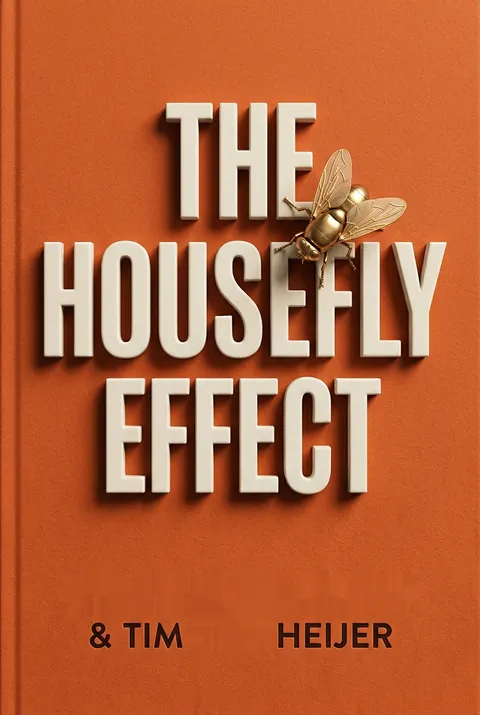

Key Takeaways
1. Your Brain's Deceptive Shortcuts Drive Behavior
Your brain evolved to show you the most useful version of reality, which isn’t the same as the most accurate one.
Self-deception is inherent. Our brains are not perfectly rational machines; they are wired for survival and efficiency, often at the expense of accuracy. This leads to systematic self-deception, where we overestimate our abilities, knowledge, and control. Examples like the Forer effect (believing vague statements apply uniquely to us) and the Dunning-Kruger effect (overestimating our expertise when we know little) highlight this fundamental flaw.
Illusions guide us. These mental shortcuts, or "houseflies," exploit our cognitive biases. Optical illusions, for instance, demonstrate that even when we know the truth, our perception remains swayed. Similarly, the placebo effect shows that belief alone can trigger real physiological changes, even when we know we're taking a dummy pill. Our brain's "press officer" constantly constructs a plausible narrative, making us believe we are rational, even when our decisions are driven by unconscious influences.
Awareness is not immunity. Understanding these deceptions doesn't automatically make us immune to them. Our consciousness often operates on a different level than the automatic processes that govern much of our behavior. Recognizing that our brain is an "accomplice" in influencing our actions is the first step to either avoiding manipulation or strategically deploying these effects.
2. The Irresistible Pull of Convenience and Simplicity
If there’s one thing the brain likes even better than an easy choice, it’s no choice at all.
Effort avoidance is key. Our brains are inherently lazy, constantly seeking the path of least resistance to conserve energy. This "Musca inertiae" or lazy fly means we're willing to pay a premium to avoid even minor inconveniences, like searching for coins for a laundrette or bending down for a product on a low shelf. Businesses exploit this by making their products easily accessible and visible ("eye level is buy level").
Simplicity reduces friction. The brain prefers information that is easy to process, a concept known as cognitive fluency. Complex explanations or too many options lead to "choice overload" (FOBO – Fear Of Better Options), causing us to disengage or choose nothing. This is why clear, simple messages, like "BUILD A WALL," often resonate more powerfully than nuanced arguments, and why breaking down tasks into smaller "chunks" makes them seem more manageable.
Defaults are powerful. When presented with a default option, most people stick with it, even if it's not their optimal choice. This is evident in organ donation rates, where opt-out systems dramatically increase participation compared to opt-in. Defaults remove the mental effort of choosing, making them incredibly potent "houseflies" that steer behavior without conscious deliberation.
3. Loss Aversion: Why Losing Hurts More Than Winning Feels Good
Losing something hits us all much harder than receiving the same item.
Pain of loss is amplified. The "Musca doloris" or pain fly highlights that the psychological impact of losing something is roughly twice as strong as the pleasure of gaining an equivalent item. This "loss aversion" drives many irrational decisions, from holding onto failing projects to overvaluing possessions we already own (the endowment effect).
Payment causes pain. Our brains literally register "payment pain" when we part with money. Marketers mitigate this by using less tangible forms of payment, like chips in casinos or contactless transactions, and by removing currency symbols from menus. This reduces the emotional sting of spending, making us more likely to open our wallets.
Risk and regret avoidance. We are hardwired to avoid risk, especially the "slightest chance of disaster" (certainty effect), and to minimize anticipated regret. This leads to defensive choices, like buying unnecessary insurance or sticking to familiar, even if suboptimal, options. The "ostrich effect" further illustrates this, as we actively avoid information that might cause us pain or guilt, such as calorie counts on food.
4. Social Proof and Norms: The Powerful Influence of the Herd
When in doubt, do what everyone else is doing and you’ll be fine.
The bandwagon effect. Humans are fundamentally social creatures, and in uncertain situations, we instinctively follow the crowd. This "social proof" is why we join long queues for clubs, trust "best-selling" labels, and are influenced by online reviews. Businesses leverage this by showing "X others are viewing this item now" or highlighting popular choices.
Norms dictate behavior. Social norms, whether explicit or implicit, govern our actions within groups. The desire to belong and avoid social exclusion is a powerful motivator. Campaigns that highlight widespread negative behavior (e.g., "Thousands of motorists run red lights!") can backfire by normalizing it, making people more likely to conform to the undesirable norm.
Authority and reputation matter. We are more compliant with instructions from figures of authority, even if their authority is merely symbolic (the "white-coat effect"). Our reputation also plays a crucial role; we cooperate conditionally, and platforms like eBay and Airbnb thrive on visible rating systems. However, "moral licensing" can occur, where a good deed provides "moral immunity" for subsequent bad behavior, and "competitive altruism" can lead to people vying to appear the most selfless.
5. Time Distorts Our Choices, Prioritizing Now Over Later
Our brains are built to value rewards now (think marshmallows) far more than rewards in the future.
Present bias reigns. Our "Musca temporis" or temporal fly makes us overvalue immediate rewards compared to future ones, a phenomenon known as "hyperbolic discounting." This explains why we procrastinate on unpleasant tasks, save too little for retirement, and struggle to resist instant gratification, even when we know it's detrimental in the long run.
Memory and prediction flaws. Our memory is unreliable, often recalling only the emotional "peak" and "end" of an experience (peak-end rule), rather than its average duration or discomfort. We also struggle to predict our future emotional states (hot/cold empathy gap), leading to overconfidence in our future preferences and poor planning.
Deadlines and stress. The timing of deadlines significantly impacts our motivation and decision-making. Deadlines that feel distant lead to procrastination, while those perceived as closer spur action. Stress, whether from lack of time or money, narrows our focus to the immediate present, impairing our ability to make sound long-term decisions.
6. Attention and Framing: How Perception Shapes Attraction
The simple fact that something has your attention has an effect on your opinion of it: the focusing illusion.
Attention is currency. To be attractive, something must first capture our attention. The "focusing illusion" makes anything we focus on seem more important or interesting. Marketers and designers strategically use contrast (Von Restorff effect), novelty, and even subtle "dark patterns" (like a fake hair on an ad) to hack our attention.
Framing shapes reality. "Framing" involves presenting information through a specific lens, influencing how it's evaluated. Describing a yogurt as "95 percent fat-free" is perceived more positively than "5 percent fat," despite being identical. Politicians master this by using evocative metaphors ("The Swamp") or by asking questions that steer thought ("Ask not what your country can do for you...").
Stories and comparisons. Narratives are powerful "houseflies" because humans are wired for stories. A compelling story, even fictional, can inflate value (as seen with eBay junk). We also struggle to judge things in isolation, relying on "anchoring" or "reference effects." A ridiculously expensive item on a menu makes the second-most expensive option seem reasonable, even if it's still overpriced.
7. Incentives Often Backfire, Creating Unintended Consequences
A reward comes at the cost of intrinsic motivation.
The cobra effect. Well-intended incentives can lead to perverse and counterproductive outcomes. The classic "cobra effect" illustrates this: rewarding people for killing cobras led to cobra breeding, ultimately increasing the snake population. This highlights the danger of not fully anticipating how people will respond to a reward.
Money's double-edged sword. While money can motivate, its effect is often overestimated and can even be detrimental. Offering financial rewards for tasks people are already intrinsically motivated to do (like donating blood) can "crowd out" that internal drive, leading to less desired behavior. Studies show that the mere thought of money can trigger more selfish and dishonest behavior, suppressing empathy.
Penalties can normalize. Punishments, like fines, can also backfire. When a nursery fined parents for late pickups, lateness increased because the fine transformed a social norm (being on time) into a market transaction (paying for lateness). Once the fine was removed, the social norm remained eroded. Effective incentives require careful design, considering context, existing motivations, and potential unintended consequences.
8. The Housefly Effect: Small Nudges, Massive Behavioral Shifts
When something apparently small has a big effect on people’s actions, we call it the housefly effect.
Subtle influences are everywhere. The core premise of the book is that tiny, often unnoticed changes in our environment or presentation can have disproportionately large impacts on our decisions and behaviors. These "houseflies" are not complex brain mechanisms but observable phenomena in the world, from painted flies in urinals to the wording on a website.
Beyond traditional persuasion. Unlike classic behavioral change methods that rely on logic, emotion, and credibility, houseflies work by subtly altering the "choice architecture." They make desired behaviors easier, more fun, or the obvious choice, often bypassing conscious thought processes entirely. This makes them incredibly effective where arguments and information alone fail.
Recognize, avoid, deploy. The goal of understanding the housefly effect is threefold: to recognize when you are being influenced, to avoid manipulation when it's against your interest, and to strategically deploy these effects for positive outcomes. Whether it's for personal goals, organizational efficiency, or societal challenges, mastering these subtle influences offers a powerful toolkit for steering behavior.
9. Context Over Character: Your Environment Dictates Your Actions
Context always wins out.
Situation trumps personality. While we often attribute behavior to personality traits, the book consistently demonstrates that the situation or environment we find ourselves in is a far more powerful determinant of our actions. The "Temptation Island" analogy perfectly illustrates this: individuals confident in their faithfulness can succumb to temptation when placed in a highly stimulating environment.
Free will through environment control. Rather than relying solely on willpower, a more effective strategy for behavioral change is to modify your environment. This means removing temptations (e.g., no crisps in the house) or creating cues for desired actions. Our brains are constantly adapting to their surroundings, making environmental design a crucial, yet often underestimated, tool for self-control.
Attribution errors blind us. We tend to make the "fundamental attribution error," attributing others' failures to their character but our own to circumstances. Conversely, we credit our successes to our personality while downplaying external factors. Recognizing that our behavior is a complex interplay of biology, culture, circumstances, and personality helps us understand why context is so influential.
10. Ethical Influence: Wielding Houseflies Responsibly
If you had the choice to deploy the housefly on a loved one, would you do it?
Power demands responsibility. Understanding housefly effects is akin to being handed a powerful tool. The book emphasizes the ethical considerations involved in deploying these techniques, urging readers to reflect on the stakes, the irreversibility of choices, and whether the individual would be happy to be nudged.
Transparency and benefit. Ethical nudging often involves transparency. If a "housefly" is plainly visible and easy to avoid, or if it's clearly in the individual's best interest and openly communicated, it's generally considered more acceptable. The "but-you-are-free" effect, where emphasizing choice increases compliance, is an example of a transparent and ethical housefly.
Ignoring effects can be unethical. Conversely, refusing to use effective behavioral science techniques for good causes, like tackling climate change, can itself be seen as unethical. When powerful "houseflies" prevent us from addressing critical societal problems (e.g., present bias, lack of feedback, negative social proof), actively deploying ethical nudges becomes a moral imperative.
People Also Read


Download PDF
Download EPUB
.epub digital book format is ideal for reading ebooks on phones, tablets, and e-readers.








































