
Plot Summary
Dream of Buried Life
Mason Reynolds, a fifteen-year-old Virginian, is haunted by dreams of being buried alive, feeling suffocated by his family's farm and the rigid social order of antebellum South. His father, a rough but loving man, sends Mason and Otha, a slave and close companion, to town to sell whiskey and find a wife for Otha. The journey is tinged with hope and anxiety, as Mason's mind drifts between the promise of adventure and the shadow of death. The world is alive with racial tension, family bonds, and the lure of the unknown, setting Mason on a path that will unravel his innocence and thrust him into a world of moral ambiguity and cosmic wonder.
Gold, Lust, and Loss
In Lynchburg, Mason is seduced by city life and the allure of women, only to be robbed by Sukie, a prostitute, who steals his gold. Humiliated and desperate, Mason's attempt to reclaim his family's money leads to a violent confrontation at the Liberty Hotel, where he accidentally kills a stableboy. The act brands him a murderer and fugitive, shattering his dreams of honor and love. Otha, his loyal companion, is drawn into the chaos, and together they flee, pursued by the law and haunted by guilt. The world's cruelty and Mason's own failings become inescapable, marking the end of his childhood and the beginning of a darker journey.
Flight and Fugitive
Mason, Otha, and their dog Arf stow away on a bateau bound for Richmond, hiding among slaves and outcasts. The river journey is fraught with danger, suspicion, and the ever-present threat of betrayal. The crew debates whether to turn Mason in for a reward, but a fragile alliance forms as Mason promises them gold. Nights are filled with ghost stories and the specter of the murdered boy, blurring the line between reality and nightmare. The river becomes a liminal space, carrying Mason further from home and deeper into the unknown, as the bonds of race, loyalty, and survival are tested to their limits.
River of Shadows
The bateau's crew, led by Tyree, is a microcosm of black America—healers, storytellers, and dreamers. Mason witnesses a secret gathering of slaves around a mysterious albino prophet, Elijah, whose red teeth and wild chants of "tekelili" hint at a deeper, hidden world. The slaves' yearning for freedom and the violence simmering beneath the surface mirror Mason's own inner turmoil. The journey ends in Richmond, where Mason and Otha part ways, their friendship strained by the weight of race and betrayal. Alone, Mason faces the city's indifference, poverty, and the first taste of true exile.
Poe's Dark Mirror
In Richmond, Mason seeks work and finds himself drawn to Edgar Allan Poe, the troubled editor of the Southern Literary Messenger. Poe, a man of dazzling intellect and deep melancholy, becomes Mason's mentor and mirror—both are haunted by doubles, guilt, and the lure of the unknown. Their friendship is forged in drink, literary ambition, and shared dreams of exploration. Poe introduces Mason to the theory of the Hollow Earth, a world within the world, and the possibility of escape from the suffocating reality above. Together, they hatch a plan that will lead them to the edge of the world and beyond.
Counterfeit and Conspiracy
Poe, Mason, and Jeremiah Reynolds conspire to fund a polar expedition by counterfeiting banknotes from a fictitious Bank of Kentucky. The plan is as audacious as it is desperate, blending literary hoax, criminality, and the yearning for transcendence. Mason's relationship with Otha and the black community deepens, revealing the complexities of race, power, and desire. The counterfeit money buys not only supplies but also a brief, illusory happiness—marriage for Poe, a taste of love for Mason, and the hope of escape for Otha. But the web of lies tightens, and the consequences of their actions begin to close in.
Marriage, Murder, and Escape
Poe's marriage to his young cousin Virginia is both a union and a tragedy, shadowed by addiction, jealousy, and the impossibility of happiness. Mason's own desires entangle him with Virginia and the world of women, blurring the lines between love, lust, and betrayal. A slave rebellion erupts, echoing the violence and longing for freedom that has haunted Mason's journey. Pursued by the law and fate, Mason, Otha, Poe, and their companions flee to Norfolk, where they prepare for a voyage to the ends of the Earth. The world above is collapsing, and only the unknown remains.
Southward to the Ice
Aboard the schooner Wasp, Mason, Otha, Jeremiah, and a motley crew sail for Antarctica, seeking the legendary South Hole. The journey is a descent into alien landscapes—icebergs, endless daylight, and the haunting beauty of the southern seas. The camaraderie of the ship is tinged with dread, as the crew faces hunger, madness, and the uncanny. The discovery of a volcanic oasis and monstrous shellsquid marks the threshold between worlds. The boundaries of the known dissolve, and the promise of the Hollow Earth becomes an obsession, a last hope for meaning and escape.
Descent into the Hollow
The Wasp is destroyed by giant ammonoids, and the survivors escape in a balloon, soaring over the Antarctic mountains and into the South Hole. The descent is a journey through terror and wonder—ice avalanches, the death of companions, and the slow, dreamlike fall into the planet's core. Gravity fades, time distorts, and the world above becomes a memory. The travelers are reborn in a new reality, suspended between life and death, past and future. The Hollow Earth is revealed as a place of endless possibility and danger, a mirror of the soul's deepest fears and desires.
The World Within Worlds
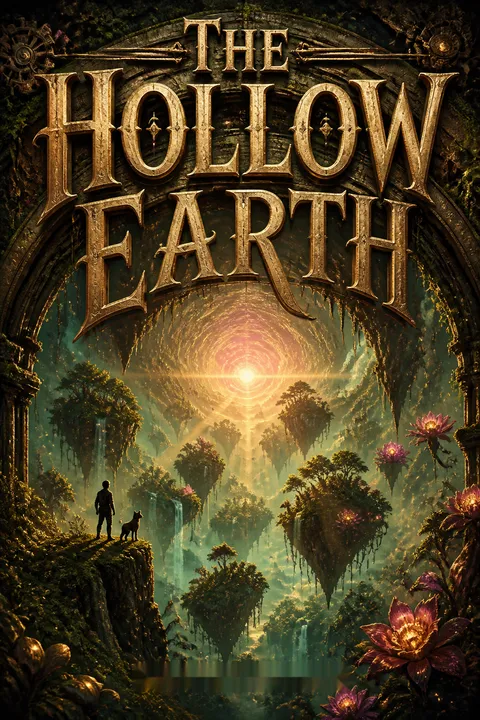
Inside the Hollow Earth, Mason and his companions discover a world of floating jungles, giant flowers, and tribes of pale, sensual people. The laws of nature are inverted—gravity is mutable, time is fluid, and the boundaries of self dissolve. Mason falls in love with Seela, a flowerwoman, and experiences a union of bodies and minds that transcends anything he has known. The travelers are worshipped, feared, and transformed, their skins darkening under the pink light of the inner sun. The world within is both Eden and Babel, a place where language, race, and identity are remade.
Tekelili: The Black Gods
Deeper within, Mason, Seela, Otha, and Eddie encounter the black gods—tekelili—who live in a state of perfect mental communion. Here, all thoughts are shared, all secrets known, and the pain of isolation is healed. The black gods are wise, playful, and compassionate, living in harmony with the Great Old Ones, the ancient beings at the planet's core. Mason and his companions are welcomed, transformed, and initiated into the mysteries of the Hollow Earth. The experience is both ecstatic and terrifying, as the boundaries of self and other dissolve in the One Mind.
The Great Old Ones
At the center of the Hollow Earth, the travelers meet the Great Old Ones—immense, ancient sea cucumbers whose thoughts shape the world. The center is a spindle, a bridge between Earth and MirrorEarth, where time slows and all things are known. The Great Old Ones are both gods and animals, indifferent and loving, creators and destroyers. Mason glimpses the true nature of reality—a universe of endless reflection, symmetry, and paradox. The journey becomes a meditation on fate, identity, and the possibility of redemption. The travelers must choose: remain in paradise, or risk everything for the world above.
Through the Spindle
With the help of the black gods and the Great Old Ones, Mason, Seela, Eddie, and Arf travel through the spindle at the planet's core, passing into MirrorEarth. The journey is a trial by light, time, and memory—twelve years pass in an instant, and the travelers are remade. Eddie is haunted by guilt and the loss of Virginia; Mason clings to Seela and the hope of a new life. The world they enter is both familiar and strange, a reflection of all they have lost and all they might become. The cost of return is high, and the past cannot be undone.
MirrorEarth's Bitter Welcome
On MirrorEarth, Mason, Seela, and Eddie are mistaken for runaway slaves, their skins still dark from the Hollow Earth's light. They are rescued by black stokers and find refuge in Baltimore, but the world is hostile and indifferent. Eddie is shattered by the realization that his double, MirrorPoe, has lived the life he dreamed of—fame, love, and literary immortality. Mason struggles to find work, love, and a place in a world that sees him as less than human. The dream of the Hollow Earth becomes a memory, a secret that cannot be shared.
The Conqueror Worm
Eddie confronts MirrorPoe, and the meeting ends in violence and tragedy—Eddie is killed, and Mason is left to dispose of the body and flee. The world above is as cruel and senseless as the world below is wondrous and strange. Mason and Seela, now nearly white again, decide to leave for California, seeking a new beginning in a land without slavery. The story ends with the hope of rebirth, but the shadow of the conqueror worm—the inevitability of death and decay—remains. The Hollow Earth is both a paradise lost and a lesson in the limits of escape.
Farewell to the Hollow
Mason, Seela, and Arf prepare to sail for San Francisco, leaving behind the ghosts of the past and the wonders of the Hollow Earth. The world is changed, and so are they—marked by love, loss, and the knowledge of worlds within worlds. The narrative is left as a testament, a plea for understanding, and a hope that the journey will continue. The Hollow Earth remains, waiting for those brave or desperate enough to seek it, a mirror of the soul's deepest longings and fears.
Analysis
Rudy Rucker's The Hollow Earth is a dazzling, subversive reimagining of the American adventure novel, blending historical fiction, science fantasy, and philosophical inquiry into a narrative that is as playful as it is profound. At its core, the book is a meditation on the search for escape—from the suffocating constraints of race, class, and fate; from the violence and hypocrisy of antebellum America; and from the loneliness of the self. Through the device of the Hollow Earth, Rucker literalizes the desire for a world within the world—a space where the rules are different, where identity is fluid, and where the boundaries between self and other, reality and dream, are porous. The novel interrogates the myths of American innocence and progress, exposing the violence and exploitation at their heart, while also offering a vision of radical empathy, transformation, and the possibility of redemption. The journey through the Hollow Earth is both a descent into the unconscious and an ascent to a higher understanding, a confrontation with the conqueror worm at the heart of all things. In the end, the book suggests that escape is both impossible and necessary—that we are always haunted by our doubles, our pasts, and the worlds we leave behind, but that the act of seeking, of telling the story, is itself a kind of salvation.
Review Summary
The Hollow Earth receives mixed reviews with an average rating of 3.41/5. Critics praise Rucker's creative reimagining of Poe's work and the physics-grounded fantastical adventure, with some calling it "Mark Twain on acid." However, many find it uneven, with slow pacing and disappointing execution. Common complaints include historical inaccuracies about Poe, flat characters, and the story dragging before reaching the hollow earth. Some appreciate the anti-racist subtext and portrayal of Edgar Allan Poe, while others find the book boring, confusing, or poorly written. Fans of Rucker's other works were often disappointed.
Characters
Mason Algiers Reynolds
Mason is a young Virginian whose restless intellect and yearning for freedom set him on a journey from innocence to experience, from the rigid world of the antebellum South to the cosmic strangeness of the Hollow Earth. His relationships—with Otha, Poe, Seela, and others—are marked by longing, guilt, and the search for belonging. Mason is both a victim and an agent of fate, haunted by the violence he commits and the betrayals he suffers. His psychological arc is one of transformation: from privileged white youth to fugitive, lover, and finally, a man remade by the worlds within. His journey is a meditation on race, identity, and the possibility of redemption.
Otha
Otha is a slave on Mason's family farm, but their relationship is complex—part friendship, part hierarchy, part brotherhood. Otha's wit, strength, and adaptability make him both a survivor and a subtle challenger of the world's injustices. He is drawn into Mason's flight, endures betrayal, and ultimately finds a kind of freedom and power in the Hollow Earth, where race and status are inverted. Otha's psychological journey is one of self-assertion and transformation, as he moves from subjugation to agency, and from the margins of society to the center of a new world.
Edgar Allan Poe (Eddie)
Poe is both a historical figure and a mythic presence—a man of dazzling intellect, deep melancholy, and self-destructive tendencies. He becomes Mason's mentor, mirror, and rival, sharing dreams of escape and the lure of the unknown. Poe's obsessions—with doubles, death, and the boundaries of reality—drive the narrative into ever stranger territory. His psychological arc is one of brilliance and ruin, as he seeks meaning in art, love, and the mysteries of the Hollow Earth, only to be undone by his own demons and the inexorable symmetry of fate.
Seela
Seela is a flowerwoman of the Hollow Earth, embodying sensuality, innocence, and the possibility of a new kind of love. Her relationship with Mason is both passionate and fraught, as they struggle to bridge the gaps of language, culture, and biology. Seela is both a guide and a mystery, leading Mason deeper into the world within and challenging his assumptions about race, gender, and identity. Her psychological journey is one of adaptation and self-discovery, as she moves from the safety of her tribe to the dangers and possibilities of the world above.
Jeremiah Reynolds
Jeremiah is a real-life advocate of the Hollow Earth theory, whose charisma and ambition inspire Poe and Mason to undertake their journey. He is both a practical organizer and a dreamer, blending scientific curiosity with a taste for the fantastic. Jeremiah's role is that of the instigator, pushing the narrative into uncharted territory and embodying the spirit of exploration. His psychological arc is one of hope and disappointment, as his dreams are both realized and undone by the realities of the world and the limits of human understanding.
Virginia Clemm
Virginia is Poe's young cousin and wife, a figure of purity, vulnerability, and doomed love. Her presence haunts the narrative, symbolizing both the possibility of happiness and the inevitability of loss. Virginia's psychological arc is one of longing and suffering, as she is caught between the desires of Poe, Mason, and the world's expectations. Her fate is a catalyst for tragedy, driving Poe deeper into madness and Mason into guilt and self-examination.
Arf
Arf is more than a pet—he is a companion, protector, and sometimes a bridge between worlds. His intelligence, adaptability, and expressive nature make him a constant presence in Mason's journey, from the farm to the Hollow Earth and beyond. Arf's psychological role is that of the innocent, the one who endures and adapts, reflecting the best and worst of his human companions.
The Great Old Ones (Tekelili)
The Great Old Ones are ancient, godlike sea cucumbers at the center of the Hollow Earth, whose thoughts and energies shape the world. They are both indifferent and compassionate, creators and destroyers, embodying the paradoxes of existence. Their psychological role is that of the sublime—beyond good and evil, beyond comprehension, yet intimately connected to the fate of all beings. They offer both union and annihilation, a vision of the self dissolved in the All.
Quaihlaihle (Queen of the Flowerpeople)
Quaihlaihle is a figure of awe and fear among the flowerpeople, marked by her red teeth and ambiguous origins. She embodies the inversion of race and status in the Hollow Earth, and her relationship with Otha and Mason is fraught with desire, violence, and the breaking of taboos. Her psychological arc is one of transformation and sacrifice, as she moves from power to victimhood, and from the center of her tribe to the maw of the Great Old Ones.
MirrorPoe
MirrorPoe is the version of Poe who has lived the life Eddie dreamed of—fame, love, and literary immortality. He is both a figure of envy and a warning, embodying the costs of ambition and the impossibility of escaping one's fate. His psychological arc is one of confrontation and collapse, as he is forced to face the shadow of his own desires and the violence that lies at the heart of creation.
Plot Devices
Doubling and Mirrors
The narrative is structured around the motif of doubles—Mason and MirrorMason, Poe and MirrorPoe, Earth and MirrorEarth. This device is used to explore questions of identity, fate, and the possibility of change. The symmetry of the worlds is both a source of comfort and horror, suggesting that every action is echoed, every choice both inevitable and contingent. The motif is reinforced by literal mirrors, twins, and the journey through the spindle at the planet's core, where all things are reflected and reversed.
Descent and Ascent
The plot is driven by a series of descents—into the river, the Hollow Earth, the self—and ascents—back to the surface, to MirrorEarth, to a new life. Each stage of the journey is marked by a crossing of thresholds, a shedding of old identities, and a confrontation with the unknown. The narrative structure mirrors the classic hero's journey, but with a postmodern twist: the return is never complete, and the self is always in flux.
Race and Inversion
The novel uses the device of racial inversion—whites becoming black, slaves becoming kings—to challenge the assumptions of antebellum America and to explore the fluidity of identity. The Hollow Earth is a space where the rules of the surface world are upended, and where the boundaries of race, gender, and power are remade. This device is used both for satire and for serious meditation on the nature of freedom, belonging, and the possibility of change.
Mindreading and Tekelili
The tekelili mindreading of the black gods is a device that allows for the exploration of radical empathy, the end of loneliness, and the dangers of total transparency. It is both a utopian vision and a source of terror, as the boundaries of self and other dissolve. The device is used to explore questions of communication, intimacy, and the limits of understanding.
Foreshadowing and Recursion
The narrative is rich in foreshadowing—dreams, omens, and repeated motifs that hint at future events and the cyclical nature of the journey. The use of recursion—stories within stories, mirrors within mirrors—reinforces the sense that the journey is both linear and circular, that every ending is a new beginning, and that the self is always haunted by its own shadow.
About the Author
Other books by Rudy Rucker
Download PDF
Download EPUB
.epub digital book format is ideal for reading ebooks on phones, tablets, and e-readers.








































