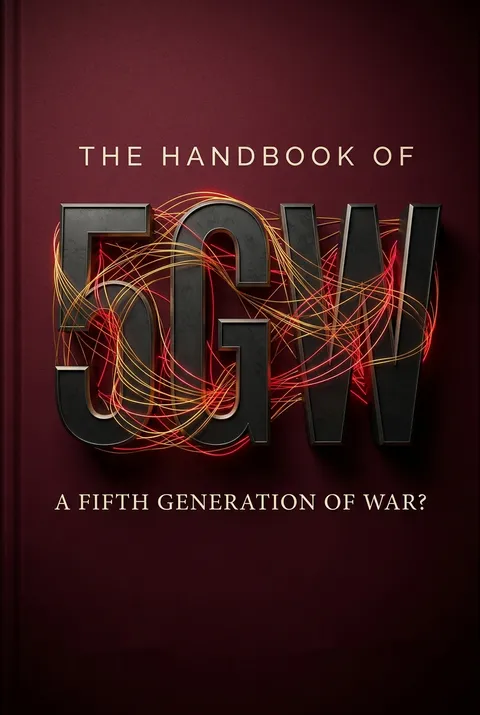

Key Takeaways
1. 5GW: A Spectrum of Influence Beyond Traditional Violence
War is more than the threat and use of violence.
Redefining warfare. Fifth-Generation Warfare (5GW) fundamentally redefines conflict, moving beyond the traditional focus on kinetic force. It emphasizes that war is a strategy to compel an enemy's political will, where violence is merely one means, not the sole defining characteristic. This broader perspective acknowledges that influence and deception can be equally, if not more, potent.
Beyond physical destruction. While earlier generations of warfare concentrated on destroying enemy armies or infrastructure, 5GW operates in a realm where physical force is minimized. The goal shifts from overt destruction to subtle manipulation, often without the target even realizing they are under attack. This makes 5GW incredibly difficult to detect and counter using conventional military approaches.
The goal of war. The essence of war, according to this framework, is "compelling the enemy to do our will," rather than simply engaging in acts of force. This means that political and cultural dimensions become paramount, as they shape "our will" and the enemy's capacity to resist. 5GW, therefore, is deeply intertwined with the political and cultural fabric of societies.
2. The xGW Framework: Gradients of Violence and Focus
According to the xGW framework, warfare exists along a gradient of violence, which is more focused on one end and more diffused on another.
Gradients, not generations. The xGW framework rejects the idea of sequential "generations" of war, instead proposing "gradients" that flow indefinitely into each other, predating written history. This model views warfare as a spectrum of violence, from total annihilation to highly diffused, almost imperceptible conflict. Each gradient represents a different level of violence concentration and societal involvement.
From total war to subtle influence. The framework outlines a progression:
- 0GW (Zeroth Gradient): Total war, genocide, no distinction between civilians and soldiers (e.g., ant colonies, the Holocaust).
- 1GW (First Gradient): Concentration of labor, selecting able fighters for battle (e.g., Napoleonic conflicts).
- 2GW (Second Gradient): Concentration of firepower, victory through deadly goods (e.g., WWI artillery).
- 3GW (Third Gradient): Better minds, maneuver, creating uncertainty (e.g., German Blitzkrieg, "Shock and Awe").
- 4GW (Fourth Gradient): War/peace breakdown, warfighter as criminal, demoralizing the enemy's will (e.g., Vietnam, insurgencies).
- 5GW (Fifth Gradient): Violence so dispersed, the losing side may never realize it has been conquered.
Understanding the shift. As warfare moves up the gradients, the violence becomes less focused and more diffuse, making it harder to identify and respond to. This shift necessitates new analytical tools and strategic thinking, as traditional military responses become increasingly ineffective against higher-gradient threats. The framework highlights that all gradients can coexist and interact simultaneously.
3. 5GW Targets the Enemy's Perception and OODA Loop
Each generation moves deeper and deeper into the OODA loop. Thus we must ask, what will 5GW look like?
Attacking the mind. 5GW operates by attacking the deepest part of the enemy's decision-making cycle: the "Observe" phase of John Boyd's Observe-Orient-Decide-Act (OODA) loop. While 3GW aims to paralyze with doubt and 4GW seeks to drain the will, 5GW strives to make the enemy unaware that a conflict is even occurring, or blind to the true identity of their adversary.
The perfect robbery. The analogy of a perfect robbery illustrates this concept: the victim never realizes they've been robbed. In 5GW, success means the losing side remains completely ignorant of the war, or that they have been conquered. This level of stealth makes 5GW the hardest form of warfare to study, as its most successful manifestations leave no discernible trace of conflict.
Beyond explicit action. 5GW moves beyond influencing explicit decisions or actions, targeting the enemy's "fingertips and gut"—their intuition and implicit understanding. It aims to guide and control behavior through subtle manipulation of observations and orientation, rather than direct confrontation. This requires a profound understanding of human cognition and societal dynamics.
4. Identity and Context Manipulation: The Core of 5GW Strategy
By altering how the world is perceived, one can achieve what Sun Tzu called the “acme of skill”: victory without fighting.
Shaping reality. 5GW is fundamentally about the deliberate manipulation of an observer's context to achieve a desired outcome. This involves altering how adversaries perceive reality, their own identity, and the identity of their opponent. It seeks to reconstruct social relations to ensure cooperation with policy objectives, often without the target's conscious awareness.
Social constructivism in action. Drawing from International Relations theory, 5GW leverages social constructivism, where identity is formed through social interaction. A 5GW actor might adopt friendly role-identities and practice self-restraint, while simultaneously altercasting potentially hostile others with cooperative interests. This process aims to break self-fulfilling prophecies of enmity and foster shared identities.
Counterinsurgency as 5GW. In the context of counterinsurgency, 5GW succeeds by denying insurgents an enemy against which to mobilize populations. By providing "popular security" and demonstrating respect for local cultural norms, 5GW counterinsurgents can empower indigenous populations to secure themselves, thereby isolating and defeating the insurgency. This was exemplified in Iraq's Anbar Province, where US forces shifted perceptions to co-opt former enemies.
5. 5GW as "Silent War": Invisible, Low-Energy, and Deceptive
In silent warfare, secrecy is paramount, and, from a passage quoted earlier, the king can prevail only by “maintaining secrecy when striking again and again.”
Kautilya's wisdom. Ancient Indian strategist Kautilya's concept of "Silent War" provides a historical antecedent for 5GW. Silent War is waged where the conflict, political desires, combatants, and strategic forms of power are all invisible, low-energy, and heavily reliant on influence and deception rather than overt violence. This contrasts with "Open War" (visible, energetic, violent) and "Secret War" (visible war/desires, invisible combatants/power).
The power of invisibility. 5GW thrives on low visibility and low energy expenditure. It aims to influence others to expend energy on its behalf, rather than directly engaging in costly, visible actions. Any visibility caused by energy expenditure is considered detrimental to its political desires, making "invisible politics" the ultimate goal.
Deception as the primary tool. Since 5GW is almost entirely a war of influence, deception is its most elemental strategic form of power. It distorts enemy perceptions in ways that help achieve desired outcomes. This means that most violence incited by 5GW is committed by third parties whose observational context has been manipulated, allowing the 5GW actor to remain unseen and untainted by direct violence.
6. Emergent Networks and Leaderless Resistance: The Formless Enemy
Thus, 5GW could be characterized not by our inability to observe an opponent, but by perceiving an opponent where there is none.
Beyond traditional networks. 5GW leverages "emergent networks" and "leaderless resistance," where individuals or small cells operate autonomously under simple rules, yet collectively produce complex, coordinated-seeming patterns. This organizational design, exemplified by concepts like "phantom cells," makes it incredibly difficult to identify a central command structure or a "center of gravity" to attack.
The illusion of an enemy. In its most advanced form, 5GW can create the perception of an opponent where none truly exists in a centralized, organized sense. This "formless enemy" can strike deep into an adversary's OODA loop, causing massive expenditures and self-inflicted damage as state leaders try to protect citizens from a threat they themselves have constructed through misperception.
Exploiting network properties. Modern network theory, particularly the study of "scale-free networks," reveals that while robust against random failures, these networks are vulnerable to targeted attacks on their few "hubs." However, 5GW's emergent nature means these hubs may be too nebulous or dispersed to identify, making traditional counter-network strategies ineffective.
7. 5GW as Counter-4GW: Systemic Liquidation or Environmental Reshaping
If each generation or gradient of war is a strategic innovation designed to defeat the previous one, then 5GW must functionally exist to defeat insurgent strategies that define 4GW.
Defeating the previous generation. 5GW emerges as a strategic innovation designed to defeat Fourth-Generation Warfare (4GW), which focuses on demoralizing state decision-makers and eroding legitimacy through asymmetric tactics by non-state actors. 5GW achieves this by either "liquidating" the ethnic/ideological networks supporting 4GW or by "disembedding" 4GW actors from indigenous populations.
Two paths to victory. Mark Safranski identifies two primary methods for 5GW to counter 4GW:
- Systemic Liquidation: Indiscriminate repression or genocide against a targeted population or social networks deemed enemies of the state. Examples include Stalin's purges, the Khmer Rouge, and the Rwandan genocide, where regimes atomized social structures to eliminate opposition.
- Environmental Reshaping: Manipulating the physical and social environment to deny insurgents their power base. Brent Grace's example of the Chicago Housing Authority's campaign against the Black Kings gang illustrates this, where urban redevelopment and law enforcement efforts fundamentally altered the gang's operating context.
The "War for Robert Taylor." In Chicago, the government waged a 5GW against the Black Kings gang by transforming their environment. Through RICO prosecutions, federal funding (HOPE VI), and urban demolition, the physical and social landscape that supported the gang was dismantled. This "waterfall development" strategy, executed by construction workers and developers, unknowingly fought a counterinsurgency by making the environment unsuitable for the gang's operations, effectively making them "not care" to fight.
8. The Technocrat's Dilemma: 5GW's Unintended Consequences and the Rise of 6GW
This is the technocrat's dilemma: any kind of apparatus for countering a means of warfare creates an overall greater level of complexity and information in the society, which increases the probability that such technology will be used as the basis for a more complex form of warfare.
Self-perpetuating complexity. The "technocrat's dilemma" posits that efforts to gain competitive advantage in 5GW, particularly through technological infrastructure and secrecy, inadvertently create feedback loops that escalate complexity. This increased complexity, in turn, raises the probability of even more advanced forms of warfare, such as Sixth-Generation Warfare (6GW), emerging.
Break loops and systemic collapse. 5GW strategies often involve instigating "break loops"—hyperbolic feedback loops that push systems past an inflection point, leading to rapid, radical changes or collapse. The 2008 financial crisis, potentially triggered by regulatory arbitrage, is cited as an example of a break loop that could be wielded as a 5GW weapon to demand a global currency.
The dawn of 6GW. 6GW is envisioned as "design warfare" between self-modifying intelligences, where the conflict is oriented towards achieving a hyperbolic explosion in computational and general intelligence. The "winner" is the one that reaches this inflection point first, gaining an insurmountable advantage. Human strategists would be rendered irrelevant, struggling against a profoundly more vast intelligence.
9. Transhumanism: Engineering the Future of 5GW
By altering what have been many of the defining characteristics of humanity they change the context—although not the nature—of politics.
NBIC technologies. Nano-Bio-Info-Cogno (NBIC) technologies are converging to enable the redesign of human beings, societies, and even the species itself. These advancements raise the prospect of a "transhuman" era, where human capabilities are radically enhanced, challenging fundamental assumptions about what it means to be human and reshaping the context of politics and war.
The transhuman warrior. In this future, 5GW becomes even more subtle, complex, and dangerous. It moves beyond violent crime to the manipulation of information and identity at a level where practitioners are neither soldiers nor criminals. A transhuman individual, empowered by these technologies, could become a 5GW warrior, capable of undermining states and shaping environments in ways that are unclear and untraceable.
Existential risks. The proliferation of NBIC technologies, driven by competitive and hedonic pressures, poses significant existential risks. The Fermi paradox highlights the possibility of natural functions preventing advanced civilizations from surviving past a certain point, suggesting that self-created threats could be the most dangerous. The potential for engineered class divisions, "clash of genomes," and even the loss of personhood underscore the profound security challenges of a transhuman world.
10. Secrecy and Waterfall Planning: The Operational Blueprint of 5GW
In 5GW, secrecy is vital for success. While this has always been true on some levels, secrecy has never been vital on the grand-strategic level before 5GW.
The paramountcy of secrecy. Unlike previous forms of warfare where some level of openness was acceptable or even necessary, 5GW demands absolute secrecy at the grand-strategic level. The enemy's knowledge of a 5GW operation's existence all but guarantees its failure. This makes 5GW operations akin to a "perfect robbery" where the victim never realizes they've been targeted.
Waterfall development. 5GW operations are best conceived and executed using a "Waterfall Development" model, borrowed from software engineering. This approach requires:
- Long-term requirements: Goals must be known well in advance of execution.
- Rigid adaptability: Plans are precise and non-adaptable once set.
- Extended planning phase: A significant time lag between proposal and victory.
This contrasts with "Rapid Application Development" (prototyping), which is too open and flexible for 5GW's need for covertness.
Closed-source networks. A 5GW military operates as a closed-source network, unable to recruit widely or during operations due to the risk of exposure. It relies on highly capable, strategically placed individuals ("strategic corporals or sheiks") who are deeply committed stakeholders in the project. This structure allows for subversion of larger systems by diverting resources under the radar, ensuring the project is fully operational before its launch.
11. Human Security: The Ultimate Defense Against 5GW
What we're going to see in the future is that security is not going to be based as much on state-centric models... but the insecurities and the conditions of human beings that create these insecurities across state borders.
Beyond state-centric models. In an age of 5GW, traditional state-centric security models are increasingly ineffective. The focus must shift to "human security," recognizing that the freedom of individuals from fear, disease, and hunger is paramount. Insecure populations, driven by desperation, pose a significant threat to global stability, as they become vulnerable to exploitation by subtle 5G actors.
Preventing exploitation. To prevent 5GW, states must prevent subtle actors from "socializing their problem"—that is, from exploiting widespread desperation to undermine the power and legitimacy of industrial states. The collective, unconscious actions of insecure individuals (e.g., mass refugee movements, resource tensions) can be more destructive in the long term than conventional military conflicts.
Somalia as a case study. The ongoing crisis in Somalia, with its persistent political and humanitarian challenges, exemplifies how 5GW operates. Somali piracy, while driven by economic motives, inadvertently served as a 5G threat, exploited by Islamists to undermine US designs and ultimately force a policy shift. The US's failure to address human security needs created a vacuum that 5G actors could leverage, demonstrating that military force alone is often counterproductive in such contexts.
People Also Read






Download PDF
Download EPUB
.epub digital book format is ideal for reading ebooks on phones, tablets, and e-readers.








































