
Key Takeaways
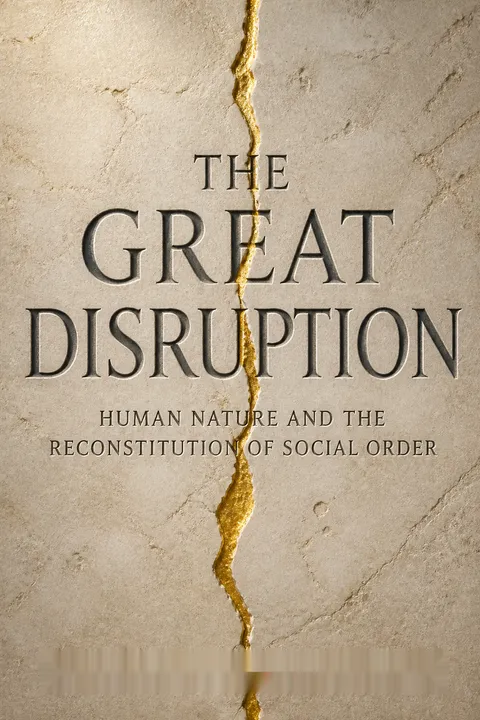
1. The Great Disruption: A Widespread Erosion of Social Order
This period, from roughly the mid-1960s to the early 1990s, was also marked by seriously deteriorating social conditions in most of the industrialized world.
A Global Phenomenon. Beginning around 1965, industrialized nations experienced a "Great Disruption" characterized by a rapid and simultaneous decline in key social indicators. This wasn't confined to one country but was a widespread trend across the developed world, challenging explanations rooted in unique national circumstances. The decline was measurable and not merely a matter of nostalgia.
Key Indicators of Decay. The disruption manifested across three broad categories, signaling a weakening of social bonds and common values:
- Crime: Significant increases in both violent and property crime rates, making urban areas less habitable.
- Family Breakdown: Accelerated decline of kinship, marked by falling fertility, fewer marriages, soaring divorce rates, and a dramatic rise in out-of-wedlock births.
- Declining Trust: A deep, forty-year erosion of confidence in institutions and fellow citizens, alongside a shift towards less permanent and engaged social ties.
Beyond Nostalgia. While often dismissed as conservative "harping on moral decline," the evidence is clear. The breakdown of social order was a tangible reality, impacting the fabric of society. This widespread and rapid shift suggests underlying, fundamental causes rather than isolated incidents or mere changes in perception.
2. The Information Age's Unintended Social Consequences
The hypothesis of this book is that the two were in fact intimately connected, and that with all of the blessings that flow from a more complex, information-based economy, certain bad things also happened to our social and moral life.
Technological Link. The transition from an industrial to an information-based society, celebrated for its benefits like freedom and equality, inadvertently triggered the Great Disruption. This shift wasn't just economic; it had profound technological and cultural connections that reshaped social and moral life.
Creative Destruction's Reach. Economist Joseph Schumpeter's concept of "creative destruction" in the marketplace, where old industries are replaced by new, found a parallel in social relationships. The same forces that drove economic innovation also disrupted traditional social structures and norms.
- Technological: Innovations like the birth control pill and increased longevity altered reproductive roles and family dynamics.
- Economic: The changing nature of work, favoring mental over physical labor, propelled millions of women into the workforce, challenging traditional family understandings.
- Cultural: An intensified individualism, beneficial for market innovation, spilled over into social norms, corroding authority and weakening communal bonds.
A Complex Interplay. The story is intricate, varying by country, but the broad pattern holds: the blessings of a knowledge-based economy came with a social cost. This connection highlights that progress in one domain can have unforeseen and significant repercussions in others, demanding a holistic understanding of societal evolution.
3. Social Capital: The Invisible Lubricant of Cooperation
Trust is like a lubricant that makes the running of any group or organization more efficient.
Defining Social Capital. Social capital is the informal glue that binds groups together: a set of shared values or norms that enable cooperation. It's not just about individual virtues, but about the collective expectation that others will behave reliably and honestly, fostering trust.
Economic and Social Value. Like physical and human capital, social capital produces wealth and is economically valuable. It reduces "transaction costs" – the expenses of monitoring, contracting, and enforcing agreements – making groups and organizations more efficient. Beyond economics, it's crucial for a healthy civil society, enabling diverse groups to band together and defend their interests.
- Examples: Honesty, reciprocity, keeping commitments.
- Benefits: Efficient group function, reduced transaction costs, innovation, healthy civil society.
The "Radius of Trust." Not all social capital is equal. The "radius of trust" defines how widely cooperative norms are shared. Strong family bonds (familism) can create high trust within kin but low trust among strangers, leading to issues like nepotism and corruption. Societies with a wider radius of trust, often influenced by traditions like Protestantism, foster cooperation beyond immediate family, benefiting broader public life and economic development.
4. Human Nature: An Innate Blueprint for Social Order
Human beings are by nature social creatures, whose most basic drives and instincts lead them to create moral rules that bind themselves together into communities.
Beyond Social Construction. For much of the 20th century, social sciences assumed norms were purely "socially constructed," with the mind as a blank slate. However, a growing body of evidence from life sciences suggests humans are born with innate cognitive structures and predispositions that naturally lead them to form societies and moral rules.
Biology's Role in Sociability. Evolutionary biology reveals that cooperation is a fundamental human advantage, explaining our species' dominance. This capacity for social capital is not merely learned but is, in part, genetically coded.
- Kin Selection: Altruism towards relatives is proportional to shared genes, ensuring the propagation of one's genetic material.
- Reciprocal Altruism: Cooperation among non-kin, driven by repeated interactions and the ability to build reputations for honesty or betrayal, is a stable evolutionary strategy.
The "Rational Devil." Humans are not inherently angelic, but "rational devils" – individuals with a mix of cooperative and opportunistic tendencies. Our brains have evolved specialized cognitive capabilities to detect cheaters and specialized emotions (anger, pride, shame, guilt) to enforce norms, even when it seems to violate short-term self-interest. This innate moral sense makes us predisposed to create and follow rules.
5. Spontaneous Order: How Cooperation Emerges from the Ground Up
No government bureaucracy, historical tradition, or charismatic leader initially laid down the rules of where to meet and how to behave; it simply emerged out of the desire of commuters to get to work faster.
Order from Chaos. Social order doesn't always require top-down imposition. The "slugs" example (carpoolers forming informal rules) illustrates how norms can emerge spontaneously from decentralized individuals pursuing their self-interest. This "spontaneous order" is a key intellectual development of the late 20th century, particularly in economics.
Mechanisms of Self-Organization. Game theory, especially the iterated prisoner's dilemma, explains how cooperation can arise without central authority. When individuals interact repeatedly, a "tit-for-tat" strategy (reciprocating cooperation and defection) proves rationally optimal over the long run, fostering trust and reputation.
- Reputation: Becomes an asset in repeated interactions.
- Informal Rules: Emerge to govern common resources (e.g., whalers, ranchers).
- Community Monitoring: In smaller, stable groups, individuals monitor and punish free-riders.
Beyond Formal Structures. In modern, high-tech workplaces, rigid hierarchies are giving way to flatter, more networked organizations. These networks rely heavily on informal norms and social capital for coordination, as information flows more freely among trusted individuals. This suggests that spontaneous order is not just a relic of traditional societies but an increasingly vital component of advanced economies.
6. The Fragile Family: Technology's Impact on Kinship Bonds
The main impact of the Pill and the sexual revolution that followed was, as the economists Janet Yellen, George Akerlof, and Michael Katz have shown, to alter dramatically calculations about the risks of sex and thereby to change male behavior.
Biology of the Family. While the mother-child bond is biologically robust, the male role in rearing offspring is more fragile and socially constructed. Historically, societies created elaborate norms and institutions (like marriage) to ensure male investment in families, protecting the mother-child unit.
Two Disruptive Forces. The mid-20th century saw two major changes that undermined these traditional family structures:
- The Birth Control Pill: Decoupled sex from reproduction, liberating women but also freeing men from the social expectation of responsibility for unintended pregnancies, leading to a decline in "shotgun marriages."
- Women in the Workforce: Increased female economic independence reduced their reliance on male providers, making divorce more feasible and lowering fertility due to higher opportunity costs of child-rearing.
Economic Shifts and Gender Roles. The transition to an information economy, favoring mental over physical labor, further accelerated women's entry into the workforce. This shift, coupled with stagnating wages for low-skilled men, altered the economic calculus of marriage. The relative value of a blue-collar husband declined, contributing to family instability, particularly in communities where male joblessness became prevalent.
7. The Paradox of Individualism: More Freedom, Less Generalized Trust
Individualism, the bedrock virtue of modern societies, begins to shade over from the proud self-sufficiency of free people into a kind of closed selfishness, where maximizing personal freedom without regard for responsibilities to others becomes an end in itself.
The Erosion of Trust. The Great Disruption saw a significant decline in trust, both in major institutions (government, corporations, organized religion) and among individuals. This erosion is linked to rising crime, economic insecurity, and family breakdown, which create traumatic life experiences and foster cynicism.
Moral Miniaturization. Despite declining trust, participation in voluntary groups often increased. This paradox is explained by "moral miniaturization":
- Smaller Radius of Trust: People retreat into smaller, more specialized groups (e.g., neighborhood watches, support groups) where trust is easier to establish.
- Less Authoritative Values: The authority of large, traditional institutions wanes, replaced by individual choice in values.
- Non-judgmentalism: A pervasive moral relativism discourages imposing values on others, even as people lament social decay.
The "No Limits" Culture. The ethos of "no limits" – celebrating individual liberation from social constraints – corroded the very bonds holding families, neighborhoods, and nations together. While promoting innovation and personal freedom, it inadvertently led to social isolation and a diminished capacity for collective action, as people sought connection in transient, elective affinities rather than deep, permanent relationships.
8. Capitalism's Dual Nature: Both Destroyer and Creator of Social Capital
The truth of the matter is that contemporary technological societies continue to require social capital, use it up, and then replenish it, much as before.
The Critique of Capitalism. Many argue that capitalism inherently depletes social capital, replacing human relationships with market logic and fostering a "cultural elite" that undermines traditional values. Its "creative destruction" tears apart communities, and its emphasis on self-interest seems antithetical to moral obligation.
Capitalism's Moralizing Force. Conversely, capitalism can also be a powerful creator of social capital. The need for reputation in iterated market exchanges incentivizes virtues like honesty, prudence, and reliability. As Montesquieu and Adam Smith argued, commerce "polishes and softens barbaric ways," promoting civility and long-term self-interest.
- Reputation as Asset: Firms and individuals cultivate honesty and reliability as economic assets.
- Spontaneous Order: Markets themselves are prime examples of spontaneous order, generating rules for cooperation.
Social Capital as a Private Good with Externalities. While often mistaken for a public good, social capital is largely produced by private agents for their own selfish reasons. However, once created, it generates positive spillover effects for society. Corporations investing in ethical customer service or employee training build social capital that benefits the broader community, demonstrating that self-interest can align with moral outcomes.
9. The Limits of Self-Organization and the Enduring Need for Hierarchy
Hierarchy is necessary to correct the defects and limitations of spontaneous order.
When Spontaneous Order Fails. While self-organization is powerful, it has limitations. It thrives under specific conditions and can fail to materialize or produce suboptimal outcomes in others.
- Size: Free-rider problems become severe in large groups, making monitoring difficult.
- Boundaries: Unclear group membership or high transience hinders reputation building.
- Lack of Iteration: One-shot interactions offer no incentive for long-term cooperation.
- Prior Norms: A common culture is often a prerequisite for effective self-organization.
- Power and Justice: Informal norms can reflect power imbalances and be unjust, requiring external correction.
- Lack of Transparency: Informal norms can be opaque, leading to injustice or hindering integration of outsiders.
The Inevitability of Hierarchy. Hierarchy, whether political or religious, remains essential for large-scale social order. It provides public goods (defense, property rights), creates conditions for peaceful market exchange, and shapes norms directly through legislation.
- Scale: Spontaneous order struggles beyond small, face-to-face communities.
- Leadership: Charismatic leaders and formal authority are crucial for establishing and maintaining large-scale social cohesion and purpose.
- Human Nature: Humans have an innate drive to organize hierarchically and seek status, making purely flat structures unstable.
Beyond the Libertarian Dream. The vision of a future solely governed by decentralized networks is unrealistic. Social order will always be a mix of spontaneous and hierarchical sources, with each correcting the deficiencies of the other.
10. Reconstructing Social Order: Lessons from Past Moral Renovations
The Victorian period in Britain and America may seem to many to be the embodiment of traditional values, but when this era began in the mid-nineteenth century, they were anything but traditional.
Historical Cycles of Order. Social order is not in a perpetual decline but ebbs and flows in cycles. The 19th century offers a powerful example of "Great Reconstruction" following a period of social disorder (late 18th/early 19th century).
- Early 19th Century Disorder: High alcohol consumption, looser sexual norms, rising crime, and crude social habits characterized this period in Britain and America.
- Victorian Renovation: A radical movement, often religiously driven (Second Great Awakening), deliberately created new social rules, instilled virtues like impulse control, punctuality, and honesty, and built dense networks of voluntary associations.
A Monumental Success. This moral renovation dramatically increased social capital. Crime rates declined, illegitimacy fell, and masses of agricultural workers were transformed into a disciplined working class. This occurred despite rapid urbanization and immigration, demonstrating society's capacity for rapid norm change.
Asian Examples. Tokugawa Japan, after a period of feudal violence, underwent a similar moral renovation during the Meiji Restoration. New norms of loyalty and discipline, though often presented as ancient traditions, were actively cultivated to support industrialization. These historical examples provide confidence that societies can actively renorm themselves in response to disruption.
11. The Future of Norms: Adaptation, Not a Return to the Past
The reconstruction of values that has started in the 1990s, and any renorming of society that may happen in the future, has and will come out of all four quadrants of the norms taxonomy defined in Chapter 8: political, religious, self-organized, and natural.
Signs of Renorming. The Great Disruption appears to be running its course. The 1990s saw crime rates fall, divorce rates stabilize, and illegitimacy rates level off in many developed countries, particularly the United States. There's a cultural shift towards personal responsibility and a recognition of the importance of family values.
Limits to Restoration. A full return to Victorian values is unlikely due to irreversible technological and economic changes. Birth control and women's integration into the workforce are permanent shifts. However, new cultural adaptations can make information-age societies more child-friendly.
- Work-Life Integration: Technology may enable more work from home, potentially restoring the co-location of home and work, which was disrupted by industrialization.
- Shifting Status: Taking time off for child-rearing might become a high-status choice, and men may face more fragmented careers, reducing the "mommy-track" disadvantage.
Decentralized Revival. Religious revival is more likely to be decentralized and instrumental, driven by a desire for community and order rather than strict dogma. People may turn to faith-based organizations for social connection and moral guidance, using religious traditions to express existing community norms. This adaptive process, drawing on innate human capacities for social order, offers hope for a "Great Reconstruction" that balances individual freedom with renewed social cohesion.
Review Summary
The Great Disruption examines the social breakdown in Western societies from the 1960s-1990s, marked by rising crime, divorce, and declining trust. Fukuyama argues this resulted from the transition from industrial to information age economies, which disrupted traditional norms and family structures. He introduces the concept of "social capital"—shared values enabling cooperation—and contends humans naturally recreate order after disruption. The book combines sociology, biology, and economics to explain moral origins and predict societal reconstruction. While praised for its interdisciplinary approach and optimistic outlook, some critics found it dense with statistics and noted its data has aged since publication.
People Also Read


About the Author
Other books by Francis Fukuyama



Download PDF
Download EPUB
.epub digital book format is ideal for reading ebooks on phones, tablets, and e-readers.








































