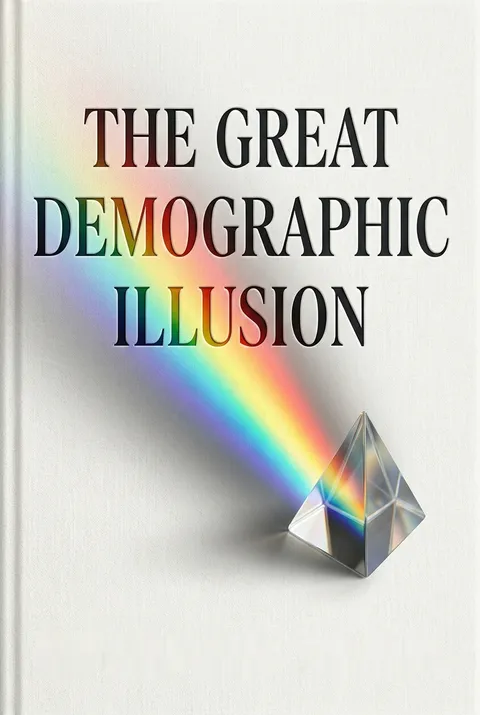

Key Takeaways
1. The "Majority-Minority" Narrative is a Demographic Illusion.
Yet there are powerful reasons to be skeptical about this demographic imagining of the present and the near future: it assumes a rigidity to racial and ethnic boundaries that has not been characteristic of the American experience with immigration.
A pervasive belief. Many Americans believe their society is on the brink of a momentous transformation where the white population will become a numerical minority, and non-whites will form a new majority. This "majority-minority" narrative, amplified by Census Bureau announcements and media headlines, fuels both white anxiety ("white extinction anxiety") and minority optimism, shaping perceptions of political power and cultural influence. However, this narrative is fundamentally flawed.
Historical parallels. The idea of a dominant group being "submerged" by newcomers is not new. A century ago, similar fears arose about Southern and Eastern European immigrants, who were then considered racially inferior to "native" white Americans. Despite widespread eugenics-inspired anxieties, these groups eventually assimilated, demonstrating the malleability of ethno-racial boundaries in the American context. The current narrative overlooks this historical precedent, assuming rigid, unchanging racial lines.
Beyond numbers. The "majority-minority" concept is misleading because it simplifies a complex social reality into a binary division between "white" and "minority" blocs. It often incorrectly implies that whites will soon be a minority of citizens or voters, when in fact, even by narrow definitions, they are projected to remain the majority of citizens and voters well past mid-century. This oversimplification ignores the internal diversity and lack of political coherence within the so-called "minority bloc."
2. Census Data Classification Distorts the Reality of Mixed Identities.
But the bottom line is this: for the critical public presentations of data, the Census Bureau classifies individuals who are reported as having both white and nonwhite ancestries as not white; my analyses for the book show that the great majority of all mixed Americans are therefore added to the minority side of the ledger.
A critical flaw. The Census Bureau's public reporting, influenced by Office of Management and Budget (OMB) guidelines for civil rights enforcement, classifies individuals with both white and nonwhite ancestries as "not white," effectively adding them to the "minority" side. This classification decision is pivotal, as it directly determines the projection of a "majority-minority" society by the mid-2040s and leads to headlines like "minority babies are the majority."
The "in-between" reality. This classification distorts social reality because it doesn't align with the lived experiences of most mixed individuals, who often have strong ties to both white and minority communities. For example:
- Over 10% of all babies born in the U.S. are of mixed white-minority parentage.
- If these mixed individuals were counted as partly white, the "majority-minority" crossover would be significantly delayed or not occur by 2060.
- The Census Bureau's own tests for a single, integrated race/ethnicity question (which would better capture mixed identities) were rejected by the OMB, highlighting political constraints on data accuracy.
Identity fluidity. Ethno-racial identities are not fixed but fluid, especially for mixed individuals. Many mixed-race Americans report their identity differently across censuses, often leaning towards a white or mixed self-identification rather than solely minority. This fluidity undermines the assumption of stable, mutually exclusive categories that underpins current demographic projections, making long-term predictions based on these classifications inherently unreliable.
3. A Surge of Mixed-Race Americans Is Reshaping Society.
The rigidity of ethno-racial lines is already being challenged by a robust development that is largely unheralded: a surge in the number of young Americans who come from mixed majority-minority families and have one white parent and one nonwhite or Hispanic parent.
Rising intermarriage. The rate of intermarriage has climbed steadily since the Supreme Court's 1967 Loving v. Virginia decision, reaching 17% of newlyweds in 2015. This widespread acceptance of ethno-racial mixing through marriage is a new phenomenon, creating family ties that span traditional racial boundaries. The most common intermarriages are between Hispanics and non-Hispanic whites, followed by whites and Asians.
Mixed-parentage births. This rise in intermarriage directly translates into a surge of children with mixed family backgrounds. In 2017, 14.1% of all births were to parents of different ethno-racial backgrounds, with 10.6% involving one white and one minority parent. This proportion is significant, nearing the number of black-only births and far exceeding Asian-only births.
A new social reality. The growing number of young Americans from mixed minority-white families represents a pivotal, yet often unheralded, demographic shift. These individuals, by virtue of their family connections, inherently bridge the traditional ethno-racial divide, challenging the simplistic binary view of American society. Their increasing presence necessitates a re-evaluation of how we understand and categorize race and ethnicity in the United States.
4. Mixed-Race Individuals Often Integrate into the White Mainstream.
On the whole, these individuals occupy a liminal “in between,” but their social mobility and social integration with whites are indicative of an assimilation trajectory into the societal mainstream.
"In-between" but integrated. While individuals from mixed minority-white backgrounds occupy an "in-between" social space, many demonstrate significant integration with the white mainstream. This is evident in their:
- Socioeconomic status: Often more educated and affluent than their minority-only counterparts.
- Residential patterns: Frequently live in diverse, often suburban, neighborhoods with many white residents.
- Social affiliations: Tend to have more contact with white relatives and friends, and feel accepted by whites.
Marriage patterns. A compelling indicator of social integration is the high rate of intermarriage among mixed individuals. Majorities of American Indian-white, Asian-white, and Hispanic-white adults marry white partners, further weaving them into white family networks. Even black-white individuals, despite facing more severe racism, marry whites at significantly higher rates than black-only individuals.
Identity flexibility. The identities of mixed individuals are fluid and context-dependent, often allowing them to present as mixed, white, or minority. For many Asian-white and Hispanic-white individuals, their identities lean towards whiteness or a mixed identity, and they often feel "white enough" to navigate predominantly white social milieus comfortably. This contrasts sharply with the experiences of black-white individuals, who, due to persistent racism, tend to identify more strongly with their black heritage.
5. Assimilation Today is Driven by Demographic Shift, Not Just Economic Boom.
In the early twenty-first century, when economic inequality is much greater than it was in the middle of the twentieth century, the basis for significant non-zero-sum mobility that favors minorities is demographic rather than economic.
Non-zero-sum mobility. Assimilation is greatly facilitated by "non-zero-sum mobility," where minorities can advance socioeconomically without causing a perceived decline in the status of the dominant group. In the mid-20th century, this was driven by post-WWII economic prosperity and massive expansion of higher education. Today, with modest economic growth and high inequality, the engine of non-zero-sum mobility is demographic.
Baby boomer exit. The aging and retirement of the predominantly white baby boomer generation is creating a vacuum in the upper echelons of the workforce and civic leadership. This demographic shift means that there are not enough younger whites to replace them, opening up opportunities for more diverse, younger cohorts. This process is inherently non-zero-sum, as it involves filling vacancies rather than displacing existing workers.
Diversifying the top tiers. As a result, the top quartile of the workforce is becoming increasingly diverse. While whites historically monopolized these positions, their share is declining, with Asians (both foreign and US-born) and US-born Hispanics showing significant gains. This demographic-driven mobility, particularly benefiting immigrant-origin groups, is gradually transforming the ethno-racial composition of leadership and professional roles, fostering greater mainstream inclusion.
6. The Mainstream is Expanding and Diversifying, Not Just "Whitening."
Instead, the mainstream can expand to accept a visible degree of racial diversity, as long as the shared understandings between individuals with different ethno-racial backgrounds are sufficient to allow them to interact comfortably.
Beyond a static ideal. The mainstream is not a fixed, exclusively white entity that minorities must conform to. Just as the post-WWII assimilation of European ethnics transformed the mainstream from "white Protestant" to "Judeo-Christian," today's assimilation is expanding and diversifying it further. This means accepting a visible degree of racial diversity and cultural variation, rather than demanding the eradication of all signs of distinctive origins.
Cultural shifts. Mainstream popular culture, including film, television, and music, increasingly reflects this diversity. Films with minority directors and casts are achieving critical and commercial success, and minority artists are prominent in the music industry. This growing visibility means that whites are increasingly exposed to diverse narratives and faces, making it harder to avoid ethno-racial diversity in cultural consumption.
Geographic variation. The mainstream's evolution towards a more multicultural identity is most advanced in diverse metropolitan regions with long-standing immigrant populations, where non-white individuals in leadership positions are increasingly common. In contrast, less diverse regions may retain a predominantly white mainstream character. This geographic divergence reflects a sorting of the white population between those comfortable with diversity and those who are not.
7. Systemic Racism and Inequality Remain Major Barriers to Full Inclusion.
However, mainstream expansion today is also consistent with high levels of average inequality among groups and with the exclusion of many nonwhites.
Persistent disparities. Despite the expanding mainstream, significant ethno-racial inequalities persist, particularly for African Americans and some other groups. The assimilation of the early 21st century is more selective than in the past, leaving many minorities and poor whites marginalized. This is evident in the disproportionate impact of the criminal justice system on black men and the stagnation of black student representation in elite higher education.
The "color-blind" fallacy. The assumption that all groups will benefit equally from non-zero-sum mobility, a "color-blind" process, is a mistake. Racism, deeply embedded in institutions and individual biases, continues to impede African American mobility. For example, black-white individuals, despite having a white parent, face more severe discrimination (e.g., police harassment) and identify more strongly with their black heritage than other mixed groups.
Intergenerational disadvantage. Systemic racism contributes to a massive wealth gap between whites and blacks, with black families having significantly fewer assets to pass on to the next generation. This lack of intergenerational wealth, exacerbated by historical and ongoing discriminatory practices (like redlining and predatory lending), limits opportunities for black children, regardless of their individual efforts or educational attainment.
8. Policy Interventions Can Broaden Mainstream Assimilation.
In the last part of the book, then, I examine social policies that could enhance mainstream expansion today and also extend the option to more African Americans and others affected by severe racism.
Addressing economic inequality. High economic inequality constrains social mobility, especially for those at the bottom, limiting their access to the mainstream. Policies to reduce this inequality are crucial:
- Progressive taxation: Higher marginal tax rates on top incomes and a wealth tax could generate revenue.
- Child poverty reduction: Investing in programs like universal child allowances or expanding the Earned Income Tax Credit.
- Educational equity: Increased federal funding for K-12 schools in disadvantaged areas and greater investment in public higher education to improve quality and affordability.
Combating systemic racism. For African Americans, color-blind policies are insufficient. Targeted interventions are needed:
- Financial resources: Reparations (e.g., direct payments, collective endowments, baby bonds) to address the racial wealth gap.
- Community investment: Improving schools, housing, and municipal services in African American neighborhoods.
- Criminal justice reform: Mitigating mass incarceration through police reform, reducing arrests for minor offenses, and addressing racial biases throughout the legal system.
Rectifying legal status. The defective legal status of many immigrants, particularly the undocumented, creates intergenerational handicaps. Granting permanent legal status to:
- Dreamers: Undocumented individuals brought as children.
- Long-term residents: Those settled for a decade or more.
- Parents of US citizens: To protect the well-being of citizen children.
These measures would remove significant barriers to mainstream integration for millions.
9. A New, Inclusive Narrative is Essential for American Cohesion.
It is my hope in writing this book that ideas about mainstream assimilation can provide the material for fashioning such a narrative.
Beyond polarization. The current "majority-minority" narrative is inherently divisive, fueling political polarization and white nationalism by portraying a zero-sum future. This narrative, while demographically flawed, has real-world consequences, contributing to anxieties and resistance to immigration and diversity across Western societies. A new narrative is urgently needed to foster national cohesion.
An expanding "us." The concept of an expanding and diversifying mainstream offers a more accurate and hopeful narrative. It emphasizes that many immigrants and their descendants are integrating into American society, retaining aspects of their distinctiveness while participating fully in mainstream institutions and social life. This process, reminiscent of the post-WWII assimilation of European ethnics, suggests the emergence of a new, multi-hued majority that transcends rigid ethno-racial divisions.
A "Composite Nation." This new narrative can draw on America's historical tradition of a "Composite Nation," celebrating a society forged by mixing rather than fearing it. By highlighting the openness of the majority to diverse Americans and the mutual adaptations that occur, it can promote a sense of shared destiny. This framework also allows for addressing persistent inequalities and racism within a context of inclusion, offering a more constructive path forward than the current divisive discourse.
Review Summary
Readers largely praise The Great Demographic Illusion for its thorough, data-driven challenge to the "majority-minority" narrative. Many highlight how the book examines mixed-race families and intermarriage to argue that traditional demographic projections are misleading. Reviewers appreciate the deep dive into census methodology and immigration trends, noting the book fosters empathy and understanding. One critical reviewer quotes the text directly regarding census data flaws. Overall, most found it an enlightening, well-researched read, though navigating the statistical tables requires patience.
People Also Read

Download PDF
Download EPUB
.epub digital book format is ideal for reading ebooks on phones, tablets, and e-readers.








































