
Key Takeaways
1. The Great Conversation: The Defining Tradition of the West
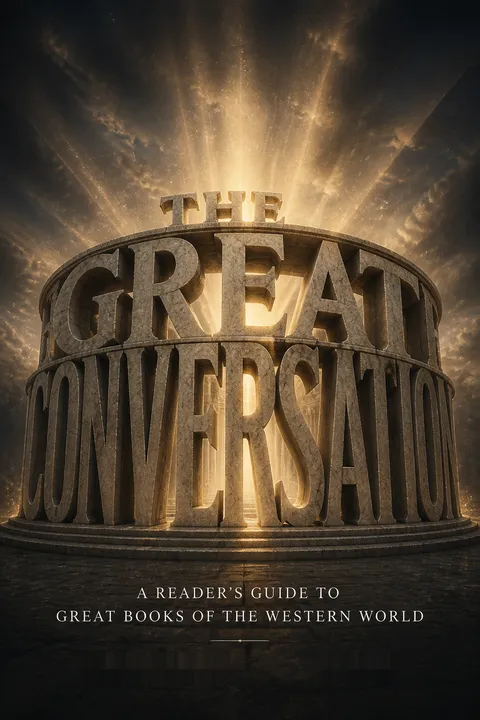
The tradition of the West is embodied in the Great Conversation that began in the dawn of history and that continues to the present day.
A unique dialogue. Western civilization is uniquely defined by a continuous, evolving dialogue among its greatest thinkers, captured in enduring books. This "Great Conversation" is not merely a collection of texts but a living spirit of inquiry, where no idea is left unexamined and every voice is encouraged to speak its mind. It represents the West's pursuit of understanding, contrasting with the common perception of it as solely a source of technology or materialism.
Repository of wisdom. These foundational books serve as the unparalleled repository of Western tradition, containing the profound ideas that shape our society and ourselves, often without our conscious awareness. Neglecting them risks severing our connection to this intellectual heritage, leading to a loss of drive and creativity. Historically, renewed engagement with these texts has consistently revitalized Western thought and progress.
Models of greatness. The authors of these great books are not just contributors to a dialogue; they are master liberal artists and teachers, offering models of fine and liberal arts. Their works inspire readers to transcend their everyday limitations, providing a "habitual vision of greatness" that elevates understanding and fosters human excellence.
2. Liberal Education: Cultivating Human Excellence for All
The aim of liberal education is human excellence, both private and public (for man is a political animal).
Purposeful development. Liberal education aims at the comprehensive development of individuals, fostering excellence in both their personal lives and their roles as citizens. It treats humans as ends in themselves, focusing on the ultimate goals of life rather than merely the means to earn a living. This makes it the education of "freemen," equipping them to lead truly human lives.
Core competencies. The substance of liberal education involves recognizing fundamental problems, understanding distinctions and interrelations across subjects, and grasping essential ideas. It clarifies how different problems connect, how various methods apply to fields like poetry, science, or philosophy, and what core concepts like "soul," "state," or "God" truly mean. This holistic understanding allows individuals to navigate complex issues with clarity.
Mastering the arts. The method of liberal education is rooted in the liberal arts, which discipline individuals to read, write, speak, listen, understand, and think effectively. These arts are not optional but unavoidable aspects of human existence; everyone practices them, well or poorly, every day. Striving for mastery in these arts is essential for becoming as fully human as possible.
3. The Decline of Liberal Education in Modern Times
By the end of the first quarter of this century great books and the liberal arts had been destroyed by their teachers.
Internal academic decay. Liberal education, once central, began to disappear due to its own practitioners. Scholars often reduced great books to mere philological exercises, focusing on linguistic details rather than the profound ideas within them. The liberal arts themselves devolved into "meaningless drill," alienating students and making these vital subjects seem archaic and irrelevant.
Misguided "scientism." Professors in humanities and social sciences, captivated by the success of experimental natural science, mistakenly tried to apply its methods universally. This led them to dismiss pre-scientific thinkers as prejudiced and to prioritize data accumulation over the exploration of ideas. Consequently, the rich insights of history, philosophy, and literature were devalued, further eroding the core of liberal education.
Public perception and vocationalism. The public, witnessing the triumphs of industrialization and technology, began to associate great books with a "dead" past. They believed progress lay in specialization and vocational training, which promised economic advancement and solutions to social problems. This shift, while understandable, inadvertently pushed liberal education to the margins, replacing it with a focus on immediate utility rather than intellectual development.
4. Democracy's Demand: Universal Liberal Education
If the people are not capable of acquiring this education, they should be deprived of political power and probably of leisure.
A democratic imperative. The commitment to universal, free, compulsory education in the West, particularly in the United States, has not translated into universal liberal education. Yet, if democracy truly means equal opportunity for full human development, then liberal education—the means to that development—must be available to all. To deny this is to implicitly accept that the masses are unfit for responsible citizenship.
Challenging the economic excuse. Historically, liberal education was reserved for an elite, often justified by the economic necessity of the many laboring for the few. However, in developed nations like the United States, industrialization has created unprecedented leisure and wealth, removing the economic barrier to universal liberal education. The argument that people are "too busy earning a living" no longer holds true.
Reforming the system. The current American educational system, with its excessive length and duplication, wastes valuable time that could be dedicated to liberal education. A more streamlined approach, focusing on core intellectual development from childhood, would make universal liberal education achievable by adulthood. This would ensure citizens are equipped with the critical thinking skills necessary for a complex democratic society.
5. Great Books Remain Essential in a Scientific, Industrial Age
We have seen that industrialization makes liberal education more necessary than ever, and that the leisure it provides makes liberal education possible, for the first time, for everybody.
Beyond technological progress. While experimental science and industrialization have brought immense progress, they also create new challenges, such as the dehumanization of work and the proliferation of propaganda. Great books, far from being obsolete, offer the intellectual framework to understand these modern dilemmas and to humanize work by infusing it with meaning and understanding.
Science as part of the conversation. The rise of experimental science is not an argument against the Great Conversation but an integral part of it. The earliest Greek thinkers were scientists, and the great books include scientific masterpieces. Reading these works allows us to appreciate the development of scientific method, understand its triumphs, and recognize its limitations, preventing the dogmatic assertion that it is the only path to truth.
Fostering communication in specialization. Specialization, a hallmark of modern society, can fragment knowledge and hinder communication. The Great Conversation provides a common language and a shared stock of ideas, enabling specialists to connect their fields to broader principles and to communicate effectively with others. This shared intellectual foundation is crucial for building community in an increasingly specialized world.
6. Challenging the Myth of Intellectual Incapacity
The business of saying, in advance of a serious effort, that the people are not capable of achieving a good education is too strongly reminiscent of the opposition to every extension of democracy.
Prejudice, not fact. The assertion that "the many" lack the capacity for liberal education is a deeply ingrained prejudice, often used to justify limiting access to quality education. This mirrors historical arguments against extending democratic rights, which claimed ordinary people were incapable of intelligent self-governance. Experience, however, suggests that when given the opportunity, people rise to the challenge.
Students rise to the occasion. When educational institutions demand greater intellectual effort, students consistently respond positively, often surprising professors who initially doubt their capabilities. This indicates that perceived limitations are often a reflection of the educators' own reluctance or the inadequacy of the curriculum, rather than an inherent lack of student potential.
Great books for ordinary people. Many great books were originally written for and addressed to ordinary people, not just scholars. They are "great teachers" that demand attention and stretch the intellect, making them infinitely rereadable and progressively more intelligible. The difficulty often lies not in the books themselves, but in the lack of proper educational preparation and the prevailing "cult of scholarship" that makes them seem inaccessible.
7. Lifelong Learning: The Adult's Indispensable Obligation
What is here proposed is interminable liberal education.
Beyond formal schooling. Education is not a finite process completed in youth but a continuous, lifelong obligation for all adults. Even those with the best childhood education cannot "store up" enough knowledge to last a lifetime. Continuous intellectual growth is essential for navigating the complexities of adult life and maintaining mental alertness.
Addressing modern challenges. Adults face unprecedented challenges, from constant propaganda to the trivialization of leisure in an age of drudgery-conquering technology. Lifelong liberal education provides the mental tools to develop independent judgment, resist manipulation, and find deeper meaning beyond mere animal gratifications or superficial amusements. It ensures that individuals continue to use their highest rational powers.
Shaping youth education. A commitment to adult liberal education fundamentally reshapes the purpose and content of schooling for the young. Instead of trying to cram all possible knowledge into childhood, education should focus on equipping youth with the disciplines and habits necessary for continuous self-education throughout their lives. This approach would reduce curriculum proliferation and ensure that the most important, complex subjects are revisited and understood in maturity.
8. Understanding the West as a Bridge to the East
The Editors believe that those who come to the meeting with some grasp of the full range of the Western tradition will be more likely to understand the East than those who have attended any number of the hastily instituted survey courses about the East proposed by educators who have been suddenly impressed by the necessity of understanding the East.
Authentic engagement. A genuine understanding between East and West requires more than superficial "survey courses" or a focus on immediate political expediency. The most effective way for Westerners to understand the East is to first deeply comprehend their own tradition, as embodied in the Great Conversation. This provides a robust intellectual framework for cross-cultural dialogue.
Beyond materialism. The West's deepest philosophical and religious traditions, often neglected today, offer points of connection with the profound metaphysical and ethical thought of the East. Conversely, the West's perceived materialism and ethnocentric pride, which alarm the East, find no support in the wisdom of its great books. A full Western education fosters an openness and capacity for genuine understanding, rather than a narrow, self-serving approach.
A call for competence. It is irresponsible to advocate for widespread "understanding the East" in education when there is a severe shortage of truly competent teachers in this area. Hasty, ill-prepared instruction risks creating more misunderstanding. The immediate priority should be to cultivate a supply of liberally educated Westerners who can then, with genuine competence, engage with and interpret Eastern traditions.
9. The World Republic of Learning: A Path to Global Community
The only civilization in which a freeman would be willing to live is one that conceives of history as one long conversation leading to clarification and understanding.
A unified future. The world is inevitably moving towards greater unity, whether through conflict or cooperation. Given the obsolescence of traditional defenses and the dangers of competing sovereign states, a world of law, enforced by a global organization, is essential. This requires a minimum level of understanding and a willingness to engage in dialogue rather than resorting to violence.
Education as national strength. A nation's true strength lies not in military might alone, but in the character and intelligence of its people, their understanding of its ideals, and their devotion to them. For the United States, these values are rooted in the Great Conversation of the West. An uneducated, inexperienced, and confused populace poses a danger to world peace, even if unintentionally.
The foundation of law and justice. A "world republic of law and justice" must be built upon a "world republic of learning." Just as a political republic relies on the intelligence and learning of its citizens, a global order requires a common educational life. This means recovering and reviving the great tradition of human thought, making learning the highest common good, accessible to all, and fostering the kind of understanding that forms a true world community.
10. A Personal Call to Engage in the Great Conversation
The death of democracy is not likely to be an assassination from ambush. It will be a slow extinction from apathy, indifference, and undernourishment.
Reclaiming your education. Most Americans, even those with extensive formal schooling, have received only a "faintest glimmering" of liberal education. The author challenges readers to honestly assess their own engagement with whole great books and their understanding of the Western tradition. He argues that formal education often leaves individuals ill-equipped to tackle anything beyond superficial content.
Lifelong intellectual work. Great books are "infinitely rereadable" because they offer new insights with each encounter, constantly stretching the mind. Liberal education is not something one "has had" but a continuous process that should only end with life itself. The great issues of civilization demand mature minds, and revisiting these texts in adulthood provides a depth of understanding impossible in youth.
The democratic imperative. To opt out of intellectual activity and political responsibility, assuming others will carry the burden, is a dangerous indulgence in a democracy. Such apathy and indifference lead to the "slow extinction" of democratic ideals. Every individual has a responsibility to strive for wisdom, to make the most of themselves, and to become a citizen of the "world republic of learning" to safeguard the future.
Review Summary
Reviewers broadly praise The Great Conversation as a compelling, timely defense of liberal arts education, noting its arguments feel even more relevant today than when written in 1952. Many highlight Hutchins' warnings about democracy's dependence on an educated citizenry, his critique of modern education's overemphasis on specialization and vocational training, and his case for lifelong learning through great books. Some critics note the work's Western-centric perspective and occasional repetitiveness, while others find it an inspiring call to intellectual engagement accessible to all readers.
People Also Read


Download PDF
Download EPUB
.epub digital book format is ideal for reading ebooks on phones, tablets, and e-readers.








































