
Key Takeaways
1. The Crisis of Christian Confidence in a Secular Age
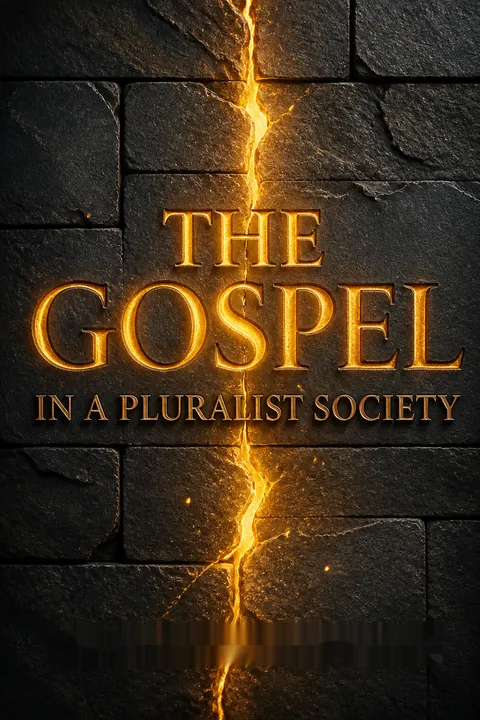
How, in this situation, does one preach the gospel as truth, truth which is not to be domesticated within the assumptions of modern thought but which challenges these assumptions and calls for their revision?
Pluralism's ideological shift. Modern society has moved beyond mere factual plurality to an ideology of pluralism, celebrating diversity as an end in itself. This shift, rooted in Western humanism and Enlightenment thought, contrasts sharply with earlier eras where Christianity provided a public doctrine. The result is a widespread timidity among Christians, especially in the West, who struggle to affirm their faith confidently.
Fact/value dichotomy. A key feature of this pluralist culture is the rigid separation between "facts" (objective, verifiable, scientific) and "values" (subjective, personal beliefs, religious). Christian faith is relegated to the realm of values, making its claims to universal truth seem arrogant or irrelevant. This dichotomy undermines the gospel's authority in public life, reducing it to one "brand" among many in an ideological supermarket.
Myth of secular society. The belief that modern society is inevitably progressing towards secularization, where religion will gradually disappear, is a pervasive myth. This myth, often uncritically accepted, justifies a social institution that claims neutrality but is, in fact, committed to a particular worldview. This "secular society" is not neutral but rather a pagan society, worshipping gods that are not God, demanding a renewed Christian confidence to challenge its underlying assumptions.
2. All Knowing Requires Prior Belief and Tradition
There is no knowing without believing, and believing is the way to knowing.
Doubt's inherent beliefs. The contemporary preference for doubt over faith, often seen as intellectually superior, is itself a form of dogmatism. Any act of doubt is predicated on a complex of other beliefs that are, at that moment, accepted without question. Therefore, universal doubt is logically impossible and ultimately leads to nihilism.
Faith as primary. Knowing anything, from learning a language to scientific discovery, fundamentally begins with an act of faith. We must trust our senses, teachers, and the traditions that transmit knowledge. While critical doubt is essential for refinement, it always operates within a framework of accepted truths, never from a vacuum.
Science rests on faith. Even modern science, often presented as purely objective, rests on foundational faith-commitments that cannot be scientifically proven. These include:
- The universe is rational and accessible to understanding.
- The universe is contingent, not a mere emanation of spirit.
- Facts are "interpreted facts," shaped by theoretical frameworks and long training.
Scientific progress relies on intuition, imagination, and a collective commitment to a tradition, demonstrating that belief is primary to knowing.
3. Reason and Revelation: Different Uses of Rationality
The difference is not between the use of reason and its abandonment; it is the difference between two ways of understanding the world, one in which the self is sovereign and the other in which I understand myself only in a relation of mutuality with other selves.
Reason within tradition. Reason is not a disembodied, neutral faculty but operates inherently within a specific social and linguistic tradition. What is considered "reasonable" is shaped by a community's shared language, experiences, and historical context. Therefore, the Anglican triad of Scripture, tradition, and reason is flawed, as "reason" itself is always tradition-bound.
I-It vs. I-Thou. The traditional dichotomy between reason and revelation stems from a misunderstanding of how we know. Autonomous reason treats reality as an "I-it" world, where the self is sovereign, dissecting and controlling. Revelation, however, invites an "I-Thou" relationship with a personal God, requiring a receptive, listening, and trusting use of reason.
God's self-communication. If ultimate reality is personal, then knowing God is more akin to knowing another person through self-communication than to analyzing an object. Natural theology can hypothesize God's existence, but it cannot provide the personal knowledge available through God's self-revelation. This revelation calls reason to serve openness and trust, not masterful autonomy.
4. God's Universal Purpose Revealed in Particular History
The truths which Buddhism teaches would (as Buddhists understand them) be true whether or not Gautama had discovered and promulgated them. But the whole of Christian teaching would fall to the ground if it were the case that the life, death, and resurrection of Jesus were not events in real history but stories told to illustrate truths which are valid apart from these happenings.
Historicity is crucial. Unlike many Eastern religions whose truths are considered timeless, Christian faith is fundamentally tied to specific, unrepeatable historical events: the life, death, and resurrection of Jesus. If these events were mere myths or illustrations, the entire gospel would collapse. This "happenedness" is essential for understanding God's purpose in the real world.
Scandal of particularity. The affirmation that God's universal purpose is revealed through particular events in the history of one nation, Israel, and one man, Jesus, is often seen as scandalous. Critics question how knowledge of the universal God can be restricted to specific segments of humanity. However, all historical understanding involves selection and interpretation based on presuppositions about meaning.
God acts in history. The Christian tradition affirms that God acts in history, not in all events equally, but in specific ones that reveal His purpose. This doesn't negate His presence in all history but highlights decisive moments. Just as human actions express purpose, God's actions in history are understood through words that interpret these deeds, forming a continuous tradition of rational discourse.
5. The Logic of Election: Suffering Service for All
To be elect in Christ Jesus, and there is no other election, means to be incorporated into his mission to the world, to be the bearer of God's saving purpose for his whole world, to be the sign and the agent and the firstfruit of his blessed kingdom which is for all.
Election is not privilege. The doctrine of election, often ridiculed as God having favorites, is central to the biblical narrative. God chooses particular individuals and communities (like Israel) not for exclusive privilege, but for a universal purpose. This election entails suffering, reproach, and humiliation, embodying God's agony over a disobedient world.
No private salvation. The biblical view emphasizes human life in terms of mutual relationships, not autonomous individualism. Salvation is never a private affair, but involves interdependence with others, especially those God sends as messengers. Paul's argument in Romans 9-11 illustrates that Israel's rejection of the Messiah ultimately leads to Gentile salvation, and eventually, all Israel will be saved through the Gentiles, completing the logic of election.
Grace is unconditional. God's electing grace is free and unconditional, never establishing exclusive claims that exclude others. The cross of Jesus exposes all humanity as enemies of God yet accepts all as beloved, objects of His forgiving grace. Election in Christ means incorporation into His mission to the world, sharing His suffering and bearing the secret of His reign for the sake of all.
6. Christ as the Clue to Universal History and Hope
The good news is that Jesus has opened a way through the curtain and has come to lead us on the way which he has opened and which he is, the way which consists in abiding in him, sharing his passion so that we may share his victory over death.
History needs a point. Human action is only meaningful if there is a conceivable goal for history. Without a vision of a worthwhile future, societies experience anomie and despair, as seen in contemporary Western culture's loss of belief in progress. The Bible, uniquely, offers a vision of universal, cosmic history with a definite goal.
Revelation of the end. We cannot know history's ultimate point until its end, unless its Author reveals the secret while we are still in the middle. This is the role of revelation, which cannot be replaced by inductive reasoning or futurology. The Bible communicates this secret through chosen witnesses, demanding faith and personal accountability, yet held with universal intent.
Hidden reign, patient hope. Jesus's message, "The kingdom of God has come near," signifies a present yet veiled reality. His reign is hidden, creating conflict and calling for patient, watchful hope. This "time between the times" is for the Church's mission to the nations, allowing all to repent and believe. This patient hope, rooted in Christ's resurrection, provides a reliable horizon for action, transcending both utopian fanaticism and privatized eschatology.
7. Mission as God's Propelling Work, Not Human Mandate
The mission of the Church in the pages of the New Testament is more like the fallout from a vast explosion, a radioactive fallout which is not lethal but life-giving.
Joyful explosion, not burden. Mission is not primarily a human mandate or a burden of duty, but a spontaneous overflow of joy at the news of the risen Jesus. The New Testament portrays mission as a natural consequence of a new reality, often initiated by questions from outsiders prompted by the Spirit's presence. It is God's work, not ours.
Spirit-empowered witness. The mission remains Christ's mission, continued through the Holy Spirit. Disciples become loci where the Spirit speaks and acts, leading them into fuller truth as they journey. The Church, in its weakness and suffering witness, unmasks worldly powers and confronts generations with history's ultimate goal, learning what Christ's lordship means through its journey.
Beyond false dichotomies. Understanding mission as missio Dei (God's mission) saves the Church from two common errors:
- Exclusive focus on individual conversions, neglecting social justice.
- Exclusive focus on social action, neglecting evangelism.
Both word and deed are integral to the total life of a Spirit-enabled community, challenging ruling powers and prompting inquiry into the new reality of the kingdom.
8. True Contextualization: Gospel's Critical Engagement with Culture
True contextualization accords to the gospel its rightful primacy, its power to penetrate every culture and to speak within each culture, in its own speech and symbol, the word which is both No and Yes, both judgment and grace.
Gospel is culturally embodied. There is no "pure" gospel disembodied from culture; it is always expressed in a particular language and life-style. From Pentecost, where the gospel was heard in diverse tongues, to missionary efforts today, the gospel is received within specific cultural forms. However, this does not mean total cultural relativism.
Gospel judges culture. While God "accepts culture" in its diversity (music, art, language), He also judges its sinful elements (e.g., cannibalism, sati, slavery). The challenge lies in discerning which cultural elements are compatible with the gospel and which are not, a discernment often complicated by missionaries' own cultural biases. The condemnation of caste by 19th-century missionaries, for instance, reflected both biblical insight and Enlightenment egalitarianism.
Community's living witness. Authentic contextualization occurs when a believing community, centered in the biblical story through worship, teaching, and sacraments, embodies the gospel's truth within its culture. This community, while local, must also be ecumenical, open to mutual correction from the global Church to avoid cultural absorption and represent God's universal purpose of grace and judgment.
9. No Other Name: Uniqueness as a Bulwark Against Arrogance
To affirm the unique decisiveness of God's action in Jesus Christ is not arrogance; it is the enduring bulwark against the arrogance of every culture to be itself the criterion by which others are judged.
Pluralism's contemporary orthodoxy. The widespread view that no single religious tradition can claim absolute truth for all humanity has become a contemporary orthodoxy. This pluralism, often driven by a desire for global unity and a "modern historical consciousness," dismisses Christian claims to uniqueness as preposterous and dangerous in a world facing global crises.
Critique of pluralist assumptions. This pluralist stance, however, rests on its own unexamined dogmas:
- The assumption that "modern historical consciousness" provides a neutral, privileged vantage point.
- The reduction of religion to a core mystical experience, ignoring other aspects of faith.
- The idea that "The Transcendent" is a purely formal, unknowable category, allowing for any conception of God.
Such views often lead to a "soteriocentric" approach, where "reality" serves the self's desire for salvation, rather than God's glory.
Uniqueness as humility. Affirming the unique decisiveness of God's action in Jesus Christ is not arrogance, but a bulwark against the arrogance of every culture to be its own ultimate criterion. The truth is personal, concrete, and historical in Jesus, who, in His weakness and suffering on the cross, humbles all human imperialisms and provides the true center for unity. This confession does not limit God's saving mercy but points to the route for all humanity.
10. Challenging Principalities and Powers: Structural Evil
The principalities and powers are real. They are invisible and we cannot locate them in space. They meet us as embodied in visible and tangible realities-people, nations, and institutions. And they are powerful.
Beyond individual sin. The New Testament, particularly Paul's letters, speaks extensively of "principalities, powers, dominions, thrones, authorities." These are not mere outdated myths but refer to real, invisible, yet powerful structural elements in human life and society. They are embodied in institutions, ideologies, customs, and roles (e.g., kingship, law, state authorities) that transcend individual human agents.
Powers disarmed, not destroyed. These powers, originally created in Christ and for Christ, are intended to serve God's purpose. However, they can usurp His place, becoming demonic when absolutized (e.g., state tyranny, legalism, money as a fetish, racial ideologies). Christ's death on the cross disarmed and unmasked these powers, exposing their rebellion, but did not destroy them. They are now under His feet, serving His purpose until His final return.
Church's wrestling. The Church's mission involves wrestling against these principalities and powers, not against "flesh and blood" (individual people). This means challenging the structural evils of society (politics, economics, education, culture) by making God's wisdom manifest through suffering witness. This calls for patient revolutionaries who, rooted in Christ's victory, resist both anarchy and complacent acceptance of the status quo, knowing that true transformation comes through the gospel's power, not worldly force.
11. The Congregation as the Gospel's Living Hermeneutic
I am suggesting that the only answer, the only hermeneutic of the gospel, is a congregation of men and women who believe it and live by it.
Beyond individualistic faith. The idea that the gospel is solely addressed to individuals, with societal change following indirectly, is a product of Western individualism. The Old Testament, and implicitly the New, addresses the whole community. The Church's impact on public life cannot be separated from its corporate behavior.
Community as interpreter. Jesus did not write a book but formed a community. This local congregation, by faithfully remembering, rehearsing, and living out the biblical story through worship, word, and sacrament, becomes the primary, credible interpretation (hermeneutic) of the gospel. It provides the "lenses" through which members understand and cope with the world.
Characteristics of a faithful congregation:
- Community of praise: Finding freedom and dignity in reverence to God, expressing boundless gratitude.
- Community of truth: Sustaining healthy skepticism against prevailing cultural assumptions through constant engagement with the true story of human nature and destiny.
- Community deeply involved: Not living for itself, but for its neighborhood, acting as God's embassy in a specific place.
- Community of priesthood: Training and sustaining members for priestly ministry in the world, offering sacrifices of love and obedience in secular life.
This living witness, rather than mere pronouncements, validates the gospel's public truth.
12. Dialogue with Other Faiths: Grace, Sin, and God's Glory
The whole discussion of the role of the world religions and secular ideologies from the point of view of the Christian faith is skewed if it begins with the question, Who is going to be saved at the end? That is a question which God alone will answer, and it is arrogant presumption on the part of theologians to suppose that it is their business to answer it.
God's universal grace. Christians must acknowledge and welcome signs of God's grace in the lives of those who do not know Jesus as Lord. Jesus, as the source of all life and light, shines into every corner of the world, evoking responses even outside the visible Church. A grudging acknowledgment of goodness in non-Christians is repulsive and misrepresents God's boundless kindness.
Sin's dark horror. The same revelation in Jesus Christ, centered on Calvary, compels recognition of the world's alienation and rebellion against God. The cross unmasks the dark horror of sin, revealing that all, including revered leaders, are guilty. True thinking must hold the tension between God's amazing grace and the appalling reality of sin.
Focus on God's glory. The central question in dialogue with other faiths should not be "Who can be saved?" (a question God alone answers), but "How shall God be glorified?" This shifts the focus from individual happiness to God's honor. Christians should cooperate with others in projects aligned with God's purpose, and in these shared commitments, true dialogue about the meaning and goal of the human story can emerge, with Christians bearing witness to the story of Jesus as the ultimate clue.
Review Summary
Reviews of The Gospel in a Pluralist Society are largely positive, averaging 4.17/5. Many readers praise Newbigin's sharp critique of modernity's fact-value distinction, his application of Polanyi's epistemology, and his vision of the local congregation as the primary hermeneutic of the gospel. Readers frequently note its enduring relevance decades after publication. Critics argue Newbigin oversimplifies complex ideas and merely popularizes others' work. Some theological concerns arise around his soteriology and universalist leanings. Most agree it is a dense but rewarding read, particularly valuable for those in ministry and missions.
People Also Read






About the Author
Other books by Lesslie Newbigin

Download PDF
Download EPUB
.epub digital book format is ideal for reading ebooks on phones, tablets, and e-readers.








































