


Plot Summary
Prologue
A woman surfaces from darkness with a scream trapped in her throat, only a thin trickle of air escaping. She cannot move. Memory comes in shards: leering faces, one betrayal that still aches, a bottle forced to her lips as she fought. A steady beeping convinces her she has been rescued, and she lets herself imagine the revenge she will take, certain no one understands vengeance better than she does.
Then she recognizes the crown molding above her, a ceiling she knows intimately. Her bed begins to rise on a soft mechanical whir. A man stands at the footboard wearing a wolfish smile and greets her as Posey.4 In that instant she understands she is alive, and that survival is the crueler fate.
The prologue weaponizes hope as horror. A familiar suspense beat, the rescue, is inverted: the beeping machine signals not safety but captivity in the very home she fled. Sheridan front-loads a mystery whose solution she will withhold for hundreds of pages, training the reader to distrust comfort. The name Posey arrives as a key with no lock yet visible. Thematically, the passage introduces the novel's obsession with helplessness and voicelessness, a body that disobeys its owner, and seeds the moral engine of the book: vengeance born from violation. The wolfish man is intimacy turned predatory, betrayal coded as familiarity, establishing that the worst monsters here wear the faces of family.
Hidden Behind the Hydrangeas
At her boyfriend Hollis Barclay's6 lavish pool party, head cheerleader Cami Cortlandt1 fakes cheer while secretly terrified that her late period means pregnancy. Slipping away from the noise, she stumbles on Rex Lowe,2 a poor, hunched scholarship student doing math behind a potted plant. For five minutes they actually talk, and Cami feels seen in a way her glossy crowd never offers.
She admits she tends to oversimplify; he admits he complicates things. Hollis6 interrupts, dismissive and crude, and Rex2 leaves on foot because he has no car and no ride. Walking home, Rex resolves to better himself for her. Cami1 drives off carrying a quiet certainty that something is ending, a feeling she cannot yet name.
The chapter stages class and visibility as the book's foundational tensions. Cami performs likability as social currency, while Rex has internalized invisibility as identity. Their connection works because each names a private truth aloud, a rare authenticity in Cami's curated world. Sheridan plants a chilling dramatic irony: Cami's musing about unrecognized last times foreshadows catastrophe, and the reader senses the trapdoor beneath the sunlight. The pregnancy subplot quietly tethers Cami's future to Hollis, whose entitlement is sketched in a single possessive grope. This is the calm that the entire novel will spend itself trying to recover, and the seed of a love story deferred by eleven years of damage.
Strangers in the Mudroom
Returning from buying a pregnancy test, Cami1 enters a too-quiet house and is punched, gagged, and dragged upstairs by a masked man called Trig10 and his partner, AJ. She finds her mother, Farrah, and fourteen-year-old sister, Elle,13 already bound and weeping. The intruders tape the women to their beds, revealing they are waiting for Cami's father, Judge Cortlandt,9 to come home.
They speak of a safe, a code, and the chilling notion that the whole point is for the judge to witness his family's suffering. Cami1 memorizes every detail of Trig's10 exposed face, vowing to describe him to police. When her father arrives, she pounds her bed in warning, but the men ambush and beat him, then bind him in his study.
The invasion converts the prologue's dread into present-tense terror. Sheridan emphasizes Cami's mind as her only weapon: she catalogs scars, moles, and clothing creases, an act of defiance against helplessness. The captors' insistence that the judge must watch reframes the crime as message rather than robbery, planting the buried mystery of motive that will organize the entire plot. Farrah and Elle become hostages to Cami's protective instinct, and the family's affluence is exposed as no shield at all. The taping of mouths literalizes the book's central wound, voicelessness, the inability to plead or refuse, which Cami will later vow never to suffer again.
A Mirror, a Window, a Plea
Using cheerleading flexibility, Cami1 works a compact mirror from her nightstand with her bare feet and angles its glare across the yard at her neighbor, Mrs. Willoughby, flashing a deliberate pattern that something is wrong. That night Trig10 forces cocaine up her nose and rapes her while AJ films, then they assault Elle13 and Farrah in turn.
Drugged and dissociating, Cami floats above her own body, but rage burns the fog away, and she silently vows that if she survives she will never let anyone steal her voice again. She also breaks the compact's glass into a blade, hiding it in the bedding. Below, the men congratulate themselves and grow careless, having let Cami1 see their faces.
This is the novel's darkest core, and Sheridan handles it through Cami's strategic mind rather than gratuitous detail. The mirror becomes the book's master symbol: light bent toward a witness, a refusal to disappear. Dissociation is rendered honestly as survival, yet the chapter's true engine is the alchemy of trauma into resolve, rage clarifying where despair would paralyze. The vow about never being silenced becomes Cami's organizing identity for the next decade and the thematic spine of her healing. The captors' fatal error, exposing their faces, both humanizes Cami's documentary instinct and arms the dramatic irony that their carelessness will doom her family.
The Morning of the Gun
At dawn the panicking men decide the women cannot be left alive to talk. A gunshot kills Farrah, and Elle13 is shot next. Cami1 saws free with her glass shard, sprints to her parents' room for her father's hidden pistol, and when Trig10 corners her, she shoots him dead just as Mrs. Willoughby's call brings sirens. AJ flees out the back, never identified.
Police storm in; the judge9 is found beaten but alive in his study. Cradling her dying mother, Cami hears her whisper fragmented words, do of, do of her, that will never make sense to her. Elle13 is gone. In a single morning Cami loses half her family and becomes both victim and survivor, hero and orphaned daughter.
The massacre completes Cami's transformation from privileged girl to scarred witness. Sheridan lets the heroism be costly rather than triumphant: Cami pulls the trigger but cannot save anyone, only herself and her father. The dying mother's garbled phrase is a planted cipher, a do-over, that the narrative will not decode for hundreds of pages, converting grief into mystery and binding past to future. The chapter interrogates the limits of agency under terror; Cami did everything right and still arrived too late, seeding the guilt that will shape her choices about her unborn child. Survival here is not victory but the beginning of a longer reckoning.
A Person of Interest
Days later, police pull Rex2 from class. His given name, Alexander John, shares initials with the fugitive AJ; witnesses note he jogged that morning, visited the hospital, and harbored a known crush on Cami.1 At the station, Rex2 volunteers a DNA swab, certain it will clear him. But overhearing through a door, he is gutted to hear Cami,1 traumatized and disoriented, concede that the attacker could have been him.
Though no DNA matches and charges never come, the rumor poisons everything. His scholarships are quietly reassigned, his college dreams evaporate, and he ends up bagging groceries, watching a pregnant Cami1 pass silently through his checkout line one night, both of them ruined in different ways.
Sheridan widens the blast radius of violence to show how trauma manufactures collateral injustice. Cami's uncertain words are not malice but the cognitive wreckage of assault, and the tragedy is that no one is villainous yet everyone is harmed. Rex becomes a study in the difference between guilt and reputation; innocence proves no defense against suspicion that attaches to the poor and othered. The grocery store encounter, two wronged people unable to reach each other, crystallizes the book's ache of mistimed connection. His simmering bitterness, and his deliberate refusal to let it consume him, establishes the moral discipline that later distinguishes him from the novel's vengeful characters.
Abandoned and Erased
Months on, Cami1 tells Hollis6 she is pregnant with his child, conceived the weekend before the attack. Eyeing his Princeton future, he insists the baby must belong to her rapist, refuses a paternity test, and flees without goodbye, his mother8 urging a clean start. Cami,1 drowning in compounded grief and unable to mother while shattered, chooses adoption.
She glimpses a San Diego couple's file by accident and selects them by intuition, comforted by the adoptive father's steady gaze. In the delivery room she holds her son3 once, memorizes his eyes and a dimple like Elle's,13 then asks her father9 to carry him away. She tells herself it is the most loving choice while her body screams its wrongness.
The chapter doubles Cami's loss: having buried mother and sister, she now relinquishes a child, grief layered upon grief. Sheridan refuses easy moralizing; adoption is framed as both sacrifice and self-preservation, a decision made by a girl with no high school diploma and no intact self. Hollis's denial exposes a particular cowardice, the willingness to rewrite a rape narrative onto a victim to protect privilege, and the Barclay machinery's instinct to erase inconvenience. The intuitive choice of the adoptive father becomes a quiet act of faith that the novel will later vindicate and complicate. The dimple linking the baby to Elle stitches the lost generations together.
An Old Wound Reopens
Cami1 now runs Flutterfly Gardens, a butterfly farm founded to honor her mother and sister. Her employee Bess14 finds a free-plants listing online, and the crew arrives to dig up an overgrown garden, only for Cami1 to discover the owner is Rex Lowe,2 transformed by army service into a tall, muscular, self-possessed man. The reunion crackles with unspoken history.
Cami1 nervously offers a fresh start, but Rex2 tells her, with quiet finality, that her failure to defend him helped destroy his future, and he has nothing left to say. He retreats into the house and shuts the door. Rex2 has come home only to settle his late grandfather's cluttered, flower-choked estate, intending to avoid Cami entirely.
Sheridan reintroduces her leads as mirror-image survivors who built selves from ruin: Cami through beauty and living things, Rex through discipline and intellect. The butterfly farm operationalizes grief into purpose, transformation literalized as business model. The reunion's friction is honest; Rex's coldness is not villainy but self-protection from a wound that derailed his life. The flower-strangled grandfather's garden becomes an accidental bridge, beauty surviving neglect, the same logic by which these two damaged people might bloom again. The chapter resets the romance as a debt unpaid and a chemistry unresolved, refusing sentimentality. Their proximity is engineered by chance, the universe, as Rex thinks wryly, enjoying its cruel symmetry.
Would You Like a Do-Over?
A distorted, doll-like female voice phones Cami,1 offering a do-over and warning her not to call police or innocents will suffer. Seconds later a photo arrives: a frightened boy in a barred room with only a bedpan and water. He has Cami's exact eyes. She is then directed to a live dark-web feed via the Tor browser and given four days to locate him before he is handed to others who mean him harm.
Searching news for missing children turns up nothing. The boy, Cyrus,3 is later seen scratching his name into the wall and learns from his guard that his adoptive parents died, that he lives with indifferent foster parents, and that buyers are coming within the week.
The do-over phrase detonates the buried cipher from Farrah's death, fusing two crimes across a decade and signaling an unseen orchestrator. Sheridan exploits modern dread, surveillance, dark-web anonymity, the helplessness of watching suffering through a screen, to revive the novel's voicelessness motif from the other side of the glass. Cami is now the witness who cannot intervene, inverting her childhood role. The boy's resourcefulness, carving proof of his existence, rhymes with Cami's mirror, establishing him as her kin in spirit before DNA confirms it. The ticking clock and the prohibition against police force Cami into the same isolating bind that defined her trauma, now reframed as a chance for redemption.
Hunting a Boy by Clues
Desperate, Cami1 goes to Rex,2 who works in cyber intelligence for the NSA. Moved by the endangered child rather than by her, he agrees to help. Together they mine the feed for evidence: a Pacific tree frog and California quail pin the region; the sound of water suggests coastline; Rex's2 friend Joaquin15 runs celestial-navigation software on the starfield; a plane contrail traced through flight radar narrows the radius near McWay Falls in Big Sur.
The boy's clothes mark him as a poor foster child, not a cherished adoptee, and a comic-shop owner confirms the rude man who bought Spider-Man issues. A half-glimpsed red logo resolves into Walker's service station. Piece by piece, the impossible search becomes a coordinate.
This is the procedural heart of the book, transmuting forensic ingenuity into hope. Sheridan makes the partnership a fusion of complementary minds: Cami's naturalist eye for frogs and birds, Rex's mathematical and military toolkit. The chapter rebuilds trust through shared mission rather than apology, the most durable kind of repair. Each decoded clue is a small resurrection of agency against the earlier theme of watching helplessly. The recurring mantra, slow and steady, links Cami's childhood escape to her adult resolve, threading discipline through trauma. Crucially, Rex's repeated use of we begins healing the wound of being unwanted, the orphan boy finally indispensable to someone.
The Cliff in Big Sur
Having rehearsed every move, Cyrus3 ambushes his guard with a loosened bedpost and a hidden spoon, blinding and clubbing him, then flees into the forest. Rex,2 racing from clue to clue, identifies the lone cabin and arrives as the wounded man corners the boy at a cliff edge with a loaded gun.
Rex2 distracts him by shaking trees, draws and dodges gunfire, and when Cyrus3 hurls dirt into the man's eyes, Rex2 shoves the kidnapper off the cliff to his death. He shows the terrified boy his army and NSA cards to prove he is a rescuer, not a captor. Recognizing the soldier's steadiness his late father had, Cyrus3 agrees to leave with him.
The rescue pays off every clue and recasts the book's children as agents of their own salvation. Sheridan parallels Cyrus's choreographed breakout with Cami's compact-mirror escape, generational courage under captivity, suggesting heroism is heritable in spirit. Rex's lethal action is framed as protection rather than vengeance, a moral line the novel polices carefully against its villains. The detail of Cyrus reading people through their eyes, taught by his soldier father, validates Cami's intuitive faith and binds the new family by recognition. The cliff becomes a threshold between captivity and freedom, and Rex, the once-suspected outsider, completes his arc from accused predator to undeniable protector.
The Boy Who Knew Her Eyes
When Cami1 steps forward, Cyrus3 declares she is his mother, having seen her face in old newspaper coverage his adoptive mom kept and watched the televised special about her family. He even deduced Hollis6 is his birth father from a campaign interview, and admits he emailed Hollis6 for help and got no reply. The live feed vanishes the moment Cyrus3 is safe.
Detectives investigate; the dead guard is identified as Oakland muscle, the cabin owned by a shell company. A judge grants Cami1 emergency custody, and she brings Cyrus3 home to Virginia, where her father, Rand,9 and stepmother, Gigi, embrace him warmly. Later a blood test confirms what Cami already knows: Cyrus3 is unmistakably her son.
Recognition replaces proof as the chapter's emotional currency; Cyrus knows his mother by the eyes they share before science certifies it. Sheridan stages reunion as restoration of the family Cami amputated in grief, a literal do-over of her delivery-room surrender. The boy's deduction of his paternity reactivates the Hollis thread and quietly indicts the politician's negligence as the spark of the kidnapping. The vanished feed underscores that an unseen hand controlled the entire ordeal, keeping the orchestrator mystery alive. Rand and Gigi's instant tenderness models the chosen-family warmth the novel prizes, contrasting the predatory bloodlines elsewhere. Cami's vow not to lose him a second time becomes the spine of the final act.
The Human Computer's Ruin
Decades earlier, Josephine Posey Kiss,4 a savant teenager, helps run her family's secret enterprise of fixers who solve elite clients' problems through manipulation, disappearances, and murder for hire. Her dying father names her, not her resentful brother Anton,7 as heir. Posey4 tentatively falls for Tatum Devore,11 an employee's son, learning she is a girl and not a machine.
At Anton's7 graduation party, Tatum11 lures her to the wine cellar for money, where Anton's7 friends gang-rape her, then throw her from a moving car. She wakes paralyzed, a quadriplegic, while Anton7 seizes the business and imprisons her, threatening a state institution if she ever speaks. The prologue's wolfish greeting was Anton's.7
This flashback decodes the prologue and supplies the novel's hidden architecture. Sheridan draws a devastating parallel between Posey and Cami, two intelligent women violated by men who weaponized intimacy, each rendered voiceless and physically helpless. Posey's tragedy is the cost of a feeling heart awakening inside a life built to suppress emotion; love makes her vulnerable, and betrayal calcifies into endurance. Anton embodies entitlement curdled into cruelty, the dark twin of the protective fathers elsewhere. The Kiss operation becomes the unseen machinery linking every crime in the book, the fixers behind both the Cortlandt hit and Cyrus's kidnapping. Posey's survival, reframed by the prologue as worse than death, sets up her decades-long campaign of quiet vengeance.
Threads of an Old Vendetta
Investigating the do-over phrase, Cami1 and Rex2 theorize the original crime was revenge against a family her judge father9 once wronged. Rex2 hacks Hollis's6 campaign site, finds Cyrus's3 ignored plea, and notices a ghostly presence typing gibberish, someone trying to communicate.
Tracing Hollis's6 fiancée, Seraphina Arnoult,5 Rex2 discovers her mother, Glory Jacobson,12 was terrorized by a burglar the judge9 had set free, her violinist hands ruined. Meanwhile Cami1 confronts Hollis,6 now a congressional frontrunner, who coldly denies their son and dismisses the kidnapping.
Back home, Cami1 and Rex2 finally surrender to their attraction and sleep together, and she tells him every detail of her assault, claiming a victory over her past as he holds her through the night.
The chapter braids detective work with intimacy, healing arriving through both truth and touch. Rex's instinct that the website glitches are messages rehearses the mirror-signal motif a third time, communication smuggled through hostile systems. The Glory Jacobson revelation reframes the Cortlandt massacre as a chain of suffering, victims begetting victims, indicting cycles of vengeance the novel will weigh morally. Hollis's unchanged narcissism confirms him as a man of ambition without conscience. The love scene matters structurally: Cami's ability to remain present in her body, after years of dissociation, marks her reclamation of selfhood and voice. Sheridan frames consensual desire as the antidote to the violation that opened the book.
Execution at the Rally
Seraphina5 lures Cami1 to the Barclay estate, drugs and binds her, and reveals everything in a limo: her mother12 ordered the original hit, and Felicia Barclay,8 Hollis's6 mother, arranged Cyrus's3 kidnapping through the same Kiss fixers, selling him to traffickers to recoup squandered wealth. Seraphina5 seats the bound Cami1 before a window overlooking Hollis's6 live rally.
Spotting Rex2 in the crowd, Cami1 drags a heavy credenza inch by inch and flickers a lamp in a deliberate pattern, the mirror trick reborn. Rex,2 tracking her through Cyrus's3 phone hidden in her purse, breaks in and frees her. On the jumbotron, Seraphina5 embraces Felicia,8 draws a pistol, and shoots her dead on live television.
The climax converges every thread: the fixers, the Barclays, the do-over, and the signaling light that has defined Cami since girlhood. Sheridan rewards the reader's pattern recognition; the lamp is the compact mirror at last answered by the right witness. Seraphina emerges as a vigilante who decides the corrupt and untouchable can only be stopped by spectacle, executing justice the legal system would never deliver. Her public assassination weaponizes the very media that mythologized Hollis, turning optics into a tool of reckoning. Cami's slow, agonized dragging of furniture restages her childhood escape as adult triumph, proof that her resourcefulness, not rescue alone, is her salvation. The reunion of leads completes their arc of presence and protection.
Carrying Posey to Freedom
A letter from the jailed Seraphina5 explains her grim logic, and Rex2 realizes the do-over caller and website ghost was Posey Kiss,4 sabotaging Anton's7 fixes from her wheelchair for years. Communicating through the campaign site, Posey4 directs Rex2 to impersonate her new doctor while Anton7 is abroad. Rex2 carries her out as she drains her brother's7 accounts.
Anton7 is arrested, the empire dissolved, and a leaked recording of Hollis's6 snarling threats destroys his campaign. AJ is identified posthumously, allowing DNA confirmation. Rex2 reconciles with his mother and gifts her the house. Cami1 and Cyrus3 arrive to declare their love just as Rex,2 having quit his job, was returning to them. The three choose to build a family together.
Resolution rewards endurance over force: Posey, the most helpless figure in the book, proves the most consequential, dismantling an empire with a tongue-driven keypad and infinite patience. Her rescue inverts the prologue, the bed that imprisoned her now a threshold to freedom. Sheridan distinguishes Posey's covert, life-saving sabotage from Seraphina's lethal vigilantism and Anton's predation, mapping a moral spectrum of vengeance. The leaked Hollis tape lets the media's own machinery deliver poetic justice. The romantic resolution literalizes the book's title and its recurring refrain, the do-over: Cami reclaims the son she relinquished, Rex gains the family he was denied, and three survivors author an ending of their own design rather than one inflicted upon them.
Epilogue
Six months later, Posey Kiss4 watches waves crash from an accessible seaside home she has outfitted for her freedom, Mahler's Resurrection Symphony swelling around her. Anton7 awaits trial and will likely never go free. She now works legitimately with Rex's2 new firm, supplying data that brings down the corrupt by the book.
Cami,1 an engagement ring on her finger, visits often, recounting how Hollis6 lost his race by forty points after the leaked footage exposed him. Posey reflects on her father's deathbed wish that she dance whenever she can, understanding at last it was never only literal. She has lost her body but kept her soul, the part that fought. Her caregiver opens a box, and butterflies burst free, dancing skyward.
The epilogue resolves the prologue's despair into hard-won serenity, captivity answered by a home built for liberation. Sheridan grants Posey the interiority the book long withheld, revealing that the so-called human computer was always a fighting soul. The released butterflies braid Cami's healing symbolism into Posey's, linking the novel's two violated women in transformation rather than revenge. Mahler's Resurrection scores the theme explicitly: a slow, agonizing journey toward triumphant payoff. The leaked tape and Hollis's collapse confirm that justice, delayed for decades, can still arrive sideways. By choosing legitimate work and friendship, Posey closes the cycle of the family business, proving that the deepest do-over is not vengeance but the freedom to begin again.
Analysis
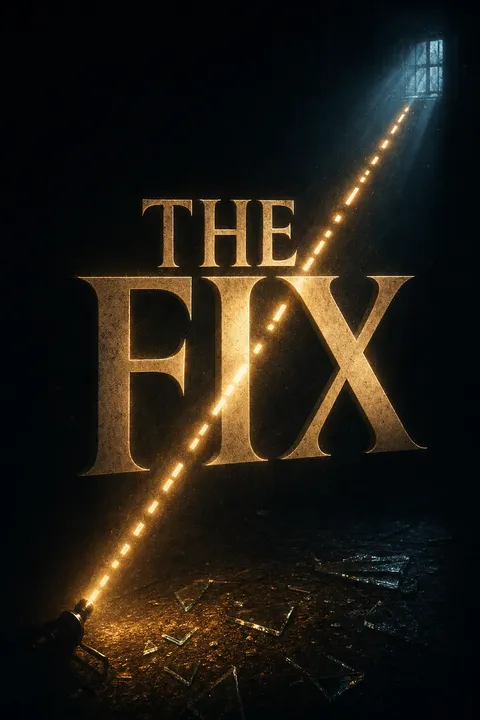
The Fix is a revenge thriller built on the recurring trauma of voicelessness, the body that cannot scream, the mouth taped shut, the witness who can only watch. Sheridan structures the novel as a series of mirrored captivities: Cami1 bound as a teenager, Cyrus3 caged in a cabin, Posey4 imprisoned in a paralyzed body, each finding ingenious ways to bend available tools, mirrors, lamps, keypads, toward freedom. The repeated signaling light becomes the book's governing image, a refusal to disappear that links its three violated protagonists across decades. The plot interrogates cycles of vengeance through a careful moral spectrum: Glory's12 grief curdles into a hit that destroys innocents; Anton's7 entitlement breeds sadism; Felicia8 treats people as problems; Seraphina5 chooses lethal spectacle when institutions fail; and Posey practices covert, life-saving sabotage. Sheridan implicitly weighs these against Rex's2 disciplined refusal of bitterness, suggesting that the deepest do-over is not retribution but the freedom to author a new beginning. The novel is also a sharp critique of power and media: wealth buys impunity, lawyers and bought judges shield the connected, and the press manufactures heroes and villains, mythologizing Hollis6 with a single televised tear before destroying him with a leaked tape. Class haunts every page, from Rex's wrongful suspicion as a poor outsider to Cami's gilded crowd's hollow performances. The butterfly farm and the released butterflies at the close offer the redemptive counter-metaphor: transformation as survival, beauty bred from ruin. Ultimately the book argues that trauma need not be destiny. Its survivors reclaim agency not by erasing the past but by refusing to be silenced, building chosen families and just endings from the wreckage that violence left behind, slowly and steadily.
People Also Read





Characters
Cami Cortlandt
Survivor turned butterfly farmerOnce the envied head cheerleader of a wealthy Virginia town, Cami learns early to simplify herself to fit in, hiding intelligence behind charm. A catastrophic act of violence transforms her into both victim and reluctant hero, leaving her dissociated, guilt-ridden, and fiercely protective. She channels grief into Flutterfly Gardens, a butterfly farm honoring the mother and sister13 she lost, finding purpose in nurturing fragile, transforming life. Driven by a vow never to let anyone steal her voice again, she is resilient, intuitive, and quietly courageous, attuned to small living details others miss. Her central wound is the child she relinquished3 and the belief she does not deserve love. Her arc is a reclamation of presence, agency, and the family she once surrendered.
Rex Lowe
Once-accused cyber soldierA poor, half-Native scholarship student raised by an alcoholic single mother, Rex spends his youth hunched and invisible, gifted with numbers and aching with an unspoken crush. Wrongly suspected of a brutal crime, he loses his scholarships and dreams, then rebuilds himself through military service into a confident, muscular cyber-intelligence operative for the NSA. Beneath the competence runs old bitterness he refuses to let consume him, plus a bone-deep sense of justice and protectiveness toward the vulnerable. He believes in second chances and chooses discipline over vengeance, distinguishing him from the story's predators. His defining trait is showing up: he is the man who stays. His arc moves from the boy nobody wanted to the indispensable protector of a chosen family.
Cyrus
Resourceful kidnapped boyAn eleven-year-old orphaned when his adoptive parents died in a crash, Cyrus survives an indifferent foster home by reading people through their eyes, a skill his soldier father taught him. Clever, defiant, and strategic, he absorbs lessons on patience and the art of war from a kindly chess player in the park. Carrying that book like a security blanket, he plans his own escape rather than waiting to be saved. He hides toughness over deep loneliness and longing for belonging. His instinct to scratch his name into a wall reveals a child desperate to be remembered. Bright beyond his years yet still a boy hungry for normalcy, he anchors the novel's themes of recognition and chosen family.
Josephine "Posey" Kiss
Brilliant captive savantA mathematical and computational savant, Posey grows up inside her family's secretive enterprise of elite problem-solvers, valued by her father for a rational mind unclouded by emotion. Socially apart and content in silence, she finds the world tedious until tenderness awakens a heart she did not know she had. A monstrous betrayal leaves her physically helpless and trapped, yet her intellect and patience remain undimmed. Defined by extraordinary endurance, she calculates odds, war-games scenarios, and waits with inhuman discipline for the chance to reclaim agency. Beneath the cool exactitude lives a fighter's soul. Her relationship to the novel's tangled crimes is profound and gradually revealed, making her one of its most quietly formidable figures.
Seraphina Arnoult
Hollis's poised fianceeThe beautiful, seemingly meek fiancee of a rising politician6, Seraphina projects agreeable serenity while concealing a childhood shattered by violence. Orphaned in spirit and raised amid an alcoholic mother's12 obsession and decline, she has lived in fear, hungry for safety and belonging. Calculating and self-aware beneath the demure surface, she harbors a complicated relationship to the Cortlandt tragedy and a chilling capacity for decisive action when she judges justice otherwise impossible.
Hollis Barclay
Charismatic golden politicianThe handsome, wealthy quarterback who becomes a congressional frontrunner, Hollis is charming on stage and hollow beneath it. Self-involved, cowardly, and ambition-driven, he abandons responsibility whenever it threatens his gilded trajectory, rewriting inconvenient truths to protect himself. He takes for granted that no one will question him, so he rarely bothers to be convincing. His relationship with his controlling mother8 shapes his choices, and his negligence ripples outward with devastating consequences.
Anton Kiss
Resentful cruel heirPosey's4 older brother, denied the family business he believed was his birthright, Anton is rash, self-involved, and bottomlessly cruel. Where his sister4 calculates, he squanders and rages, running the enterprise toward ruin while clinging to power through intimidation. He embodies entitlement curdled into sadism, savoring control over the helpless and threatening worse, the dark mirror of the protective figures elsewhere in the novel.
Felicia Barclay
Ruthless political matriarchHollis's6 mother, a formidable society matriarch obsessed with her son's ascent. Calculating, image-conscious, and willing to wield expensive lawyers and darker resources against any threat, she treats inconvenient people as problems to be managed. Cold even to a grieving girl years earlier, she values power and reputation above conscience, and her ambition casts a long, dangerous shadow over the story.
Rand Cortlandt
Judge and grieving fatherCami's1 father, a respected judge whose rulings unknowingly set tragedy in motion. A loving, protective parent who survives the attack that destroys his family, he later rebuilds a gentle life with a second wife. Warm and steadying, he becomes a devoted grandfather, urging Cami1 toward love and away from isolation, though his sentencing decisions hold buried significance.
Trig
Sadistic hired intruderA petty criminal and drug user, born Collin Smith, hired as cheap muscle for the home invasion. Cruel, undisciplined, and self-satisfied, he escalates the crime far beyond its plan, embodying the danger of incompetent, conscienceless violence.
Tatum Devore
Posey's first loveThe charming son of a Kiss family employee who awakens Posey's4 emotions with curiosity and warmth, asking what sings to her soul. Financially desperate and weak-willed, he proves a pivotal figure in her fate.
Glory Jacobson
Ruined violinist motherA gifted classical violinist whose career and family are destroyed by a home invasion. Consumed afterward by obsession and drink, she fixates on the judge9 who freed her attacker, her grief metastasizing into a fateful desire for retribution.
Elle Cortlandt
Cami's younger sisterCami's1 sensitive fourteen-year-old sister, shy about her braces and beloved for her dimpled laugh. The childhood butterfly hunts the sisters shared inspire Cami's1 later life work and the name Flutterfly.
Bess
Loyal shop employeeCami's1 cheerful gift-shop employee and product designer at the butterfly farm, who first spots the plant listing that reunites Cami1 with Rex2 and becomes a warm surrogate aunt to Cyrus3.
Joaquin
Rex's navigation expertRex's2 recovering army buddy who builds celestial-navigation software, helping narrow the kidnapped boy's3 location from a photograph of the stars and sun.
Plot Devices
The signaling light
Calls for rescue when voicelessTwice Cami1, bound and unable to speak, manipulates light to summon help: as a teenager she works a compact mirror with her feet to flash a coded glare at a neighbor, and years later, captive again, she flickers a lamp toward Rex2 in a crowd. The device crystallizes the novel's obsession with voicelessness and the determination to be seen against impossible odds. It also rhymes with a quieter variant, gibberish typed into a hacked website by someone trapped, communication smuggled through hostile systems. Each instance converts helplessness into agency, the prisoner bending available technology toward a witness. Sheridan rewards attentive readers by paying off the mirror's setup with the lamp at the climax.
The do-over offer
Links two crimes across timeAn anonymous, distorted voice offers Cami1 a do-over and a chance to find an endangered boy, echoing the garbled dying words of her mother years earlier. The phrase functions as the novel's master cipher, secretly connecting the long-ago massacre to the present kidnapping and pointing toward a single hidden orchestrator. It dangles redemption, the chance to undo a past failure, while imposing a four-day clock and a prohibition against police that re-creates Cami's original isolation. Structurally, it converts grief into mystery and propels the entire investigation. The repetition of the concept, offered to multiple victims over years, gradually reveals the strategy and morality of the person quietly subverting an empire of fixers from within.
The dark-web feed
Forces helpless witnessingA live, encrypted video streamed through the Tor browser shows Cyrus3 in a barred room, watchable but undownloadable, with the threat of vanishing if police are contacted. The device modernizes the book's terror, surveillance and anonymity, and inverts Cami's1 childhood role: now she is the helpless witness behind glass rather than the bound victim. It generates the procedural spine of the rescue, since the feed is the only evidence available. The DRM encryption and IP-tracking rules raise the stakes and explain the protagonists' constraints. Its sudden disappearance the instant Cyrus3 is freed confirms an unseen hand controlled the ordeal, sustaining the orchestrator mystery and tethering the kidnapping to the larger criminal machinery.
Forensic clue-tracking
Pinpoints an impossible locationLacking any address, Cami1 and Rex2 triangulate the cabin from tiny details: a Pacific tree frog and California quail at the window, the distant roar of water, a starfield run through celestial-navigation software, a plane contrail traced via flight radar, a comic-shop purchase, and a half-glimpsed red service-station logo. The device showcases the leads' complementary intelligences, Cami's1 naturalist eye and Rex's2 mathematical and military toolkit, and dramatizes the reclamation of agency through ingenuity. Each decoded clue is a small resurrection of hope against the theme of watching helplessly. It also rebuilds the couple's trust through shared mission rather than confession, and pays off the boy's3 resourcefulness with the adults' answering competence.
The Kiss fixers
Hidden engine of all crimesA secretive family enterprise that solves elite clients' problems through manipulation, disappearances, and murder for hire, insulated behind shell companies and bought officials. The operation is the buried architecture connecting every crime in the novel, the original massacre, the kidnapping, the sale to traffickers, revealed gradually through a parallel flashback narrative. It embodies the book's meditation on power, money, and impunity, the way the connected can outsource cruelty and erase inconvenience without trace. Its internal decay under incompetent leadership creates the opening for sabotage from within, while its near-mythic untouchability raises the question of whether justice is even possible. The device unifies the thriller's threads and frames the moral spectrum of vengeance the novel explores.









Download PDF
Download EPUB
.epub digital book format is ideal for reading ebooks on phones, tablets, and e-readers.








































