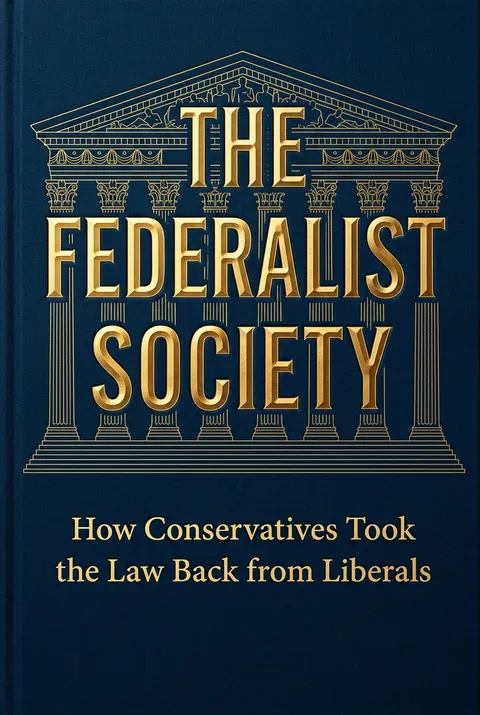

Key Takeaways
1. The Federalist Society emerged as a powerful force by strategically cultivating conservative legal thought.
“Where so many of the nation’s leaders are groomed, the Federalists manipulate the landscape. It was once held that liberals ran the law schools. The liberals had the name but the Federalists own the game. For students on the go, there is nowhere else to go.”
Counter-establishment origins. In 1980, conservative law students like Steven Calabresi, Lee Liberman, and David McIntosh felt isolated in liberal-dominated law schools, believing that prevailing ideologies distorted constitutional principles and threatened individual rights. They began organizing to articulate a comprehensive conservative critique, initially forming a "social club for students to come comfortably out of the political closet." This nascent movement quickly gained support from influential conservative professors like Robert Bork and Antonin Scalia, who shared their vision.
Rapid expansion and influence. Within a year of its first symposium in 1982, the Federalist Society had seventeen law school chapters, growing to 140 campuses and 60 city chapters by 2000. This rapid expansion transformed it from an outlier group into a dominant force in legal education and the profession. Its success demonstrated the power of ideas, providing a platform for conservative legal principles to gain respect and traction, ultimately shaping a new generation of legal professionals.
Ideological diversity within unity. The Society's "big tent" approach allowed it to unite diverse conservative factions—economic conservatives, social conservatives, Christian conservatives, and libertarians—despite their disagreements on specific issues. By avoiding formal policy positions, it fostered cooperation and intellectual debate, enabling a broad conservative agenda to advance without internal ideological battles. This strategic flexibility was crucial to its sustained growth and effectiveness.
2. Originalism became the bedrock of their constitutional interpretation, guiding judicial philosophy.
“What drives originalists is nothing more, and nothing less, than the noble pursuit of a coherent and principled approach to interpreting and implementing the various provisions of our written Constitution.”
Return to foundational principles. The Federalist Society championed originalism as the only legitimate method of constitutional interpretation, a concept given solid footing by Attorney General Edwin Meese during the Reagan administration. This approach posits that judges should base rulings on the original public understanding of the Constitution's authors and ratifiers, rather than their own biases or contemporary policy preferences. This was a direct challenge to the "living Constitution" philosophy prevalent among liberals.
Distinguishing meaning from intent. While initially influenced by Robert Bork's emphasis on "original intent," the Society's prevailing thought, exemplified by Justice Scalia, evolved to focus on the "original meaning" of the Constitution's words. This distinction argues that original meaning can be objectively determined through historical sources, whereas discerning the subjective intent of the framers is speculative. This nuanced approach aimed to provide a more rigorous and less subjective basis for judicial decisions.
Predictable conservative outcomes. Despite claims of neutrality, originalism often leads to predictable conservative results. Proponents like Steven Calabresi openly link originalism to desired policy outcomes, such as:
- More federalism and decentralization
- Increased presidential power over bureaucracy
- Restrictions on abortion
- Expanded religious expression in public schools
- Protection of private property rights against government seizure
This demonstrates how a seemingly neutral interpretive method serves a broader ideological agenda.
3. Reshaping the judiciary through strategic appointments was a core, highly successful strategy.
“No President exercises any power more far-reaching, more likely to influence his legacy, than the selection of federal judges.”
Long-term judicial transformation. From its inception, the Federalist Society recognized that changing the law fundamentally required changing the judges. This long-term strategy involved seeding lower federal courts with like-minded jurists who could eventually ascend to the Supreme Court. This approach proved phenomenally successful, culminating in four Supreme Court justices—Antonin Scalia, Clarence Thomas, John Roberts, and Samuel Alito—who were current or former members or approved by the Society.
Pipeline to power. The Society established a powerful pipeline from law schools to influential government and judicial positions. Membership became a "passport to career opportunities" under Republican presidents, with young Federalist Society lawyers dominating legal staffs in the Justice Department and the White House. This network ensured that conservative legal principles were embedded at every level of the federal legal apparatus, from judicial clerkships to federal judgeships.
Ideological vetting and influence. Republican administrations, particularly those of George H. W. Bush and George W. Bush, relied heavily on Federalist Society members for judicial selection. Key figures like Lee Liberman Otis and Leonard Leo played crucial roles in vetting nominees, ensuring their adherence to conservative judicial philosophies. This systematic screening, though denying "litmus tests," effectively ensured that appointees shared the Society's views on:
- Judicial restraint
- Originalist interpretation
- Limited government
- States' rights
Empirical studies confirm that judges appointed by Republican presidents, especially those with Federalist Society ties, consistently render more conservative decisions.
4. The Society built an extensive, interconnected network to translate ideas into law and policy.
“Ideas need networks through which they can be shared and nurtured, organizations to connect them to problems and to diffuse them to political actors, and patrons to provide resources for these supporting conditions.”
Interdependent ecosystem. The Federalist Society fostered an interdependent network of conservative think tanks, public interest law firms, prominent lawyers, elected representatives, judges, and law professors. This ecosystem allowed for the creation, adoption, and proliferation of conservative legal ideas, ensuring they moved from academic articles and debates into legislative proposals, legal briefs, court opinions, and White House policy. This comprehensive approach amplified their influence across all branches of government.
Financial and intellectual fuel. Wealthy conservative philanthropists, such as the Olin Foundation and the Koch family, provided substantial, often unrestricted, funding. This financial support enabled the Society to:
- Sponsor numerous conferences, panels, and debates
- Publish prolifically in journals like the Harvard Journal of Law and Public Policy
- Support the development of openly conservative law schools
- Fund public interest law firms that litigated test cases
This sustained investment in intellectual capital and organizational infrastructure was critical to their long-term success.
Strategic communication and branding. The Society was keenly aware of the power of branding and rhetoric. Named for the Federalists and "the principles of the American Founding," its publications and projects, such as ABA Watch and State AG Tracker, positioned it as a defender of core republican ideals. This strategic communication, supported by significant public relations expenditures, helped legitimize their agenda and frame public debates in their favor, even while maintaining a public image as a neutral intellectual forum.
5. They aggressively expanded property rights protections, challenging government regulation via the Takings Clause.
“This chapter addresses land use regulation and more comprehensive forms of economic regulation, including wage and price controls, on the assumption that these are all . . . takings of private property.”
Radical reinterpretation of "takings." Federalist Society members, notably Richard Epstein, advanced a radical theory that any government regulation of private property constitutes a compensable "taking" under the Fifth Amendment. This theory, initially considered extreme even by some conservatives, became a linchpin for deregulation efforts. It challenged the post-New Deal consensus that allowed broad government regulation without compensation, aiming to restore a laissez-faire economic philosophy.
Chipping away at regulatory power. Through litigation and advocacy, the Society sought to:
- Broaden the definition of a "taking" to include "partial takings" (restrictions on any "stick" in the bundle of property rights).
- Narrow the "nuisance exception," making more regulations compensable.
- Limit government's ability to exact concessions for development permits.
- Challenge the concept of "public use" in eminent domain cases, as seen in Kelo v. City of New London.
These efforts aimed to make government regulation prohibitively expensive, thereby reducing its scope and impact on private enterprise.
Judicial activism for economic rights. Despite generally decrying judicial activism, proponents of this expanded Takings Clause theory advocated for it to embed their ideas into law. Cases like Nollan v. California Coastal Commission and Lucas v. South Carolina Coastal Council, with opinions often authored by Justice Scalia, demonstrated a judicial willingness to scrutinize land-use regulations more strictly and to overcome procedural hurdles to rule in favor of property owners. This strategic use of judicial power aimed to roll back decades of environmental and land-use protections.
6. Limiting access to courts became a key tactic to curb "regulation by litigation" and promote tort reform.
“It is a settled and invariable principle, that every right, when withheld, must have a remedy and every injury its proper redress.”
Hostility to litigation. Conservatives, including Federalist Society members, have actively sought to limit access to courts, viewing litigation as a form of "regulation" that bypasses legislative processes and burdens private businesses. This "hostility to litigation" became a dominant theme in the Rehnquist and Roberts Courts, leading to increased procedural hurdles and narrow interpretations of substantive law that restrict civil claims.
Strategies for limiting access:
- Preemption doctrine: Aggressively arguing that federal statutes or regulations preempt state tort claims, thereby shielding manufacturers from liability. The Bush administration, with Daniel Troy at the FDA, actively pushed this "stealth tort reform."
- Tort reform: A broad movement to limit tort claims through legislative changes (e.g., caps on punitive damages, restrictions on joint and several liability) and public campaigns that demonized "frivolous lawsuits" and "opportunistic trial lawyers."
- Arbitration clauses: Promoting contractual provisions that force individuals into private arbitration, often prohibiting class-wide claims, effectively denying access to traditional court remedies. The Supreme Court's AT&T Mobility v. Concepcion decision significantly bolstered this strategy.
Undermining investor protections. The Society's influence also extended to securities litigation, as seen in Stoneridge Investment Partners v. Scientific-Atlanta, Inc. This decision narrowly interpreted securities laws, limiting the ability of investors to sue secondary parties involved in fraudulent schemes. This approach, championed by figures like Ted Olson and Kenneth Starr, prioritized reducing litigation burdens on corporations over providing redress for defrauded investors, further curtailing "regulation by litigation."
7. A "colorblind" Constitution was championed to dismantle race-conscious policies and affirmative action.
“The way to stop discrimination on the basis of race is to stop discriminating on the basis of race.”
Absolute colorblindness. Federalist Society members advocate for a "colorblind" interpretation of the Fourteenth Amendment's Equal Protection Clause, arguing that any government classification based on race, even for affirmative action, is unconstitutional. This stance, famously articulated by Chief Justice John Roberts in Parents Involved in Community Schools v. Seattle School District No. 1, asserts that the Constitution protects individuals, not groups, and that racial preferences are inherently discriminatory and harmful.
Strict scrutiny for all racial classifications. A core tenet of this campaign is that all racial classifications, regardless of their intent (benign or invidious), must be subjected to "strict scrutiny"—a legal standard rarely met. This approach effectively limits the compelling government interests that can justify race-conscious measures to only:
- Remedying past intentional discrimination by the specific government entity in question.
- Achieving "diversity" in higher education, a narrow exception established in Grutter v. Bollinger and subsequently limited.
Rejecting societal discrimination and equal results. Conservatives reject the idea that government can use race-conscious policies to remedy "societal discrimination" or achieve "equal results." They argue that once overt, intentional discrimination is eliminated, "equal opportunity" is achieved, and any remaining disparities are not the government's responsibility. This perspective dismisses the complex, systemic nature of racism and its lingering effects, focusing instead on formal equality.
Targeting gender-based policies. The "colorblind" philosophy extends to gender, with Federalist Society publications criticizing policies like Title IX for allegedly creating "quota systems" in college athletics and neglecting the needs of boys and young men. This reflects a broader concern that efforts to achieve gender equality have gone too far, leading to "reverse discrimination" and undermining traditional gender roles.
8. The Society actively challenged personal sexual autonomy rights, particularly regarding abortion and LGBTQ+ issues.
“Many Americans do not want persons who openly engage in homosexual conduct as partners in their business, as scoutmasters for their children, as teachers in their children’s schools, or as boarders in their home. They view this as protecting themselves and their families from a lifestyle that they believe to be immoral and destructive.”
Moral and constitutional opposition. Federalist Society members, particularly within the Religious Liberties Practice Group, have been central to the anti-abortion and "family values" movements. They view the constitutional right to abortion, and by extension, rights related to contraception and consensual homosexual conduct, as judicially created policies that lack constitutional basis and offend traditional morality. Their strategy often involves a blend of judicial restraint (arguing against unenumerated rights) and moral conviction.
Incremental erosion of abortion rights. Recognizing the difficulty of directly overturning Roe v. Wade, the Society and its allies adopted an "incrementalist strategy" to chip away at abortion access through state and federal legislation. This involved:
- Banning specific abortion procedures (e.g., "partial-birth abortion").
- Mandating waiting periods and parental consent for minors.
- Requiring "informed consent" materials designed to discourage abortion.
- Limiting public funding for abortion services.
This approach, championed by figures like Hadley Arkes and James Bopp, aimed to shift public opinion and legal precedent gradually.
Challenging LGBTQ+ rights. The Society's opposition extends to LGBTQ+ rights, viewing them as an expansion of "individual autonomy" that conflicts with "traditional family values." The Reagan Justice Department, influenced by young conservative lawyers, presciently outlined how an expansive right to privacy could lead to the recognition of homosexual marriages and challenge laws disadvantaging homosexuals. This foreshadowed later legal battles, including those against same-sex marriage, where Federalist Society members have played leading roles.
Influence in government and advocacy. Federalist Society members have held key positions in administrations that actively opposed abortion rights, such as those of Ronald Reagan and George W. Bush. They have also collaborated with powerful Christian advocacy groups like Focus on the Family and the National Right to Life Committee, leveraging these networks to draft model legislation, file amicus briefs, and influence public discourse on these deeply divisive issues.
9. American Exceptionalism and national sovereignty were invoked to resist international law and foreign influence.
“It is our true policy to steer clear of permanent alliances with any portion of the foreign world; so far, I mean, as we are now at liberty to do it; for let me not be understood as capable of patronizing infidelity to existing engagements.”
Unilateralism and self-determination. Federalist Society members, often termed "new sovereigntists," champion American Exceptionalism as a rationale for resisting international law, institutions, and foreign legal influence. They hold a realist view of foreign relations, believing the United States, as a hegemonic power, should act unilaterally to advance its interests, picking and choosing which international agreements to follow. This ideology rejects any external constraints on U.S. self-determination.
Rejecting foreign and international law in domestic courts. A core tenet is that international law (e.g., Geneva Conventions) and foreign law (e.g., foreign court rulings) are irrelevant to interpreting the U.S. Constitution. Justices like Antonin Scalia have vehemently argued that American law should not conform to global norms, asserting that the U.S. legal system and moral framework are uniquely exceptional. This stance aims to preserve the Constitution's preeminence and prevent "legal isolationism."
Skepticism of global governance. The Society and its allies, including organizations like Global Governance Watch, view international organizations (like the UN) and non-governmental organizations (NGOs) with deep suspicion. They argue that these bodies are often undemocratic, promote "collectivist proclivities," and seek to transfer authority from national governments to supranational entities. This skepticism fuels opposition to:
- Ratification of human rights treaties (e.g., Convention on the Rights of the Child, CEDAW).
- Trade agreements with labor or environmental side agreements.
- International criminal courts that could prosecute U.S. citizens.
Shaping foreign policy and public opinion. Figures like John Bolton, a Federalist Society friend and former U.S. Ambassador to the UN, have actively shaped U.S. foreign policy to reflect this unilateralist stance, famously "unsigning" the Rome Statute. Through extensive scholarship, debates, and lobbying, the Society has successfully propagated the idea that American Exceptionalism justifies a distinct, unconstrained role for the U.S. on the world stage, often framing international cooperation as a threat to national sovereignty.
10. The unitary executive theory was advanced to expand presidential power, especially in foreign policy.
“The executive power shall be vested in a President of the United States of America.”
Centralizing executive authority. Federalist Society members, including Steven Calabresi and John Yoo, have been instrumental in advancing the "unitary executive theory." This theory posits that all executive power must be under the direct control of the President, derived from Article II of the Constitution. In the foreign policy and national security arenas, this translates into an expansive view of presidential authority, particularly as Commander-in-Chief, allowing the President to act unilaterally, even to override legislation or international law.
Presidential supremacy in wartime. At its most extreme, the theory asserts the President's independent power to interpret the constitutionality of laws and international agreements, effectively placing presidential interpretation above that of Congress or the judiciary. This was evident in the George W. Bush administration's "torture memos," authored by John Yoo and Jay Bybee, which provided legal justifications for:
- Circumventing federal wiretapping laws.
- Defining "torture" narrowly to permit "enhanced interrogation techniques."
- Asserting that the Geneva Conventions did not apply to certain "enemy combatants."
- Establishing military commissions without explicit congressional authorization.
Challenging judicial review. This expansive view of executive power directly challenges the Supreme Court's established power of judicial review, as articulated in Marbury v. Madison. The theory suggests that the President can independently determine the constitutionality of laws, undermining the judiciary's role as the ultimate arbiter of legal meaning. This was reflected in the Bush administration's use of "signing statements" to express constitutional objections to legislation, effectively asserting a presidential veto over parts of laws.
Consequences for checks and balances. The unitary executive theory, as promoted by the Federalist Society, fundamentally reconfigures the balance of power among the branches of government. By granting the President near-absolute authority in areas of national security and foreign policy, it reduces the checks and balances intended by the Constitution's framers. This approach prioritizes executive efficiency and decisiveness, particularly in times of crisis, over legislative and judicial oversight.
Download PDF
Download EPUB
.epub digital book format is ideal for reading ebooks on phones, tablets, and e-readers.








































