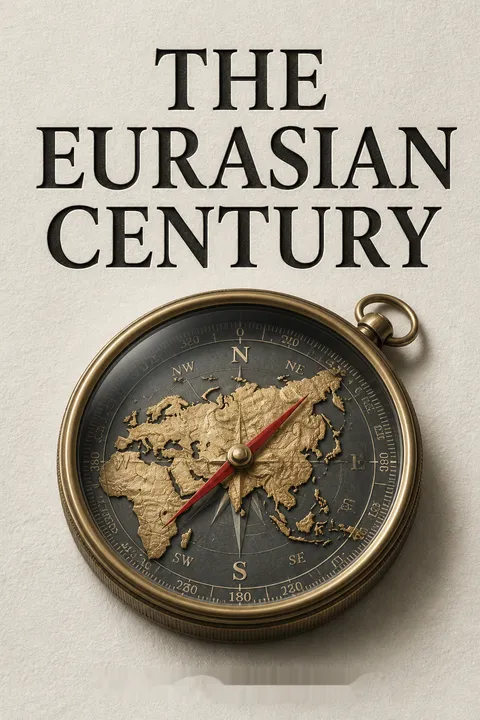

Key Takeaways
1. Eurasia: The Enduring Crucible of Global Power
The struggle over the Eurasian landmass and the waters around it is the defining feature of global politics in the modern era.
A Recurring Pattern. Since the early 1900s, Eurasia has been the central stage for global rivalry, repeatedly drawing nations into conflict. This vast "world island," encompassing Europe, Asia, and North Africa, holds over a third of Earth's land, 70% of its population, and the bulk of its industrial and military might. Its strategic importance makes it an unparalleled prize, shaping the course of modern history through hot wars, cold wars, and proxy conflicts.
The Strategic Core. Eurasia's diverse topography, from steppes to seas, and its connection to all major oceans, make it the strategic heart of the world. Control over its inner seas, like the Mediterranean and South China Sea, facilitates commerce and military projection. The shift of economic gravity from Western Europe to East Asia, and the evolution of warfare from oil and air power to digital domains, have changed the landscape, but not Eurasia's fundamental role as the epicenter of global competition.
A Long, Violent Century. The modern era, often seen as the age of American power, is more accurately described as a long, violent Eurasian century. Ambitious autocracies have consistently sought dominance by seizing commanding positions within this supercontinent, while offshore democracies have partnered with allies to keep Eurasia divided and preserve a world where freedom can flourish. This pattern, which forged the contemporary world, is once again raging today.
2. Geopolitics: A Timeless Battle of Land vs. Sea Power
Man and not nature initiates, but nature in large measure controls.
Geography's Enduring Influence. Halford Mackinder, a British polymath and the father of geopolitics, argued that geography profoundly shapes the timeless struggle for power. His 1904 lecture, "The Geographic Pivot of History," warned that technological advancements, particularly railways, were shrinking Eurasia, potentially allowing a single land power to control this vital landmass and then project power globally. This would pit assertive continental states against offshore maritime powers.
Mahan's Sea Power Counterpoint. American naval officer Alfred Thayer Mahan, a contemporary of Mackinder, emphasized the decisive role of sea power. He argued that oceans were highways, not barriers, and control of the seas was essential for national prosperity and global influence. Mahan believed that maritime dominance would allow a country to contain enemies on land, as Britain had done against Napoleon, and advocated for a powerful U.S. navy and alliances to secure global sea lanes.
Spykman's Rimland Theory. Nicholas Spykman, a Dutch American strategist, adapted Mackinder's ideas, arguing that the "Rimland"—the coastal areas of Eurasia where sea and land power meet—was more crucial than the interior "Heartland." Spykman's corollary, "Who controls the Rimland rules Eurasia; who rules Eurasia controls the destinies of the world," highlighted the amphibious nature of future conflicts and the necessity for offshore powers to project both naval and land forces.
3. World Wars I & II: Autocratic Bids for Eurasian Hegemony
This World War has become a conflict between two systems of philosophy.
Germany's First Bid. World War I, the "great black tornado," was Germany's initial attempt at Eurasian hegemony, driven by soaring ambitions and a social Darwinist worldview. Its Schlieffen Plan aimed for rapid conquest of France and Russia, but fierce resistance and an unexpectedly swift Russian offensive foiled it. The war became a brutal stalemate, revealing the destructive potential of modern industrial warfare and the resilience of states capable of total mobilization.
The Crucial American Intervention. The war's global scale and ideological stakes—democracy versus autocracy—eventually drew the United States into the conflict. American economic aid sustained the Allies, and its military intervention in 1917-1918 provided the decisive manpower and industrial might to break the stalemate. This intervention prevented a German-dominated Europe, but America's subsequent withdrawal from the League of Nations and European affairs left a fragile peace.
Hitler's Totalitarian Abyss. World War II saw an even more malevolent bid for Eurasian dominance by Nazi Germany and Imperial Japan, fueled by extreme racism and a "smash-and-grab" economic strategy. Their rapid conquests and genocidal atrocities demonstrated the terrifying potential of modern tyranny. The Grand Alliance, comprising the U.S., Britain, and the Soviet Union, eventually defeated the Axis through unprecedented industrial mobilization, global coalition warfare, and the synergistic application of air and sea power.
4. The Cold War: America's Containment and the Rise of a Free World
World War I has wrested one country from capitalist slavery; World War II has created a socialist system; and the third will finish off imperialism forever.
Stalin's Eurasian Ambition. Following World War II, the Soviet Union emerged as a formidable land power, controlling a vast Eurasian Heartland and seeking to expand its influence into the Rimlands. Stalin, though wary of direct war, aimed for global communist triumph, probing for advantage in Europe, the Middle East, and Asia. This presented a new, terrifying challenge to the war-weary democracies, who feared a totalitarian sweep across Eurasia.
Kennan's Containment Strategy. U.S. diplomat George Kennan proposed "containment," arguing that Soviet power, though aggressive, was deterrable and possessed profound internal weaknesses. He believed that by blocking Soviet expansion and surrounding it with unity and strength, the West could force Moscow to confront its own contradictions, leading to a "mellowing" or "breakup" of Soviet power without a hot war. This strategy blended high-minded ideals with ruthless geopolitics.
Building a Free World. The Truman administration, guided by Dean Acheson, transformed containment into a global strategy. This involved:
- The Marshall Plan to rebuild Western Europe and Japan.
- The formation of NATO, a peacetime alliance to deter Soviet aggression.
- Intervention in the Korean War, globalizing U.S. commitments.
- A monumental military buildup and nuclear deterrence.
This created a "free half" of the world, a security community spanning continents that ultimately outlasted and outmaneuvered the Soviet empire.
5. The Post-Cold War Illusion: History's Brief Pause
Either we take hold of history, or history will take hold of us.
The Unipolar Moment. The end of the Cold War ushered in a period of unprecedented U.S. dominance, with America and its allies commanding the majority of global GDP and military spending. Neo-isolationist calls for withdrawal were largely rejected, as U.S. policymakers understood the need to prevent a return to Eurasian anarchy. Washington maintained its Cold War alliances and military hegemony, intervening in conflicts from the Persian Gulf to the Balkans.
The "Golden Fetters" Strategy. The U.S. sought to integrate former rivals like China and Russia into the global economy, hoping that economic interdependence would foster liberalism and turn them into "responsible stakeholders." This strategy aimed to transform potential adversaries into pacific democracies, thereby locking in a liberal, U.S.-led world order. However, this approach inadvertently strengthened autocratic regimes and fueled their ambitions.
Distraction and Retrenchment. The post-Cold War era, while largely peaceful among great powers, saw the rise of new challenges. The 9/11 attacks diverted U.S. resources and attention to prolonged wars in the Middle East, leading to a sense of "nation-building here at home" under subsequent administrations. This period of distraction and defense spending cuts coincided with the resurgence of Eurasian powers, loosening the "handcuffs on history" just as new threats were stirring.
6. The Second Eurasian Century: A New Axis of Authoritarians
Russia, China, and Iran were making moves in the same regions that had been at issue in every major conflict of the modern era.
A New Alignment. The 21st century has seen the re-emergence of a familiar pattern: a new axis of authoritarians—China, Russia, and Iran, often joined by North Korea—challenging the U.S.-led liberal order. Their February 2022 joint statement, proclaiming "no limits" to their cooperation, signaled a collective intent to reshape the international system with an illiberal Eurasia at its core. This alignment, though fraught with internal tensions, is united by shared opposition to U.S. power and liberal values.
Putin's Violent Revisionism. Vladimir Putin's full-scale invasion of Ukraine in February 2022 was a stark reminder that history rolls on. Driven by a desire to restore Russia's post-Soviet empire and dismantle Europe's post-Cold War peace, Putin's war aimed to absorb Ukraine and reassert Russian primacy in Eastern Europe. This aggression, though met with fierce Ukrainian resistance and robust Western support, underscored the willingness of revisionist powers to use force to achieve their aims.
Global Reverberations. The Ukraine war, coupled with China's assertive moves in the Indo-Pacific and Iran's regional destabilization, confirmed that a second Eurasian century was underway. This era is characterized by heightened geopolitical polarization, with a cohort of autocracies confronting a free-world community. The stakes are familiar: preventing a hot war that could rip the world apart, while winning a new cold war against this emerging authoritarian axis.
7. China's Hybrid Hegemony: Mastering Land and Sea
China’s destiny will not be fulfilled, says Xi, until the country is a “great maritime power.”
A Unique Challenge. Xi Jinping's China presents the most formidable and novel challenge of the second Eurasian century. As a Leninist regime practicing state-driven capitalism, China combines immense wealth and technological prowess with an angry, atavistic nationalism. Its geography, offering both vast continental reach and usable oceanic frontage, enables aspirations for mastery in multiple domains, making it a uniquely scary sort of power.
Omnidirectional Expansion. China is pursuing global primacy through a "great rejuvenation of the Chinese nation," aiming to replace the U.S. system with a China-centric global network. This involves:
- Dominating East Asia and the Western Pacific, particularly the South China Sea and Taiwan.
- Building the world's largest missile force and navy to challenge U.S. military presence.
- Leveraging the Belt and Road Initiative to create economic and security spheres of influence across Eurasia, Africa, and Latin America.
- Leading in critical technologies like AI and quantum computing.
This hybrid approach combines traditional military coercion with economic and technological influence.
Taiwan: The Strategic Linchpin. Taiwan is central to China's ambitions, not just for historical reasons, but due to its critical role in global semiconductor production and its strategic location. Control of Taiwan would allow the Chinese navy to project power across the Western Pacific, threaten vital shipping lanes, and undermine U.S. alliances. For Beijing, Taiwan is a springboard to regional dominance and global reach, a "lock around the neck of a great dragon" that Xi is determined to break.
8. Russia and Iran: Disruptors of the Global Order
Our cooperation can isolate America.
Russia's Destabilizing Role. While Russia cannot aspire to global primacy like China, its actions have global implications by weakening the international order. Putin's goal is to restore Russia's "great Eurasian future" by reclaiming primacy in the post-Soviet space through military interventions and subversion. He also seeks to break transatlantic bonds, making Europe dependent on Russian energy and undermining democratic institutions through cyberattacks and political warfare.
Iran's Regional Ambitions. Iran, heir to a proud Persian civilization, seeks to expel the U.S. from the Middle East, eliminate Israel, and remake the region in its image. Despite its economic limitations, Iran leverages asymmetric strengths—drones, missiles, special operations forces, and a network of proxies like Hezbollah and Hamas—to project influence and sow disorder from the Mediterranean to the Gulf of Aden. Its pursuit of nuclear capabilities further complicates regional security.
A Symbiotic Alliance. The growing strategic partnerships between Russia, China, and Iran, along with North Korea, create a "Fortress Eurasia" united by shared enmities against the U.S.-led order. This collaboration involves:
- Military cooperation, arms sales, and joint exercises.
- Restructuring international trade and transportation networks to evade Western sanctions.
- Promoting illiberal norms and governance models in international forums.
This "perverse symbiosis" allows them to exploit each other's strengths, pose dilemmas for an overstretched superpower, and collectively challenge the existing global balance.
9. Technology and Ideology: New Tools, Old Rivalries
The great struggles of the twentieth century . . . ended with a decisive victory for the forces of freedom.
The Resumption of Ideological Rivalry. The post-Cold War belief in democracy's inevitable triumph has proven premature. The global financial crisis and the rise of powerful autocracies have fueled a democratic recession, with illiberal rulers actively challenging liberal norms. China, in particular, is updating autocracy for the 21st century, using AI and ubiquitous surveillance to create a "social credit" system that precisely targets dissent and reduces the economic cost of repression.
Technological Competition as Geopolitical Battleground. Geopolitical competition is fundamentally technological competition. Today's "fourth industrial revolution"—driven by AI, advanced robotics, and quantum computing—promises to reshape global power. China is making huge strides in these areas, leveraging technological theft, massive state investment, and forced technology transfer to narrow the gap with the U.S. The race for techno-primacy will determine economic leadership and military advantage.
Weaponized Interdependence. The deep interdependence fostered by post-Cold War globalization has become a conduit for coercion. China's "dual circulation" strategy aims to reduce its dependence on democratic countries for vital inputs while increasing its control over critical chokepoints, such as mineral supplies. This "offensive decoupling" transforms the global economy into a battleground, where control over supply chains and technological networks becomes a tool of strategic leverage.
10. The Price of Peace: Sustaining a Global Democratic Order
A cold war is the reward for deterring a hot one.
Deterrence as the Foundation. The Eurasian century teaches that preventing global war requires continuous, robust deterrence. The "long peace" of the Cold War was not accidental but the result of a decades-long effort to maintain a military balance favoring the free world, even if it meant preparing for the unthinkable. Today, with high-intensity warfare a stark reality in Ukraine and the Western Pacific, the price of peace is another long military competition.
A Multi-faceted Strategy. Sustaining order demands a comprehensive approach:
- Military Strength: Well-armed frontline states, forward-deployed forces, and a credible nuclear deterrent to counter Russian and Chinese aggression.
- Technological Edge: Investments in cutting-edge technologies and alliances to outpace rivals and control critical supply chains.
- Coalition Building: Forging deep solidarity among advanced democracies and pragmatic cooperation with ambivalent states to create an "overbearing power."
- Hemispheric Security: Securing the Western Hemisphere against hostile influence to free up U.S. power for global projection.
No Room for Complacency. While the democratic world holds significant advantages, history offers no guarantee of victory. The pathologies of autocratic regimes can make them more bellicose and dangerous, even as they face internal weaknesses. The U.S. and its allies must avoid the temptation of retrenchment and be willing to pay the rising costs of influence. The outcome of this second Eurasian struggle will hinge on their choices, commitment, and willingness to master the ruthless practice of geopolitics to preserve a world where freedom can flourish.
People Also Read







Download PDF
Download EPUB
.epub digital book format is ideal for reading ebooks on phones, tablets, and e-readers.








































