


Key Takeaways
Passion ignites where attraction meets resistance, not where access is easy
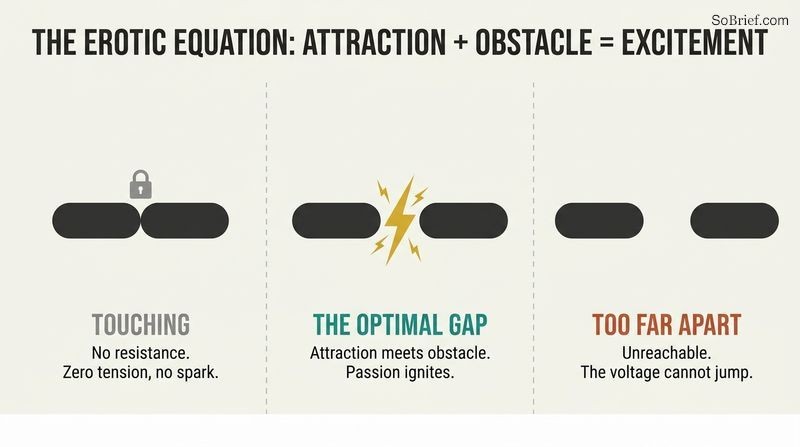
The erotic equation is the book's spine: Attraction plus Obstacles equals Excitement. Jack Morin, a sex therapist, borrowed psychologist C. A. Tripp's insight that desire rarely fires toward a fully accessible partner. We want most intensely what we cannot easily have. The obstacle can be physical distance, a partner's hesitation, social disapproval, uncertainty, or inner conflict.
Morin discovered this personally. His most sexually exhilarating relationship was also his most painful, with a lover who repeatedly vanished. The unavailability itself was the accelerant. He visualizes arousal as an electric spark: if the gap between two poles grows too wide, the voltage cannot jump it; if the poles touch constantly, the circuit completes and no spark is possible. Optimal desire lives in the charged space between, where we feel slightly off-balance.
What's striking is how this reframes frustration as fuel rather than failure. The equation echoes psychological reactance theory, where forbidden options gain appeal precisely because they are restricted, and dovetails with research on intermittent reinforcement, the most addictive reward schedule. The framework also explains why dating advice promising effortless compatibility often produces tepid chemistry. One limitation worth flagging: Morin treats obstacles as nearly universal aphrodisiacs, yet for trauma survivors or anxiously attached people, the same uncertainty that excites others triggers shutdown. The equation describes a tendency, not a law, and the optimal gap size varies enormously across individuals and nervous systems.
Mine your most arousing memories like data, not just pleasure
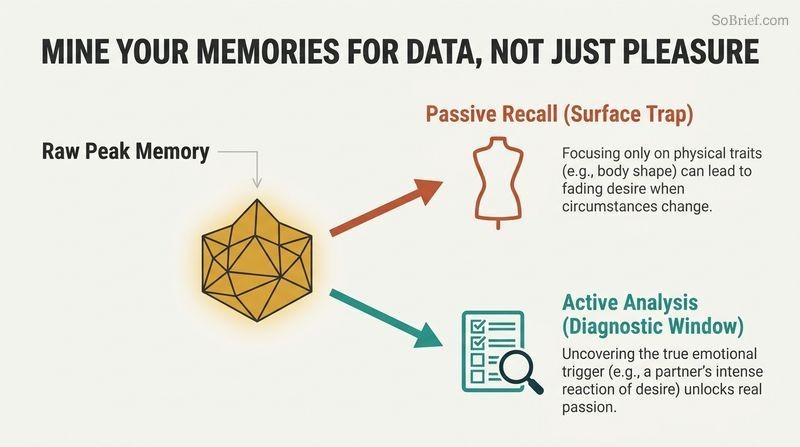
Peak turn-ons are diagnostic windows. Inspired by Abraham Maslow's study of peak experiences, Morin argues your most unforgettable sexual encounters reveal how your eroticism actually works, because during high arousal every element gets amplified and easier to observe. He built the Sexual Excitement Survey (SES), collecting over 1,000 detailed peak encounters and fantasies from 351 anonymous respondents he calls The Group.
A client named Fred illustrates the payoff. Fred blamed his fading desire on a Playboy-fueled obsession with flawless bodies, what he called centerfold syndrome. But examining his peak memories revealed the real trigger: partners losing control with desire for him. His wife had grown passive, mistaking his aggression for a preference. Naming the true turn-on let them rebuild. The lesson: study what excited you to learn who you are.
This applies Maslow's positive psychology, studying health rather than only pathology, to a domain still dominated by dysfunction models. The move is methodologically clever: peak states exaggerate signal and reduce noise, similar to how astronomers study stars during eclipses. Fred's case also previews attribution error, where people misdiagnose the cause of their own desire by latching onto a culturally available story (porn ruined me) instead of the subtler relational truth. A caution: memory is reconstructive, not a recording, so peak recollections are partly edited narratives. That does not negate their value, but it means they reveal what you find meaningful as much as literal history.
Four childhood challenges become the building blocks of adult arousal
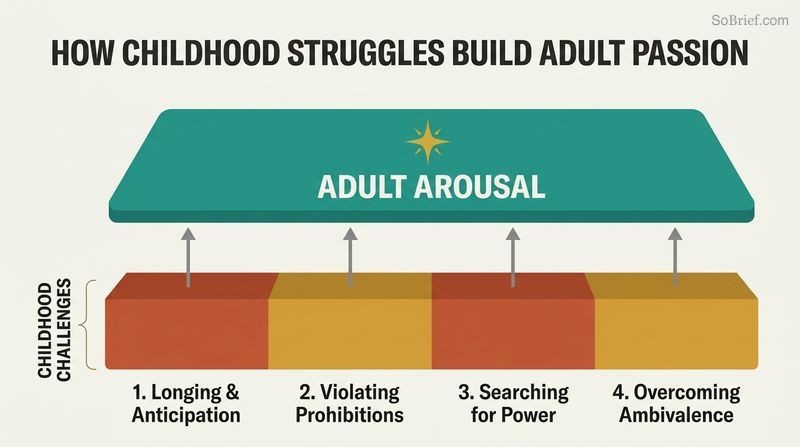
Morin's cornerstones of eroticism are universal early-life struggles that get woven into desire because each involves overcoming an obstacle:
1. Longing and anticipation (yearning for what is absent)
2. Violating prohibitions (the naughtiness factor)
3. Searching for power (dominance and submission)
4. Overcoming ambivalence (transforming mixed feelings into focused desire)
At least one appears in over three-quarters of The Group's peak experiences. The naughtiness factor shows up in 37% of encounters, rising to 69% among those raised Catholic, evidence that restrictive upbringings forge the strongest taste for forbidden thrills. Power surfaces in 56% of women's favorite fantasies and 83% of lesbians'. Morin's point is paradoxical: the very difficulties that wounded us as children get recycled into reliable engines of excitement, which is why eroticism is so individually patterned yet structurally shared.
The cornerstones resemble a developmental map laid over Freud without the determinism. What's compelling is the data on Catholic upbringing: prohibition does not extinguish desire but eroticizes the transgression itself, a finding consistent with research showing repression intensifies rather than removes preoccupation. The framework connects to attachment and trauma literature too, where early ruptures shape later relational templates. One critical note: Morin presents these as the dominant categories but concedes in his own framing they may not be exhaustive. Cross-culturally, societies with radically different prohibition structures might generate different cornerstones, suggesting these are partly artifacts of Western, sex-negative, individualistic child-rearing rather than human universals.
Anxiety, guilt, and anger can supercharge arousal, not just kill it
Morin calls these the unexpected aphrodisiacs. Conventional sex therapy treats anxiety and guilt purely as obstacles to remove. Morin insists they are paradoxical: the same feeling that wrecks sex in one moment intensifies it in another. He divides emotions into response emotions (exuberance, satisfaction) that follow arousal, and emotional aphrodisiacs (closeness, anxiety, guilt, anger) that generate it.
Ron's story shows the mechanism. Having an affair with his employer's wife in a pub cellar, with her husband pouring pints directly overhead, Ron felt terror and the most intense arousal of his life. Yet he could lose his erection simply because a roommate was in the next room. The difference: when anxiety interweaves with arousal from the start, the two climb together; when fear arrives first, it strangles desire. These emotions usually work best in small doses, in the background.
This is the book's most counterintuitive and clinically useful claim. It aligns with misattribution of arousal research, notably the famous shaky-bridge study where fear-induced physiological activation got relabeled as attraction. Physiologically, fear and sexual arousal share sympathetic nervous system signatures: elevated heart rate, heightened sensation. Morin's dosage caveat matters enormously, though. The same mechanism that adds spice can, at higher intensities or with the wrong timing, produce dysfunction or trauma reenactment. The honest reading is that these emotions are amplifiers, not additives, magnifying whatever erotic charge already exists rather than reliably creating it, which makes them powerful but unpredictable tools.
Your hottest fantasy is a formula for healing an old wound
The Core Erotic Theme (CET) is Morin's central concept: a single, deeply personal scenario underlying your most compelling turn-ons that converts unfinished emotional business from childhood into excitement. Roughly two-thirds of The Group said 80% or more of their fantasies share their favorite one's theme, often unchanged for ten-plus years.
Jana's case maps it cleanly. Her recurring fantasy: being relentlessly pursued by a determined man until she surrenders. The root: growing up feeling ugly and second-best to a prettier sister, crying herself to sleep. Her CET reverses that wound, she becomes the irresistibly desired one, winning the attention she craved. Morin describes two processes: exporting (being valued for what you offer) and importing (absorbing qualities you lack from a partner). The CET is not a prison; bringing it into consciousness expands choice rather than eliminating desire.
The CET is the book's signature contribution, sitting between Robert Stoller's erotic scenario and John Money's lovemap but more accessible. Its therapeutic power lies in reframing shame: a fantasy that feels deviant becomes legible as ingenious self-repair. This resonates with schema therapy and Jungian individuation, where symptoms encode unmet needs. The empirical caveat is real, though: Morin himself acknowledges these themes resist clean categorization or counting, so the CET is an interpretive lens, not a measurable construct. Its falsifiability is weak, much like psychoanalytic readings generally. Still, as a tool for self-understanding rather than prediction, its clinical utility appears genuine, and the durability data (decade-long stable fantasies) is provocative.
The same turn-on that thrills you can quietly sabotage your life
Troublesome turn-ons arise when a CET perpetuates the very pain it tries to solve. Morin maps three traps:
1. Feeling side effects (anxiety or guilt that once excited now blocks arousal)
2. Troublesome attractions (repeatedly choosing unavailable or hurtful partners)
3. Love-lust conflicts (inability to feel desire and affection for the same person)
Maggie embodies the second. She chased only unavailable men, culminating in a four-year affair with a married man, then mourned a relationship that never existed. Her insight cut deep: what truly aroused her was almost being loved. Her childhood taught her longing as a way of life, modeling her sad, neglected mother. To choose a man who would love her fully meant betraying that template. The pattern works erotically while guaranteeing emotional starvation, the cruel signature of a turn-on turned against you.
This is where Morin's framework earns its clinical stripes by explaining repetition compulsion without jargon. Maggie's almost being loved captures the intermittent-reinforcement trap with literary precision: partial, unpredictable reward is more bonding than reliable affection, which is why ambivalent partners feel magnetic and steady ones feel boring. The loyalty-to-mother insight adds an underappreciated dimension: people unconsciously refuse fulfillment that would require surpassing or betraying a parent. This connects to family-systems theory and Bowen's concept of differentiation. The actionable edge: recognizing that your erotic pattern is solving a problem you no longer have is the first step to choosing partners by different criteria.
When self-hatred fuses with arousal, you get the most destructive turn-on
Eroticized self-hate is Morin's darkest category. When deeply negative core beliefs (convictions formed in early childhood about being worthless or flawed) get woven into arousal, the erotic mind finds indirect routes to affirmation that paradoxically reconfirm the wound.
Regina cut her wrists before entering therapy. Sexually abused by her stepfather from age six, she had become a compulsive seductress whose vagina involuntarily clamped shut during intercourse (vaginismus). Her core belief: she had value only as a sex object, the one role that earned her stepfather's fleeting tenderness. Seducing men let her become master of her exploitation rather than its helpless victim. Morin notes a chilling pattern: as such people build genuine self-esteem, their old turn-ons can intensify or collapse, triggering an erotic crisis, because feeling worthy becomes incompatible with the scenario that secretly required feeling worthless.
This section is the book's most ethically and clinically serious, and Morin handles it with appropriate gravity. The insight that rising self-esteem can destabilize a trauma-rooted erotic pattern is genuinely important and underdiscussed, mirroring findings in trauma therapy where improvement provokes paradoxical relapse as old coping structures lose their function. Regina's case shows masochism as mastery, reframing helplessness as authorship, which aligns with Stoller's analysis. A necessary caution for readers: Morin wrote in the 1990s, and his cautious handling of recovered memories and false memories was prescient. This material demands professional support, not self-diagnosis, a boundary Morin himself repeatedly stresses.
Fight a compulsive sexual urge head-on and it grows stronger
Struggle is the fuel for compulsion. Morin argues the abstinence model that works for alcohol backfires for sexual compulsions, because the erotic equation guarantees that resisting a desire adds an obstacle that intensifies it. You cannot sever the relationship with your own eroticism the way an alcoholic abstains from drink.
Ryan called himself a sex addict a decade before the term was fashionable. His telephone sex and porn obsession escalated precisely through his fighting it. Morin's seven-step change program emphasizes self-affirmation over self-criticism and aiming at what you want rather than what you want to stop. He notes that twelve-step sex programs are among the least successful, plagued by endless slips, because their premature focus on abstinence amplifies the very urges they target. Healing comes from claiming an expanding range of self-affirming choices, not from white-knuckled prohibition.
This directly challenges the sex-addiction-industrial-complex and remains contested. Morin's mechanism, prohibition as eroticizing obstacle, is theoretically consistent with his framework and finds support in ironic process theory, where thought suppression increases intrusion frequency. It also echoes harm-reduction and acceptance-based approaches that have gained traction in addiction science generally. The counterargument deserves airing: for behaviors causing genuine catastrophic harm, some structure and interruption are clearly necessary, and Morin concedes voluntary moratoriums have a place. The nuance is timing, not principle: he opposes premature abstinence imposed before internal consensus, not all boundaries. The distinction between secrecy and privacy he draws elsewhere reinforces a non-shaming stance.
Deepening closeness slowly dissolves the obstacles passion needs
The intimacy-passion paradox is the cruelest finding for long-term couples. Citing Tripp, Morin observes that as partners achieve genuine closeness and compatibility, their erotic zest for each other tends to decline, because intimacy erases the distance and otherness that fuel desire. The best relationships can make passion most elusive.
Erotic couples counter this with learnable skills, not luck. In Blumstein and Schwartz's study of thousands of couples, frequency dropped over time for everyone, yet most kept enjoying sex. Successful long-term couples deliberately preserve separateness, cultivate warm sex (calm sensuality and affection that does not aim at high arousal or orgasm), sustain attraction by actively remembering what drew them together, and protect privacy. Morin found no couple able to rebuild an erotic connection after they had stopped seeing each other in a sexual light for five or more years.
This is the most consequential takeaway for the average reader, and it contradicts the popular therapeutic dogma that better communication automatically yields better sex. Esther Perel built a career elaborating exactly this tension between security and desire, between the comfort of belonging and the thrill of the unknown. Morin's electric-spark metaphor (passion needs a gap) gives it physical intuition. The warm-sex concept is practically valuable: it reframes low-arousal physical affection as maintenance of the erotic bond rather than failed sex. The five-year point of no return is a sobering, falsifiable-sounding claim that deserves empirical testing, but clinically it underscores the cost of letting a sexual connection go entirely dormant.
Treat fantasy and action as separate countries with a guarded border
Differentiating fantasy from behavior is, for Morin, a signpost of erotic health and a public-safety issue. Thinking is not doing. He argues humans cannot corral every wayward thought, and that people who panic over impure fantasies become so consumed by guilt they make worse real-world choices.
His critique of the antipornography movement is pointed: by treating disturbing images as equivalent to destructive acts, it blurs the very fantasy-action boundary whose erasure enables harm. Citing Stoller, Morin notes that what distinguishes people who are perverse may be precisely that they stay aroused while actually doing what others only imagine. Healthy people enjoy dark or taboo fantasies freely while choosing wisely in reality, because they know the difference. The line that matters is not pure thoughts versus impure ones, but consensual versus coercive behavior.
This argument was ahead of its time and has aged well against subsequent research showing no simple causal link between fantasy content and behavior, and that the overwhelming majority of people with taboo fantasies never act on them. The fantasy-as-safe-container idea aligns with how clinicians now use imaginative rehearsal therapeutically. Morin's claim that sex offenders often show impoverished rather than excessive fantasy lives is intriguing and partially supported by literature on deficits in offenders' inner worlds. The challenge worth noting: the boundary is not always clean for everyone, and Morin acknowledges the erotic mind refuses pigeonholing. His pragmatic ethic, judge conduct by consent rather than thoughts by purity, remains a sound compass.
Build your sexual ethics from lived values, not inherited prohibitions
Morin rejects two extremes: rigid don't-do-it morality that breeds the forbidden-fruit fascination it tries to suppress, and the empty if-it-feels-good-do-it credo of the 1970s that collapsed once detached from any sense of how one wants to live. His alternative rests on three principles:
1. Respecting self and others (consent is the bedrock; no one owes sex to anyone)
2. Facing your erotic shadow (acknowledging your dark impulses rather than denying them)
3. Claiming the responsibilities of freedom (owning the consequences of your choices)
The key skill is suspending judgment to see clearly, then applying values to guide action. Morin notes a deep irony: only by courageously examining difficult erotic truths, including the predatory potential in lust and love, can someone build an ethical system that actually governs behavior rather than merely shaming thought.
This is a mature moral philosophy that resists both authoritarianism and relativism, resembling virtue ethics more than rule-based deontology: character and discernment over checklists. The shadow concept, borrowed from Jung, is psychologically astute, integrating denied material reduces its power to erupt destructively, a principle supported across clinical traditions. Morin's claim that prohibition breeds fascination has strong support, yet his framework places heavy weight on individual self-examination, which assumes a level of introspective capacity and safety not everyone possesses. The consent-as-bedrock principle has only grown more central since the 1990s. What dates well is his insistence that suppressing eros drives it into the shadows, where it assumes the shapes we most fear.
Peak sex heals because it momentarily silences your inner critic
Fulfillment and excitement become indistinguishable at the peak. Analyzing The Group's stories, Morin identified five recurring subjective responses, ranked by frequency:
1. Sensual and orgasmic intensity
2. Reduced inhibitions
3. Validation given and received
4. Mutuality and resonance
5. Transcendence of personal boundaries
The intensity is not extra nerve sensitivity, which actually drops as arousal climbs; it is total absorption that screens out everything else, an altered state akin to hypnosis Morin calls a sexual trance. Maslow described peaks as a momentary loss of fear, inhibition, and defense. One man, Harold, who hated being touched his whole life, described a morning when his wife's caresses suddenly electrified his whole body, recovering an innocent delight in his physical self. Peak sex validates because it counteracts the self-doubt your CET works to overcome.
Ending on the rewards rather than the pathology reframes the entire project: eroticism is not just neurosis recycled but a route to self-transcendence. The sexual-trance concept anticipates later work on flow states and absorption, and Csikszentmihalyi's flow research (which Morin cites) shows the self emerges more complex after such experiences through simultaneous differentiation and integration. The validation theme connects to self-determination theory, where feeling seen and affirmed meets a core psychological need. Harold's case poignantly illustrates that reduced inhibition can reopen access to pre-shame embodiment. The transcendence material, linking peak sex to spiritual experience and Tantra, challenges the religious framing that severs body from spirit, a divide Morin argues impoverishes both.
Analysis
The Erotic Mind is a thesis-driven psychology book built on an unusual evidence base: Jack Morin's Sexual Excitement Survey, a qualitative trove of over 1,000 detailed peak encounters and fantasies from 351 respondents, combined with decades of clinical case material. Its difficulty for a summarizer is that the book's value lives in granular, often explicit narratives, and its central constructs (the erotic equation, cornerstones, Core Erotic Theme) are interpretive frameworks rather than measurable findings.
What distinguishes Morin is the paradoxical perspective. Against both the pathology model (eros as dangerous drive to be tamed) and the neat-and-clean model of mainstream sex therapy (eros as natural function blocked only by anxiety and guilt), he insists that anything inhibiting arousal can also amplify it, and vice versa. This single move dissolves the false binary of good versus bad sex and reframes obstacles, negative emotions, and even old wounds as fuel. It is intellectually closer to Jung and the depth-psychology tradition than to behaviorism, yet written for a lay reader.
The book's lasting influence is visible in later popular work, especially Esther Perel's exploration of the intimacy-desire tension, which Morin articulated crisply through the spark-and-gap metaphor. His differentiation of fantasy from action, his harm-reduction skepticism toward the sex-addiction and antiporn movements, and his consent-centered ethics were ahead of their cultural moment.
The principal weakness is epistemic: the CET and cornerstones resist falsification, and the sample skews introspective, verbal, and educated, limiting generalizability. Morin is admirably candid about both. The work is best read not as science but as a clinically grounded interpretive map, a way of seeing that expands the reader's range of conscious erotic choice. Its enduring contribution is reframing shame: the turn-ons that feel deviant are revealed as ingenious, if sometimes costly, attempts at self-repair, which makes self-understanding, rather than self-correction, the path to fulfillment.
Review Summary
The Erotic Mind is widely praised as an insightful exploration of human sexuality and eroticism. Readers appreciate Morin's non-judgmental approach, the book's blend of case studies and self-assessment tools, and its exploration of core erotic themes. Many found it eye-opening and helpful for self-discovery. The book is commended for its clear writing, scientific basis, and relevance even decades after publication. Some readers found it dry or overly clinical, but most consider it a valuable resource for understanding sexuality and relationships.
People Also Read






FAQ
1. What is The Erotic Mind by Jack Morin about?
- Exploration of erotic psychology: The book investigates the inner workings of sexual passion, focusing on the psychological and emotional sources of arousal rather than just physical acts.
- Paradoxical nature of desire: Morin emphasizes the complex, often contradictory dynamics of eroticism, where obstacles and emotions can both inhibit and intensify passion.
- Self-discovery and fulfillment: Readers are guided to explore their own erotic experiences and fantasies to uncover personal patterns, leading to greater sexual satisfaction and self-understanding.
- Therapeutic and practical insights: The book draws on clinical cases and research to offer pathways for healing, growth, and sustaining passion in relationships.
2. Why should I read The Erotic Mind by Jack Morin?
- Bridges knowledge gaps: The book addresses the often-overlooked psychology of arousal, providing insights into how the mind shapes sexual enthusiasm and fulfillment.
- Tools for self-exploration: Morin offers practical methods, such as the Sexual Excitement Survey and erotic journaling, to help readers understand their own erotic minds.
- Promotes healthier sexuality: By embracing the paradoxes of eroticism, readers can resolve sexual problems, improve relationships, and sustain passion over time.
- Empowerment and healing: The book provides a compassionate framework for overcoming sexual difficulties, including those rooted in trauma or conflicting feelings.
3. What are the key takeaways from The Erotic Mind by Jack Morin?
- Core Erotic Theme (CET): Each person has a unique, unconscious blueprint for arousal shaped by early experiences and emotional conflicts.
- Paradoxical perspective: Erotic health involves embracing contradictions—what inhibits arousal can also enhance it, and emotions like anxiety or guilt can act as unexpected aphrodisiacs.
- Importance of obstacles: Sexual excitement often arises from the interplay of attraction and obstacles, making desire dynamic and unpredictable.
- Pathways to growth: Self-awareness, nonjudgmental exploration, and conscious change are essential for healing and sustaining erotic fulfillment.
4. What is the "erotic equation" in The Erotic Mind by Jack Morin and why is it important?
- Definition: The erotic equation is ATTRACTION + OBSTACLES = EXCITEMENT, highlighting that sexual excitement is fueled by both desire and the presence of barriers.
- Explains desire dynamics: This equation clarifies why unavailable or resistant partners can intensify longing and erotic tension.
- Foundation for paradox: It underpins Morin’s paradoxical perspective, showing that inhibitions and challenges can actually enhance arousal.
- Guides self-understanding: Recognizing this dynamic helps readers understand their own patterns of desire and attraction.
5. What are the "four cornerstones of eroticism" in The Erotic Mind by Jack Morin?
- Longing and Anticipation: The excitement of waiting and wanting intensifies desire and makes experiences more memorable.
- Violating Prohibitions: Breaking rules or taboos can heighten arousal by adding a sense of danger or transgression.
- Searching for Power: Erotic experiences often involve dynamics of dominance, submission, or control, reflecting deeper psychological needs.
- Overcoming Ambivalence: Navigating mixed feelings or internal conflicts can create powerful erotic energy and deepen fulfillment.
6. What is a Core Erotic Theme (CET) according to The Erotic Mind by Jack Morin?
- Personal erotic blueprint: A CET is a deeply ingrained, unconscious pattern that shapes an individual’s erotic desires and turn-ons, often rooted in early life experiences.
- Links past and present: CETs connect current sexual attractions and fantasies with unresolved childhood wounds or emotional conflicts.
- Influences behavior: They affect partner selection, sexual scripts, and the types of scenarios that are most arousing.
- Pathway to healing: Understanding one’s CET can transform old emotional pain into sources of excitement and fulfillment.
7. How does The Erotic Mind by Jack Morin explain the relationship between love and lust?
- Love-lust dichotomy: Morin explores how people often either fuse love and lust or keep them separate, both of which can cause sexual dissatisfaction or dysfunction.
- Zone of interaction: The healthiest erotic relationships maintain a "zone of interaction" where love and lust overlap, especially during the early, limerent phase.
- Therapeutic insight: Recognizing and cultivating this overlap is key to sustaining passion and intimacy in long-term relationships.
- Case examples: The book uses real-life cases to illustrate how unresolved love-lust conflicts can inhibit orgasm and closeness.
8. How do emotions function as aphrodisiacs in The Erotic Mind by Jack Morin?
- Emotional energizers: Emotions like exuberance, satisfaction, closeness, anxiety, guilt, and anger can all intensify sexual arousal.
- Paradoxical effects: While some emotions can disrupt arousal, in the right context, anxiety, guilt, and anger can actually enhance excitement.
- Emotional transformation: During sexual experiences, negative emotions can shift into positive ones, releasing bursts of erotic energy.
- Fluidity of feelings: The book highlights how feelings are not fixed and can be harnessed to deepen erotic fulfillment.
9. What are "troublesome turn-ons" in The Erotic Mind by Jack Morin and how do they affect sexual fulfillment?
- Paradox of arousal: Some erotic patterns that heighten excitement can also cause problems, such as inhibiting desire or leading to unworkable relationships.
- Emotional side effects: Intense emotions like anxiety or guilt can become antiaphrodisiacs if unmanageable, resulting in sexual dysfunction.
- Repetitive patterns: People may unconsciously repeat harmful erotic scripts linked to unresolved childhood issues, perpetuating cycles of frustration.
- Path to change: Morin outlines steps for recognizing and transforming these patterns to reclaim erotic health.
10. How does The Erotic Mind by Jack Morin address the impact of childhood abuse and low self-esteem on sexuality?
- Core beliefs and self-worth: Childhood abuse and neglect can create negative core beliefs that become intertwined with erotic patterns, leading to self-destructive behaviors.
- Eroticized self-hate: Trauma may result in a fusion of pleasure and pain, causing compulsive or avoidant sexual behaviors.
- Case studies: The book presents real-life examples to illustrate how trauma shapes sexual scripts and perpetuates cycles of exploitation or secrecy.
- Healing approach: Morin emphasizes truth-telling, compassion, and professional support as essential for transforming destructive patterns.
11. What practical advice does The Erotic Mind by Jack Morin offer for sustaining passion in long-term relationships?
- Balance intimacy and passion: The book explains that passion thrives on novelty and contrast, while intimacy grows from comfort and similarity, requiring conscious effort to balance both.
- Communication skills: Morin encourages positive feedback, well-timed discussions, and active listening to maintain desire and connection.
- Warm sex and attraction: Couples are advised to cultivate sensuality and affection without pressure, and to appreciate both familiar and new qualities in each other.
- Flexibility and creativity: Successful couples adapt to changes, negotiate relationship boundaries, and honor each other’s Core Erotic Themes.
12. What is the "paradoxical perspective" on erotic health in The Erotic Mind by Jack Morin?
- Beyond absence of dysfunction: Morin argues that erotic health is not just about avoiding problems, but about integrating conflicting emotions and desires.
- Embracing contradictions: Healthy sexuality involves recognizing and working with the paradoxes inherent in erotic life.
- Signposts of health: Abilities like enjoying peak experiences, acknowledging childhood wounds, and balancing love and lust are key indicators.
- Ongoing journey: Erotic health is a dynamic, lifelong process requiring self-awareness, compassion, and the courage to face ambiguity.

Download PDF
Download EPUB
.epub digital book format is ideal for reading ebooks on phones, tablets, and e-readers.








































