
Plot Summary
Dawn in the Café
In the early morning gloom, the manager of the Café des Allies moves through his habitual motions, arranging tables and chairs with mechanical precision. The city outside is still, but the peace is deceptive. The manager's thoughts drift between mundane concerns and the recent shooting of Daniel Dupont, a local academic. The event, though seemingly minor, has already begun to unravel the day's order, introducing confusion and uncertainty. The manager's memories and regrets mingle with the present, haunted by the specter of his lost love, Pauline, and the persistent stains—literal and figurative—on the café's marble. The city, like the manager, is on the cusp of awakening to a day that will be anything but ordinary.
Failed Assassination Attempt
Garinati, a nervous, clumsy hitman, reflects on his failed attempt to kill Daniel Dupont. He had meticulously followed instructions, sneaking into Dupont's house with the intent to murder, but a small error—leaving the light on—ruined the plan. Instead of a clean kill, Dupont is only wounded. Garinati's anxiety grows as he replays the event, uncertain if his mistake will be forgiven by his superior, Bona. The city's dreary streets and the canal's oily water mirror his sense of failure and the growing sense that the machinery of conspiracy is far larger and more relentless than any individual.
Dupont's Disappearance
Contrary to public reports, Daniel Dupont is not dead. In a clandestine clinic, he conspires with Doctor Juard and an associate, Marchat, to fake his death for political reasons. Dupont's wound is real but not fatal, and the ruse is meant to protect him from a shadowy organization targeting influential figures. The plan is fraught with risk and secrecy, requiring the complicity of the doctor and the silence of his housekeeper, Anna. The city's authorities are kept in the dark, and the press is fed a carefully crafted narrative. Dupont's "death" becomes a pivot for further intrigue.
The Investigation Begins
Wallas, a special agent from the capital, arrives to investigate Dupont's supposed murder. He is methodical, observant, and somewhat out of place in the provincial city. His investigation is hampered by bureaucratic indifference, unreliable witnesses, and the city's confusing geography. The local police, led by Commissioner Laurent, are content to let the case go, suspecting either suicide or a crime beyond their reach. Wallas's outsider status and his own uncertainties make progress slow, as he tries to piece together the truth from a web of conflicting stories and elusive clues.
The City's Labyrinth
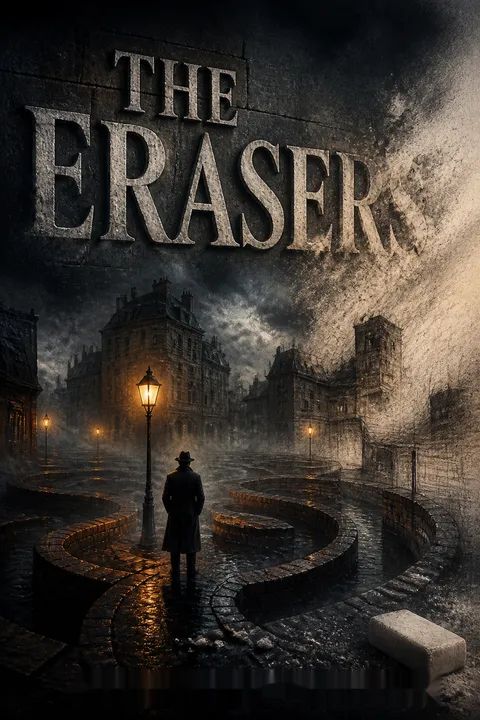
The city itself becomes a character, its streets and canals forming a bewildering labyrinth that mirrors the investigation's complexity. Wallas's attempts to navigate the city are marked by wrong turns, dead ends, and circular routes. The city's architecture—its austere brick offices, somber canals, and modest shops—embodies the monotony and opacity of daily life, while also hiding secrets. Encounters with locals, from a woman with a broom to a drunk with riddles, add to the sense of dislocation and the difficulty of distinguishing meaningful clues from background noise.
The Eraser's Trail
Wallas's search for a particular kind of eraser—a soft, crumbly one—becomes a recurring motif, symbolizing the desire to erase mistakes, memories, or even identities. The eraser, mundane yet elusive, parallels the investigation's central question: what can be erased, and what remains? The motif extends to the city's attempts to cover up or rewrite the truth about Dupont's fate, and to the characters' efforts to escape their pasts. The eraser is both a literal object and a metaphor for the mechanisms of forgetting, denial, and the rewriting of history.
Conspirators and Doubt
The conspiratorial network behind the attacks on figures like Dupont is revealed to be both highly organized and riddled with uncertainty. Bona, the mastermind, is frustrated by Garinati's incompetence and the unpredictability of events. The organization's members are plagued by doubt, fear, and the sense that their actions are being manipulated by forces beyond their control. Wallas, meanwhile, struggles to determine who can be trusted, as every witness and suspect seems to have their own agenda. The boundaries between victim, perpetrator, and investigator blur.
Wallas in Pursuit
Wallas's investigation leads him through a series of encounters with ambiguous figures: a drunk who may have witnessed the crime, a woman who may be Dupont's estranged wife, and a mysterious man in a green coat. Each encounter raises more questions than answers, and Wallas finds himself increasingly uncertain of his own role. He is mistaken for others, and others are mistaken for him. The investigation becomes a search not only for the truth about Dupont, but for the nature of identity itself in a world where everyone is playing a part.
The Post Office Clue
A crucial clue emerges at the post office: a letter addressed to "Andre WS," a pseudonym possibly linked to the conspirators. Wallas's resemblance to the man who usually collects the mail adds to the confusion, as does the testimony of the post office staff, who recall details inconsistently. The letter's cryptic contents suggest a rendezvous and hint at further violence. The post office, with its bureaucratic rituals and anonymous transactions, becomes a microcosm of the city's larger opacity and the difficulty of tracing responsibility in a world of aliases and intermediaries.
The Many Faces of Truth
As Wallas interviews more witnesses and reviews police reports, the story of Dupont's death becomes increasingly fragmented. Competing theories—murder, suicide, blackmail, political intrigue—are all plausible, yet none can be definitively proven. The inspector's report introduces the possibility of a family dispute, while others suggest a professional hit or a staged suicide. The truth remains elusive, shaped by the perspectives and prejudices of those who tell it. Wallas, like the reader, is left to navigate a maze of partial truths and deliberate obfuscations.
The Shadow of Suicide
The possibility that Dupont killed himself, and that his death was staged to look like murder, haunts the investigation. The narrative delves into Dupont's psychology: his isolation, his meticulousness, his sense of exhaustion. Suicide, in this context, is both an act of agency and a final erasure—a way to control the narrative of one's own life and death. Yet even this explanation is undermined by conflicting evidence and the manipulations of those around him. The line between suicide and murder, between victim and perpetrator, is blurred beyond recognition.
The Rendezvous at Dusk
Acting on a cryptic message, Wallas returns to Dupont's house at the appointed hour, prepared for a confrontation. The house, now empty and silent, becomes a stage for the final act. Wallas positions himself in the study, revolver in hand, waiting for the arrival of the supposed killer. The tension is palpable, as the boundaries between hunter and hunted dissolve. The city outside is shrouded in fog and darkness, mirroring the uncertainty and danger within.
The Fatal Encounter
The anticipated confrontation unfolds with sudden violence. A man enters—disguised, armed, and equally wary. In the confusion, Wallas fires first, killing the intruder. Only afterward does he realize the man was not the expected assassin, but Dupont himself, returning in disguise to retrieve important papers. The tragic irony is complete: the investigator, seeking to prevent a murder, has become the unwitting murderer. The cycle of misunderstanding, mistaken identity, and fatal error is unbroken.
Aftermath and Realizations
The aftermath is marked by exhaustion, bureaucratic procedures, and a sense of futility. Wallas, traumatized and disillusioned, is left to grapple with the consequences of his actions. The police, eager to close the case, focus on procedural details and the restoration of order. The city resumes its routines, indifferent to the tragedy that has unfolded. Wallas's own identity is called into question, as he is mistaken for others and struggles to distinguish himself from the roles he has played.
The City Resumes
As dawn breaks once more, the city returns to its habitual rhythms. The manager of the café resumes his mechanical tasks, haunted by memories and regrets. Wallas, exhausted and alienated, prepares to leave, his investigation unresolved and his sense of self fractured. The conspirators remain at large, the truth about Dupont's death is buried beneath layers of confusion, and the city's labyrinthine streets continue to swallow secrets. The cycle of erasure, misunderstanding, and routine persists, indifferent to individual suffering or the search for meaning.
Analysis
Alain Robbe-Grillet's The Erasers is a masterful exploration of ambiguity, repetition, and the impossibility of definitive truth. Through its fragmented narrative, shifting perspectives, and symbolic motifs, the novel deconstructs the conventions of detective fiction, replacing the search for a single solution with a meditation on uncertainty and the limits of knowledge. The city's labyrinthine streets and the recurring motif of the eraser encapsulate the characters' desire to erase the past, rewrite identities, and impose order on chaos—efforts that are ultimately doomed to failure. The tragic irony of Wallas's investigation, culminating in his unwitting killing of Dupont, underscores the futility of human intention in a world governed by chance, misunderstanding, and the relentless machinery of routine. The novel's modernist sensibility anticipates postmodern concerns with the instability of meaning, the multiplicity of narratives, and the constructedness of reality. In the end, The Erasers offers no resolution, only the return to routine and the persistence of unanswered questions—a powerful commentary on the human condition in an age of uncertainty.
Review Summary
The Erasers receives praise for its experimental structure and maze-like narrative that blurs reality and perception. Reviewers highlight Robbe-Grillet's obsessive attention to physical details and objects, his circular plot structure, and connections to the Oedipus myth. The novel is described as a deconstructed detective story where the investigation itself matters more than solving the crime. While some find it brilliant and groundbreaking, others struggle with its dense, repetitive descriptions and lack of traditional narrative flow. Most agree it's a challenging but rewarding introduction to the nouveau roman movement.
People Also Read


Characters
Wallas
Wallas is a special agent sent from the capital to investigate Dupont's supposed murder. He is analytical, persistent, and somewhat naive, struggling to adapt to the city's opaque social codes and labyrinthine geography. Psychologically, Wallas is marked by self-doubt and a longing for clarity in a world that resists it. His identity is fluid—he is mistaken for others, and others for him—reflecting the novel's themes of uncertainty and the instability of self. Over the course of the story, Wallas's confidence erodes as he becomes entangled in the city's web of secrets, ultimately becoming both investigator and unwitting perpetrator.
Daniel Dupont
Dupont is a reclusive academic, known for his work in political economy and his solitary habits. He is meticulous, rational, and emotionally distant, traits that both protect and isolate him. Dupont's decision to fake his own death is driven by a mix of political necessity and existential exhaustion. He is both a target and a manipulator, orchestrating his disappearance with the help of Doctor Juard. Psychologically, Dupont embodies the tension between control and surrender, agency and victimhood. His ultimate fate—killed by mistake—underscores the tragic consequences of miscommunication and the impossibility of total self-erasure.
Garinati
Garinati is the would-be assassin tasked with killing Dupont. He is nervous, insecure, and prone to mistakes, haunted by the fear of disappointing his superior, Bona. Garinati's actions are dictated by orders he only partially understands, and his sense of agency is undermined by the complexity of the conspiracy he serves. Psychologically, he is a study in guilt and impotence, his failures both personal and systemic. Garinati's journey through the city mirrors his internal confusion, and his ultimate irrelevance to the plot highlights the expendability of individuals within larger machinations.
Bona (Jean Bonaventure)
Bona is the leader of the shadowy organization orchestrating the attacks on figures like Dupont. He is calculating, detached, and intolerant of failure, viewing his subordinates as tools rather than individuals. Bona's psychological profile is marked by a sense of superiority and a belief in the inevitability of his plans. He is both omnipresent and inscrutable, his motivations rooted in political ideology and personal ambition. Bona's interactions with Garinati reveal his impatience with human weakness and his reliance on the machinery of conspiracy over individual initiative.
Doctor Juard
Doctor Juard is a surgeon and old acquaintance of Dupont, drawn into the plot to fake Dupont's death. He is cautious, anxious, and deeply conflicted, torn between loyalty to his friend and fear of the consequences. Juard's psychological state is one of perpetual unease, as he navigates the demands of secrecy, professional ethics, and self-preservation. His evasive behavior and ambiguous statements make him a suspect in the eyes of the police, and his inability to control events around him reflects the novel's themes of impotence and the limits of individual agency.
Commissioner Laurent
Laurent is the city's chief commissioner, responsible for the initial investigation into Dupont's death. He is pragmatic, cynical, and more interested in maintaining order than uncovering the truth. Laurent's psychological stance is one of resignation; he is content to let higher authorities take over difficult cases and is skeptical of grand conspiracies. His interactions with Wallas are marked by irony and a subtle power struggle, as he seeks to protect his own position while avoiding responsibility. Laurent's character highlights the limitations of institutional responses to complex, ambiguous events.
Marchat
Marchat is a businessman and reluctant participant in Dupont's scheme. He is indecisive, anxious, and easily overwhelmed by the dangers surrounding him. Psychologically, Marchat is a study in avoidance and self-preservation, constantly wavering between action and retreat. His fear of being targeted by the conspirators leads him to seek police protection, but his inability to commit to any course of action renders him ineffective. Marchat's role as a go-between underscores the novel's focus on intermediaries, miscommunication, and the paralysis induced by uncertainty.
The Manager
The manager of the Café des Allies is a minor but symbolically important character. He is gruff, disillusioned, and trapped in the monotony of daily life. Psychologically, he is burdened by regrets and memories, particularly of his lost love, Pauline. The manager's mechanical routines and his fixation on stains and imperfections reflect the novel's themes of repetition, erasure, and the persistence of the past. His interactions with customers and his indifference to the unfolding drama around him highlight the city's broader indifference to individual suffering.
Madame Smite (Anna)
Anna is Dupont's elderly, hard-of-hearing housekeeper. She is practical, loyal, and somewhat oblivious to the larger conspiracies at play. Psychologically, she is anchored in routine and the tangible details of housekeeping, more concerned with bloodstains than with the implications of violence. Her partial understanding of events and her tendency to misinterpret or ignore what she cannot comprehend make her both a witness and a symbol of the limits of perception. Anna's presence grounds the narrative in the material realities of daily life, even as larger forces swirl around her.
Evelyne (Madame Dupont)
Evelyne is Dupont's much younger, now-divorced wife. She is intelligent, independent, and reflective, offering insight into Dupont's character and the nature of their failed marriage. Psychologically, Evelyne is marked by a sense of detachment and a recognition of the impossibility of true intimacy with Dupont. Her observations about his solitude and rationality provide a counterpoint to the conspiratorial paranoia of other characters. Evelyne's role is that of a commentator, her distance from the main action allowing her to articulate the novel's themes of isolation and the limits of understanding.
Plot Devices
Nonlinear Narrative and Repetition
The novel employs a nonlinear, repetitive narrative structure, with events recounted from multiple perspectives and at different points in time. This device creates a sense of disorientation and mirrors the characters' confusion, as well as the city's labyrinthine geography. Scenes are revisited with new information, and motifs—such as the eraser, the stopped watch, and the recurring riddle—are repeated with variations, emphasizing the difficulty of establishing a coherent narrative or definitive truth.
Unreliable Narration and Multiplicity of Perspectives
The story is told through a shifting array of viewpoints, each colored by the character's biases, limitations, and psychological states. Witnesses contradict each other, official reports are incomplete or misleading, and even the protagonist's perceptions are called into question. This multiplicity of perspectives undermines the possibility of objective truth and foregrounds the novel's central concern with ambiguity, miscommunication, and the instability of meaning.
Symbolism and Motifs
Everyday objects—erasers, revolvers, post cards, clocks—are imbued with symbolic significance. The eraser, in particular, represents the desire to erase mistakes, memories, or identities, while also highlighting the impossibility of total erasure. The stopped watch and the recurring riddle about time and identity reinforce the themes of repetition, circularity, and the elusiveness of resolution. These motifs serve as anchors in a narrative otherwise marked by flux and uncertainty.
Foreshadowing and Irony
The narrative is laced with foreshadowing, as characters anticipate violence, betrayal, or failure, only to have their expectations fulfilled in unexpected ways. The ultimate irony—that Wallas, the investigator, becomes the unwitting killer of Dupont—serves as the novel's tragic climax, fulfilling the foreshadowed sense of fatal error and the futility of human intention. The use of dramatic irony, where the reader is aware of information unknown to the characters, heightens the sense of inevitability and the limitations of individual agency.
The City as Labyrinth
The city's confusing streets, canals, and neighborhoods are not merely a backdrop but an active force in the narrative. The physical labyrinth mirrors the psychological and narrative complexity of the story, reinforcing the themes of disorientation, repetition, and the difficulty of finding one's way—literally and figuratively. The city's indifference to individual drama underscores the existential isolation of the characters.
Download PDF
Download EPUB
.epub digital book format is ideal for reading ebooks on phones, tablets, and e-readers.








































