

Key Takeaways
Nobody has ever had a self — your Ego is a model you can't see through
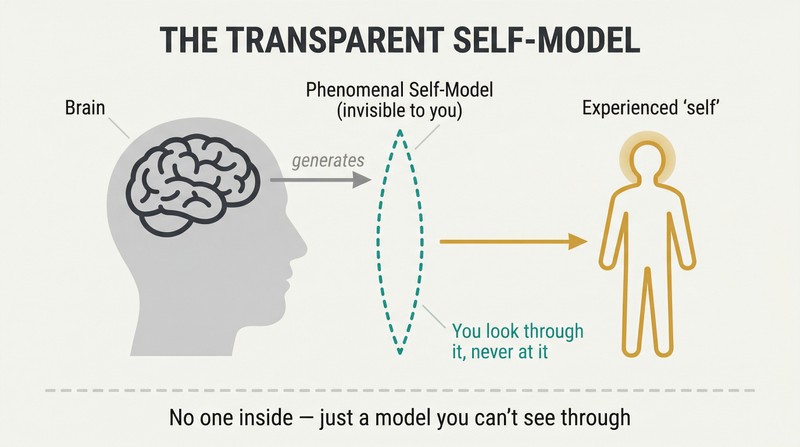
The self is a useful fiction. Metzinger's central claim: there is no indivisible entity that is "you" — not in the brain, not in a metaphysical realm. What you experience as your self is the content of the Phenomenal Self-Model (PSM), the brain's integrated, real-time image of the organism as a whole. This model includes your body, emotions, perceptions, memories, and your relationship to past and future. Crucially, this model is transparent — your brain cannot recognize it as a model. You look through it, never at it.
Like a flight simulator that generates its own virtual pilot, the brain produces the convincing experience of "being someone" without there being anyone inside to have the experience. The PSM enabled empathy, cooperation, and cultural evolution — but the Ego it creates is a tool, not a soul. We are Ego Machines, but we do not have selves.
Consciousness is a tunnel your brain paints, not a window onto reality
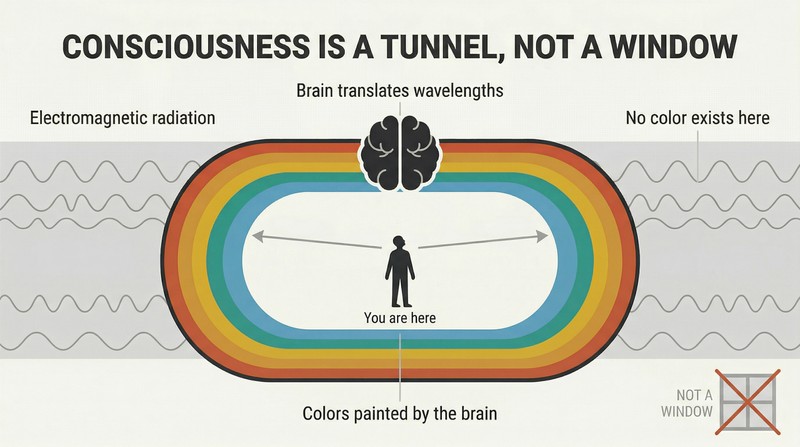
The evening sky is colorless. The apricot-pink of a sunset is a property of your brain's internal model, not of the atmosphere. Out there is only electromagnetic radiation — wavelengths your visual system selectively translates into subjective color. Many different wavelength mixtures produce identical pinks (scientists call these metamers). You can dream that color, hallucinate it, or experience it under psychedelics — all without a sunset present.
Metzinger calls consciousness an "Ego Tunnel" because sensory organs evolved for survival, not for depicting reality's full richness. What you experience is a low-dimensional projection of an inconceivably richer physical universe. Your brain drills through this overwhelming information environment and paints the tunnel walls in phenomenal color — for your conscious eyes only.
Evolution hid the simulation because seeing it costs too much sugar
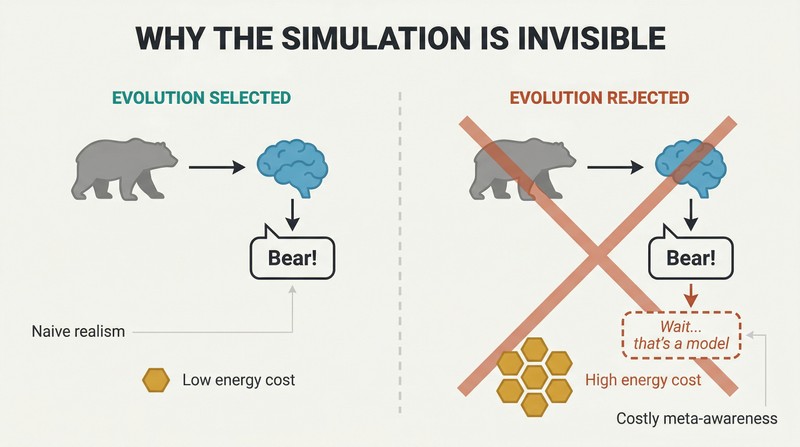
Naive realism is energy-efficient. Every cognitive upgrade requires additional glucose. Building a neural model of a charging bear is expensive enough; building a meta-model — an awareness that the bear is merely a representation in your neural circuitry — would demand even more hardware and fuel. Evolution never made that investment because "Bear over there!" was sufficient for survival. The formation of metarepresentations, or images about images, simply wasn't cost-efficient.
This is why all humans are born as naive realists — beings who mistake their mental models for direct reality. Attention cannot dissolve the illusion either: zooming in on a perception stabilizes it rather than revealing its constructed nature. The tunnel walls are impenetrable from the inside. You cannot introspect your way to the construction process.
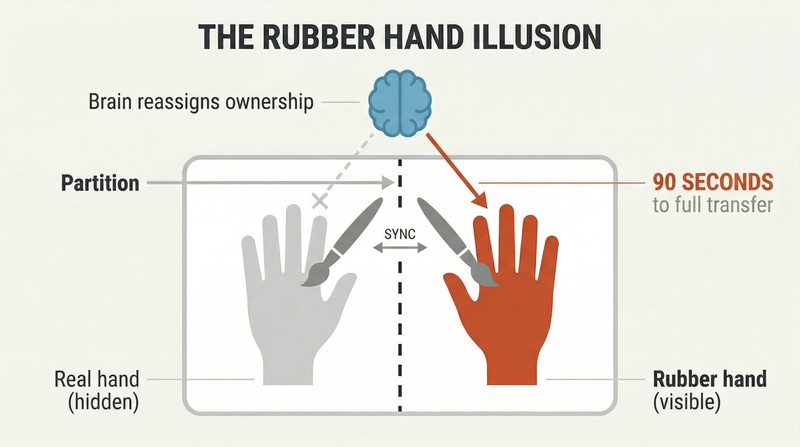
Your body ownership is so hackable, a rubber hand fools the brain in 90 seconds
You can try this at home. In Botvinick and Cohen's 1998 rubber-hand illusion, subjects watch a fake hand being stroked while their hidden real hand receives identical strokes. Within roughly 90 seconds, the brain claims the rubber hand. Subjects even show stress responses when rubber fingers are bent backward — two of 120 subjects reported actual pain.
This hackability extends everywhere. Race-car drivers feel the car's boundaries as body. Japanese macaques integrate rake tips into their body maps during tool use. Ramachandran's mirror box "plugged in" a patient's paralyzed phantom arm through matching visual feedback — the patient gasped, "My left arm is plugged in again!" Your body image is not a fixed photograph but a continuously updated virtual prediction. You are never in direct contact with your physical body.
Out-of-body experiences probably gave rise to humanity's concept of a 'soul'
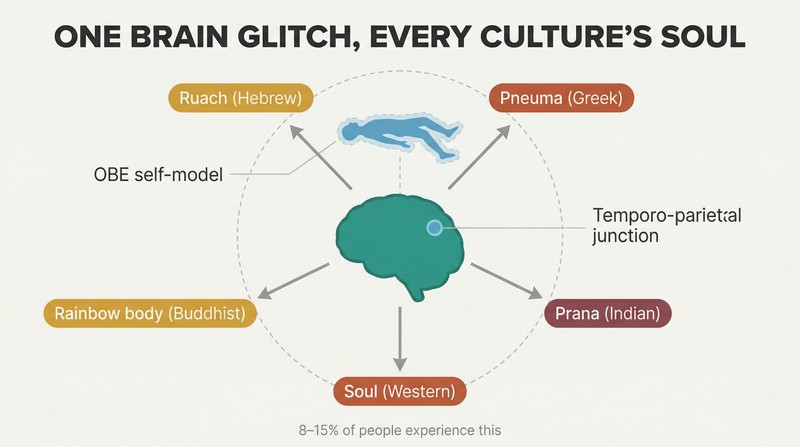
Between 8 and 15 percent of people have had at least one out-of-body experience. Neuroscientist Olaf Blanke triggered OBEs by electrically stimulating the right angular gyrus of an epileptic patient — at 3.5 milliamperes, she reported seeing herself lying in bed from above. Metzinger himself experienced OBEs as a young man and spent years attempting verifiable observations in the disembodied state. He never succeeded.
Metzinger proposes that every culture's concept of a soul — the Hebrew ruach, Greek pneuma, Indian prana, Buddhist "rainbow body" — traces back to the self-model experienced during neurological OBE events. The "subtle body" found in all spiritual traditions isn't made of angel stuff. It's made of information flowing in the brain during multisensory disintegration at the temporo-parietal junction.
Free will feels spontaneous because you only see the middle of the chain
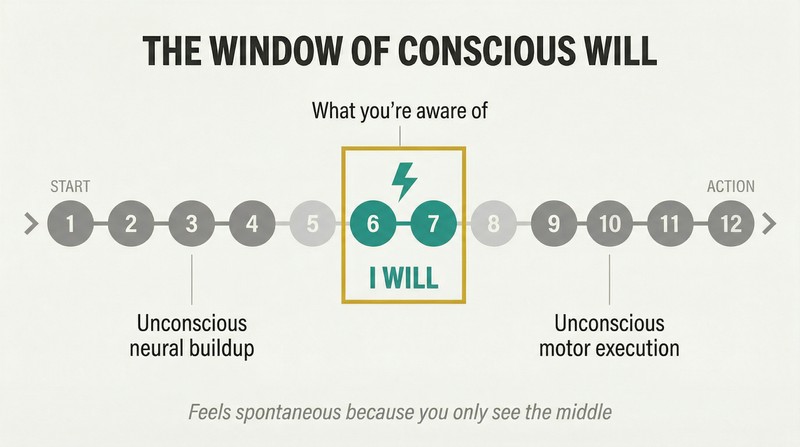
You can hallucinate willing. In Wegner and Wheatley's "I Spy" experiment, subjects moved a cursor Ouija-board style with a hidden confederate who forced stops at specific moments. When subjects had just heard a word matching the target object, they rated the forced stop as their own intentional action. Three conditions produce the illusion of will: the thought matches the action, precedes it, and no alternative cause is apparent.
Brain stimulation deepens the puzzle. Kremer's team triggered an irresistible "urge to grasp" by stimulating a patient's anterior cingulate cortex — the urge switched on and off with the current. Neuroscientist Patrick Haggard's research shows our awareness of intention is tied to assembling motor commands, not executing them. We introspect only a sliver of a much longer unconscious process.
False awakenings prove you can never verify you're truly awake
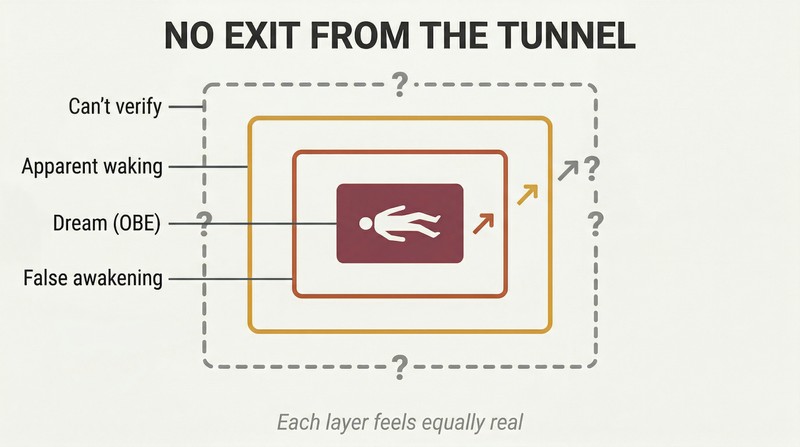
Metzinger woke up twice. He fell asleep, experienced a vivid OBE, then "woke up" and excitedly told his sister — only to truly awake and discover the entire sequence, including the awakening and the conversation, had been a dream. He sat frozen for five minutes, afraid that moving might trigger yet another layer of waking.
Lucid dreams deepen the problem. In lucid dreams, the dreamer knows she's dreaming, possesses full memory and agency, and can even signal researchers through deliberate eye movements — as Stanford's Stephen LaBerge demonstrated via polygraphy, establishing rare "trans-tunnel communication" between dream and waking states. Yet even lucid dreams can dissolve into false awakenings. Vividness and coherence guarantee nothing about contact with reality.
You decode others' minds by involuntarily simulating them in your own body
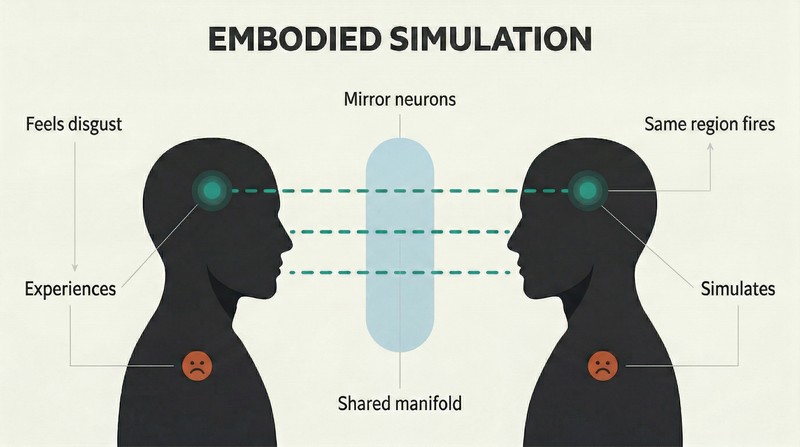
Mirror neurons fire both ways. Discovered in the 1990s at the University of Parma, these neurons activate both when a monkey performs an action and when it observes another agent performing the same action. Humans possess a more generalized version extending to emotions and pain: when you see disgust on someone's face, the same insular cortex regions activate as when you smell something revolting.
Vittorio Gallese calls this embodied simulation — we use our own body-model to virtually replicate others' experiences, creating what he terms a "shared manifold" of intersubjective understanding. This mechanism preceded language by millions of years and may have seeded it: Broca's area, crucial for speech, also contains a motor representation of the hand, suggesting meaning was first communicated through gestures, not sounds.
Consciousness is a virtual organ that flags the dangerous present
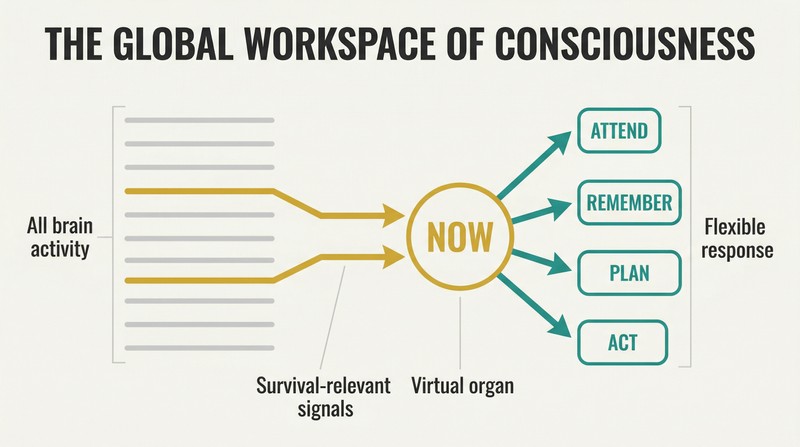
Why bother with a world that appears? Bernard Baars's global-workspace theory holds that conscious information is exactly that subset of brain data whose next use is unpredictable — will you need to attend to it, remember it, think about it, or act on it? Consciousness makes that information available to every cognitive capacity simultaneously, within a virtual "Now."
Metzinger calls conscious states "virtual organs" — like the immune response, they activate when needed and dissolve when finished. A transparent world-model let organisms compare actual situations with simulated alternatives, plan escapes, and evaluate goals. This is consciousness's core evolutionary function: representing that something is actually the case, right now, and making that fact available for flexible, context-sensitive action.
One in five scientists already enhance their brains; drug policy is medieval
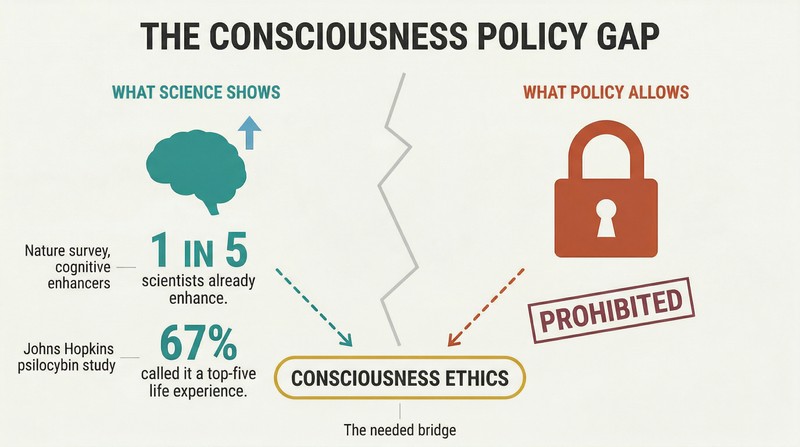
The homework was never done. A Nature poll found one in five respondents used cognitive enhancers like Ritalin or modafinil for non-medical purposes, with four-fifths supporting healthy adults' right to do so. Meanwhile, psilocybin studies at Johns Hopkins showed 67% of screened volunteers rated their experience among the top five most meaningful of their lives at 14-month follow-up — yet such exploration remains illegal.
Metzinger argues we need "consciousness ethics" — normative principles for which brain states to cultivate, permit, or prohibit. His proposals include religion-free meditation in schools, legal access to classic hallucinogens under controlled conditions, and a "neurophenomenological toolbox" for children: meditation techniques, relaxation training, lucid-dream induction, and media hygiene. If neurotechnology is becoming consciousness technology, principled answers can't wait.
Analysis
Metzinger's Ego Tunnel occupies a peculiar niche in the consciousness literature — neither popular science nor academic treatise but a philosophical manifesto built on empirical scaffolding. Where Dennett provocatively denies qualia and Damasio maps emotions to brain regions, Metzinger fuses first-person phenomenology — including his own disturbing OBE episodes — with third-person neuroscience to arrive at a position more radical than either: the self doesn't exist, and this fact has consequences we're barely beginning to grasp.
The book's structural genius is decomposition. By parading rubber hands, phantom limbs, OBEs, alien hands, lucid dreams, and mirror neurons past the reader, Metzinger systematically disassembles the Ego into separable functional layers — ownership, location, agency, attention, emotion — then shows that none requires a self. Each experiment removes another strut from the scaffolding of personal identity, until the entire edifice stands revealed as an elegant but unsupported construction.
The weakest section is arguably the closing ethics. Metzinger's call for consciousness ethics is conceptually essential but underdeveloped — his concrete proposals (meditation in schools, legal psilocybin) rest on limited evidence and sit awkwardly beside his otherwise rigorous standards. The postbiotic philosopher dialogue, while philosophically interesting, reads as speculative fiction rather than argument.
What gives the book lasting power is its refusal to comfort. Metzinger doesn't offer the 'you're-more-than-you-think' narrative common to popular neuroscience. He offers the opposite: you're less than you think, and evolution designed it that way. The hedonic treadmill keeps you running; the transparent self-model keeps you believing. The combination of intellectual honesty and existential gravity — rarely achieved in anglophone philosophy of mind — places the book closer to Buddhist contemplative traditions than to the cognitive science from which it emerges. This may be its most subversive contribution: demonstrating that ancient meditative insights and cutting-edge neuroscience converge on the same unsettling conclusion about the nature of selfhood.
Review Summary
The Ego Tunnel explores consciousness and the myth of self, drawing on neuroscience and philosophy. Metzinger argues that the self is an illusion created by the brain's model of reality. Reviewers praise the book's insights on topics like out-of-body experiences, lucid dreaming, and empathy. Some find the philosophical arguments challenging, while others appreciate the ethical implications discussed. The book is dense but thought-provoking, offering a new perspective on human consciousness and identity. However, some readers find the later sections less cohesive or relevant.
People Also Read







Glossary
Ego Tunnel
Selective internal reality simulationMetzinger's central metaphor for conscious experience. The brain constructs a unified world-model and embeds a self-model within it, creating a subjective first-person perspective. Because the model is transparent (unrecognizable as a model), the organism experiences itself as being in direct contact with reality—like living inside a tunnel while believing you're in the open air.
Phenomenal Self-Model (PSM)
Brain's whole-organism conscious modelThe brain's integrated, continuously updated internal image of the organism as a whole—including body, emotions, perceptions, memories, and temporal orientation. Its content is the Ego. When the PSM is transparent (the system cannot recognize it as a model), the organism experiences itself as a self. The PSM is not a little man in the head but an activation pattern that can be experimentally manipulated.
Transparency
Invisibility of a representation to its userA technical term in Metzinger's framework: a conscious representation is transparent when the system using it cannot recognize it as a representation through introspection. The system sees only the content, never the carrier medium. This creates the subjective feeling of direct contact with reality and explains naive realism. Transparency evolved because the metabolic cost of recognizing models as models was too high.
Naive realism
Mistaking models for direct realityThe default human condition in which we experience our brain's internal models of the world and the self as unmediated reality. According to Metzinger, naive realism results from the transparency of the PSM and the world-model—we cannot attentionally access the construction process behind our perceptions. Evolution sustained this 'illusion' because metarepresentational awareness offered no survival advantage worth its glucose cost.
World-zero hypothesis
Transparency flags one world as realMetzinger's proposal that the primary function of transparent conscious representation is to solve the problem of simulating multiple possible worlds without getting lost in them. By making one world-model transparent—experienced as actual rather than merely possible—the brain creates a reliable frame of reference (world zero) against which memories, plans, and fantasies can be compared.
Embodied simulation
Understanding others via one's body-modelA concept developed by Vittorio Gallese describing the automatic, prereflective mechanism by which we understand others' actions, emotions, and sensations. Mirror-neuron systems activate shared neural representations—the same brain regions involved in our own experiences activate when we observe equivalent states in others. This process is mandatory, unconscious, and prelinguistic, and forms the neurobiological basis of empathy.
Shared manifold
Intersubjective space of bodily mirroringGallese's term for the multilevel space of implicit intersubjective understanding created by mirror-neuron systems and embodied simulation. It operates at three levels: phenomenological (the felt sense of similarity with others), functional (embodied simulation of observed behavior), and subpersonal (mirror-neuron circuit activation). It explains the immediate, non-inferential quality of social understanding.
Attentional agency
Controlling one's focus of attentionThe conscious experience of being the entity that directs the 'ray of attention'—drawing things from the fringe of consciousness into its center, or deliberately ignoring them. Metzinger considers this a deeper layer of selfhood than bodily agency, because controlling attention is controlling what information appears in your mind. Lost during ordinary dreaming, severe intoxication, and infancy; regained during lucid dreaming.
Ego Machine
Any system with conscious self-modelMetzinger's term for any information-processing system—biological, artificial, or postbiotic—capable of generating a conscious self-model and thereby experiencing itself as a subject. Humans are biological Ego Machines. The term emphasizes that selfhood is a functional property of a system, not an immaterial essence, and that in principle it could be instantiated in non-biological substrates.
Consciousness ethics
Normative principles for brain statesA new branch of applied ethics proposed by Metzinger. Where traditional ethics asks 'What is a good action?', consciousness ethics asks 'What is a good state of consciousness?' It addresses the ethical value of subjective experiences as such—including those induced by psychoactive substances, brain stimulation, meditation, or neurotechnology—and which states society should cultivate, permit, or prohibit.
FAQ
What's The Ego Tunnel about?
- Exploration of Consciousness: The Ego Tunnel by Thomas Metzinger explores the nature of consciousness, proposing that the self is an illusion crafted by the brain.
- Ego Tunnel Metaphor: It introduces the "Ego Tunnel" metaphor, suggesting our conscious experience is a selective representation of reality, filtering out much of the external world.
- Interdisciplinary Approach: Metzinger combines philosophy, neuroscience, and psychology to offer a comprehensive understanding of consciousness, emphasizing empirical data's role in philosophical discussions.
Why should I read The Ego Tunnel?
- Understanding Selfhood: The book provides a profound perspective on self and consciousness, potentially reshaping your understanding of personal identity.
- Engaging with Research: It presents cutting-edge neuroscience and psychology research, making complex ideas accessible and relevant to contemporary discussions.
- Philosophical Insights: Metzinger challenges readers to reconsider beliefs about the self, free will, and consciousness, promoting critical thinking.
What are the key takeaways of The Ego Tunnel?
- Self as Illusion: The self is not a fixed entity but a dynamic construct created by brain processes, challenging the notion of a singular "self."
- Selective Conscious Experience: Consciousness is a limited representation of reality, shaped by evolutionary processes and sensory limitations.
- Ethical Implications: The book discusses ethical challenges posed by neuroscience advancements, particularly regarding consciousness and moral responsibility.
What are the best quotes from The Ego Tunnel and what do they mean?
- "There is no such thing as a self.": This encapsulates the argument that the self is an illusion, urging readers to rethink personal identity.
- "Consciousness is the appearance of a world.": It highlights that consciousness creates a subjective experience of reality, not direct access to the external world.
- "The Ego is a transparent mental image.": This suggests our perception of self is a constructed representation, often mistaken for reality.
What is the Ego Tunnel metaphor in The Ego Tunnel?
- Conscious Experience as a Tunnel: The metaphor illustrates how our conscious experience is a narrow, selective representation of vast external reality.
- Dynamic Inner Portrait: It emphasizes that our brains create a dynamic inner portrait of reality, experienced as conscious life.
- Understanding Reality: By viewing consciousness as a tunnel, Metzinger encourages questioning how subjective experiences may not reflect true reality.
How does Thomas Metzinger define consciousness in The Ego Tunnel?
- Biological Phenomenon: Consciousness is a complex biological process allowing organisms to experience a unified world.
- Integration of Sensory Information: It involves integrating sensory inputs into a coherent experience, essential for navigating environments.
- Subjective Experience: Consciousness is inherently subjective, experienced differently by individuals, raising questions about reality and self.
What is the Self-Model Theory of Subjectivity in The Ego Tunnel?
- Definition of Self-Model: The theory posits that our sense of self is a mental construct created by the brain, not a fixed essence.
- Dynamic Nature: The self-model evolves based on experiences, emotions, and interactions, meaning identity can change over time.
- Implications for Identity: Understanding the self as a model can lead to greater self-awareness and flexibility in viewing oneself.
How does The Ego Tunnel address the concept of free will?
- Free Will as an Illusion: Metzinger suggests our perception of free will may be an illusion created by brain processes.
- Agency and Responsibility: The book explores implications for moral responsibility, questioning accountability if free will is an illusion.
- Reframing Free Will: Metzinger encourages a nuanced understanding, considering the interplay of conscious and unconscious processes.
What is the "One-World Problem" discussed in The Ego Tunnel?
- Unity of Consciousness: The problem refers to understanding how different aspects of conscious experience integrate into a unified perception.
- Binding of Features: It addresses how sensory features combine into a coherent whole, crucial for object perception.
- Neuroscientific Insights: The book examines how synchronized neural activity creates a seamless experience, shedding light on consciousness unity.
What are out-of-body experiences (OBEs) and their significance in The Ego Tunnel?
- Definition of OBEs: OBEs are experiences where individuals feel they have left their bodies, observing themselves externally.
- Philosophical Implications: They challenge the idea of a fixed, embodied self, suggesting consciousness can exist independently of the body.
- Research Findings: Metzinger discusses research inducing OBEs in labs, providing insights into selfhood and conscious experience.
How does The Ego Tunnel relate to artificial intelligence and consciousness?
- Artificial Ego Machines: Metzinger explores creating artificial systems with consciousness and self-models, raising ethical questions.
- Technological Challenge: Understanding consciousness is a technological issue, with moral implications for creating conscious machines.
- Ethical Considerations: The book emphasizes ethical frameworks for AI and consciousness technologies, considering suffering and autonomy.
How does The Ego Tunnel redefine the concept of self?
- Self as a Process: Metzinger redefines the self as a dynamic process, encouraging a fluid and adaptable view of identity.
- Transparency of the Self-Model: The self-model is often transparent, leading to a strong sense of identity but potential misunderstandings.
- Implications for Personal Growth: Understanding the self as a model empowers embracing change and personal growth, allowing exploration and transformation.
Download PDF
Download EPUB
.epub digital book format is ideal for reading ebooks on phones, tablets, and e-readers.








































